This is the last chapter in the book, and it's the one that turns everything you've learned into an actual career: how trainers get paid, how they find clients, and the professional and legal responsibilities that come with the job.
Nineteen lessons ago, this course opened with Lesson 1's philosophy of integrated training. This final lesson closes the loop — from the science of how the body adapts, to the business of actually building a career around helping people train it. It's easy to treat this as the "soft skills" chapter and skim it after nineteen lessons of harder science, but the exam weights this domain deliberately, and the real-world stakes (insurance, scope of practice, income stability) are just as real as anything covered under program design.
Common Business Models for Trainers
| Model | What it means |
|---|---|
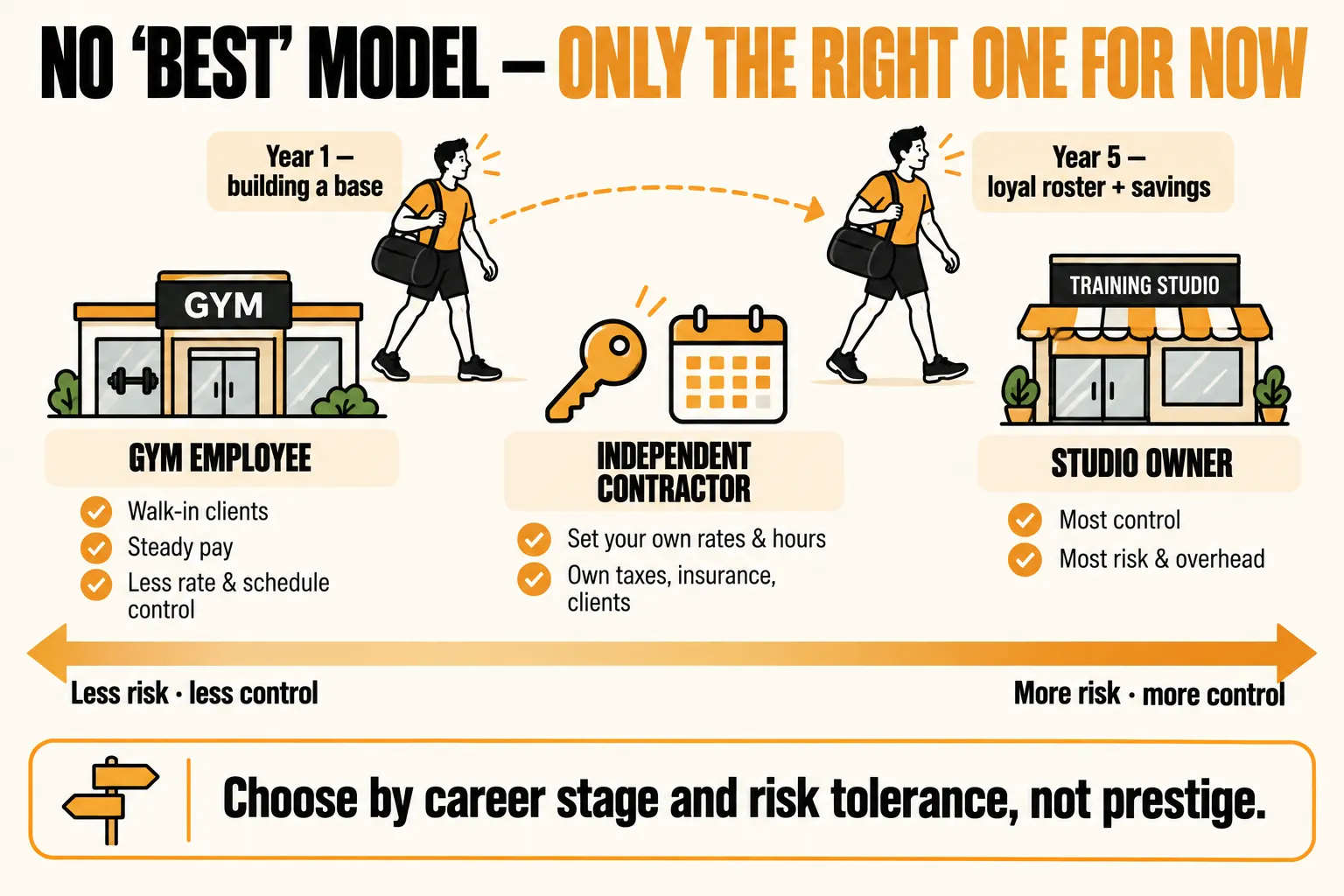
| Gym/studio employee | Works under an employer's structure with set hours and often benefits, but less control over rates and schedule |
| Independent contractor | Sets their own rates and schedule (often renting space or paying a facility fee), but handles their own taxes, insurance, and client acquisition |
| Studio or business owner | Owns the business itself, taking on the most control and the most risk and overhead |
There's no universally "best" model — the right choice depends on a trainer's tolerance for business risk, desire for schedule control, and stage of career.
A Worked Example: Choosing a Model at Two Career Stages
Consider the same trainer at two different points in their career. Fresh out of certification, with no existing client base and limited savings to fall back on, the gym-employee model offers something valuable that's easy to undervalue early on: a built-in flow of walk-in clients, a facility that's already equipped, and a paycheck that doesn't depend entirely on this month's bookings. The tradeoff — lower per-session pay and less schedule control — is a reasonable price for the stability while a client base and reputation are still being built.
Five years later, that same trainer has a loyal client roster built largely through the referrals and retention habits from Lesson 19, plus enough savings to absorb a slow month. The independent contractor or studio-owner model now makes more sense: higher earning potential per session, full schedule control, and enough of an existing client base that the "no built-in walk-ins" tradeoff of leaving employee status barely registers. Same person, same profession, two very different appropriate business models — because the right choice depends on where a trainer actually is, not on which model sounds more prestigious.
Marketing and Client Acquisition Basics
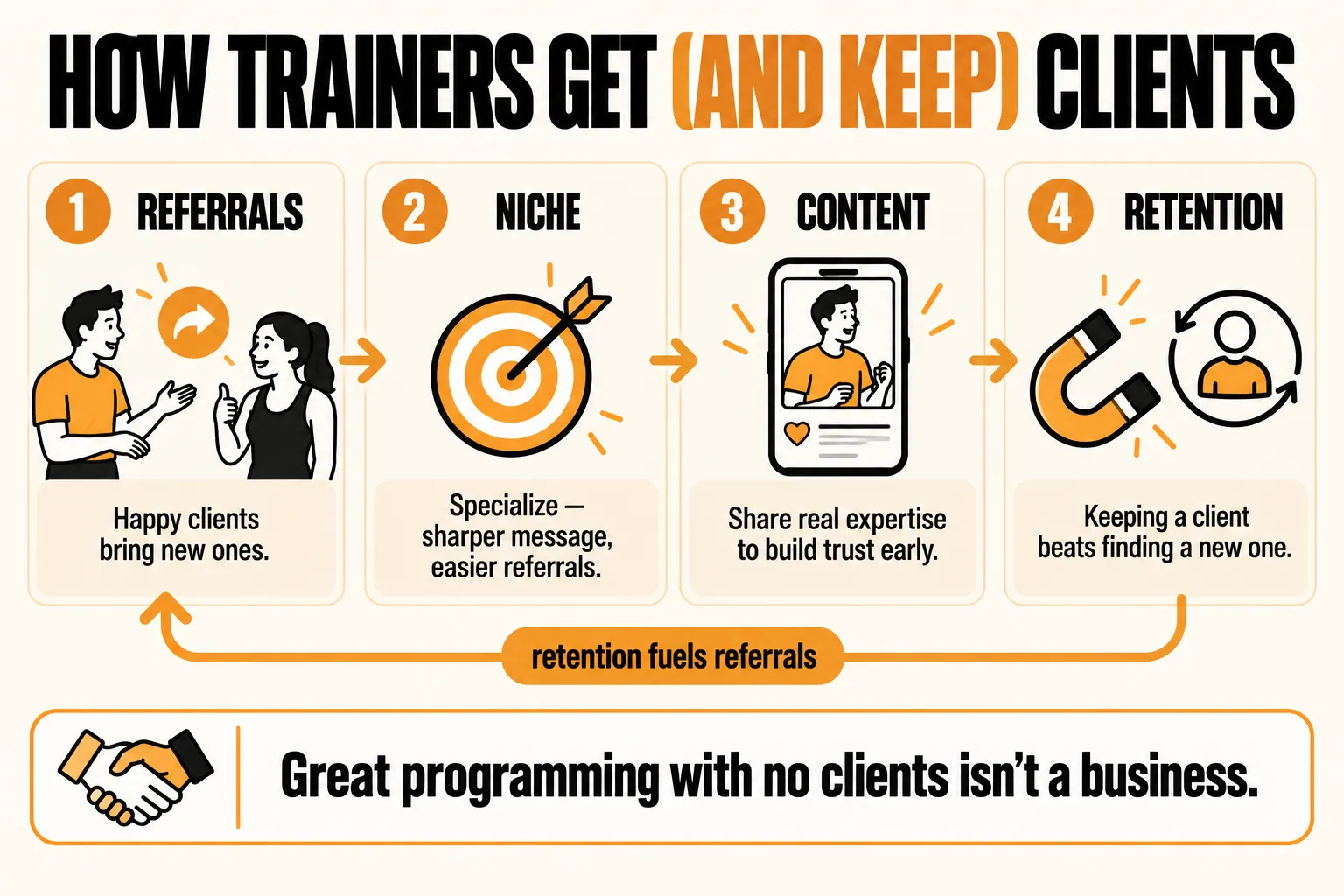
A trainer with excellent programming skills but no clients doesn't have a business. A few foundational approaches:
- ReferralsExisting clients are usually the strongest source of new ones — consistent results and a good client experience compound into word-of-mouth growth.
- Niche positioningSpecializing in a specific population (e.g. postnatal clients, older adults, a particular sport) makes marketing messages sharper and referrals easier to generate.
- Content and social mediaSharing genuine expertise publicly builds trust with potential clients before they ever book a session.
- Client retentionAcquiring a new client costs far more effort than keeping an existing one — the coaching and adherence techniques from Lesson 19 directly support retention.
Professional Conduct, Liability, and Continuing Education
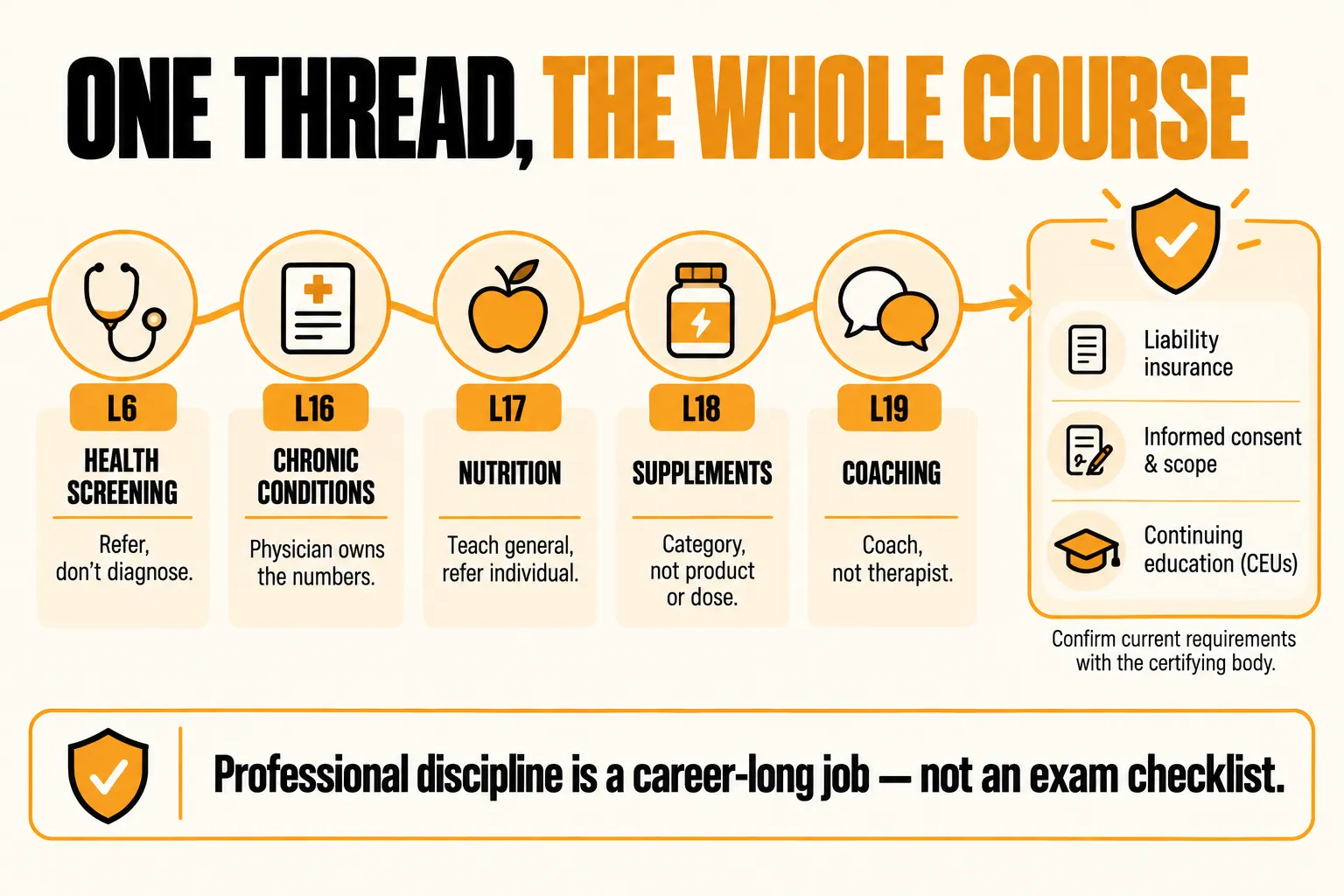
This closing section pulls together every scope-of-practice boundary raised earlier in this course (Lessons 6, 16, 17, and 18) into the broader professional and legal responsibilities of running a training business:
- Liability insuranceProtects a trainer financially if a client is injured or claims injury during a session — most gyms and studios require proof of coverage before allowing a trainer to work with clients.
- Informed consent and scope of practiceEvery referral boundary covered across this course (medical, nutrition, supplements, mental health) is a professional responsibility, not just an exam technicality.
- Continuing education units (CEUs)Maintaining an active NASM-CPT certification requires earning CEUs within each certification cycle and paying a recertification fee.
It's worth stepping back and noticing how much of this final lesson is really a callback. Informed consent traces to Lesson 6's screening framework. The nutrition and supplement referral boundaries trace to Lessons 17 and 18. The "refer, don't diagnose" principle that first showed up around health risk screening in Lesson 6 shows up again here, applied to the business itself rather than to a single client interaction. None of this is new material dressed up as a business lesson — it's the same professional discipline built across nineteen lessons, now framed as what it actually is: a career-long responsibility, not a checklist that ends when the exam does.
8 questions, modeled on NASM's real exam style. Score 70%+ to mark this lesson complete.
- Three common business models: gym/studio employee, independent contractor, studio or business owner — each trades control for stability differently.
- Referrals, niche positioning, content, and retention are the foundational levers for building a client base.
- Liability insurance and informed consent are professional and legal responsibilities, not optional extras.
- Every scope-of-practice boundary from this course is part of a trainer's broader professional responsibility.
- Maintaining certification requires ongoing CEUs and recertification — always confirmed directly with NASM.
- The "right" business model changes over a trainer's career — a stable, walk-in-fed employee role often makes sense early on, while independent models make more sense once a client base and financial cushion exist.
You've now reached the end of the full 20-chapter syllabus:
- Decide which business model best fits your current situation and goals.
- Write down one referral-generating action you could take with your current or first client.
- Think honestly about which business model fits your current savings, client base, and risk tolerance today — and which one you might grow into later.
- Complete the knowledge check above, then revisit any earlier lesson where your knowledge-check score was lowest before exam day.