Before deciding which phase of Muscular Training a client starts in, you need to see how they actually move. Chapter 7 covers ACE's functional-assessment toolkit — static posture, four movement screens, core function, balance, and flexibility — all aimed at spotting compensation before it gets loaded with resistance.
Lesson 6 covered the investigation stage — health history, readiness, and goals. Functional assessment is the next step: now that you know it's safe and appropriate to train this client, you need to see how their body actually moves before you decide what to program.
Straighten Before You Strengthen
ACE's functional assessments follow a deliberate sequence, and the underlying principle is simple to remember: straighten the body before you strengthen it. Static posture gets checked before movement is evaluated, and movement gets evaluated before anything gets loaded with resistance. Skipping ahead — say, assessing muscular strength before checking whether a client can control a basic bend-and-lift pattern — risks building strength on top of a compensation instead of fixing it.
Static Postural Assessment
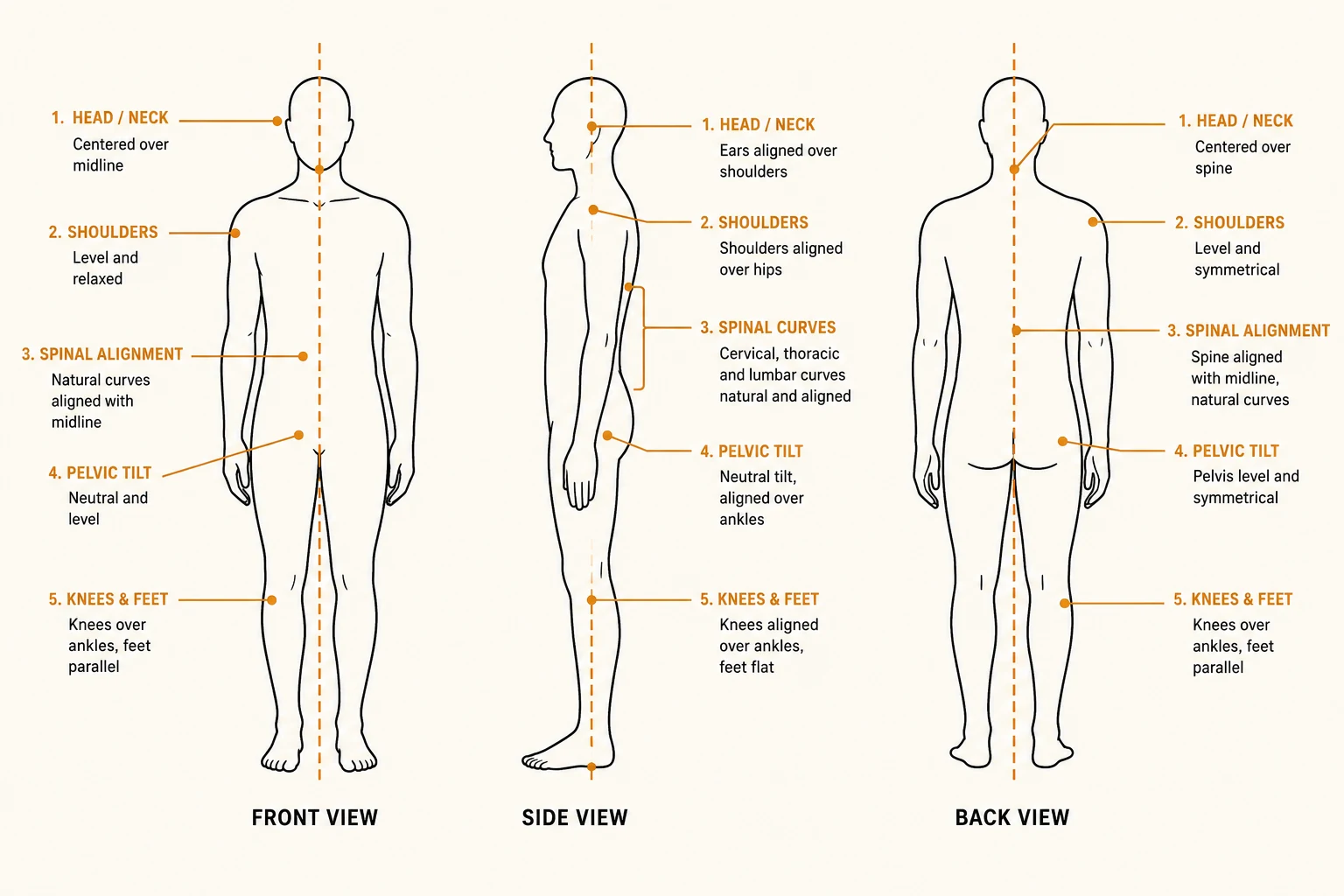
A static postural assessment is typically done with the client standing relaxed, viewed from the front, side, and back — often against a plumb line or grid to make deviations easier to spot. You're looking for how the body organizes itself at rest: where the head sits relative to the shoulders, how much curve is in the spine, whether the pelvis tilts forward or back, and how the knees and feet line up underneath everything else.
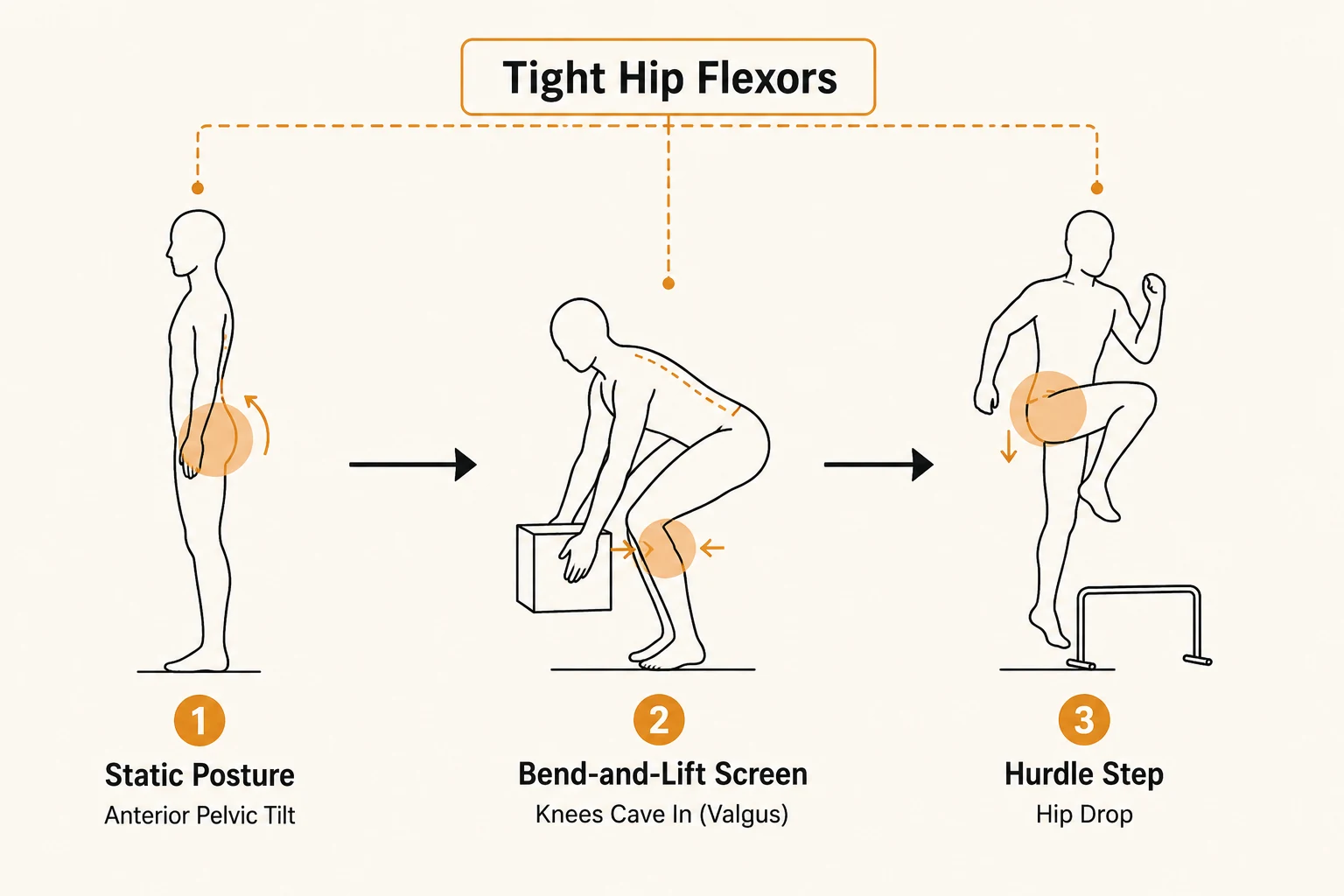
None of this is about judging what "good" posture looks like in the abstract — it's about building a baseline. A deviation you spot here (say, an exaggerated forward head position or an increased lumbar curve) becomes a flag to watch for again once you get to the movement screens, because posture problems at rest often show up as compensations once the body starts moving. A client sitting at a desk eight hours a day, for instance, very commonly shows an anterior pelvic tilt and a mild forward head posture at rest — findings that, on their own, are just observations. Their real value shows up a few minutes later, once you're watching that same client attempt a bend-and-lift pattern.
The Four Movement Screens
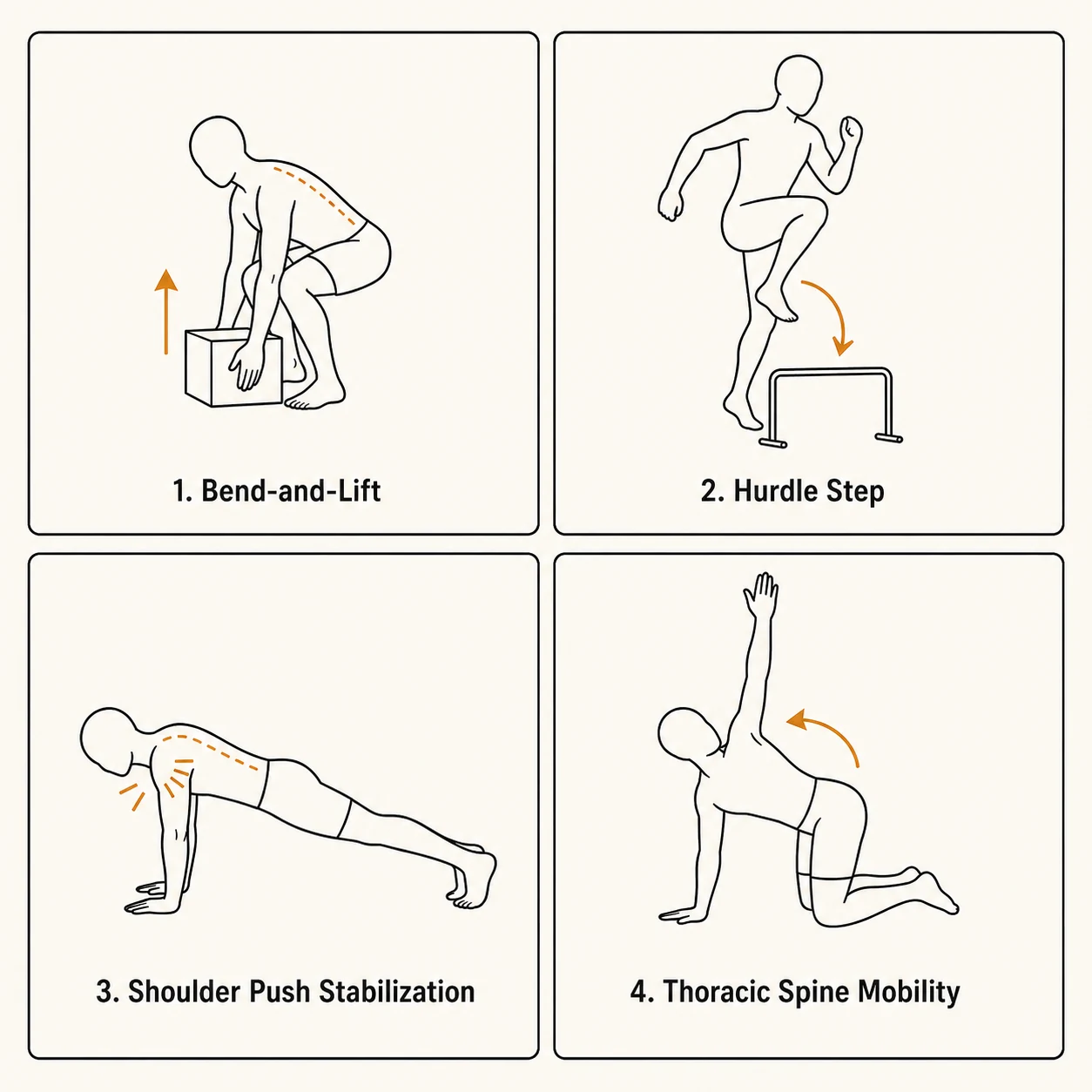
Once static posture is documented, ACE uses four movement screens to see whether that posture holds up under basic, unloaded movement:
- Bend-and-lift screenWatches the squat-style pattern used constantly in daily life — checking whether the knees track properly, the spine stays neutral, and the heels stay down.
- Hurdle stepA single-leg movement screen — stepping over a low obstacle reveals balance, hip control, and stability issues that a two-legged screen would hide.
- Shoulder push stabilization (push-up screen)Uses a push-up to check core and shoulder-girdle stability during an upper-body pushing pattern.
- Thoracic spine mobilityChecks rotational mobility through the upper back — limited here often shows up as compensation somewhere else in the kinetic chain during rotational or overhead movements.
Each screen is less about pass/fail and more about pattern-spotting: does the same compensation show up in more than one screen? That repetition is usually more useful information than any single screen in isolation. That desk-bound client from the postural assessment is a good example: an anterior pelvic tilt spotted at rest often reappears as knee valgus (the knees caving inward) on the bend-and-lift screen, and as wobbling or hip drop on the hurdle step — three different-looking findings that trace back to the same underlying tightness and weakness pattern.
From Assessment Findings to Program Decisions
These findings aren't just descriptive — they directly shape where a client starts in the Muscular Training component of the IFT Model, which you'll cover in Lessons 9 through 11. A client whose movement screens show multiple compensation patterns typically starts in the Stability phase, where the priority is building control and correcting those patterns before adding meaningful load. A client who moves cleanly through all four screens with no repeated compensation can often be placed further along, spending less time on corrective work and more time in strength-focused programming.
This is the practical payoff of the whole chapter: functional assessment isn't a box to check before "the real work" of programming begins — it's the data that determines what the real work should actually look like for this specific client.
Assessing Core Function
"Core function" in this chapter means something more specific than abdominal strength — it's whether a client can properly engage the deep stabilizing muscles, particularly the transverse abdominis (TVA), before movement gets more demanding. One common way to test this uses a pressure biofeedback device (essentially a blood-pressure cuff) placed under the low back while the client draws the navel in — a client with good TVA engagement can reduce the cuff pressure by a target amount and hold it, while a client who lacks that control tends to substitute the more superficial rectus abdominis instead, which doesn't provide the same deep stability.
Balance and Flexibility Assessments
Balance is typically assessed across both static conditions (holding a position, like standing on one leg) and dynamic conditions (maintaining control while moving), since the two draw on different underlying systems and clients can perform very differently on each.
Flexibility, or muscle-length, assessments check specific muscle groups that commonly get tight and pull posture or movement out of alignment — hip flexors and calves are frequent culprits given how much time most clients spend seated. A muscle-length finding here often explains a compensation you already spotted during the postural or movement screens, tying the whole assessment picture together.
8 questions, modeled on ACE's real exam style. Score 72%+ to mark this lesson complete.
- Functional assessments follow "straighten before strengthen" — static posture, then movement, then more specific testing.
- Static postural assessment checks the body at rest from front, side, and back, often against a plumb line.
- The four movement screens are bend-and-lift, hurdle step, shoulder push stabilization, and thoracic spine mobility.
- Core function testing looks at deep stabilizer engagement (TVA), not just abdominal strength.
- Balance is checked in both static and dynamic conditions; flexibility testing targets muscles that commonly pull posture out of alignment.
- Assessment findings directly determine where a client starts within Muscular Training (Lessons 9-11) — more compensation typically means more time in the Stability phase before load increases.
Before moving to Lesson 8:
- List the four movement screens in order and write one sentence on what each one is designed to reveal.
- Pick one common postural deviation and describe how it might show up across two different movement screens.
- Write one sentence distinguishing what a flexibility assessment tells you from what a stretching program would do about it.
- Complete the knowledge check above and review any question you missed.