Where Chapter 7 asked "does this client move well?", Chapter 8 asks "what can we actually measure?" — body composition, cardiorespiratory fitness, muscular strength and endurance, and for some clients, sports-skill measures like power and speed. Every test comes with a matching set of criteria for when to stop it.
Functional assessments and physiological assessments aren't competing tools — they're sequenced together, chosen based on where a client sits in each of the IFT Model's phases from Lesson 5. A client just starting Base Training doesn't need a VT2 threshold test; a client entering Performance Training might. The pattern to remember: assessment intensity should scale with training intensity, never run ahead of it.
Body Composition and Anthropometric Measurements
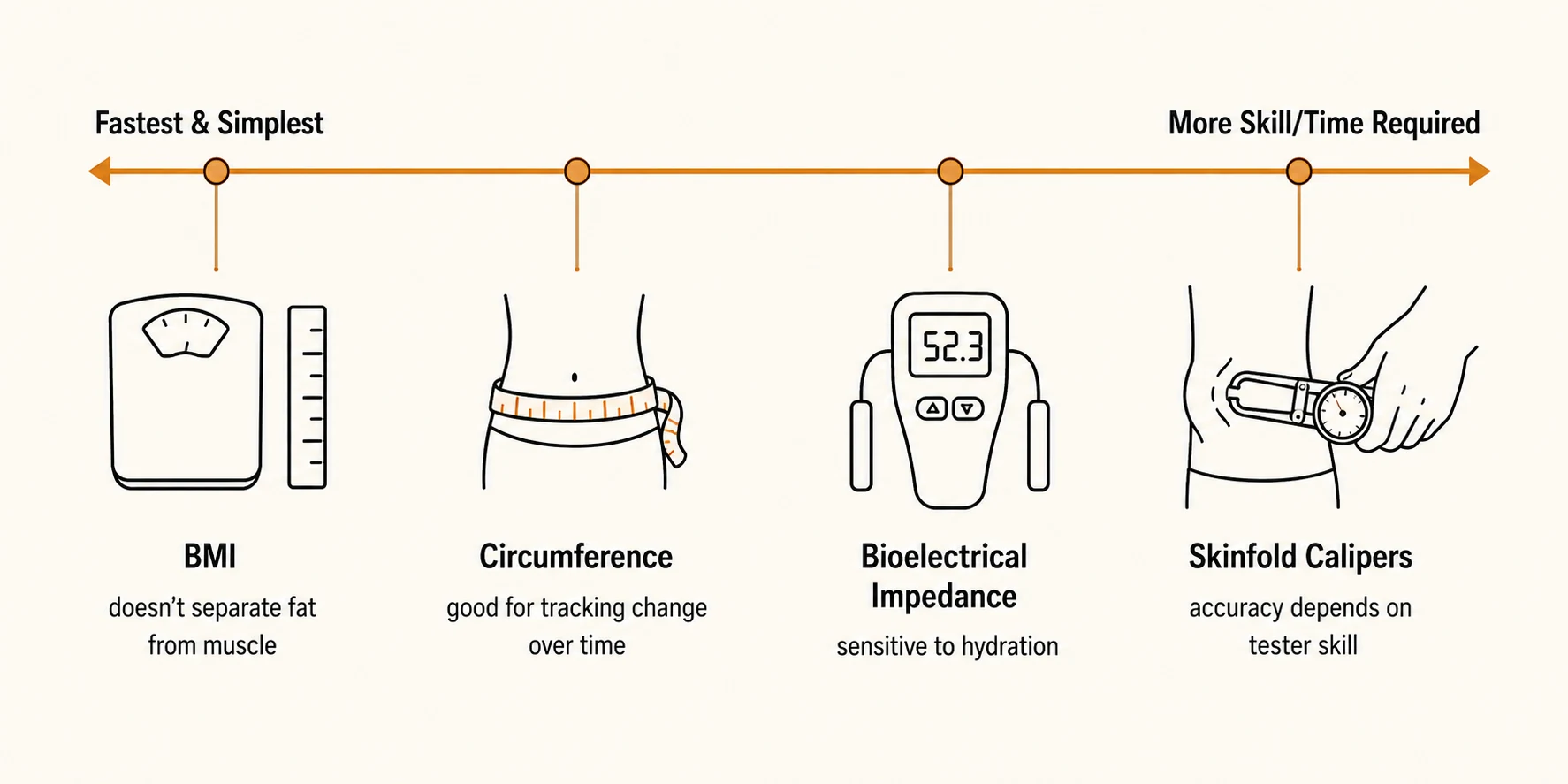
Body composition assessments estimate the proportion of fat mass to lean mass, and there's a real trade-off between accuracy, cost, and practicality for a working trainer:
| Method | What it measures | Trade-off |
|---|---|---|
| Skinfold calipers | Subcutaneous fat thickness at several standardized sites | Inexpensive and portable, but accuracy depends heavily on tester skill |
| Bioelectrical impedance (BIA) | Body composition estimated from resistance to a small electrical current | Quick and easy, but sensitive to hydration status |
| Circumference measurements | Waist, hip, and other site measurements (e.g., waist-to-hip ratio) | Simple and useful for tracking change over time, less precise for absolute body-fat percentage |
| Body mass index (BMI) | Weight relative to height | Fast screening tool, but doesn't distinguish muscle from fat — can misclassify very muscular clients |
None of these methods is "the" correct one — the right choice depends on what equipment is available, what the client is comfortable with, and whether you're tracking a single snapshot or change over months.
Cardiorespiratory Fitness Assessment
This builds directly on the three-zone intensity model from Lesson 5. The submaximal talk test and VT1 threshold test are appropriate once a client is consistently exercising (Fitness Training phase and beyond); the VT2 threshold test is reserved for clients with performance goals in Performance Training. Field and lab-based cardiorespiratory tests exist across a range of intensities and equipment needs, so the test you choose should match both the client's current phase and what's realistically available in your setting.
Muscular Strength and Endurance Testing
Two related but different questions get tested here: how much can a client lift (strength), and how many times can they lift a given load before fatiguing (endurance).
-
1-repetition maximum (1RM) The most direct strength measure, but it carries real injury risk for untrained or deconditioned clients and requires good technique under maximal load.
-
Multi-rep max testing Estimating strength from a lighter, safer load performed for multiple reps (e.g., a 10-rep max), then predicting 1RM — a common lower-risk alternative for general clients.
-
Muscular endurance tests Tests like a timed push-up test measure how many reps a client can sustain — useful for tracking Functional and Movement Training progress without needing any external load at all.
Sports-Skill Assessments: Power, Speed, Agility, Quickness
These tests are the outlier in this chapter — they're not for every client. They matter most for clients approaching or already in Load/Speed Training's performance end, where plyometrics, sprint work, and agility drills are actually being programmed. A vertical jump test, for example, gives you a baseline power number before introducing jump training, so you have something concrete to measure progress against later. For a client who will never train at that intensity, these tests add very little value and simply aren't part of their assessment battery.
A Worked Example: Choosing the Right Test Battery
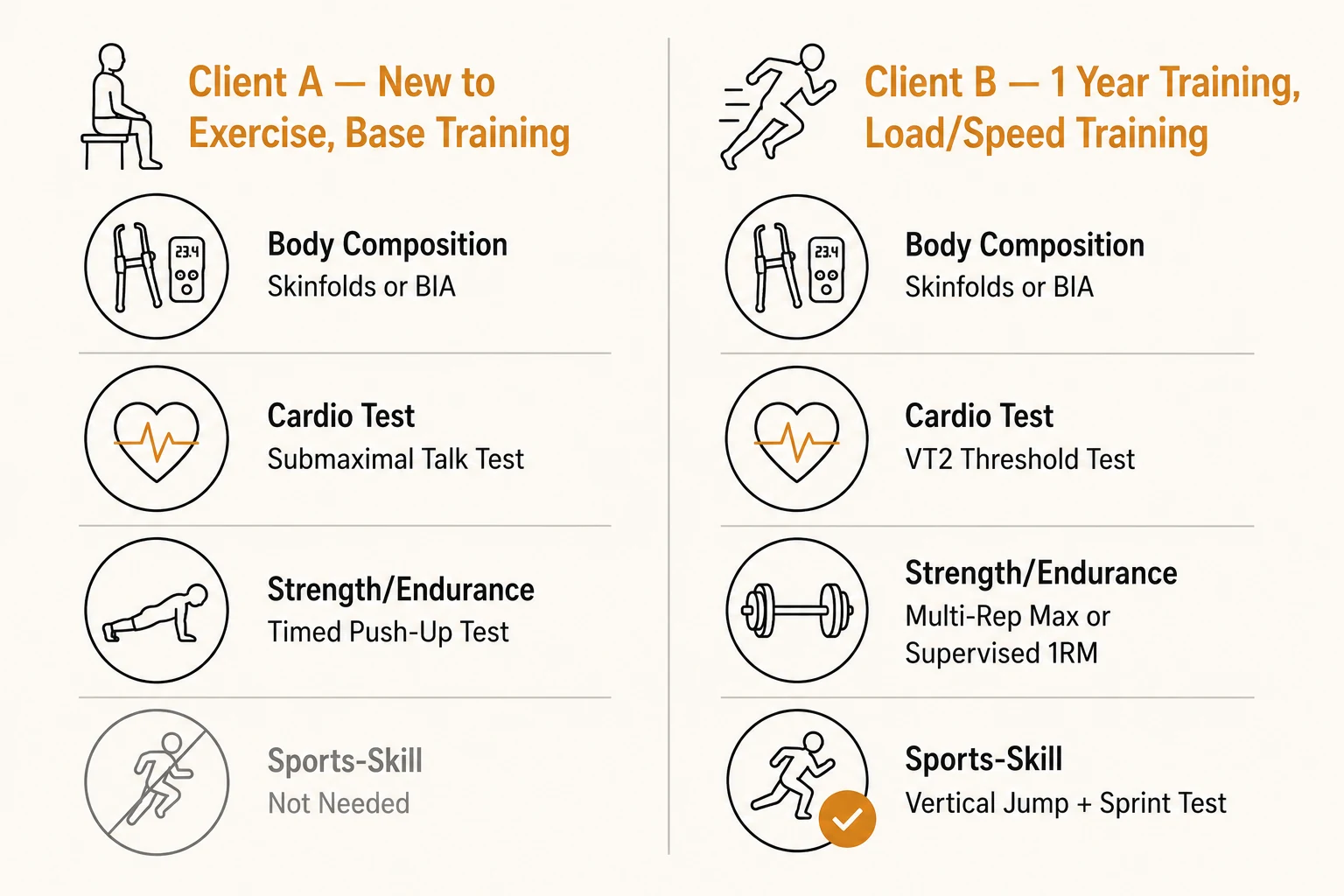
Consider two clients on the same day. Client A is brand new to exercise, just cleared the PAR-Q+ from Lesson 6, and is entering Base Training. Her battery would reasonably include a body-composition method (skinfolds or BIA, whichever equipment and comfort level fit), a submaximal talk test rather than anything maximal, and a muscular endurance test like a timed push-up test rather than 1RM testing. Nothing about her battery involves sports-skill measures — they'd add risk and produce numbers with no programming use yet.
Client B has been training consistently for a year, is moving into Load/Speed Training, and has a goal of improving his 5K time and vertical jump for a rec-league basketball season. His battery looks different: a VT2 threshold test to establish his higher-intensity zone, multi-rep max testing (or a supervised 1RM given his training history) for strength, and sports-skill measures like a vertical jump test and a short sprint test to baseline the power and speed work ahead. Same chapter, same tools available — but the selected battery is built entirely around what each client's next phase of training actually demands.
When to Stop a Test
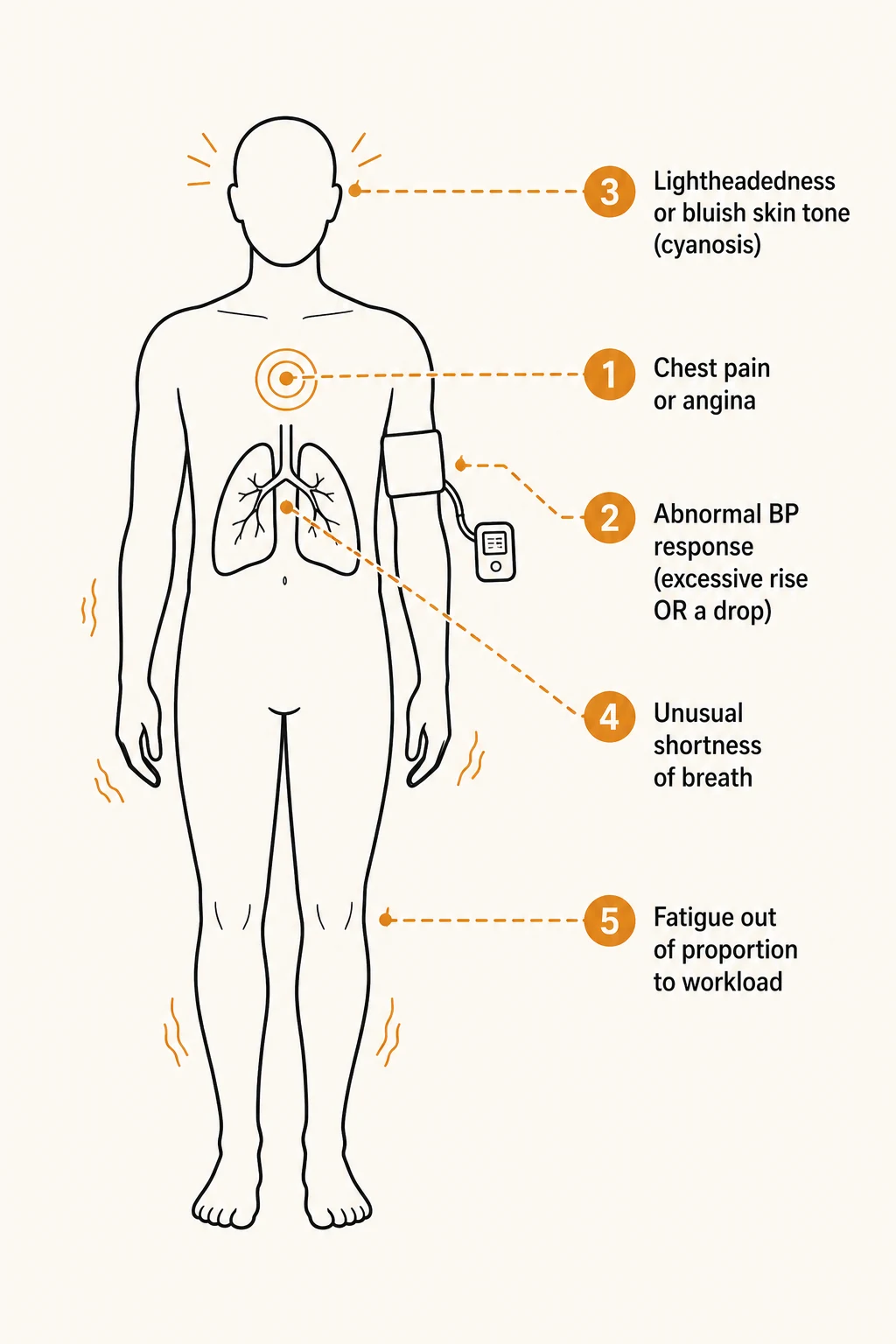
Every physiological test needs a clear stopping point, independent of what the protocol "calls for." Some of the most important signs that call for immediate termination — and possible referral to a healthcare professional — include:
- Onset of chest pain or anginaAny new chest pain during exertion is an immediate stop.
- A significant drop in systolic blood pressureA drop of more than 10 mmHg despite increasing workload is a red flag, not a normal response.
- An excessive rise in blood pressureSystolic or diastolic pressure climbing well beyond normal exercise response ranges.
- Unusual shortness of breath or fatigueDistress that's out of proportion to the workload being performed.
- Signs of poor perfusionLightheadedness, confusion, or a bluish skin tone (cyanosis) all indicate the body isn't getting adequate blood flow or oxygen.
8 questions, modeled on ACE's real exam style. Score 72%+ to mark this lesson complete.
- Physiological assessments include body composition, cardiorespiratory fitness, muscular strength/endurance, and sports-skill measures.
- Body composition methods (skinfolds, BIA, circumference, BMI) each trade off accuracy, cost, and practicality differently.
- Cardiorespiratory testing scales with a client's IFT phase — VT1 for Fitness Training, VT2 reserved for Performance Training.
- 1RM testing is direct but higher-risk; multi-rep max testing and muscular endurance tests are safer alternatives for most clients.
- Sports-skill assessments (power, speed, agility, quickness) apply mainly to clients in or near Load/Speed Training's performance end.
- Every test needs clear termination criteria — chest pain, abnormal blood pressure response, unusual fatigue, or signs of poor perfusion all mean stop immediately.
- Both a rise and a drop in systolic blood pressure can be abnormal — a drop during increasing workload is the more easily-overlooked danger sign.
Before moving to Lesson 9:
- List the four body-composition methods and one trade-off for each, from memory.
- Explain, in one sentence, why VT2 testing is reserved for Performance-Training clients rather than used for everyone.
- Build a full test battery for one beginner client and one advanced client, and compare where they differ and why.
- Complete the knowledge check above and review any question you missed.