Chapters 7 and 8 told you where a client stands. Chapter 9 is where that information turns into an actual program — specifically, programming for the first two phases of Muscular Training: Functional Training and Movement Training, built around the principle that proximal stability promotes distal mobility.
You've now got a full picture of a client: their posture, their movement-screen results, their core function, and their physiological baseline. Chapter 9 is about acting on that picture — not yet with external load (that's Chapter 10), but with the exercise selection and progression logic that makes Functional and Movement Training actually work.
The Stability-Mobility Relationship
Recall from Lesson 5: joint stability is the ability to control joint position and movement; joint mobility is the range of uninhibited movement around a joint. Neither should come at the expense of the other — true stability doesn't restrict mobility, and true mobility doesn't sacrifice control.
The key programming principle here is that proximal stability promotes distal mobility. Joints tend to alternate along the kinetic chain between needing more stability and needing more mobility. When a joint closer to the center of the body (proximal) lacks stability, the joints further out (distal) often can't move well either — the body recruits whatever control it can find, usually by borrowing stability from a neighboring joint that's supposed to stay mobile. That's compensation, and it's exactly what Chapter 7's assessments are designed to catch.
- AnkleNeeds mobility — a stiff ankle is a very common driver of compensation further up the chain.
- KneeNeeds stability — this is why a mobile (unstable) ankle so often shows up as knee valgus on the bend-and-lift screen.
- HipNeeds mobility — restricted hip mobility is a frequent root cause behind both knee and low-back compensation.
- Lumbar spineNeeds stability — when the hips can't supply mobility, the low back often "borrows" movement it isn't built to control.
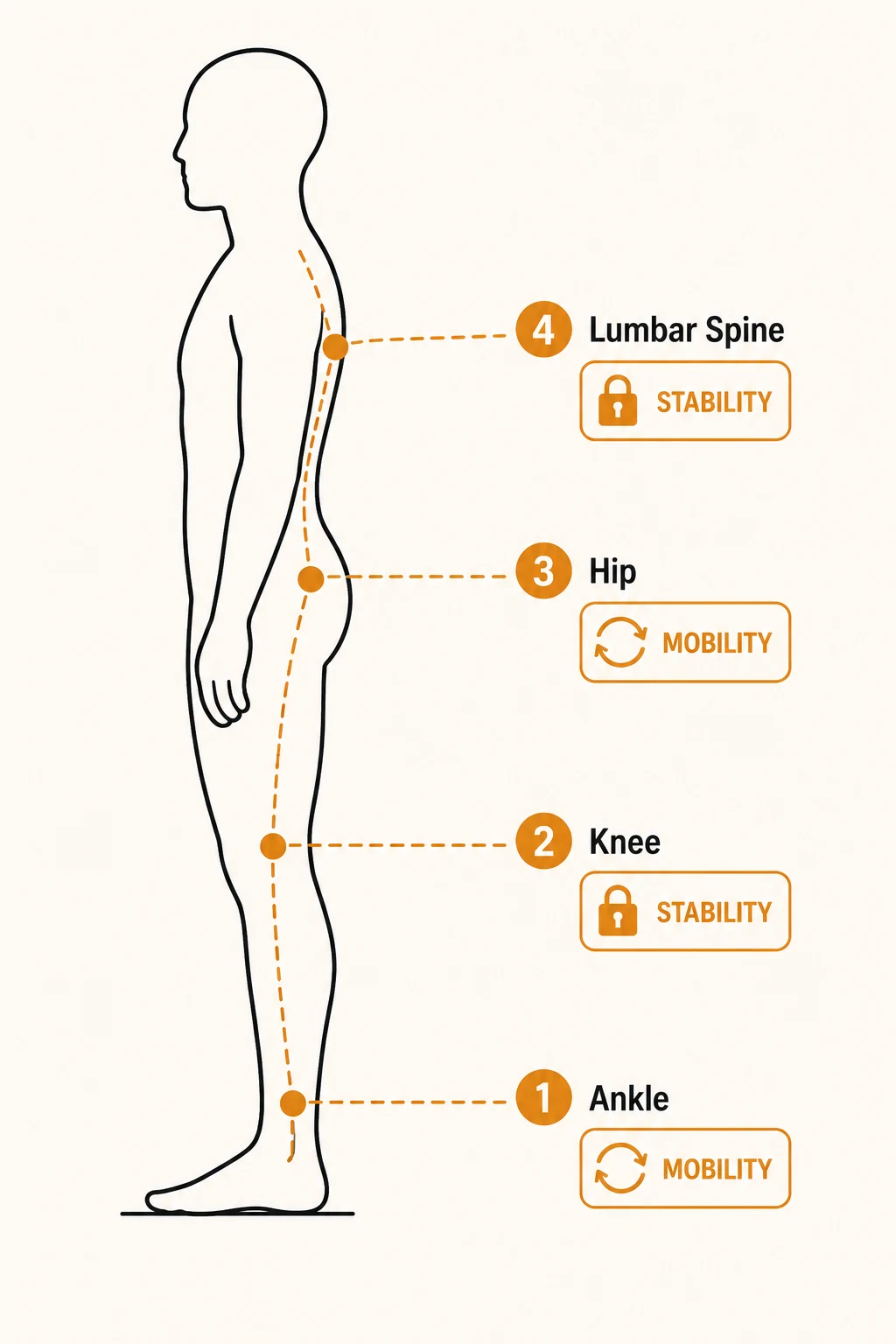
This is the practical version of the principle: it's not abstract, it's a specific, memorizable pattern you can use to reason through where a compensation is actually coming from — even when the symptom shows up somewhere else entirely.
Programming Functional Training
Functional Training programs are built directly off Chapter 7's findings. If the postural assessment flagged an anterior pelvic tilt, or the core-function test showed poor transverse abdominis engagement, the Functional Training program is where that gets addressed — deliberately, before any of the five primary movement patterns are trained with real intent.
Exercise selection at this stage emphasizes core and balance work using primarily body weight, targeting the specific stability or mobility deficit the assessments identified. This isn't generic "core work" — it's core work chosen because a specific test result called for it. Two clients who both technically need "core work" can end up with very different Functional Training exercises: one whose core-function test showed weak TVA engagement might start with basic drawing-in exercises and dead bugs, while another whose issue is closer to poor rotational control on the thoracic-spine mobility screen might instead get anti-rotation holds and cable chops. Same broad label, different root cause, different program.
Programming Movement Training
Once a client demonstrates reasonable postural stability and control, Movement Training programs shift the focus to the five primary movement patterns from Lesson 5: bend-and-lift, single-leg, pushing, pulling, and rotational. The goal isn't just performing these patterns — it's performing them with proper sequencing and control of the body's center of gravity through a normal range of motion.
| Programming focus | What "good" looks like |
|---|---|
| Sequencing | Joints and muscles fire in the right order for the pattern — not compensating by recruiting the wrong muscle group first |
| Center-of-gravity control | The client stays balanced and controlled through the full movement, not just at the start and end positions |
| Range of motion | The pattern is trained through a full, appropriate range — not artificially shortened to hide a mobility restriction |
Body-weight exercises are typically used first, with light external resistance introduced only once a pattern is performed consistently well — control comes before load, every time.
Sequencing a Single-Leg Pattern: A Worked Example
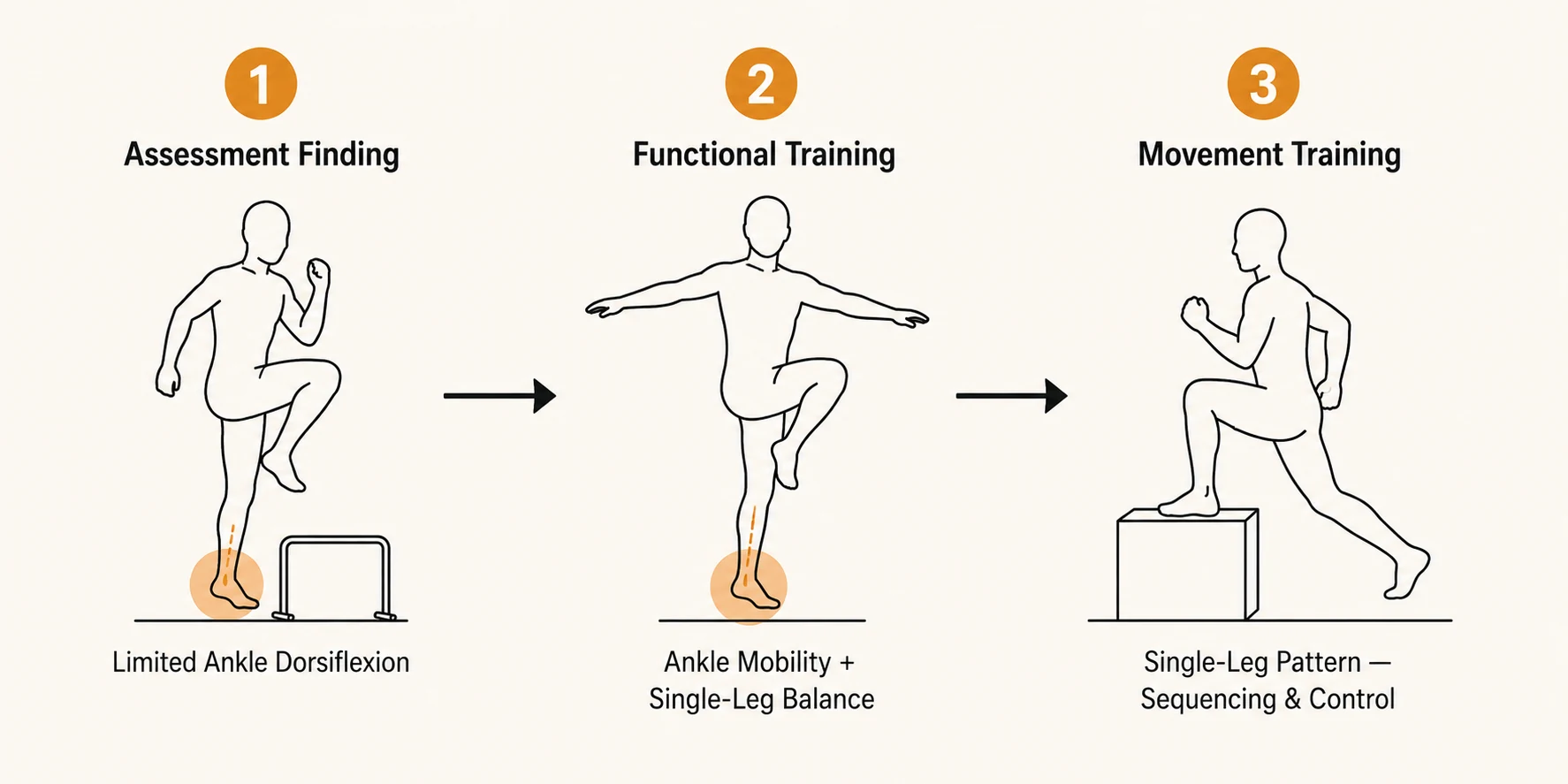
Take a client whose Chapter 7 hurdle-step screen showed poor single-leg control, and whose postural assessment flagged limited ankle dorsiflexion on the same side. Applying the joint-by-joint pattern above, the ankle's mobility restriction is the likely root cause — so Functional Training programming for this client would prioritize ankle mobility drills and single-leg balance work, building the stability foundation at the knee and hip that the restricted ankle was undermining.
Only once that single-leg balance work is performed with good control does programming progress into Movement Training's single-leg pattern — a step-up or split-squat variation, still body weight, now assessed for sequencing and center-of-gravity control rather than just balance. Notice the throughline: the exercise selected at every stage traces directly back to a specific Chapter 7 finding, not a generic template applied to every client with "hip issues."
8 questions, modeled on ACE's real exam style. Score 72%+ to mark this lesson complete.
- Chapter 9 turns Chapter 7 and 8's assessment findings into actual Functional and Movement Training programs.
- "Proximal stability promotes distal mobility" — a lack of control at one joint often shows up as compensation at a neighboring joint.
- Functional Training programming targets the specific deficits found in postural and core-function assessments, mostly using body weight.
- Movement Training programming trains the five primary movement patterns with an emphasis on sequencing, center-of-gravity control, and full range of motion.
- Functional Training exercises continue even after a client progresses — usually as part of the warm-up.
- The alternating ankle-knee-hip-lumbar spine pattern is a concrete tool for tracing a compensation back to its likely root joint.
Before moving to Lesson 10:
- Explain "proximal stability promotes distal mobility" in your own words, using one real joint pair as an example.
- Pick a hypothetical client with a specific Chapter 7 finding (e.g., poor TVA engagement) and describe how you'd choose a Functional Training exercise to address it.
- Write out the ankle-knee-hip-lumbar spine alternating pattern from memory, without looking back at the lesson.
- Complete the knowledge check above and review any question you missed.