Chapter 10 is where external load formally enters the picture — the Load/Speed Training phase from Lesson 5. Once a client has earned the right to load a movement (per Chapter 9), resistance training variables get manipulated deliberately based on the client's goal, and progressed using a structured method rather than guesswork.
Everything up to this point — rapport, investigation, functional assessment, physiological assessment, and Functional/Movement Training programming — has been building toward this moment: a client who can safely and effectively have resistance added to their training.
The Training Variables
Resistance training programs are built by deliberately manipulating a set of variables: frequency (how often), volume (sets × reps), intensity (load relative to maximum), tempo (speed of the lift), rest intervals, and exercise selection and order. Changing any one variable changes what adaptation the program is actually driving toward — which is why "goal" has to come before "sets and reps," not the other way around.
Volume and intensity are the two variables most often confused with each other. Volume is how much work gets done — sets multiplied by reps, regardless of how heavy any single rep is. Intensity is how hard each rep is relative to the client's maximum. Two programs can have identical volume (say, 4 sets of 10) while one uses a light load and the other uses a genuinely challenging one — same volume, very different intensity, and very different adaptation.
FITT Guidelines: Muscular Endurance
For clients whose primary goal is muscular endurance — the ability to sustain repeated muscular contractions — the general FITT prescription looks like this:
| Variable | Typical prescription |
|---|---|
| Frequency | 2–3 days per week |
| Intensity | 60–70% of maximum resistance |
| Repetitions | 12–16, reaching fatigue around 75–100 seconds |
| Sets | 3–4 |
| Rest | 1–2 minutes between sets |
| Type | Emphasizes the five basic movement patterns from Lesson 5, often via circuit-style training |
FITT for Strength and Hypertrophy Goals
Muscular strength and hypertrophy goals shift these same variables in predictable directions: strength-focused programming generally uses lower reps at higher relative intensity with longer rest periods to allow full recovery between heavier efforts, while hypertrophy-focused programming sits in a moderate rep range at moderate-to-high intensity with shorter rest — enough volume and metabolic stress to drive muscle growth without needing near-maximal loads on every set. The exact numbers a program uses should still be individualized to the client's training history and the assessment findings from Chapters 7 and 8.
| Goal | Typical reps | Typical rest |
|---|---|---|
| Muscular endurance | 12–16 | 1–2 minutes |
| Hypertrophy | 8–12 | 30–90 seconds |
| Strength | 4–8 | 2–5 minutes |
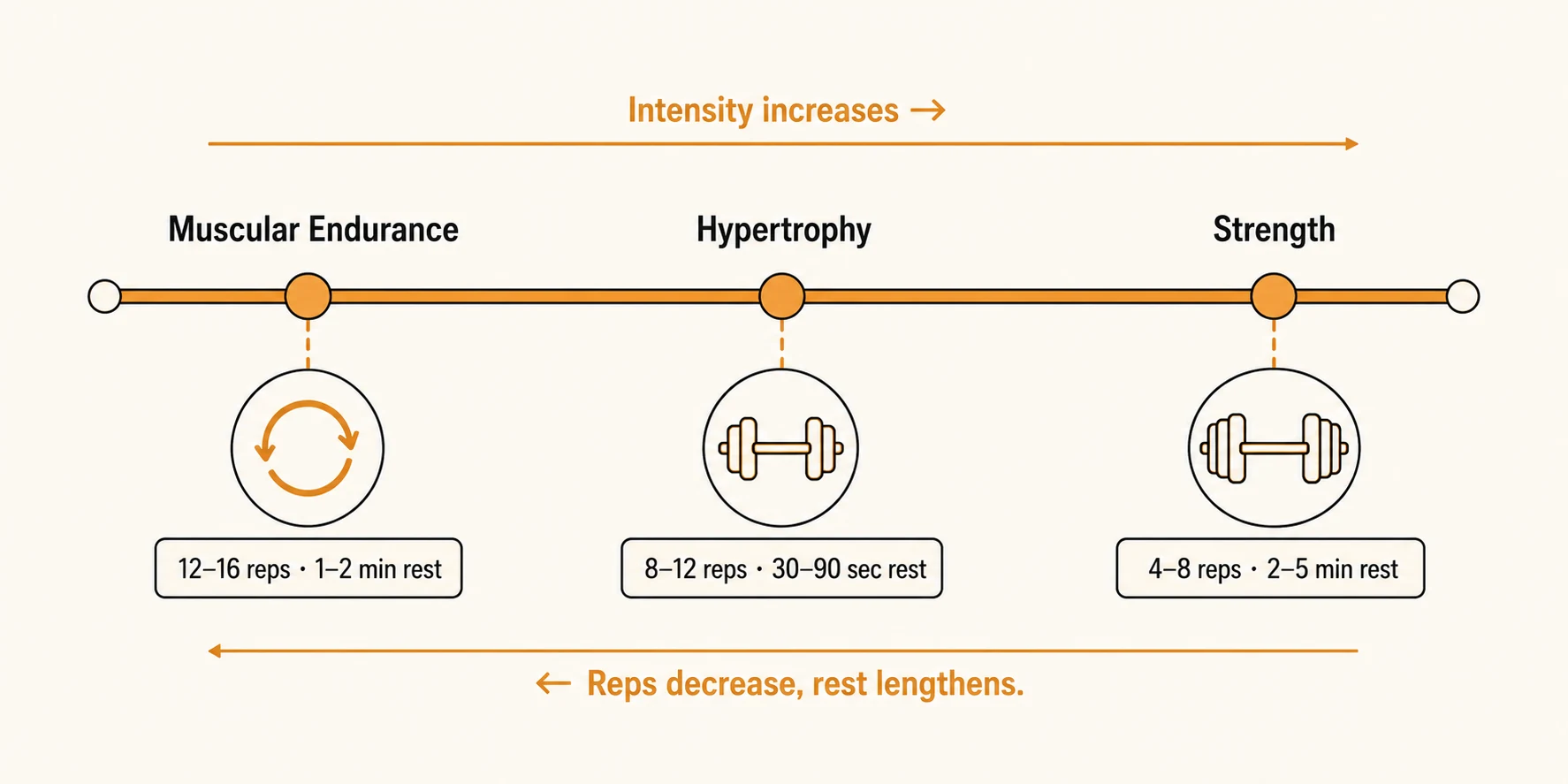
Notice the pattern moving down the table: as intensity climbs and reps drop, rest periods lengthen. That's not arbitrary — a near-maximal effort set needs meaningfully more recovery before the next one than a lighter, higher-rep set does, and cutting rest short on strength work undermines the very quality (near-maximal force output) the program is trying to build.
The Double-Progressive Training Protocol
Rather than guessing when to add weight, ACE uses a structured two-step progression:
- Step 1 — Add repsThe client stays at a fixed resistance and works to increase repetitions across sessions, up to the top of the target rep range, with good form throughout.
- Step 2 — Add loadOnce the top of the rep range is hit cleanly, resistance increases by roughly 5%, and reps drop back to the bottom of the range — restarting the cycle at the new load.
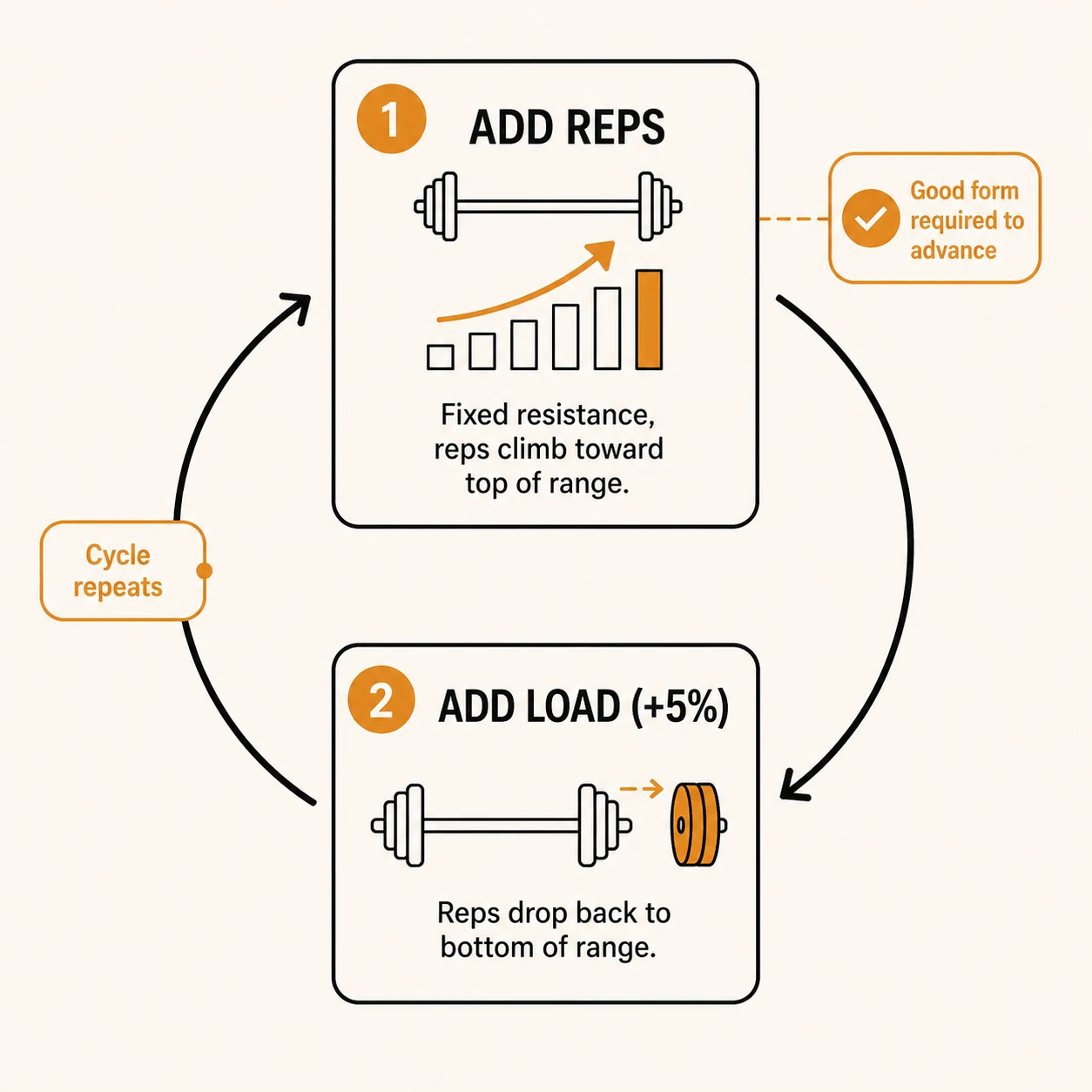
For example: a client doing an incline bench press at 180 lbs. for 8 reps stays at that load, working up to 12 reps with good form. Once they hit 12 clean reps, the load increases by about 5%, and they start again at a lower rep count with the new weight.
Exercise Order
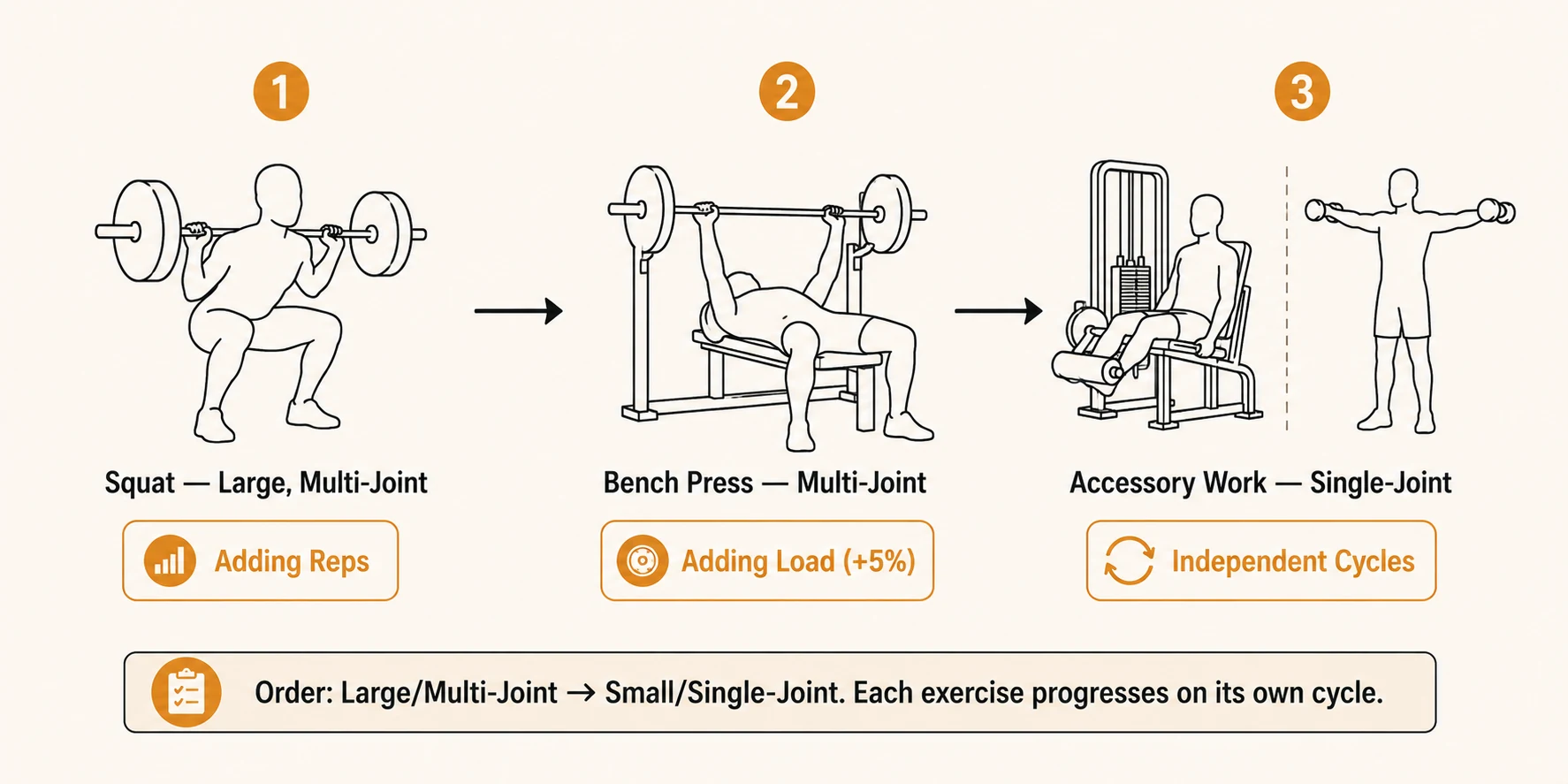
As a general rule, larger muscle groups and multi-joint (compound) exercises get programmed before smaller muscle groups and single-joint (isolation) exercises. Fatiguing a small stabilizing muscle early in a session compromises performance and safety on the bigger, more technically demanding lift that should have come first.
Putting a Session Together: A Worked Example
Take a client with a hypertrophy goal, three weeks into Load/Speed Training. Their session might start with a barbell squat (large muscle group, multi-joint, and the exercise that most needs fresh energy and focus), followed by a bench press (also multi-joint, still demanding but slightly less systemically taxing), and close with single-joint accessory work like leg extensions and lateral raises — exercises that tolerate accumulated fatigue far better than the squat would.
Within each exercise, the double-progressive protocol runs independently. This client might be adding reps on the squat (still building toward the top of their hypertrophy rep range at the current weight) while simultaneously adding load on the bench press (having hit the top of their rep range there last week). Progression isn't synchronized across the whole session — each exercise moves through its own cycle at its own pace, based on that specific lift's performance.
8 questions, modeled on ACE's real exam style. Score 72%+ to mark this lesson complete.
- Resistance training variables — frequency, volume, intensity, tempo, rest, and exercise order — are manipulated based on the client's specific goal.
- Muscular endurance programming typically uses 12–16 reps at 60–70% intensity, 3–4 sets, 1–2 minutes rest.
- Strength goals generally use lower reps, higher intensity, longer rest; hypertrophy goals use moderate reps and intensity with shorter rest.
- The double-progressive protocol adds reps first, then increases load by ~5% once the top of the rep range is hit with good form.
- Larger, multi-joint exercises are typically ordered before smaller, single-joint exercises in a session.
- Volume (sets × reps) and intensity (load relative to maximum) are independent variables — programs can share one while differing on the other, and progression runs on its own cycle per exercise, not per session.
Before moving to Lesson 11:
- Write the FITT prescription for muscular endurance from memory, then check it against the table above.
- Walk through a double-progressive example: a client benching 100 lbs. for 8 reps. Describe the next three "steps" in their progression.
- Write one sentence distinguishing volume from intensity, using a concrete example of a program where they differ.
- Complete the knowledge check above and review any question you missed.