Mind-body exercise spans traditional practices like yoga, qigong, and tai chi through contemporary methods like Pilates and the Feldenkrais Method — all sharing a deliberate focus on the connection between movement, breath, and attention. A trainer doesn't need to teach a full class in any of them, but does need to understand where they fit into a client's broader program.
Lessons 5 through 12 covered the ACE IFT Model's cardiorespiratory and muscular training tracks. This chapter adds a third lens — modalities that emphasize the connection between the body and the mind, and how they complement rather than replace everything covered so far.
What Counts as Mind-Body Exercise
Mind-body exercise is a broad category, spanning traditional practices with centuries of history and much newer contemporary methods — but all of them share a deliberate emphasis on the connection between movement, breath, and focused attention, rather than treating the body as a machine to be loaded and fatigued.
What actually ties these modalities together isn't the specific movements — a tai chi form and a Pilates roll-up look nothing alike — it's the underlying mechanism. Each one asks a client to slow down enough to notice what their body is actually doing: where tension is held, how breath and movement are sequenced, whether one side of the body compensates for the other. That's a very different skill than the "get through the set" mindset most resistance training rewards, and it's exactly why mind-body work often shows up as a complement to the IFT Model's cardio and muscular tracks rather than a replacement for either.
| Category | Examples |
|---|---|
| Traditional practices | Hatha yoga, qigong, tai chi, pranayama (yogic breathing) |
| Contemporary methods | Pilates, the Feldenkrais Method, the Alexander Technique, Nia, Somatics |
Pilates: The Core-First Principle
Pilates is built on the idea that a core set of postural muscles — often referred to in Pilates instruction as the "powerhouse," roughly the abdominals, low back, hips, and glutes — keeps the body balanced and provides essential support to the spine. Programming built around this principle prioritizes control and precision — moving well, with the core engaged throughout — over speed or added load.
That emphasis on control links directly back to Lesson 9's Functional Training programming: both are, at their core, about training stability before anything else gets layered on top. Picture the desk-job client from Lesson 12's worked example — the one whose postural assessment showed an anterior pelvic tilt and poor transverse abdominis engagement. A trainer who understands Pilates principles has another practical tool for that exact profile: slow, controlled, low-load movements that reinforce the same deep-core engagement Lesson 7's TVA test was checking for, without needing any equipment beyond a mat.
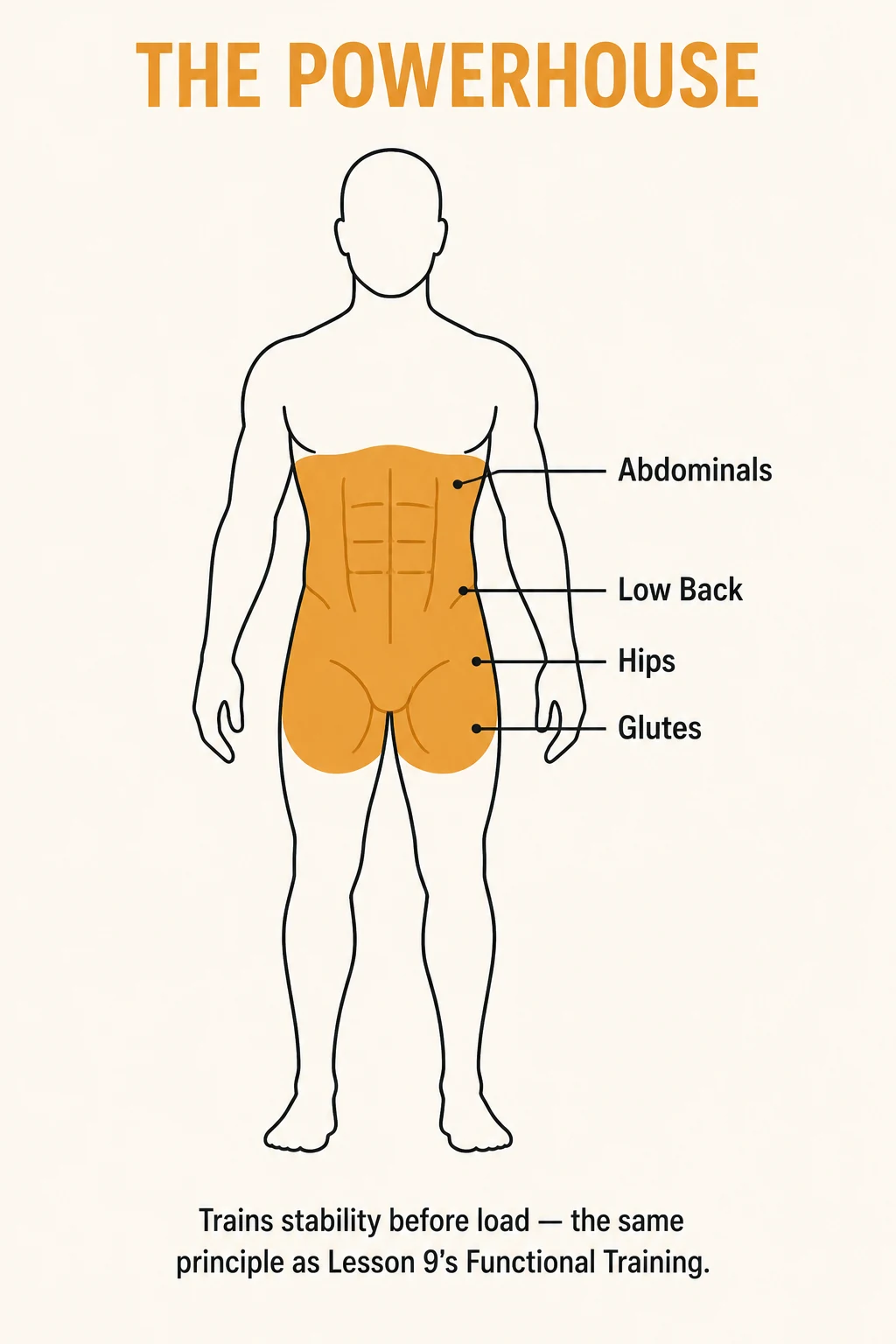
This is also why Pilates sits comfortably alongside Functional and Movement Training rather than only appearing as a separate class format — the two are teaching overlapping skills from different angles.
Contemporary Methods: Retraining Movement Habits
Methods like the Feldenkrais Method and the Alexander Technique take a different angle than Pilates — instead of strengthening a specific muscle system, they focus on retraining ingrained movement habits by directing a client's attention to their own sensory experience of moving.
The Feldenkrais Method is typically delivered in one of two formats: Awareness Through Movement, taught in a group setting through verbally guided movement sequences, and Functional Integration, a one-on-one, hands-on session where a practitioner guides a client's movement directly. Both share the same underlying goal — expanding a person's movement options by making them consciously aware of habits they'd otherwise never notice.
The Alexander Technique, specifically, teaches the transformation of neuromuscular habits by helping a person notice and adjust patterns — like habitual tension in the neck and shoulders — that they'd otherwise never consciously register. A common real-world example: someone who spends all day at a laptop develops a forward-head, rounded-shoulder pattern so gradually that it feels normal to them. The Alexander Technique doesn't "strengthen" anything to fix that — it works by rebuilding the person's sense of what neutral actually feels like.
Documented Health Benefits
Beyond the visible flexibility and balance improvements, mind-body exercise has research behind it addressing several less obvious areas: hypertension, insulin resistance, chronic pain, cardiovascular disease risk factors, anxiety, and depression.
A lot of this traces back to a shared mechanism across these modalities: slow, controlled breathing and deliberate, unhurried movement tend to shift the body toward parasympathetic ("rest and digest") nervous system activity, as opposed to the sympathetic ("fight or flight") state that high-intensity training deliberately calls on. Neither state is "better" in isolation — a well-rounded program uses both — but for a client dealing with chronic stress, this is a genuinely different tool than another hard interval session, and it connects directly back to Lesson 2's point that adherence often comes down to whether a client's program actually fits their life, not just their fitness goals.
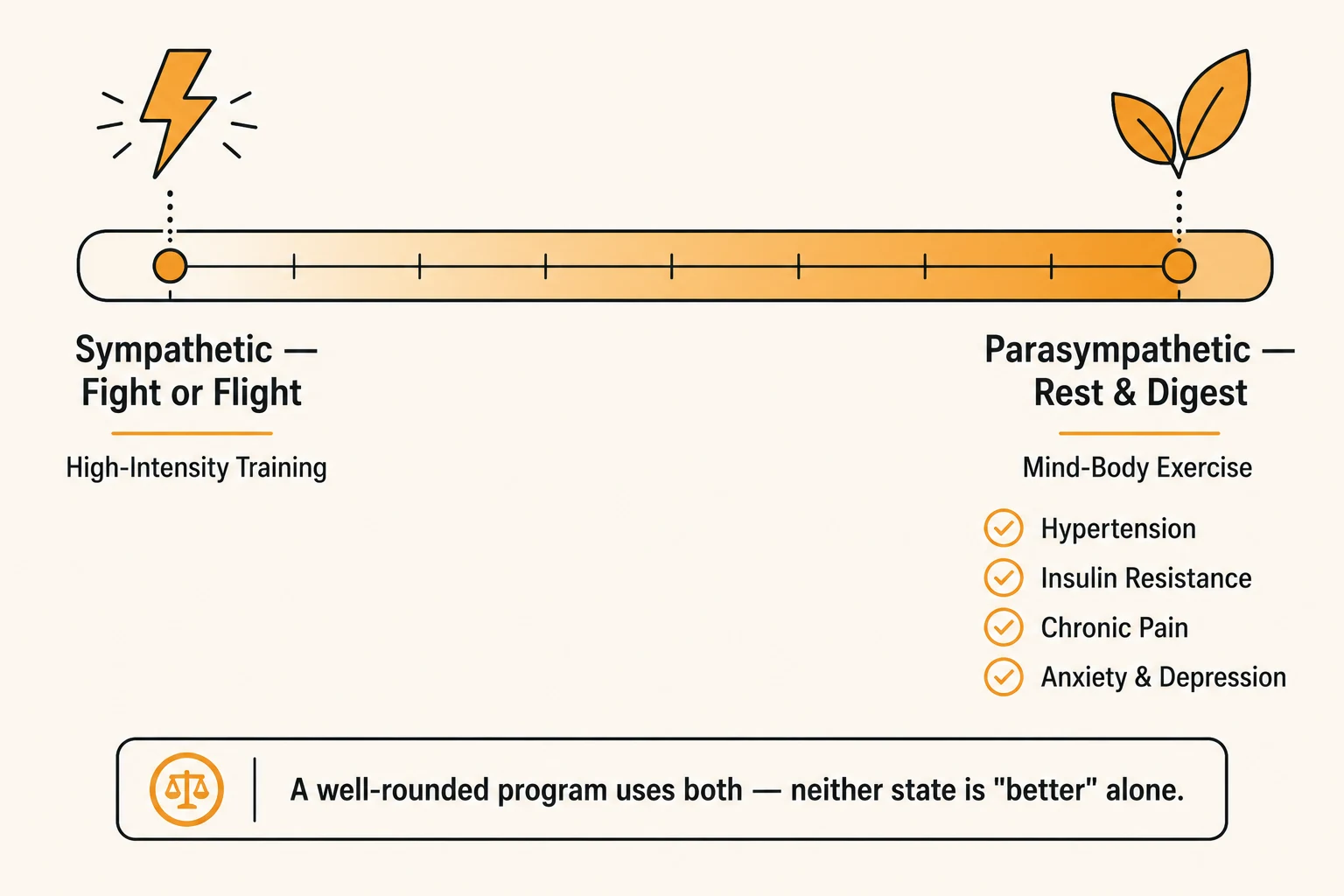
This matters directly for Lesson 14's special-populations content — mind-body modalities are frequently a lower-impact, appropriate entry point for clients who aren't yet ready for more demanding Load/Speed Training.
Programming Mind-Body Work Into the IFT Model
Mind-body modalities don't get their own third track in the IFT Model from Lesson 5 — they get folded into the existing Cardiorespiratory and Muscular Training components, usually in one of three places: as part of a warm-up or cool-down (a few minutes of breath-focused movement to transition a client in or out of a session), as the primary modality on a lower-intensity training day, or as a dedicated once- or twice-weekly session for a client whose goals are more about stress management and mobility than performance.
For a client still in Functional Training, mind-body work often overlaps almost entirely with what's already being programmed — slow, controlled, body-weight movement that reinforces core engagement and postural awareness is the point of both. For a client further along in Load/Speed Training, it tends to show up as active recovery: something that keeps them moving and attentive to their body on a day they're not lifting heavy or pushing pace.
8 questions, modeled on ACE's real exam style. Score 72%+ to mark this lesson complete.
- Mind-body exercise spans traditional practices (yoga, qigong, tai chi) and contemporary methods (Pilates, Feldenkrais, Alexander Technique).
- Pilates is built around a core set of postural muscles that support the spine, prioritizing control and precision.
- Contemporary methods like the Feldenkrais Method and Alexander Technique retrain movement habits through sensory attention, not muscular strengthening.
- Documented benefits extend beyond flexibility and balance to hypertension, insulin resistance, chronic pain, and mental health — largely through the same parasympathetic-activation mechanism across modalities.
- Mind-body work doesn't get its own IFT Model track — it's folded into warm-ups, lower-intensity days, or dedicated sessions within the existing Cardiorespiratory and Muscular Training components.
- A trainer's job is understanding these modalities well enough to program around and refer to them — not necessarily teaching a full class.
Before moving to Lesson 14:
- Pick one mind-body modality and write two sentences on how you'd introduce it to a hypothetical Functional Training-phase client.
- List one health condition where a mind-body modality might be an appropriate lower-impact entry point.
- Decide where in a hypothetical client's weekly split you'd place a mind-body session — warm-up, recovery day, or dedicated session — and write one sentence on why.
- Complete the knowledge check above and review any question you missed.