Chapter 12 closes out Program Design and Implementation — the highest-weighted domain on the exam — by pulling Lessons 5 through 11 into one worked example. If you can walk a single client all the way from investigation to a finished, two-track program, you've genuinely learned this domain, not just memorized its pieces.
Every lesson since Chapter 5 has covered one piece of the puzzle in isolation. Real clients — and real exam questions — don't hand you the pieces separately. This lesson walks through a full scenario, showing how the pieces click together.
A Worked Example
Consider a hypothetical client: mid-40s, works a desk job, hasn't exercised regularly in several years, and wants to "get healthier and have more energy." Here's how that turns into a program, lesson by lesson:
| Stage | What happens |
|---|---|
| Investigation (Lesson 6) | Rapport-building conversation, PAR-Q+ and health-history intake, no red flags found. Client is in the contemplation-to-preparation range on the stages-of-change model — motivated, but hasn't started yet. A SMART goal gets set collaboratively via the GROW model. |
| Functional assessment (Lesson 7) | Static posture shows an anterior pelvic tilt and forward head position — consistent with years at a desk. The bend-and-lift screen shows knee valgus; the TVA core test shows poor engagement, with compensation from the rectus abdominis. |
| Physiological assessment (Lesson 8) | Resting vitals are normal. The client hasn't exercised enough to warrant VT1/VT2 testing yet. A simple push-up test establishes a muscular-endurance baseline. |
| Muscular Training placement (Lessons 9–10) | Given the postural and core findings, this client starts in Functional Training — not Movement or Load/Speed — regardless of how motivated they feel to "lift weights" right away. |
| Cardiorespiratory placement (Lesson 11) | Since the client isn't yet exercising consistently, Cardiorespiratory Training starts in Base Training — Zone 1 only, building toward 20+ minutes, 3–5 days a week. |
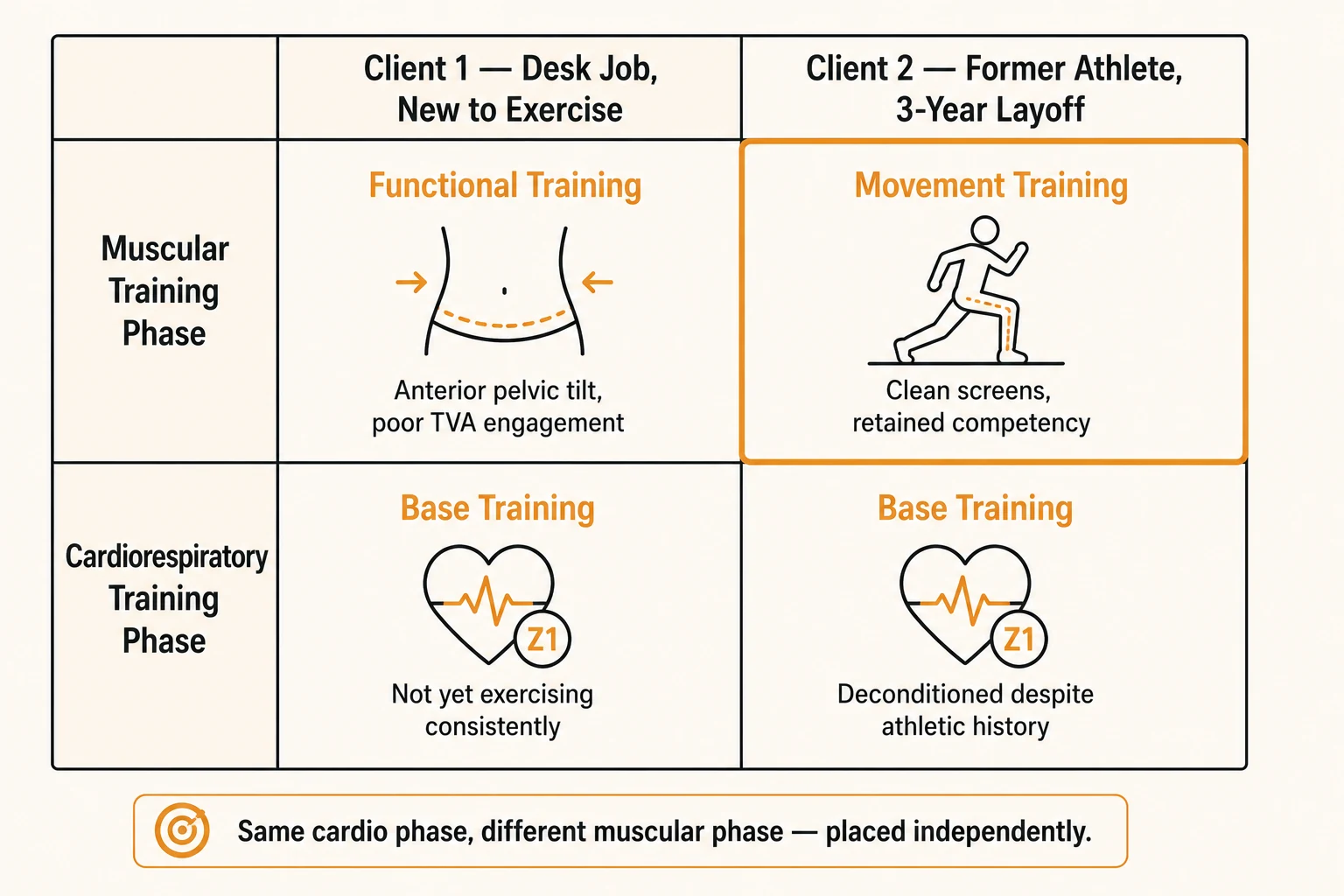
Notice what happened here: this client landed in the earliest phase of both components. That won't always be true — a former athlete returning after a long break might start in Base Training for cardio (deconditioned) while still qualifying for Movement Training for muscular work (retained movement competency). The two placements are decided independently, exactly as Lesson 5 described.
A Second Client: Where Placements Diverge
To make that divergence concrete, walk through the former-athlete example properly. This client is late-20s, played competitive soccer through college, and has done almost no structured exercise for the past three years while working long hours. His stated goal is "get back in shape for a rec league starting in four months."
Investigation surfaces no health red flags, and he's clearly in the preparation stage of change — motivated and already looking at signing up for the league. Functional assessment tells a different story than the first client's: his movement screens are clean, with good sequencing and control on the bend-and-lift and hurdle-step screens, and his TVA engagement is solid. Years of athletic training left lasting movement competency even after a long layoff. Physiological assessment, though, shows a resting heart rate and submaximal talk-test response consistent with someone who hasn't done real cardiorespiratory work in years.
The placements split accordingly: Muscular Training starts in Movement Training, not Functional Training, since his movement patterns don't show the compensations that would call for a Functional Training-first approach. Cardiorespiratory Training still starts in Base Training, because current conditioning — not athletic history — is what the assessment measures. Four months out from his goal, this split placement matters: starting his cardio too aggressively based on his athletic past, rather than his current deconditioning, is exactly the kind of mistake that leads to overuse injury before the season even starts.
Common Synthesis Mistakes
- Forcing matched phasesAssuming a client must be in "Phase 1 of everything" or "Phase 3 of everything" — the two components are assessed and placed independently.
- Defaulting to a templateReaching for a generic program instead of letting this specific client's assessment findings — posture, core function, current cardio habits — drive the phase and exercise selection.
- Skipping reassessmentTreating the initial assessment as a one-time event instead of a recurring checkpoint that determines when a client is actually ready to progress phases.
What Happens After the Program Is Designed
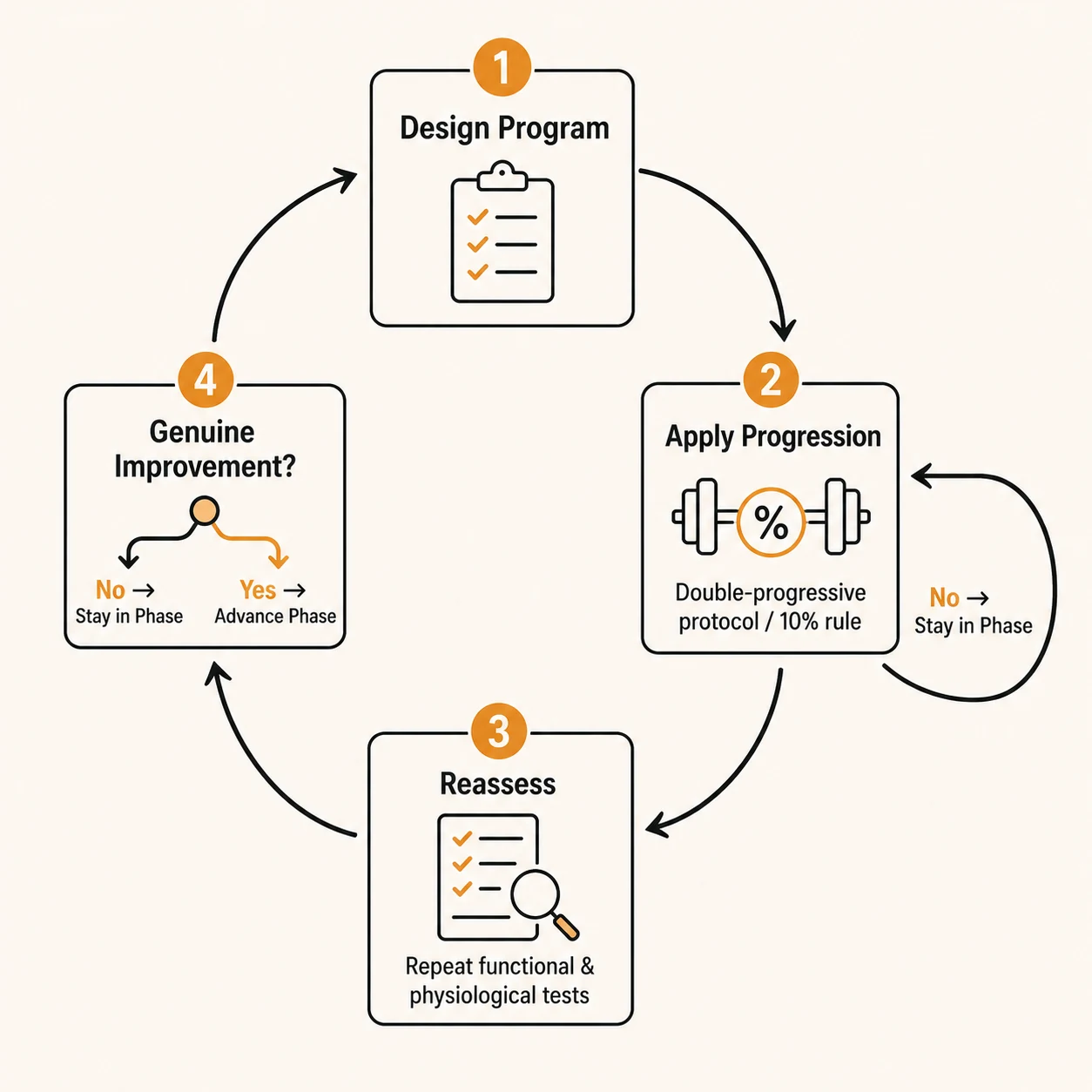
Program design isn't a one-time event — it's the start of an ongoing cycle. Resistance training progresses via the double-progressive protocol from Lesson 10; cardiorespiratory training progresses using the 10% rule from Lesson 11. Periodically, the original functional and physiological assessments get repeated, and only a genuine improvement in those results — not just enthusiasm or time elapsed — justifies moving a client into the next phase of either component.
For the desk-job client from the worked example above, that might mean re-checking the postural assessment and TVA test after six to eight weeks of consistent Functional Training. Clean movement patterns and solid core engagement at that checkpoint justify a move into Movement Training; a repeat of the same compensations means staying in Functional Training longer, regardless of how many weeks have passed or how ready the client feels.
8 questions, modeled on ACE's real exam style. Score 72%+ to mark this lesson complete.
- A client's Cardiorespiratory and Muscular Training phases are decided independently, based on each component's own assessment findings.
- Common mistakes include forcing matched phases, defaulting to a generic template, and skipping ongoing reassessment.
- Progression after the initial program relies on the double-progressive protocol (resistance) and the 10% rule (cardio) — plus repeated assessment, not just time elapsed.
- ACE's real exam leans on scenario-based questions, which is exactly the skill this synthesis chapter builds.
- Athletic history and current conditioning aren't the same thing — placement should reflect what assessments show today, not what a client used to be capable of.
You've completed the Program Design and Implementation domain — the highest-weighted section of the exam. Before moving on:
- Write your own one-paragraph client scenario and walk it through all six stages from the worked example table above.
- Review Lessons 5–11 together and note any concept you couldn't explain without looking back.
- Explain in one sentence why the returning-athlete client split placements instead of matching them.
- Complete the knowledge check above and review any question you missed.