Once a client with a chronic condition, or one in a specific life stage like pregnancy or older adulthood, has been medically cleared to exercise, the same IFT Model from Lessons 5-12 still applies — it just gets modified. A trainer's job is applying that modification appropriately and conservatively, not treating the condition itself.
Lesson 1 drew a firm line: personal trainers don't diagnose or treat disease. This chapter is about what happens on the other side of that line — once a physician has cleared a client to exercise, how does a trainer actually adjust programming to fit that client's real situation?
The General Approach: Low-to-Moderate, Gradual, Monitored
Across nearly every special population covered in this chapter, the same baseline principle applies: start with a low-to-moderate intensity program and progress gradually, adjusting based on how the client actually responds rather than following a fixed template regardless of feedback.
This is a direct, more conservative application of the same progression principles from Lessons 10 and 11 — the double-progressive resistance protocol and the 10% cardio rule both still apply, just with a lower starting point and closer monitoring. In practice, that often means starting a special-population client one full step below where their fitness level alone might suggest — not because they can't handle more, but because the cost of misjudging the starting point is higher for these clients than for a generally healthy one.
Cardiovascular and Metabolic Conditions
Clients with cardiovascular disorders, hypertension, dyslipidemia (unhealthy cholesterol/lipid levels), or diabetes make up one major group this chapter addresses. For all of them, the exercise guidance is broadly similar in shape even though the specific medical details differ: conservative starting intensity, closer monitoring of exertion and vital signs where relevant, and tighter communication with the client's physician about any red-flag symptoms.
| Condition | What a trainer specifically watches for |
|---|---|
| Hypertension | Blood pressure response to exertion — an exaggerated rise is a signal to ease off, tying back to Lesson 8's test-termination criteria |
| Diabetes | Signs of hypoglycemia (shakiness, confusion, sudden fatigue) during or after a session, especially with insulin-dependent clients |
| Dyslipidemia | No exercise-specific red flags beyond general cardiovascular monitoring — the training emphasis leans toward consistent cardiorespiratory work |
| Cardiovascular disorders | Chest discomfort, unusual shortness of breath, or dizziness — any of which is an immediate stop, per Lesson 8's termination signs |
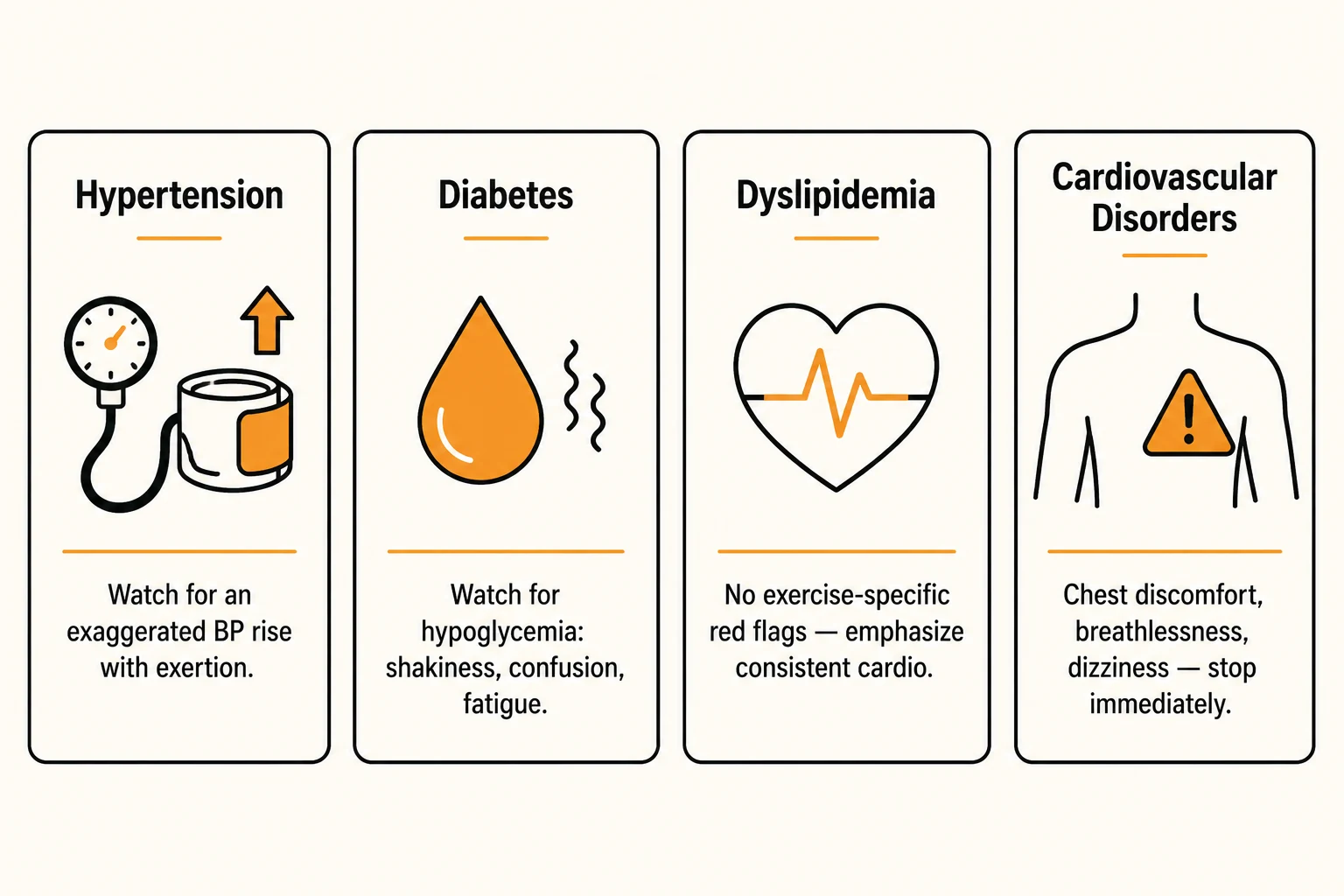
Notice the pattern: none of this requires a trainer to become a cardiologist or an endocrinologist. It requires knowing which specific signs, for which specific condition, mean "stop and refer" versus "note it and continue" — and that distinction is exactly what tends to get tested.
Youth, Older Adults, and Prenatal/Postpartum Clients
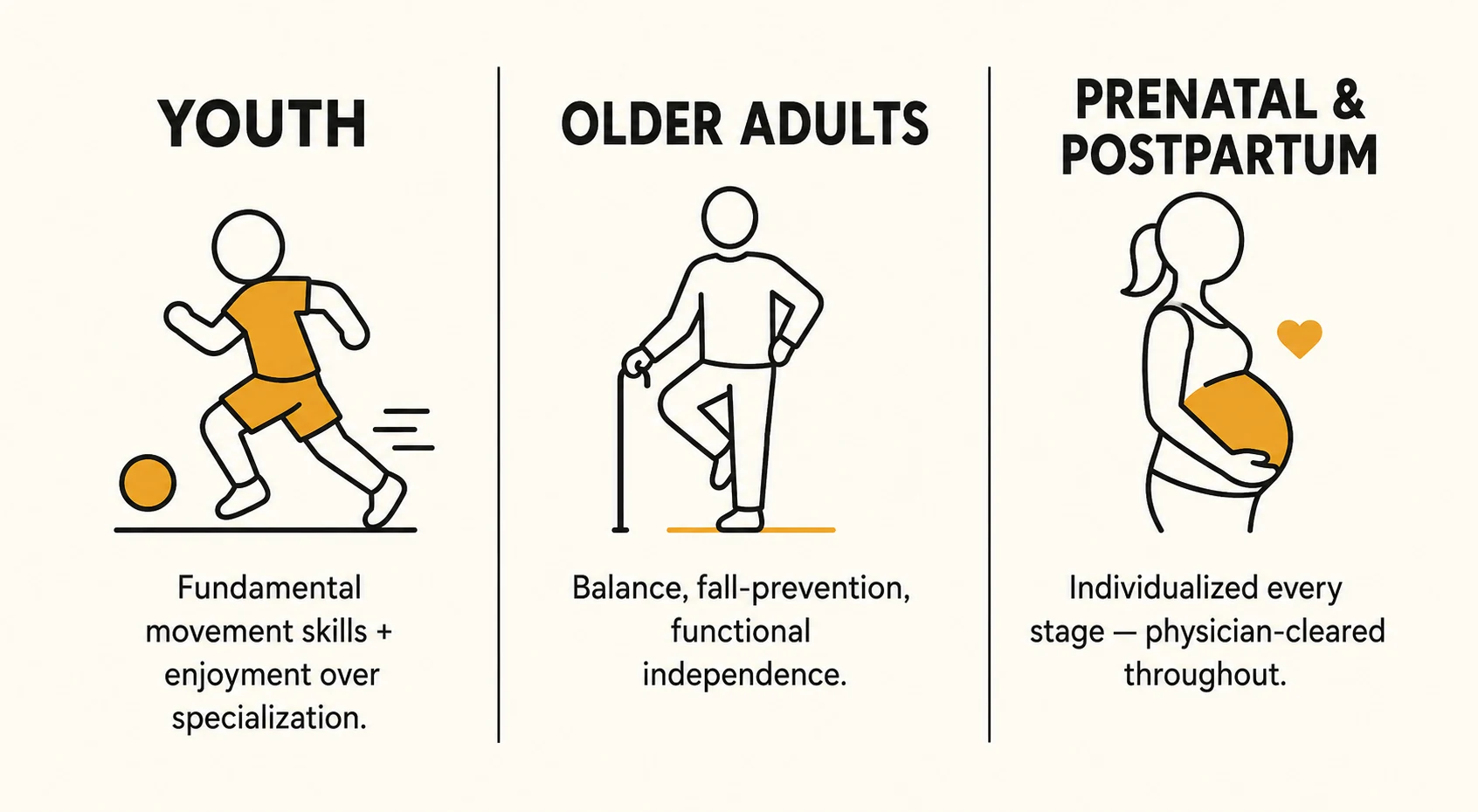
- YouthProgramming should emphasize fundamental movement skills and enjoyment over early specialization or maximal loading. A youth client isn't a smaller adult client — the goal at this stage is building a broad movement vocabulary, not chasing a specific performance outcome.
- Older adultsBalance, fall-prevention, and maintaining functional independence typically take priority alongside standard strength and cardio goals. Resistance training remains appropriate and valuable here — the modification is in exercise selection and progression speed, not in avoiding resistance training altogether.
- Prenatal and postpartum clientsProgramming must be individualized and cleared by the client's physician at every stage — this is one of the clearest examples of "modify, don't guess." What's appropriate can also change meaningfully from one trimester to the next, or week to week postpartum, which is why ongoing physician communication matters more here than almost anywhere else in this course.
The IFT Model Still Applies — Modified
None of this replaces the IFT Model from Lessons 5 through 12. A special-population client still gets assessed (Lessons 7 and 8), still gets placed into Cardiorespiratory and Muscular Training phases (Lesson 5), and still progresses using the same core mechanics. What changes is the starting point, the pace, and the degree of caution — not the underlying framework.
Take Lesson 12's worked example again, but this time imagine that same mid-40s desk-job client also has controlled hypertension. The investigation, functional assessment, and physiological assessment stages from Lessons 6 through 8 all still happen exactly as described. The client still lands in Base Training and Functional Training for the same postural and conditioning reasons. What changes is the monitoring layer on top: blood pressure response gets tracked more deliberately during cardio sessions, and progression through the 10% rule from Lesson 11 gets applied more conservatively than it would for a client without that condition.
Working With the Client's Care Team
Because special-population programming sits right at the edge of scope of practice, communication with the professionals already involved in a client's care matters more here than almost anywhere else in this course. That ties directly back to Lesson 1's referral network: a physician's clearance note, a physical therapist's specific restrictions, or an obstetrician's trimester-by-trimester guidance aren't paperwork to file away — they're the actual boundaries a program has to be built inside of.
In practice, this means documenting clearance before programming begins, keeping a simple record of any symptoms or concerns a client reports session to session, and being willing to pause and check back in with the client's physician when something changes — a new medication, a new symptom, a condition that seems less controlled than before. None of that is optional caution; it's the standard-of-care concept from Lesson 1 applied to a higher-risk population.
8 questions, modeled on ACE's real exam style. Score 72%+ to mark this lesson complete.
- Special-population programming assumes physician clearance has already happened — the trainer's job is appropriate modification, not diagnosis or treatment.
- The general approach is low-to-moderate intensity, progressing gradually, closely monitored.
- Cardiovascular, hypertension, dyslipidemia, and diabetes clients broadly share this conservative approach, adjusted per condition.
- Youth, older adult, and prenatal/postpartum programming each carry distinct priorities beyond standard strength and cardio goals.
- The IFT Model still applies to special populations — modified in starting point and pace, not replaced.
- Ongoing communication with the client's care team — documenting clearance, tracking symptoms, checking back in when something changes — is part of standard of care for this population, not extra caution.
Before moving to Lesson 15:
- Pick one special population from this lesson and write two sentences on how you'd adjust a standard Base Training program for them.
- Write one sentence explaining why medical clearance has to come before any of this chapter's modifications apply.
- Write down what you'd document after a session with a special-population client, and why each item matters.
- Complete the knowledge check above and review any question you missed.