Lesson 1 introduced scope of practice; this lesson widens the lens to the rest of a trainer's legal and professional footprint — negligence, informed consent, employment status, and liability insurance. None of it is a substitute for real legal advice, but understanding the basic shape of each concept is what lets a trainer recognize when they actually need that advice.
This is the closest the course comes to a formal legal chapter, and it's worth taking seriously — not because a trainer needs to become a lawyer, but because these are the concepts that show up when something goes wrong, and being unfamiliar with them at that point is expensive.
Negligence: Omission vs. Commission
Negligence in a training context splits into two forms, and it's worth being able to tell them apart precisely.
- Act of omissionNegligence through failing to act — for example, not stopping a session despite clear warning signs during a test (tying back to Lesson 8's test-termination criteria).
- Act of commissionNegligence through acting inappropriately — for example, programming an exercise clearly outside a client's documented limitations.
Both connect directly back to the standard-of-care concept from Lesson 1: negligence claims generally hinge on whether a trainer acted the way a reasonably competent trainer would have in the same situation.
- Duty of careThe trainer owed the client a responsibility to act with reasonable care — this exists as soon as a trainer-client relationship begins.
- Breach of dutyThe trainer failed to meet that standard — this is where omission and commission both apply.
- CausationThe breach actually caused the harm — not just happened to precede it.
- DamagesA real, demonstrable harm resulted — an injury, medical costs, lost income.
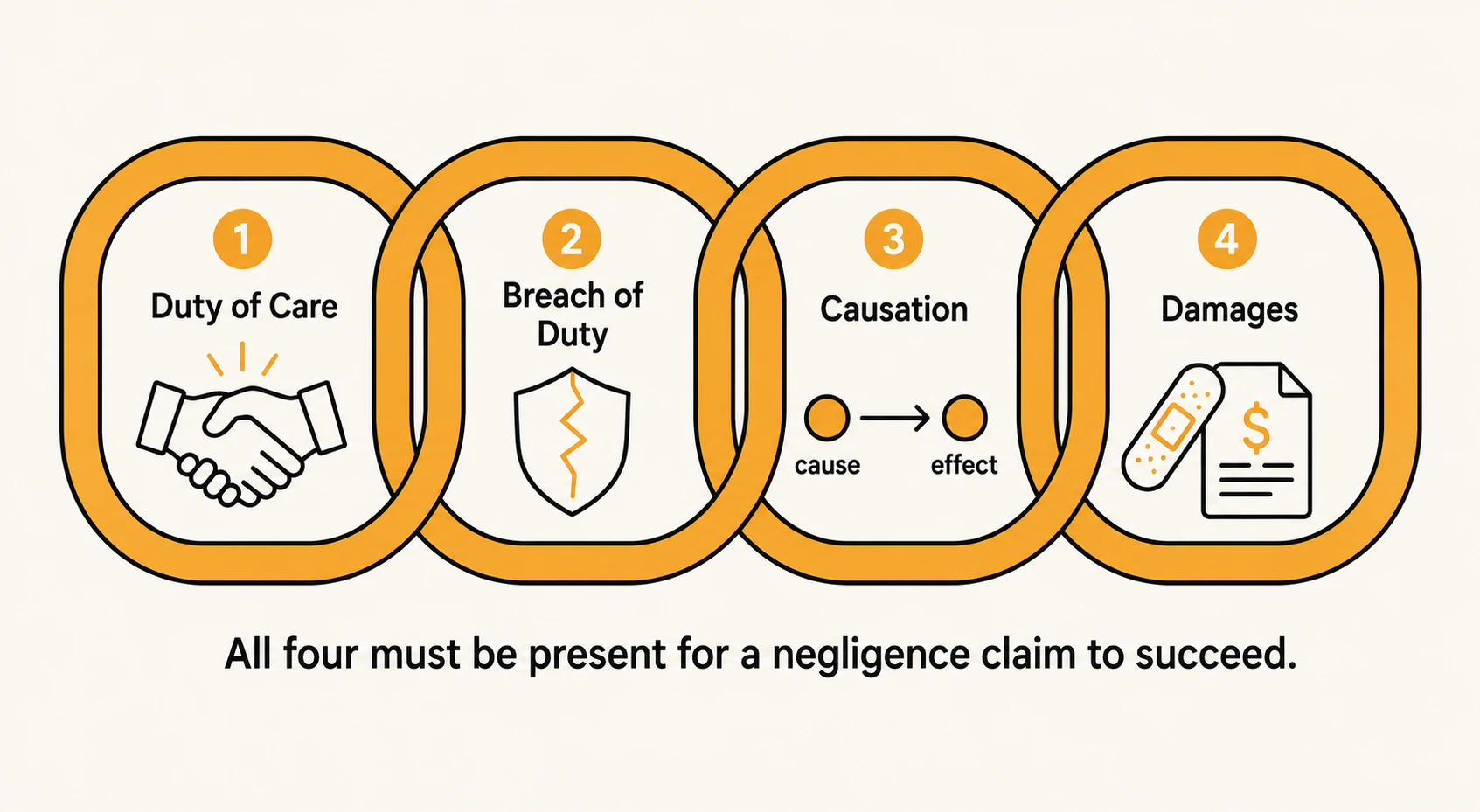
All four generally need to be present for a negligence claim to succeed. A trainer might genuinely breach their duty of care — say, ignoring a test-termination sign — but if no actual harm resulted, the damages element is missing. This is a helpful frame for understanding why "a trainer made a mistake" and "a trainer is liable" aren't automatically the same thing, even though a mistake is never something to shrug off.
Informed Consent and Waivers
These two concepts are related but distinct, and conflating them is a common mistake.
| Concept | What it actually does |
|---|---|
| Informed consent | Confirms a client was told the real risks of exercise and understands/accepts them before participating |
| Waiver | An agreement attempting to limit the trainer's or facility's liability if something goes wrong |
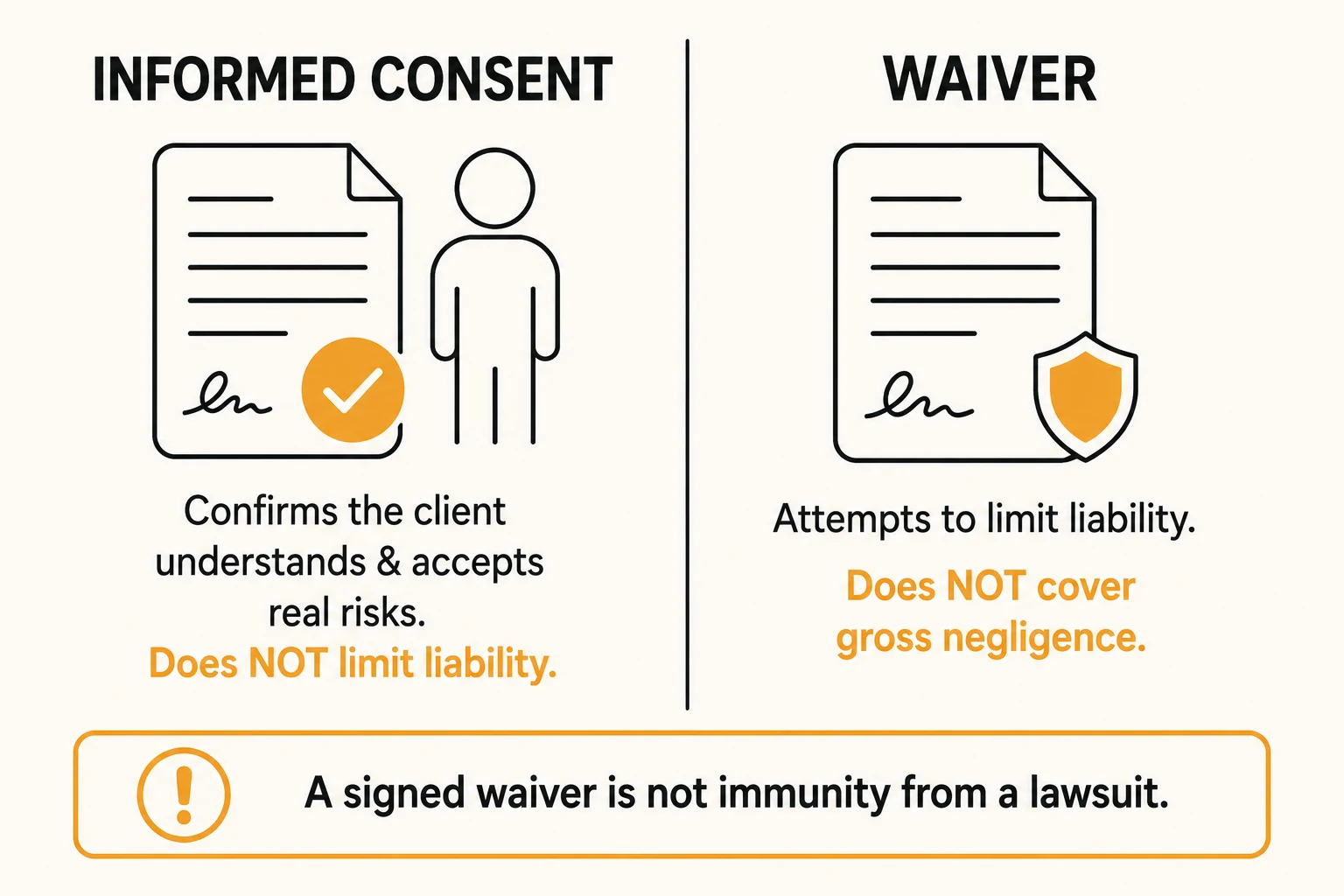
Neither one is a blank check — a waiver generally can't protect a trainer from claims of gross negligence, and informed consent doesn't eliminate the trainer's responsibility to actually exercise reasonable care.
Independent Contractor vs. Employee
How a trainer is classified affects taxes, benefits, control over schedule, and who bears legal responsibility for many situations.
- EmployeeWorks under an employer's direct control — set schedule, provided equipment, taxes withheld by the employer.
- Independent contractorOperates with more autonomy over schedule and methods, and is generally responsible for their own taxes and business expenses.
Liability Insurance and Vicarious Liability
Liability insurance helps protect a trainer financially if a negligence claim is made — and it's strongly recommended even when not strictly required by a facility. Vicarious liability is a related concept worth recognizing: an employer can sometimes be held liable for an employee's actions during the course of their work, which is part of why facilities care about trainer conduct even when a specific client relationship seems purely personal.
A Realistic Scenario: Where These Concepts Collide
A client with a documented shoulder limitation is programmed into an overhead press anyway, gets hurt, and later claims the trainer was negligent. Walking through this with the four elements above: duty of care clearly existed (an active trainer-client relationship), and breach of duty is plausible (programming against a documented limitation is an act of commission). Whether the claim succeeds still depends on causation (did the overhead press actually cause the injury, versus a preexisting condition flaring up independently) and damages (a real, demonstrable injury, not just discomfort).
A signed waiver in this scenario doesn't automatically end the analysis — if programming directly against a documented limitation counts as more than ordinary negligence in the relevant jurisdiction, the waiver may not cover it. This is exactly why the earlier "On the Exam" trap matters: the presence of paperwork doesn't replace the underlying question of whether the trainer actually exercised reasonable care.
8 questions, modeled on ACE's real exam style. Score 72%+ to mark this lesson complete.
- Negligence splits into acts of omission (failing to act) and acts of commission (acting inappropriately).
- Informed consent confirms a client understands real risks; a waiver attempts to limit liability — the two are related but distinct.
- Employee vs. independent contractor status affects taxes, control, benefits, and legal responsibility.
- Liability insurance and vicarious liability are both worth understanding, even though specifics vary by location.
- None of this substitutes for real legal advice from an attorney or insurance professional.
- A negligence claim generally requires all four elements: duty of care, breach of duty, causation, and damages.
- A signed waiver does not automatically shield a trainer from claims of gross negligence.
Before moving to Lesson 18:
- Write one example each of an act of omission and an act of commission in a training context.
- Write one sentence distinguishing informed consent from a liability waiver.
- List the four elements of a negligence claim from memory, and apply them to the shoulder-injury scenario above.
- Complete the knowledge check above and review any question you missed.