Every skill from Lessons 1 through 17 — assessment, programming, communication, risk management — still needs a viable business wrapped around it to turn into an actual career. This final chapter covers the practical fundamentals: a real business plan, branding, pricing, marketing, and the professional services almost every training business eventually needs.
This is the last chapter in the book, and it closes the loop the course opened in Lesson 1: understanding scope of practice matters, but so does understanding how to actually build a sustainable business around that scope.
The Business Plan as Foundation
An effective business plan is the foundation everything else in this chapter builds on. At minimum, it should address a marketing strategy, financial projections, and a risk analysis — not because a trainer needs to write a formal document to succeed, but because skipping this thinking entirely tends to show up later as avoidable problems. A trainer who never runs the financial projections, for instance, is the one who discovers six months in that their pricing doesn't actually cover their real costs — insurance, continuing education, equipment — once client volume is lower than hoped.
Two Common Business Models
Most trainers work under one of two structures, echoing Lesson 17's legal distinction but applied to day-to-day business reality.
| Model | What it typically looks like |
|---|---|
| Direct employee | More stability and less business overhead — the facility often handles marketing, scheduling, and equipment |
| Independent contractor | More autonomy, but the trainer handles their own marketing, taxes, and business expenses |
Creating a Brand and Marketing It
A brand is how a trainer communicates the specific benefits of working with them — not just a logo, but a consistent answer to "why this trainer, for this client." A trainer who works exclusively with new parents returning to exercise postpartum has a very different brand from one who specializes in powerlifting prep — same underlying skill set from Lessons 1-15, communicated to a completely different audience.
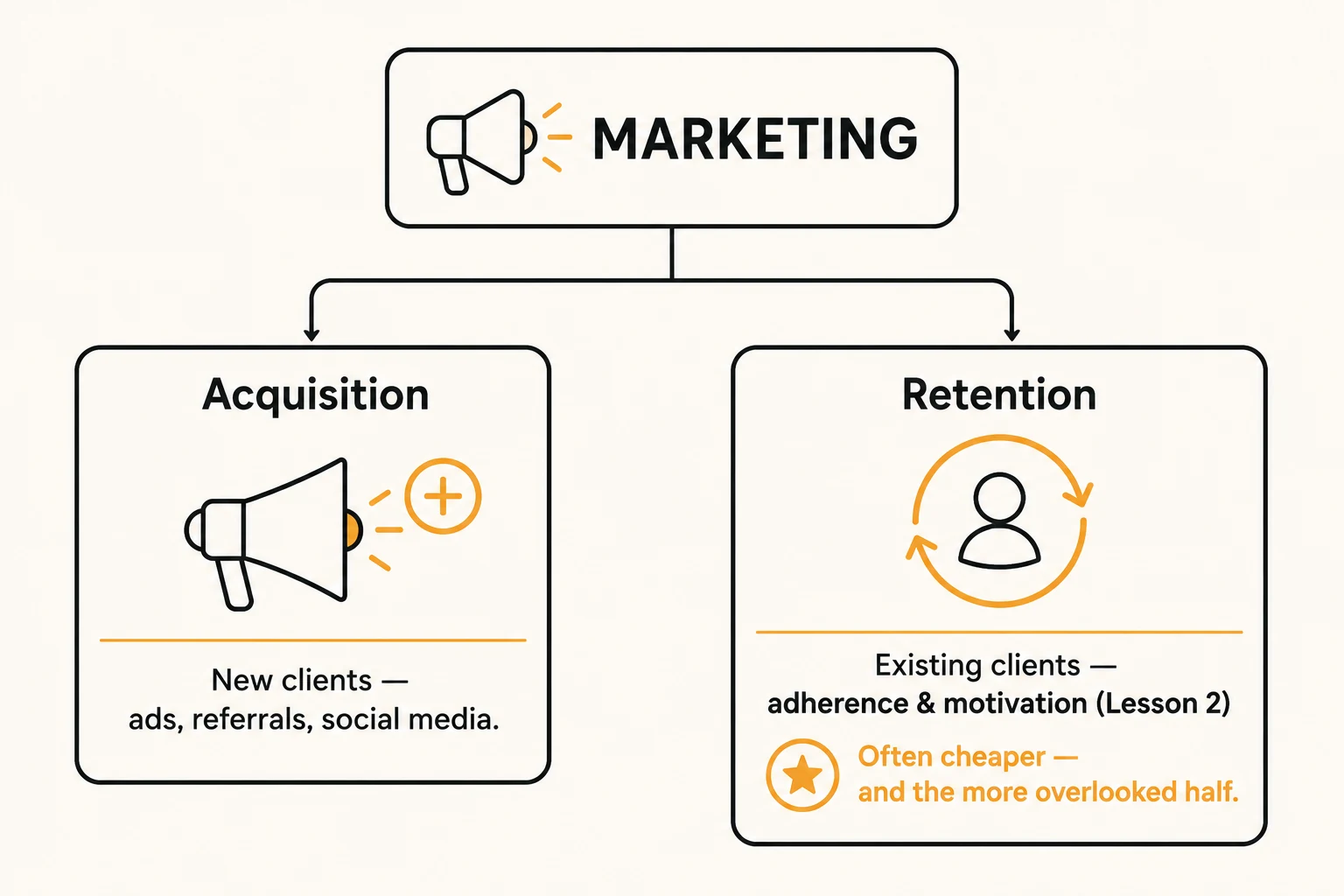
Marketing then splits into two related jobs: acquiring new clients and retaining existing ones, with retention often the more overlooked half despite being cheaper and more valuable long-term. Lesson 2's adherence and motivation principles are, in a very real sense, the retention half of marketing — a client who stays motivated and sees results is a client who renews, refers friends, and reduces how much new-client acquisition a trainer needs to do at all.
Pricing Considerations
When starting out, a common approach is pricing slightly below comparable competitors in the local market — often around 5% lower — as a way to build a client base and track record before adjusting rates upward as demand and reputation grow.
A Worked Example: A New Trainer's First Year
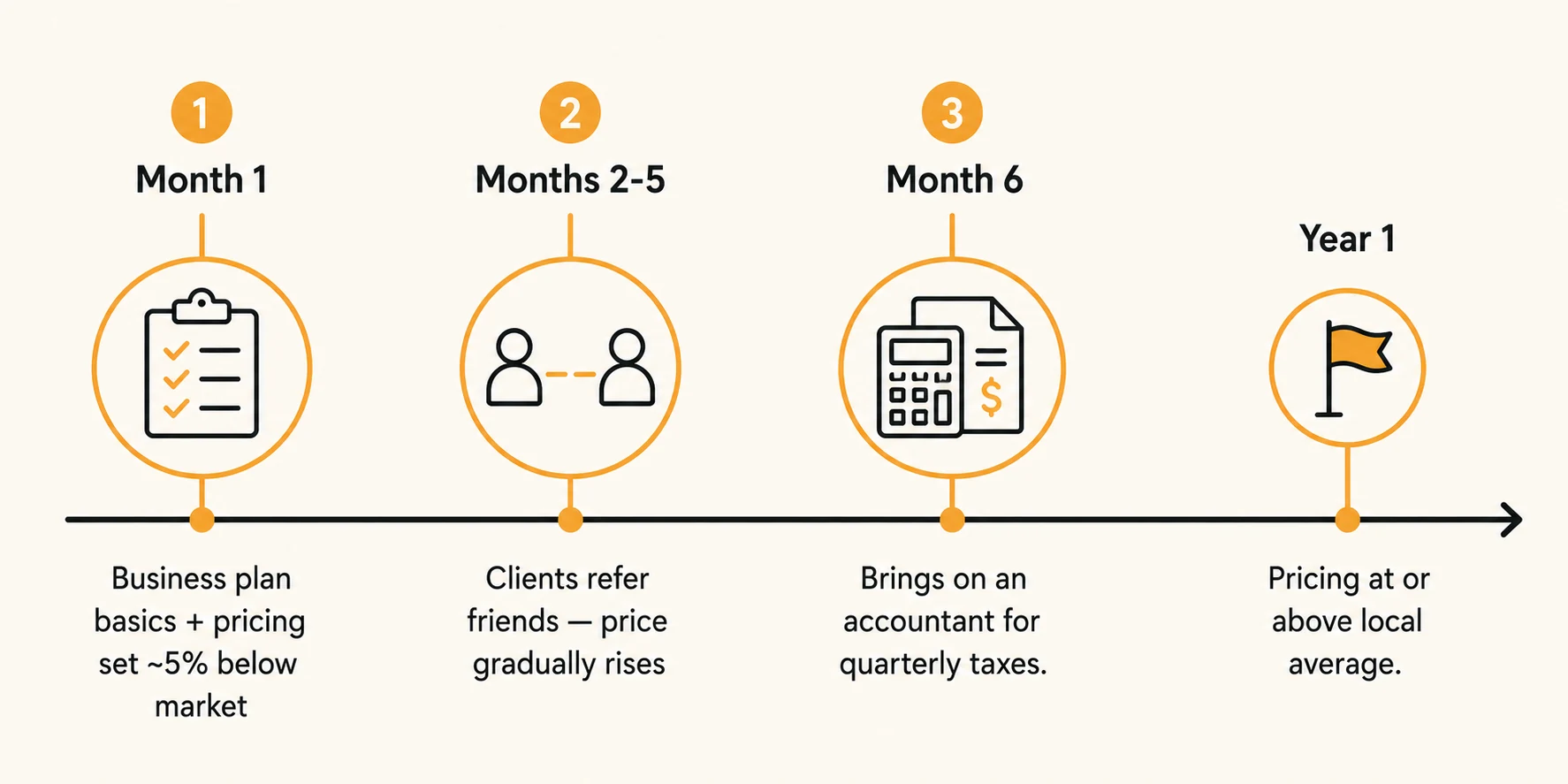
Consider a newly-certified trainer starting at an established gym as an independent contractor. Month one is spent on the business plan basics: a simple marketing strategy (a social-media presence plus asking the gym for referrals), financial projections (how many sessions per week cover expenses, including the liability insurance from Lesson 17), and a risk analysis (what happens if client volume is lower than expected in the first quarter).
Pricing starts about 5% below comparable trainers at competing gyms nearby, deliberately, to build a client base quickly. As the first few clients see real results and refer friends — Lesson 2's adherence work paying off as free marketing — pricing gradually moves toward, then above, the local average. By month six or so, the trainer brings in an accountant to make sure quarterly estimated taxes are being handled correctly, since that's a genuinely different obligation as an independent contractor than it would be as a direct employee.
The Professional Services a Training Business Needs
- An attorneyFor contracts, waivers, and the legal structure questions from Lesson 17.
- An accountantFor tax structure, especially important for independent contractors managing their own filings.
- A web developer or designerTo support the branding and marketing work above, especially as a business scales past word-of-mouth.
None of these need to be hired all at once, or even as full-time relationships — many trainers start with a one-time consultation for contracts and taxes, then expand the relationship as the business grows. The point isn't to build a large team on day one; it's knowing which questions genuinely require professional expertise rather than guesswork, the same "know your limits" principle from Lesson 1's scope of practice applied to running a business instead of running a session.
8 questions, modeled on ACE's real exam style. Score 72%+ to mark this lesson complete.
- An effective business plan — marketing strategy, financial projections, risk analysis — is the foundation everything else builds on.
- Direct employee and independent contractor are the two common business models, each with different overhead and autonomy trade-offs.
- Branding communicates why a specific client should work with a specific trainer; marketing splits into acquisition and retention.
- New trainers often price slightly below local competitors while building a track record.
- An attorney, accountant, and web developer are professional services most training businesses eventually need.
- Retention through strong adherence practices (Lesson 2) is itself a marketing strategy, not separate from one.
Final steps for this course:
- Sketch a one-paragraph business plan for a hypothetical training business, touching marketing, financial projections, and risk analysis.
- Write one sentence on how Lesson 2's adherence principles double as a client-retention marketing strategy.
- Complete the knowledge check above and review any question you missed.
- Take the full-length, domain-weighted mock exam — pass at 72%+ to unlock your free completion certificate.