Domain 2 explained what's happening inside a client's motivation — self-efficacy, self-determination, mindset, positive psychology. Domain 3 opens with the practical toolkit a coach actually uses to act on all of that, sentence by sentence, inside a real session. OARS names four core communication skills — open-ended questions, affirmations, reflections, and summaries — and NBHWC's content outline separately names a set of facilitation tools, from scaling questions to wellness visioning, that give a session something concrete to work with. Both are named, testable pieces of Domain 3's content outline.
Lessons 5 through 7 built the theory: how habits form, how motivational interviewing draws out real motivation, how goal-setting theory turns it into a goal that sticks, and what's happening inside a client's head once all of that is in motion. This lesson closes the gap between theory and an actual conversation. What does a coach literally say, moment to moment, to put all of that into practice? OARS and NBHWC's facilitation tools are the answer.
Active Listening: Attending to Content and Delivery
Everything else in this lesson sits on top of one foundational skill: active listening. Active listening means giving a client full attention — not waiting for a pause to say the next thing, but genuinely tracking both what a client says and how they say it. NBHWC's content outline frames this as listening with curiosity for both content and delivery: the words themselves, and the tone, pace, hesitation, and body language surrounding them.
A client who says "I'm fine with the plan" while sighing, avoiding eye contact, and pausing a beat too long isn't necessarily fine with the plan — the delivery is contradicting the content, and a coach who only tracks the words misses it entirely. Active listening also means noticing what's left unstated: the topic a client keeps circling back to without naming directly, or the answer they give for someone else ("my spouse thinks I should…") rather than for themselves.
- Open-ended questionsQuestions that invite the client to generate their own answer, rather than pick from yes/no or preset options.
- AffirmationsGenuine recognition of a client's strengths and effort.
- ReflectionsStatements — not questions — that show the client the coach understood what they said and meant.
- SummariesOrganizing what's been said so far and handing it back to the client.
OARS is the practical skill set built on top of active listening — the four moves a coach actually makes, sentence by sentence, inside a session. The rest of this lesson works through each one, plus the separate set of facilitation tools NBHWC names alongside them.
Open-Ended Questions and Affirmations
The first OARS skill is the open-ended question — one that invites a range of possible answers instead of confining the client to yes/no or a preset menu. Closed question: "Did you exercise this week?" Open question: "What did movement look like for you this week?" The closed version gets a fact; the open version gets a client thinking out loud about their own week, which is where real motivation gets found rather than just reported.
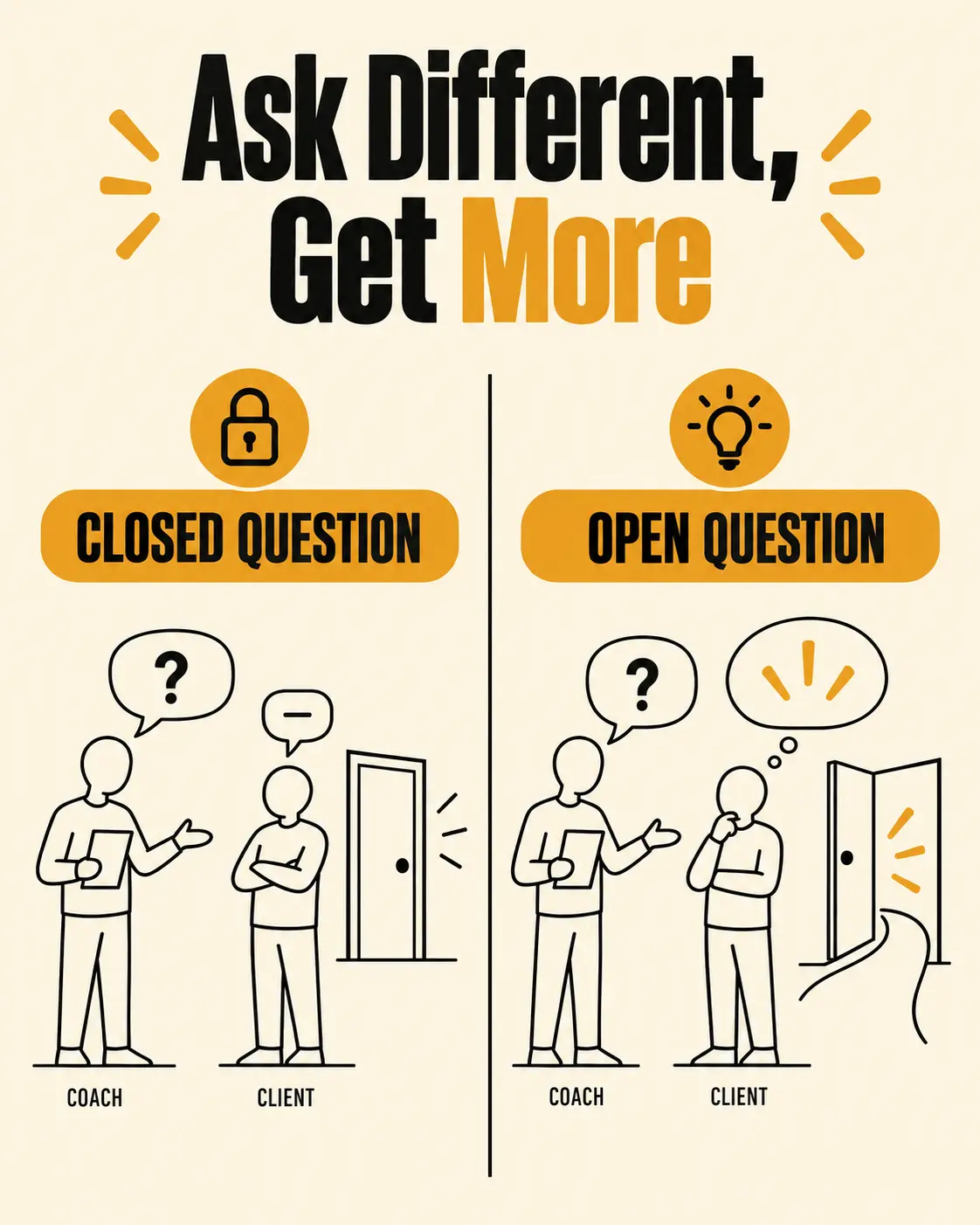
Closed questions aren't wrong — they're efficient for confirming a specific detail. But when a coach defaults to them, the conversation turns into an interview the coach is steering, rather than an exploration the client is doing. Open questions cost more time and give up some control, and that trade is usually worth it.
The second skill, affirmations, is genuine recognition of a client's strengths and effort — especially useful when a client is doubting themselves. "You showed up to this session even after a rough week" affirms something real and specific. A generic "great job!" doesn't land the same way, because affirmations only work when they're accurate and specific enough that the client can't dismiss them as politeness.
A client sits down and says nothing changed this week. A closed-question coach might ask, "Did you follow the plan?" — inviting a yes/no that ends the conversation there. An OARS-fluent coach instead asks, "What got in the way this week?" (open question), and after the client explains a chaotic work stretch, reflects it back and adds, "You still made it to this session in the middle of that — that's not nothing" (affirmation). Nothing about the plan has been discussed yet, and the client is already more open than they were thirty seconds ago.
Reflective Listening: Simple and Complex Reflections
Reflective listening is the third OARS skill, and it's often called the hardest one to learn because it isn't a question at all — it's a statement that shows the client the coach understood not just their words, but what they meant. A simple reflection paraphrases without adding interpretation: the client says "I don't have time to cook," and the coach reflects, "Cooking feels like it doesn't fit into your week right now." It proves the coach was listening, and it often gets the client to keep talking without being asked to.
Complex reflections go further. A double-sided reflection names both halves of a client's ambivalence in one sentence — "You want to cut back on drinking, and you're worried about how you'll socialize without it" — without taking either side. Reflecting emotion names the feeling underneath the words ("that sounds like it left you discouraged"), and reflecting with metaphor hands a client's own image back to them ("it sounds like this diet felt like running on a treadmill that never stopped").
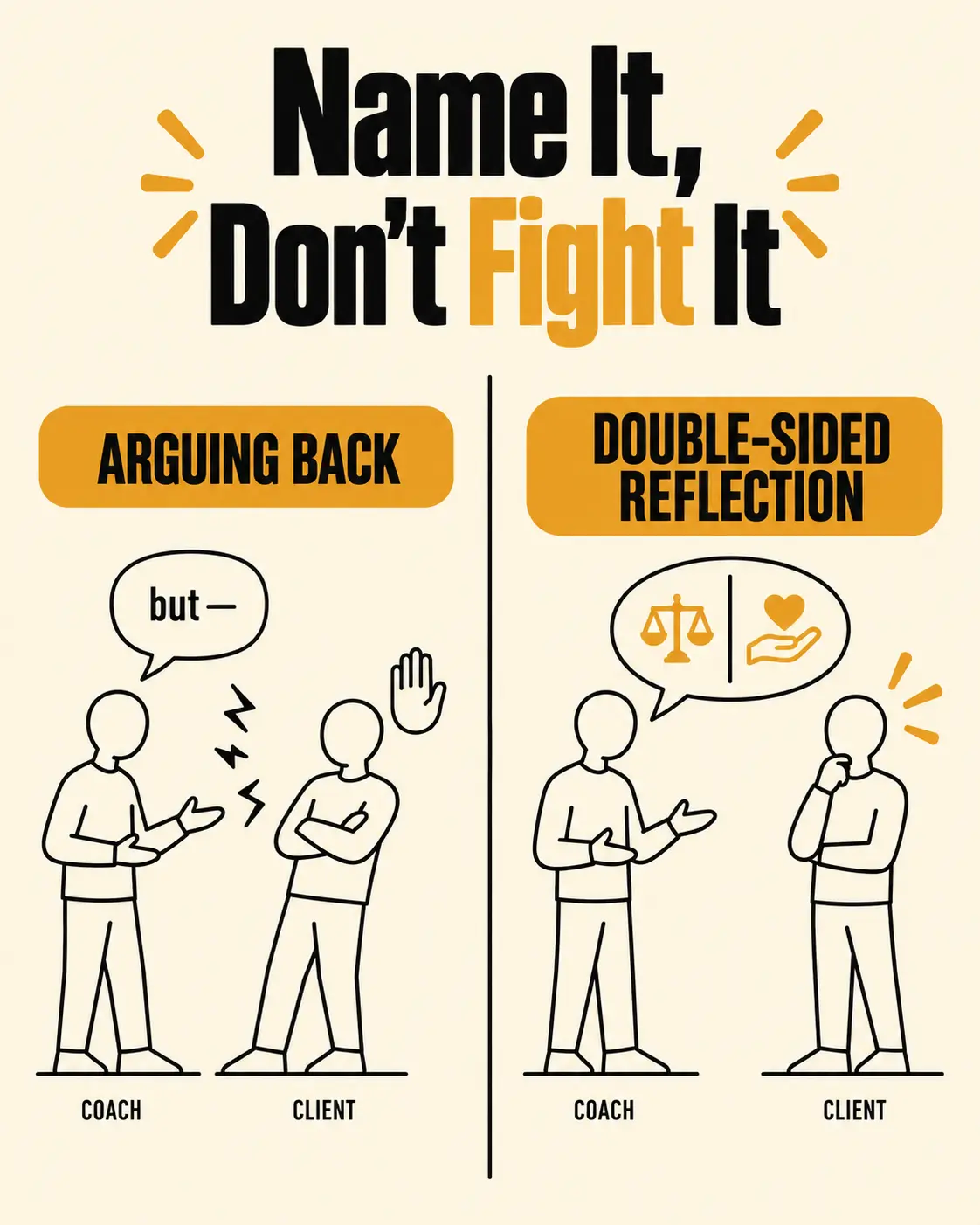
Complex reflections, especially double-sided ones, are also the main tool for working with resistance. When a client pushes back or argues for staying the same — what NBHWC's outline calls discord or sustain talk — arguing against it directly tends to entrench the client further; people talk themselves out of a position less often when someone else is pushing on it. A double-sided reflection instead names the resistance without fighting it, which paradoxically makes it easier for the client to move past it on their own.
A client says, "I know I should cut back on sugar, but honestly, dessert is the one thing I look forward to every day — I'm not giving it up." A coach who argues back ("but it's really affecting your energy levels") is likely to get more of the same defense. A coach who reflects instead — "Dessert is one of the real bright spots in your day, and you're not willing to trade that away just because it'd be good for you" — names the resistance accurately, and often the client's next sentence starts qualifying their own position: "I mean, I'm not saying I couldn't cut back somewhere else."
Summaries and Ask-Offer-Ask
The fourth OARS skill, summarizing, organizes what a client has said across several minutes — or an entire session — and hands it back to them in a structured form, usually followed by an open question. It shows the client the coach was tracking the whole conversation, not just the last thing said, and gives the client a chance to hear their own words compressed into one place.
| Collecting Summary | Transitional Summary |
|---|---|
| Gathers what's been said on the same topic so far. | Gathers what's been said, then pivots to a new topic or direction. |
| Used to slow the pace and check understanding mid-conversation. | Used to close one part of a session and open the next. |
| Followed by a question that stays on the same thread. | Followed by a question that opens a different thread. |
Coaches also need a way to share information — a resource, an observation, a piece of health education — without it turning into a lecture. NBHWC's outline names this structure ask-offer-ask: first ask what the client already knows or wants to know, then offer the information neutrally and without pressure, then ask how that information lands for them or what they make of it. The structure keeps the client in charge of what happens to the information, rather than positioning the coach as the expert delivering a verdict.
A client asks a coach what they think about intermittent fasting. Instead of answering directly, the coach asks, "What have you already heard about it?" (ask), listens, then offers a brief, balanced summary of what the research actually shows (offer), then asks, "What do you make of that, given what you're trying to do?" (ask). The client leaves with information, but the conclusion is still theirs to draw.
Facilitation Tools Beyond the Conversation
OARS covers what a coach says. NBHWC's content outline also names a separate set of facilitation tools — structured exercises a coach brings into a session that go beyond conversation alone. These include wellness exploration instruments (structured questionnaires or assessments that surface a client's current habits and priorities), values and strengths-based exploration (helping a client name what actually matters to them, separate from what they think should matter), wellness visioning (picturing a specific, vivid future state worth working toward), brainstorming, and scaling questions ("On a scale of 1 to 10, how confident are you that you could do this?").
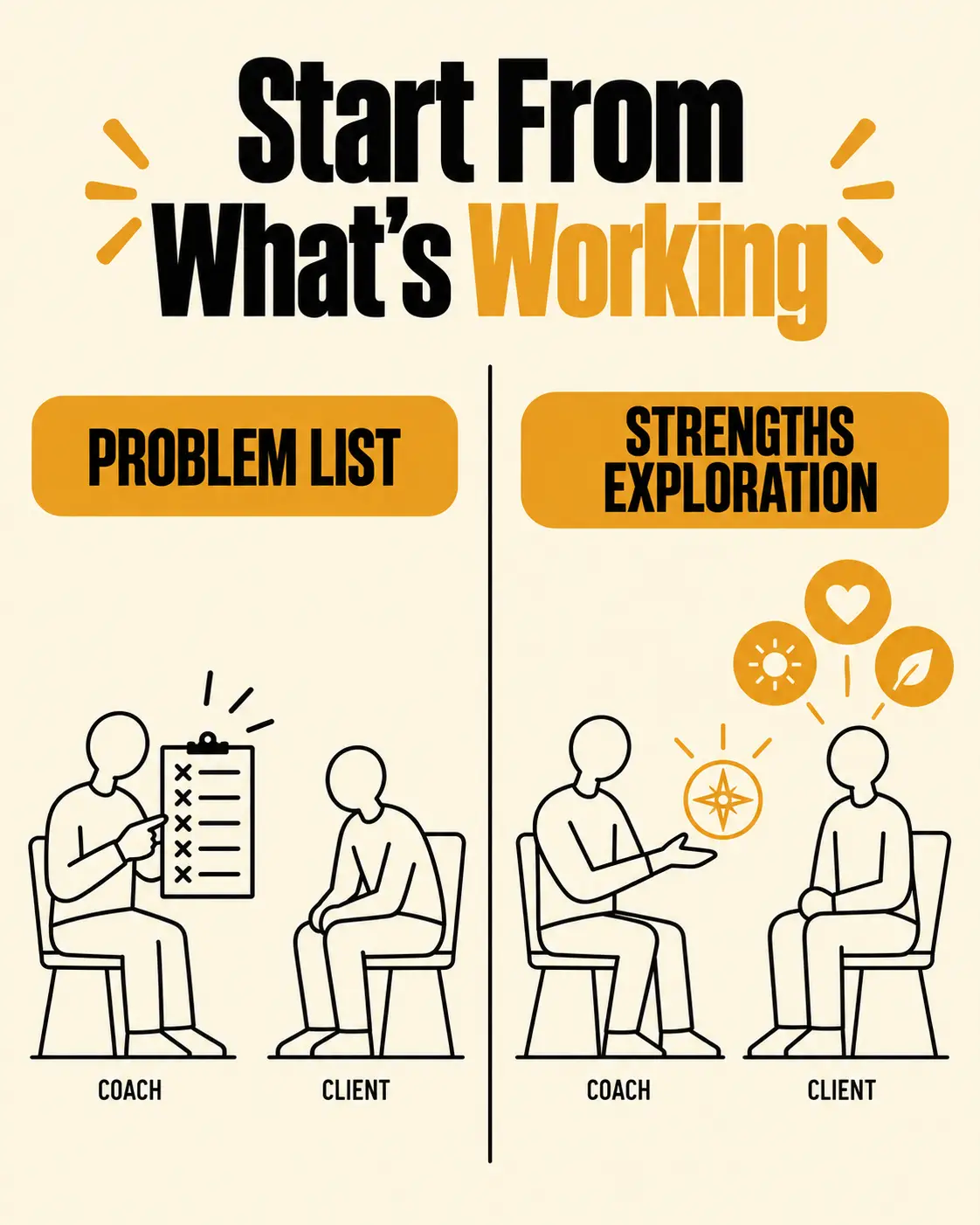
The outline also names reflective and self-awareness practices a coach might introduce or point a client toward — journaling, meditation, guided imagery, visualization, and mindfulness — along with digital health platforms and apps that support tracking and habit change between sessions. None of these replace the conversation; they give it something concrete to work with when the conversation alone stalls.
A client keeps saying they "want" to start strength training, but three sessions in, nothing has moved. Rather than repeating the same open question, the coach tries a scaling question: "On a scale of 1 to 10, how confident are you that you could do one 20-minute session this week?" The client says "maybe a 4." That number becomes something concrete to work with — "what would need to be true for that to be a 6 or a 7?" — in a way "how's it going" never quite got to.
How OARS and Facilitation Tools Work Together
OARS and facilitation tools operationalize everything the earlier lessons named. The PACE spirit and MI's four tasks from Lesson 6 describe the posture a coach takes; self-efficacy, SDT, mindset, and PERMA from Lesson 7 describe what's happening inside the client. OARS and facilitation tools are the actual, sentence-by-sentence and tool-by-tool moves a coach makes to act on all of that inside a real session.
Domain 3 continues in Lesson 9, which turns from communication skills and facilitation tools to protecting a client's autonomy and intrinsic motivation, and helping them build awareness and see their situation from a new angle.
8 questions on active listening, the OARS communication skills, working with resistance, ask-offer-ask, and NBHWC's facilitation tools. NBHWC doesn't publish a fixed pass/fail line for its own exam, so this knowledge check doesn't invent one either — you'll get a raw score and a rationale for every question instead.
- Active listening attends to both content and delivery — the words a client uses and the tone, pace, and body language around them.
- OARS names the four core communication skills: open-ended questions, affirmations, reflections, and summaries.
- Complex reflections, especially double-sided ones, are the main tool for working with resistance — naming it instead of arguing against it.
- Collecting summaries gather what's been said on one topic; transitional summaries gather it and then pivot to a new one.
- Ask-offer-ask lets a coach share information without lecturing — ask what the client knows, offer neutrally, ask what they make of it.
- Facilitation tools like scaling questions, wellness visioning, and values-based exploration give a stalled conversation something concrete to work with.
Before moving to Lesson 9:
- Notice one closed question you default to this week and rewrite it as an open question.
- Practice one double-sided reflection the next time someone — a client or otherwise — pushes back on something.
- Try a scaling question the next time a goal conversation feels stuck.
- Complete the knowledge check above and review the rationale for any question you missed.