Lesson 6 covered how to draw out a client's motivation (motivational interviewing) and turn it into a goal that holds up (goal-setting theory). This lesson goes one layer deeper into what's actually happening inside that motivation once it's there. Four related frameworks explain it from different angles: self-efficacy (whether a client believes they personally can do the thing), self-determination theory (what a client's motivation needs to stay intrinsic rather than borrowed), mindset (how a client interprets a setback once one happens), and positive psychology (what a client is building toward, not just avoiding). All four are named, testable concepts in NBHWC's Domain 2 content outline.
Lessons 5 and 6 built the conversational and goal-setting machinery of behavior change: how habits form, how to read readiness, how to have the conversation that draws out real motivation, and how to turn that motivation into a goal that actually sticks. This lesson closes out Domain 2 with four frameworks that explain what's happening underneath all of that — inside the client, not just across the table from them. Each one answers a different question a coach runs into constantly: Does this client believe they can actually do this? What kind of motivation is sustainable versus borrowed? How does this client treat a setback when one inevitably happens? And what is coaching actually building toward, beyond just removing problems?
Self-Efficacy: Bandura's Four Sources of Belief
Self-efficacy, a concept developed by psychologist Albert Bandura, is a person's belief in their capacity to execute the specific behaviors needed to produce a specific outcome. It's easy to confuse with self-esteem, but they're not the same thing — self-esteem is a general sense of self-worth, while self-efficacy is task-specific. A client can have healthy self-esteem overall and still have low self-efficacy for, say, cooking at home four nights a week, because self-efficacy is about a belief in capability for that particular behavior, not a global judgment of personal value.
Bandura identified four sources that build or erode self-efficacy, and they aren't equally powerful.
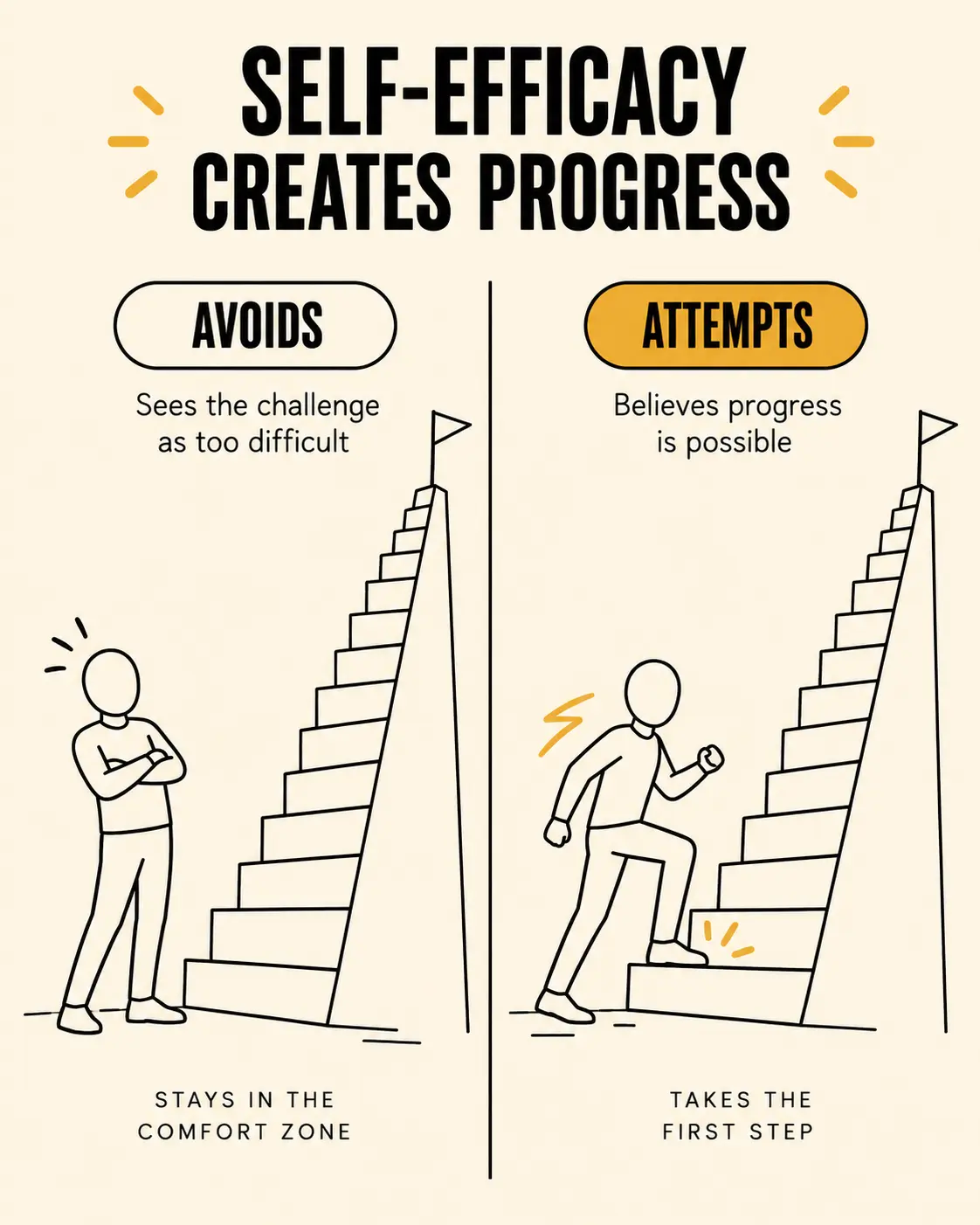
- Mastery experiencesActually succeeding at a challenging task — the strongest and most durable source, because it's direct proof rather than something borrowed from someone else.
- Vicarious experiencesWatching someone similar to yourself succeed through sustained effort, which raises belief that you could master a comparable challenge too.
- Verbal persuasionGenuine encouragement from a credible, trusted source — real, but weaker than the first two, and most useful when it's paired with an actual chance to succeed.
- Physiological and emotional statesHow a person interprets their own arousal — nerves before a first gym visit can be read as "I'm not cut out for this" or reframed as "I'm just keyed up, that's normal."
A client says they've "never been a runner" and doubts they could finish a 5K. Rather than handing over a training plan, the coach starts smaller: a single 10-minute walk-run the client can complete this week (a mastery experience in miniature), mentions a client with a similar starting point who built up gradually (vicarious experience), and reflects back the client's own past success finishing a demanding work project (verbal persuasion, grounded in something real). None of this is the training plan itself — it's deliberately building the belief that has to exist before the plan has any chance of being followed.
Self-Determination Theory: Autonomy, Competence, Relatedness
Self-efficacy asks whether a client believes they can do something. Self-Determination Theory (SDT), developed by Edward Deci and Richard Ryan, asks a related but different question: what kind of motivation will actually hold up over time? SDT proposes that humans have three basic psychological needs, and when all three are supported, motivation tends to become intrinsic — pursued because the activity itself is satisfying, not because of an external reward or pressure.
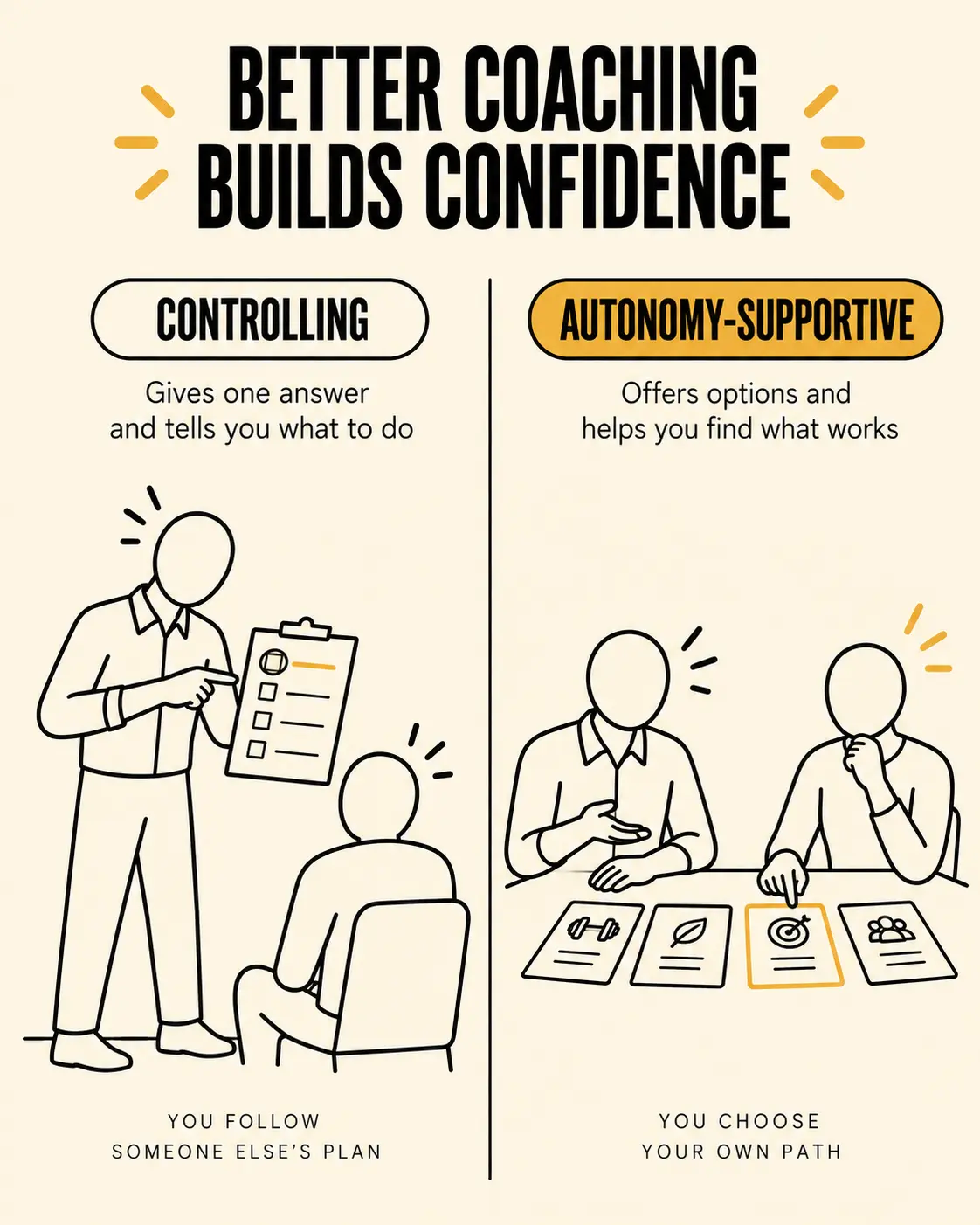
- AutonomyFeeling like the genuine author of your own actions, operating from real choice rather than being controlled or pressured into it.
- CompetenceFeeling genuinely capable of achieving the outcome — built through appropriately challenging tasks paired with meaningful feedback.
- RelatednessFeeling genuinely connected to and cared for by others — a sense of belonging that supports sustained effort rather than isolated willpower.
SDT also names something coaches run into constantly: the overjustification effect. Adding an external reward to an activity someone already does for its own sake can quietly erode the original intrinsic motivation — once the reward stops, the motivation often stops with it. It's a reason to be cautious about leaning too hard on prizes, streaks, or gamified rewards as the main driver of a client's behavior change, rather than as a light supplement to motivation that's already genuinely theirs.
Coach A tells a client exactly which three workouts to do this week and checks compliance at the next session. Coach B asks the client which of several reasonable options feels most doable this week (autonomy), sets the bar just above what the client has already shown they can do (competence), and offers to check in by text if the client wants that (relatedness, offered rather than imposed). Both coaches want the same outcome. Coach B's approach is far more likely to survive past the point where the coach is watching.
Growth vs. Fixed Mindset
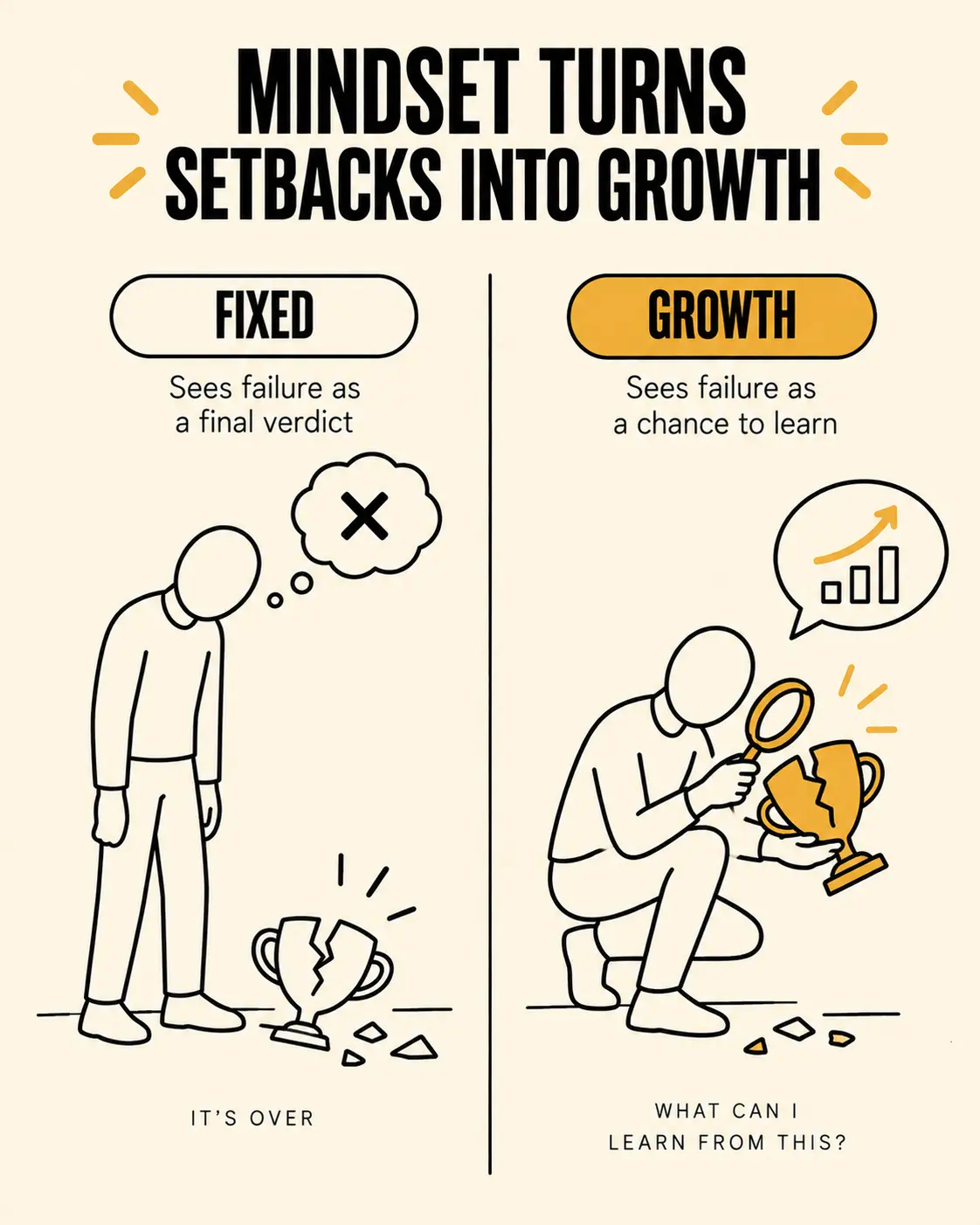
Psychologist Carol Dweck's research describes two broad ways people interpret their own abilities. A fixed mindset treats intelligence, talent, and personality as static traits — you either have them or you don't — which makes failure feel like a verdict on inherent worth rather than a normal part of learning. A growth mindset treats those same traits as developable through effort, strategy, and practice, which makes a setback informative rather than threatening. The difference shows up most clearly in how someone responds when something goes wrong.
| Fixed Mindset | Growth Mindset |
|---|---|
| Ability is a fixed trait — you either have it or you don't. | Ability is developable through effort, strategy, and practice. |
| Challenges are threats that risk exposing inadequacy. | Challenges are opportunities to build capability. |
| Failure is a verdict on inherent worth. | Failure is informative feedback for the next attempt. |
| Effort is a sign that you're not naturally good at something. | Effort is the mechanism that builds mastery. |
A client misses a week of planned workouts after a rough stretch at work and says, "I always do this — I just don't have the discipline for this stuff." That's fixed-mindset language: the miss is being read as proof of a fixed, unchangeable trait. A coach working with mindset in mind doesn't argue the point directly — instead, they ask what specifically got in the way this week, and what one thing might make next week more realistic. The reframe isn't forced positivity; it's redirecting attention from "what this says about me" to "what this teaches me about the plan."
Positive Psychology: The PERMA Model and Appreciative Inquiry
Where the previous three frameworks focus on belief, motivation, and interpreting setbacks, positive psychology — the field founded by Martin Seligman — asks a different question: what is a coach actually building toward, beyond the absence of a problem? Seligman's PERMA model names five elements of psychological flourishing that a coach can deliberately help a client build, rather than treating well-being as simply "not struggling."
- Positive emotionHope, joy, gratitude, and similar feelings — broader than simple happiness, and something that can be deliberately cultivated.
- EngagementOften called "flow" — complete absorption in an activity, typically when challenge and personal strengths line up well.
- RelationshipsFeeling supported, valued, and connected to others — humans are social, and this dimension shows up in both mental and physical health outcomes.
- MeaningA sense of belonging to or serving something larger than yourself, which helps carry a person through a difficult stretch.
- AccomplishmentPursuing and achieving goals for their own sake — well-being rises more when this comes from intrinsic growth than from chasing external status.
Appreciative Inquiry, developed by David Cooperrider, is a closely related, strengths-based approach to change that fits the same spirit as PERMA. Instead of starting a conversation by diagnosing what's broken, it starts by identifying what's already working, then builds forward from there through a four-stage cycle: Discover (what's already working), Dream (what could be, building on those strengths), Design (concrete steps grounded in that vision), and Destiny (implementing and sustaining the change). For a coach, it's a genuinely different starting question — not "what's wrong here?" but "what's already going right that we could build on?"
A client opens a session by listing everything that's gone wrong with their eating this month. A deficit-based conversation would dig straight into the failures. An Appreciative Inquiry-informed coach instead asks, "Was there a day or a meal this month that actually went the way you wanted?" — and builds the next steps outward from whatever specific, real thing the client names, rather than from the list of problems. The information about what went wrong isn't ignored; it's just not where the conversation starts.
How These Four Frameworks Work Together
None of these four frameworks replaces motivational interviewing or goal-setting theory from Lesson 6 — they explain what's happening underneath them. A client can have a genuinely evoked, well-formed goal and still stall out because they don't believe they can do it (low self-efficacy), because the plan was imposed rather than chosen (an SDT need going unmet), because one setback gets read as a permanent verdict (fixed mindset), or because the whole process feels like nothing but problem-fixing with no sense of what it's building toward (missing PERMA elements or a deficit-only frame). A coach who only knows MI and goal-setting theory has the conversation skills; these four frameworks explain why the conversation sometimes still doesn't hold.
This closes out Domain 2. From here, the course moves into Domain 3 with Lesson 8: the practical facilitation tools and core communication skills a coaching session actually runs on, day to day.
8 questions on Bandura's self-efficacy theory, Self-Determination Theory, growth vs. fixed mindset, and Seligman's PERMA model plus Appreciative Inquiry. NBHWC doesn't publish a fixed pass/fail line for its own exam, so this knowledge check doesn't invent one either — you'll get a raw score and a rationale for every question instead.
- Self-efficacy (Bandura) is task-specific belief in your own capability, built through four sources — mastery experiences are the strongest, verbal persuasion the weakest on its own.
- Self-Determination Theory (Deci & Ryan) names three basic psychological needs — autonomy, competence, relatedness — that sustain intrinsic motivation; the overjustification effect explains how external rewards can erode it.
- A growth mindset (Dweck) treats ability as developable and failure as feedback; a fixed mindset treats ability as static and failure as a verdict on worth.
- Seligman's PERMA model names five elements of flourishing — positive emotion, engagement, relationships, meaning, accomplishment — that go beyond just the absence of a problem.
- Appreciative Inquiry builds change from existing strengths through a four-stage cycle — Discover, Dream, Design, Destiny — rather than starting from what's broken.
- All four frameworks explain what's happening inside a client's motivation once MI and goal-setting theory have drawn it out and shaped it into a goal.
Before moving to Lesson 8:
- Think of a task you personally avoid. Identify which of Bandura's four sources of self-efficacy is weakest for you there.
- Notice one moment this week you used fixed-mindset language about a setback, and rewrite it in growth-mindset terms.
- Pick one PERMA element you could deliberately build more of into a client conversation this week.
- Complete the knowledge check above and review the rationale for any question you missed.