Domain 3 was about what a coach does inside a session. Domain 4 turns outward, to a coach's obligations as a professional: staying current through ongoing development, knowing exactly where NBHWC's scope of practice ends and referral begins — closing two open threads this course planted back in Lesson 1 and Lesson 4 — and the Code of Ethics that governs privacy, boundaries, and professional integrity, including one of coaching's newest ethical questions: disclosing the use of AI.
Everything Domain 3 covered lived inside a single coaching conversation. Domain 4 zooms out further than Lesson 11 did — past the client relationship entirely, to the standards a coach is expected to hold as a professional, whether or not a client ever sees them directly. NBHWC names four sub-competencies here: ongoing development, scope of practice, the Code of Ethics, and legal obligations. This lesson covers the first three; Lesson 13 closes out the fourth.
Engaging in Ongoing Professional Development
NBHWC's outline lists eight specific practices for a coach's own ongoing development. Grouped together, they fall into four categories: formal learning, community, reflective practice, and the coach's own wellbeing.
- Formal learningContinuing education, staying up-to-date on emerging research, and knowing how to locate and evaluate evidence-based resources.
- CommunitySeeking mentorship and collaboration, and building a professional network for referrals, collaboration, and support.
- Reflective practiceDeveloping ongoing reflective practices that deepen self-awareness and cultural humility.
- The coach's own wellbeingMonitoring one's own physical and emotional health, seeking help when needed, and cultivating personal health and wellbeing practices.
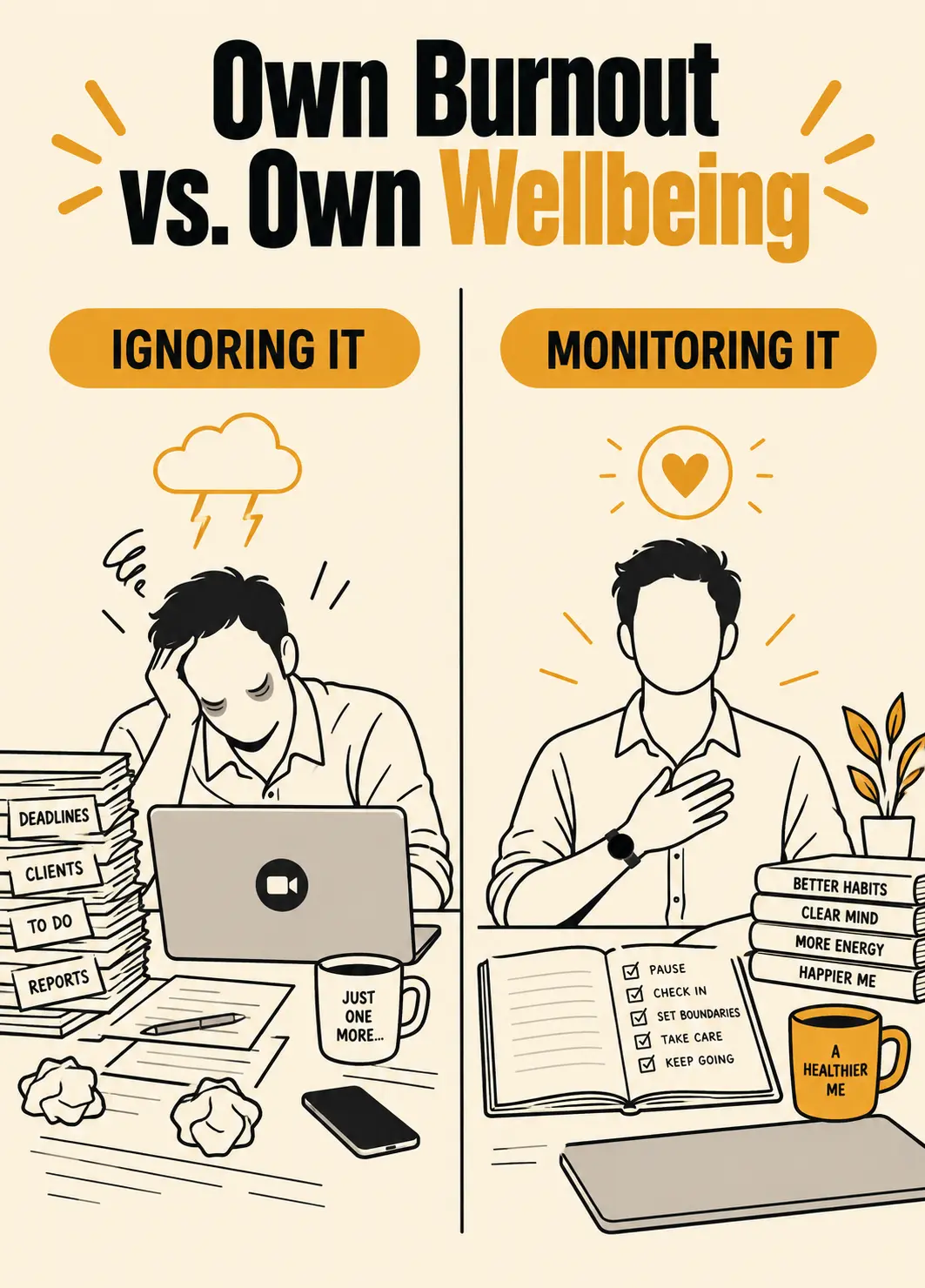
The last category is easy to skip past, but NBHWC's outline treats it as its own named practice, not an afterthought. Lesson 1 introduced self-awareness and self-regulation as skills a coach builds in order to stay useful to a client's process. This part of the outline asks a coach to keep turning those same skills on themselves throughout their career — noticing their own state, not just their client's, and seeking help when something needs more than reflection alone can offer.
Knowing NBHWC's Scope of Practice
NBHWC's outline names a first, narrower piece of scope: a coach may educate or share information within their scope of practice when given permission or specifically asked. That single condition — permission or a direct ask — is what keeps sharing knowledge from drifting into unsolicited advice.
This closes a thread Lesson 1 left open on purpose. That lesson drew a boundary between a therapist's scope, working with a client's internal psychological material directly, and a coach's scope, working with present-day goals and behavior change — and said the full treatment of that boundary would come later, in Domain 4. This is that boundary, named as an explicit ethical practice rather than just a working definition.
Knowing When to Refer
The second piece of scope is the one Lesson 4 flagged: refer clients as appropriate, for imminent danger, trauma treatment, mental health treatment, or other professional healthcare. A referral isn't a failure or an ending — Lesson 4 already drew that distinction, separating referral from termination. It's the coach recognizing that something in front of them now needs a different kind of expertise than coaching provides.
| Within a Coach's Scope | Calls for a Referral |
|---|---|
| A client asks what a realistic weekly step-count goal looks like. | A client describes a panic attack that's happening right now. |
| A client wants to talk through their own motivation for a goal. | A client discloses trauma that needs dedicated treatment. |
| A client asks the coach to share information the coach already has expertise in. | A client's concern needs a different professional healthcare provider entirely. |
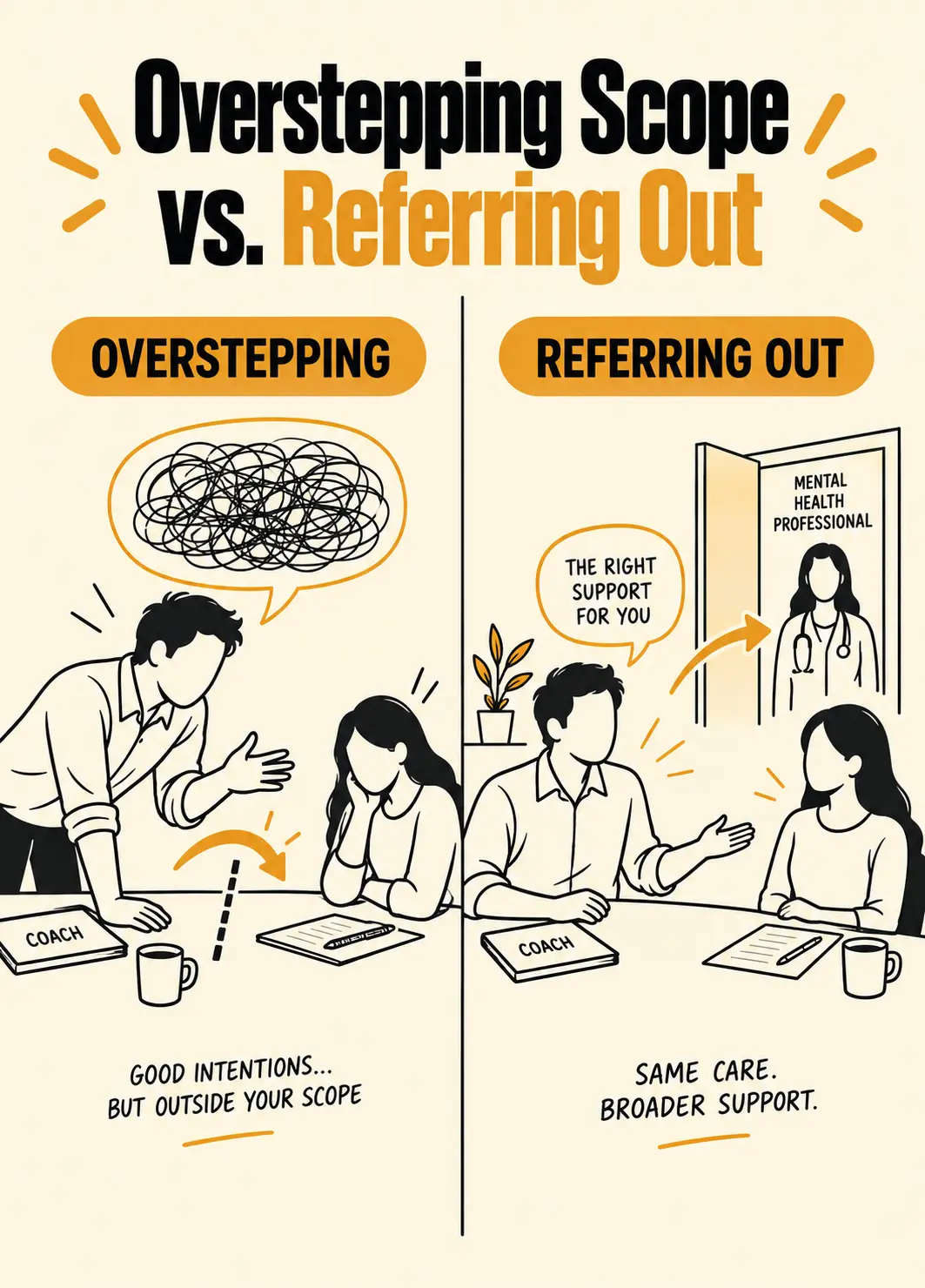
A client who has been making steady progress on a fitness goal mentions, almost offhand, that they haven't been sleeping because of overwhelming anxiety about a family situation. The coach doesn't try to coach through the anxiety itself — that's outside scope. Instead, the coach acknowledges what the client shared and refers them to a mental health professional, while keeping the door open to continue coaching around the original fitness goal.
The Code of Ethics: What a Coach Owes the Client
NBHWC's Code of Ethics names nine specific practices. The first four describe what a coach owes directly to the client in front of them.
- Client privacyMaintain and uphold client privacy.
- Conflicts of interestIdentify and address conflicts of interest directly.
- Diversity & cultural humilityHonor diversity, demonstrate dignity and respect, and practice cultural humility.
- Professional boundariesMaintain clear professional boundaries with clients.
Cultural humility already showed up earlier in this course, without the label. Lesson 11 asked a coach to incorporate cultural considerations into a client's goals and action plan. NBHWC's Code of Ethics makes the same expectation explicit as a standalone ethical obligation — not just good coaching practice, but a named professional standard.
The Code of Ethics: Integrity, Attribution, and Technology
The Code of Ethics' remaining five practices turn to a coach's professional integrity: how they represent themselves, credit others' work, and handle new technology responsibly. NBHWC's outline names true and accurate representation of training, experience, expertise, and credentials; attribution for the contributions of others, including copyrighted material; understanding the ethical implications of digital health technology and platforms; disclosing the use of artificial intelligence or emerging technologies, as appropriate; and seeking consultation or supervision on ethics when needed.

A coach uses an AI tool to help draft a starting list of meal ideas that fit a client's stated preferences. Rather than presenting the list as entirely their own work, the coach tells the client plainly that AI helped generate the starting point, and that it's meant to be adjusted together — not accepted as-is. The client gets the same useful list, plus an accurate picture of where it came from.
Domain 4 Continues in Lesson 13
This lesson covered three of Domain 4's four sub-competencies: ongoing professional development, scope of practice, and the Code of Ethics. One piece remains — the legal obligations around client data: confidentiality, secure platforms, and the laws and regulations that govern health coaching, including HIPAA. Lesson 13 covers that in full, including a related but distinct AI question from the one this lesson covered: not just disclosing AI use, but keeping client data out of it in the first place.
8 questions on ongoing professional development, NBHWC's scope of practice and when to refer, and the Code of Ethics governing privacy, conflicts of interest, cultural humility, representation, and disclosing AI use. NBHWC doesn't publish a fixed pass/fail line for its own exam, so this knowledge check doesn't invent one either — you'll get a raw score and a rationale for every question instead.
- Ongoing professional development covers four areas: formal learning, community, reflective practice, and the coach's own wellbeing.
- A coach can educate or share information within their scope when given permission or specifically asked — closing the boundary Lesson 1 first drew between coaching and therapy.
- A referral is needed for imminent danger, trauma treatment, mental health treatment, or other professional healthcare — distinct from ending the coaching relationship, as Lesson 4 established.
- NBHWC's Code of Ethics names nine practices, the first four centered on the client relationship: privacy, conflicts of interest, cultural humility, and professional boundaries.
- The Code of Ethics' remaining five practices govern a coach's professional integrity: accurate representation, attribution, digital technology, disclosing AI use, and seeking consultation.
- Domain 4's fourth sub-competency, the legal obligations around client data, is covered in full in Lesson 13.
Before moving to Lesson 13:
- Name one practice from each of the four ongoing-development categories that you'd actually commit to this year.
- Think of a recent situation, in any context, where sharing your own knowledge without being asked crossed a line — what would asking first have changed?
- If you've ever used an AI tool to help produce something for someone else, consider whether you disclosed that — and how it might have landed either way.
- Complete the knowledge check above and review the rationale for any question you missed.