This final lesson closes out Domain 5 — and the domain-specific content of this entire course — with four more sub-competencies: health and healthcare disparities and equity, the structural determinants that sit upstream of a client's circumstances, the social determinants of health (SDOH) those structural forces shape, and health literacy and numeracy. None of this is about a coach fixing systemic barriers directly — it's about recognizing the wider context a client's health sits inside, and adjusting how you coach, not what a client should want, in response.
Lesson 15 covered the components and conditions a coach works with directly, inside a session. This lesson steps back to the forces shaping a client's health before they ever walk into that session — the disparities, structural conditions, and everyday circumstances that make one client's path to a goal easier than another's, plus the health-literacy gap that shapes how well any of it actually lands.
Health and Healthcare Disparities, Equity, and Inequity
NBHWC's outline opens this section with definitions worth being precise about, because these terms get used loosely outside a coaching context.
- Health disparitiesPreventable differences in health outcomes and access that are closely linked with social, economic, or environmental disadvantage.
- Health and healthcare equityEveryone having a fair, just opportunity to be as healthy as possible, and to access the healthcare they need.
- Health and healthcare inequityThe absence of that fair opportunity — the gap equity work is meant to close.
NBHWC's outline also expects a coach to recognize that strategies and resources exist to promote equity — including approaches that work to dismantle power dynamics, address stereotyping, and reduce discrimination. A coach isn't the one implementing systemic change here; recognizing that inequity exists, and that it isn't a client's personal failing, shapes how a coach shows up in the room.
Structural Determinants of Health: The Root Causes
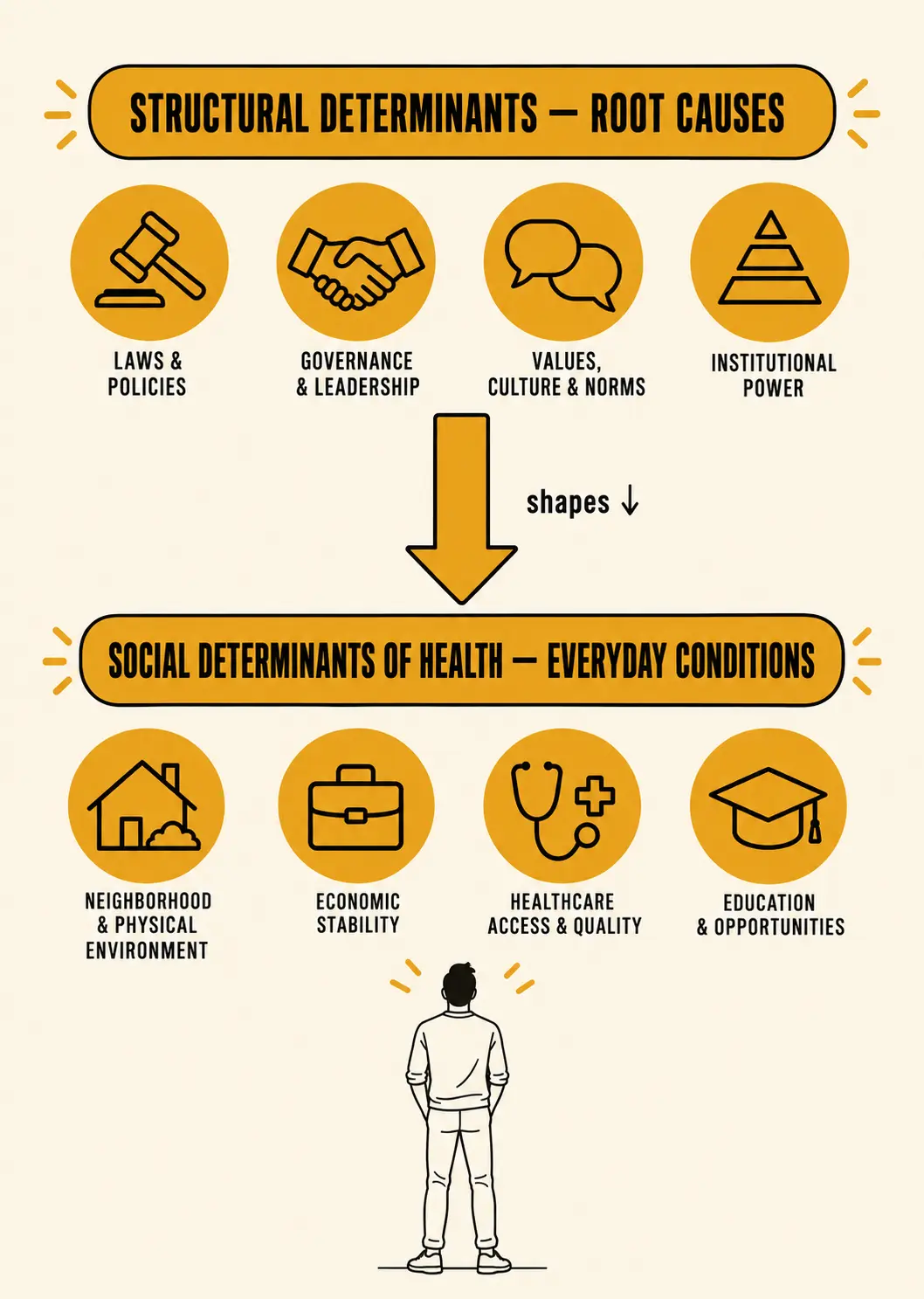
NBHWC's outline treats structural determinants of health as the “root causes” of health inequities — the upstream forces that shape the quality of the more visible, everyday conditions covered next.
- Values, beliefs & normsThe shared assumptions a society holds about health, work, and who deserves what.
- GovernanceHow decisions get made and who has a seat at the table when they do.
- Laws and policiesThe formal rules that allocate resources, protections, and opportunity.
- Institutional practicesPractices that create hierarchical patterns of advantage across institutions.
- Power relationsWho holds influence over decisions that affect others' health and opportunity.
These structural determinants matter because they decide whether the resources necessary for health — safe housing, quality food, reliable healthcare, fair wages — are distributed equally across society in the first place. A coach doesn't set laws or policy, but recognizing that a client's health, wellbeing, behavior, and medical conditions can be shaped by forces this far upstream is part of coaching without judgment.
Social Determinants of Health (SDOH)
Where structural determinants are the root causes, social determinants of health are what NBHWC's outline calls the intermediate, “downstream” conditions people actually live inside: the conditions under which people are born, grow, live, work, and age — shaped by forces largely beyond an individual's control.
- Education access and qualityHow much schooling and quality of instruction a person could actually reach.
- Economic stabilitySteady income, employment, and the buffer to absorb an unexpected expense.
- Healthcare access and qualityWhether care is nearby, affordable, and actually good when a person reaches it.
- Neighborhood and built environmentHousing quality, walkability, food access, and environmental safety where a client lives.
- Social and community contextThe relationships, support networks, and sense of belonging available to a person.
Structural determinants create and shape SDOH; SDOH, in turn, shape a client's health, wellbeing, behavior, and even their medical conditions. A client who's missing appointments isn't automatically “non-compliant” — inconsistent transportation, an unpredictable work schedule, or living in a food desert are SDOH, not character traits.
| Structural Determinants (Root Causes) | Social Determinants of Health (Downstream Conditions) |
|---|---|
| Laws and policies | Healthcare access and quality |
| Governance and institutional practices | Economic stability |
| Values, beliefs, and norms | Education access and quality |
| Power relations | Neighborhood, built environment, and social & community context |
Structural determinants sit upstream, shaping the downstream, everyday conditions social determinants of health describe — but a client experiences both together, not separately.
Health Literacy and Numeracy
NBHWC's outline closes Domain 5 — and the domain-specific content of this entire course — with one more definitional sub-competency: health literacy and numeracy.
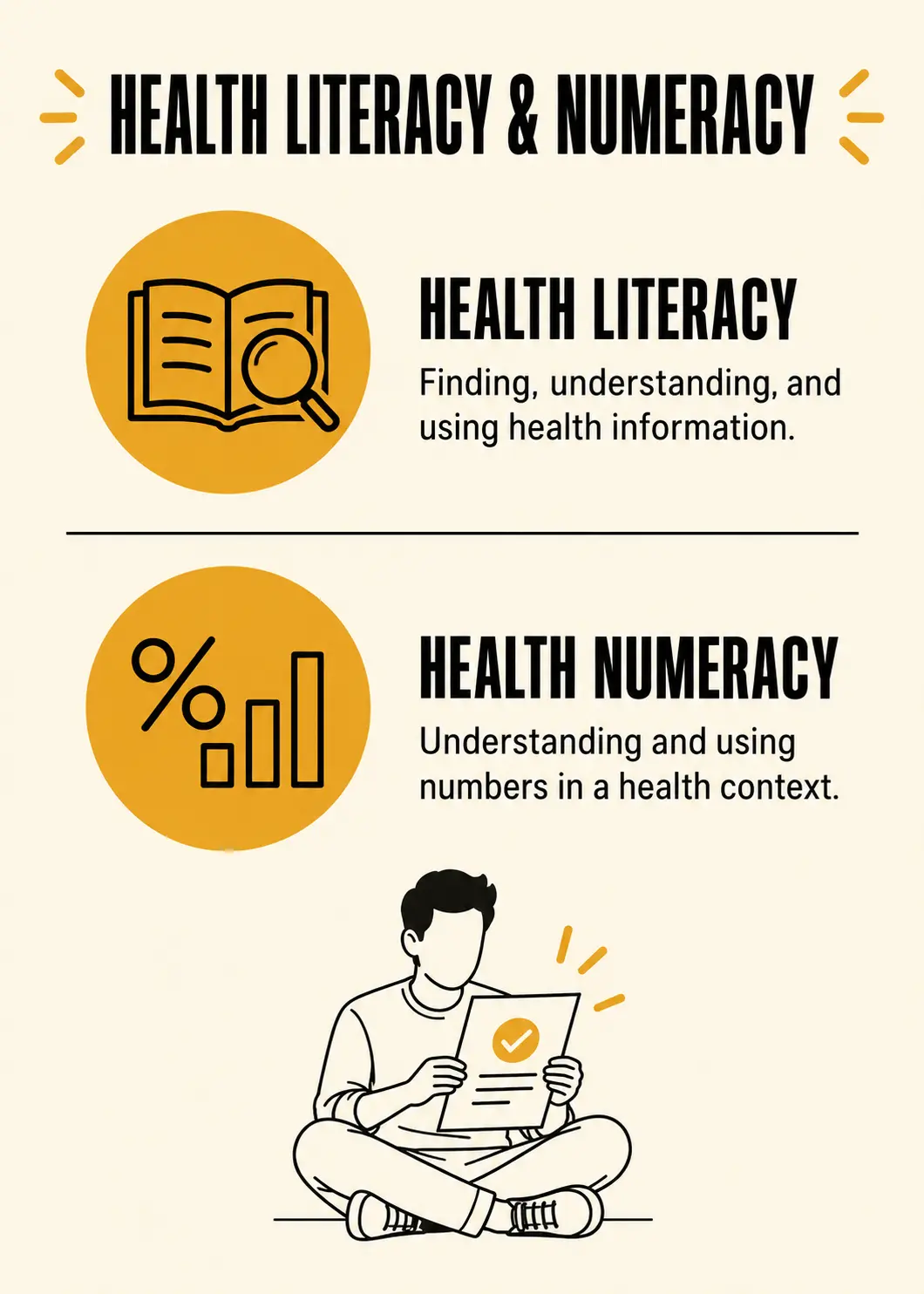
- Health literacyA person's ability to find, understand, and use health information and services to make informed decisions.
- Health numeracyThe specific ability to understand and use numbers in a health context — reading a nutrition label, interpreting a risk percentage, following a dosage, tracking a lab trend.
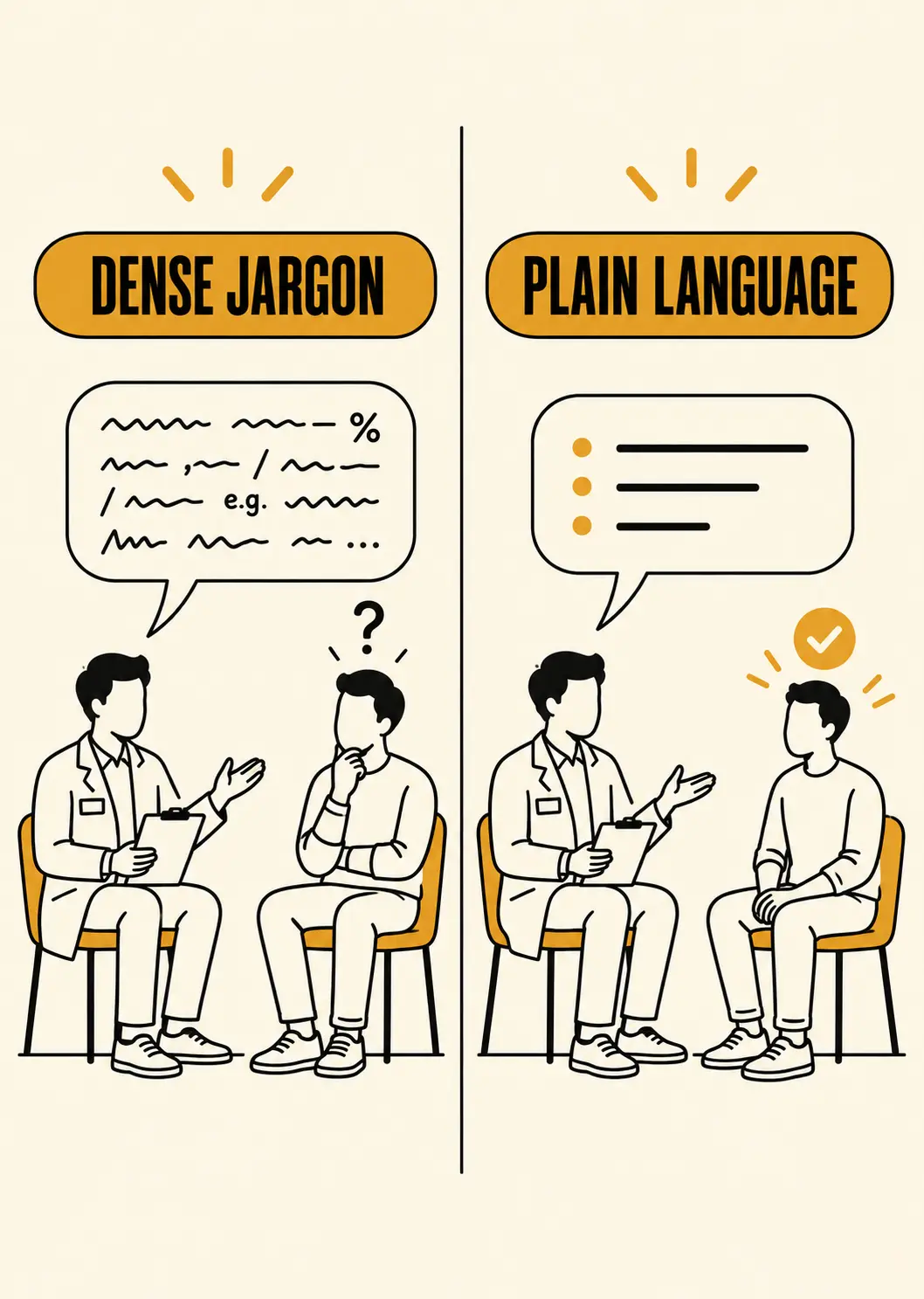
Health literacy and numeracy aren't about a client's intelligence — they're about whether health information was ever communicated in a way a specific client could actually use. NBHWC's outline doesn't name a specific technique here, but the practical implication for a coach is straightforward: plain language over jargon, checking understanding rather than assuming it, and adjusting how a goal, plan, or piece of information gets explained to the client in front of you.
A client managing prediabetes mentions she skips her lab-result appointments because the after-visit summary is full of numbers she doesn't understand, and the clinic is a two-bus ride from her apartment. The coach doesn't diagnose or reinterpret her labs — that's outside scope. Instead, they help her prepare specific questions to ask her provider next time, break down in plain language what a number like A1C generally represents so she can confirm the specifics with her provider, and problem-solve around the transportation barrier together. The habit change and the systemic barrier both stay real; the coach just meets the client where the SDOH and health-literacy gap actually are.
Domain 5 Complete — You've Finished the Course's Domain Content
This lesson closes Domain 5, and with it, the domain-specific content of NBHWC's entire 2026–2030 outline — all 5 domains, all 16 lessons. Lesson 16 covered health and healthcare disparities and equity, the structural determinants that sit upstream of a client's circumstances, the social determinants of health those structural forces shape, and health literacy and numeracy — the last of Domain 5's sub-competencies.
A domain-weighted practice exam is planned next, pulling questions across all 5 domains at the real exam's 25/15/25/15/20 weighting, so you can see exactly where your gaps are before sitting the actual NBHWC exam.
8 questions on health disparities and equity, structural and social determinants of health, health literacy and numeracy, and staying inside a coach's scope. NBHWC doesn't publish a fixed pass/fail line for its own exam, so this knowledge check doesn't invent one either — you'll get a raw score and a rationale for every question instead.
- Health disparities are preventable, disadvantage-linked differences in outcomes and access; health equity is the goal of removing them.
- NBHWC's outline names structural determinants — values/beliefs/norms, governance, laws/policies, institutional practices, and power relations — as the upstream root causes of health inequities.
- Social determinants of health (SDOH) are the downstream, everyday conditions structural determinants shape: education, economic stability, healthcare access, neighborhood/built environment, and social/community context.
- A client's missed appointments or inconsistent follow-through can reflect SDOH, not a lack of motivation.
- Health literacy and numeracy describe whether health information was communicated in a way a specific client can actually use — plain language and checked understanding matter more than a client's intelligence.
- This lesson closes Domain 5 and all domain-specific content in this course; a domain-weighted practice exam comes next.
Before moving on:
- Review the difference between health disparities and health equity in your own words.
- Memorize the five structural determinants and five SDOH examples, and practice sorting a new example into the right category.
- Practice rewriting one piece of jargon-heavy health information in plain language, as if explaining it to a client.
- Complete the knowledge check above, then watch for the domain-weighted practice exam.