Professional organizers help people take control of their spaces, things, information and time — at home and at work. The CPO® credential shows that an organizer has real paid client experience, has passed a 125-question exam built on six domains that follow one client job from first call to follow-up, and has agreed to a code of ethics. The exam rewards judgement: what an organizer should do first, next or best, for this client.
Welcome to CPO® Exam Prep. Before getting into the six exam domains, this lesson sets the scene: what professional organizers actually do, what the Certified Professional Organizer credential means, who can sit the exam, how the exam is built, and — most usefully — how to think through the scenario questions it's full of.
If you're already logging paid hours toward the exam, this lesson gives you the big picture to hang everything else on. If you're exploring the profession, or you're here to organize your own home the way professionals do, it shows you how the work is structured from first phone call to follow-up.
Free on YouTube Subscribe to get every lesson video in this course SubscribeWhat Professional Organizers Do
A professional organizer helps people bring order to their spaces, possessions, information and time — and, just as importantly, teaches them how to keep it. The work is far broader than tidy closets:
- ResidentialKitchens, wardrobes, garages, children's rooms, whole-home projects, moves and downsizing.
- Business and productivityOffices, paper and digital files, workflow, time management and team systems.
- Life transitionsRelocation, combining households, a new baby, retirement, and settling a loved one's home.
- Specialist workStudents, older adults, photo and memorabilia, and clients experiencing chronic disorganization — often alongside other professionals.
Services range from hands-on sessions to virtual coaching, maintenance visits and workshops. Across all of them, the organizer's role is the same: understand the client, plan with them, help them do the work, and leave them able to carry it on. Organizers also know where their role ends — they work alongside movers, cleaners, contractors, financial and legal professionals, and health and mental-health professionals, and refer to them when needed.
Where the organizer's role ends
Knowing what an organizer doesn't do is as important on the exam as knowing what they do. Many wrong answers are things a helpful person might do but a professional organizer shouldn't:
| An organizer is not… | So they… |
|---|---|
| The decision-maker about the client's belongings | Guide and ask questions; the client decides what stays and goes |
| A cleaner, mover or contractor | Refer or coordinate those services (Lesson 8) |
| A therapist or health professional | Recognise, adapt and refer — never diagnose or treat (Lesson 5) |
| A financial, tax or legal adviser | Set up systems; refer the advice (Lessons 12 and 17) |
| A judge of how people live | Work without judgement, in the client's own terms |
What the CPO® Credential Means
The Certified Professional Organizer® designation was developed by NAPO (the National Association of Productivity & Organizing Professionals) and is operated by the Board of Certification for Professional Organizers (BCPO). According to NAPO, the BCPO follows the accreditation guidelines of the National Commission for Certifying Agencies.
It's a voluntary professional certification, not a government licence. What it signals to clients is a combination of three things: documented paid experience with real clients, a passing result on a standardized exam, and a commitment to the BCPO Code of Ethics — kept current through recertification every three years.
Who can sit the exam
According to NAPO's current certification pages, candidates need:
- A high school diploma or equivalent.
- Documented paid work experience as a professional organizer — currently 1,000 hours within the five years before applying, with up to 250 of those hours replaceable by certain alternative activities.
- Agreement to the BCPO Code of Ethics.
Membership of NAPO or any other association isn't required. Requirements can change, so always confirm the current rules on napo.net before applying. And to be clear about this course: it's independent study material, and it doesn't count toward eligibility hours or continuing education.
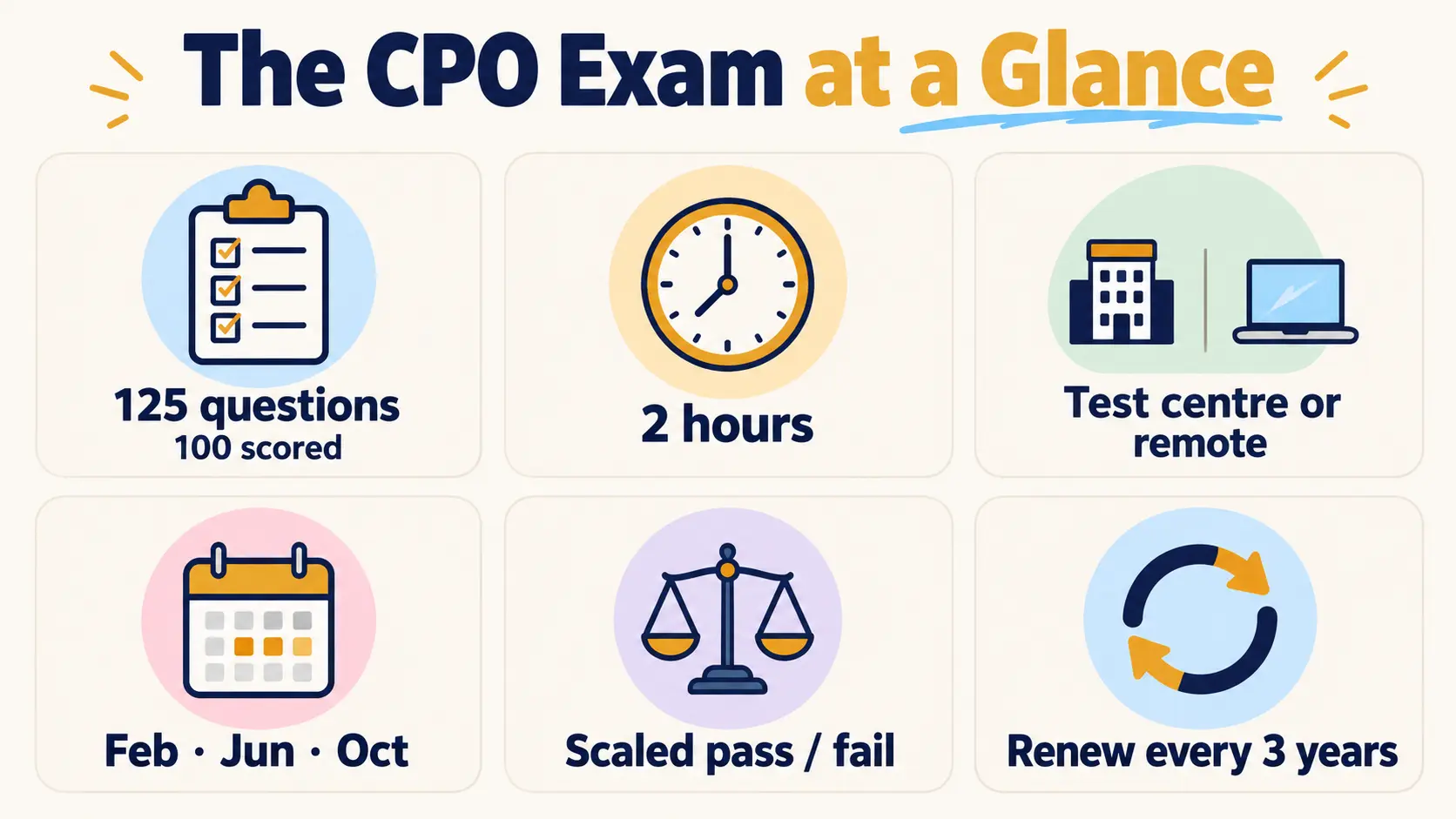
How the Exam Works
| Feature | What to know |
|---|---|
| Questions | 125 multiple-choice, four options each |
| Scored | 100 — the other 25 are unscored pretest questions you can't tell apart |
| Time | 2 hours — about 58 seconds per question |
| Delivery | Testing centre or remote proctoring; English or Spanish |
| When | Three testing windows a year: February, June and October |
| Scoring | Scaled, weighted score reported as pass/fail; no domain has its own pass mark |
| Renewal | Every three years, through continuing education or by retaking the exam |
Exam details like fees, delivery arrangements and deadlines change, so check napo.net for the current information. The course hub's Exam Snapshot keeps the version this course was checked against.
Six Domains, One Client Journey
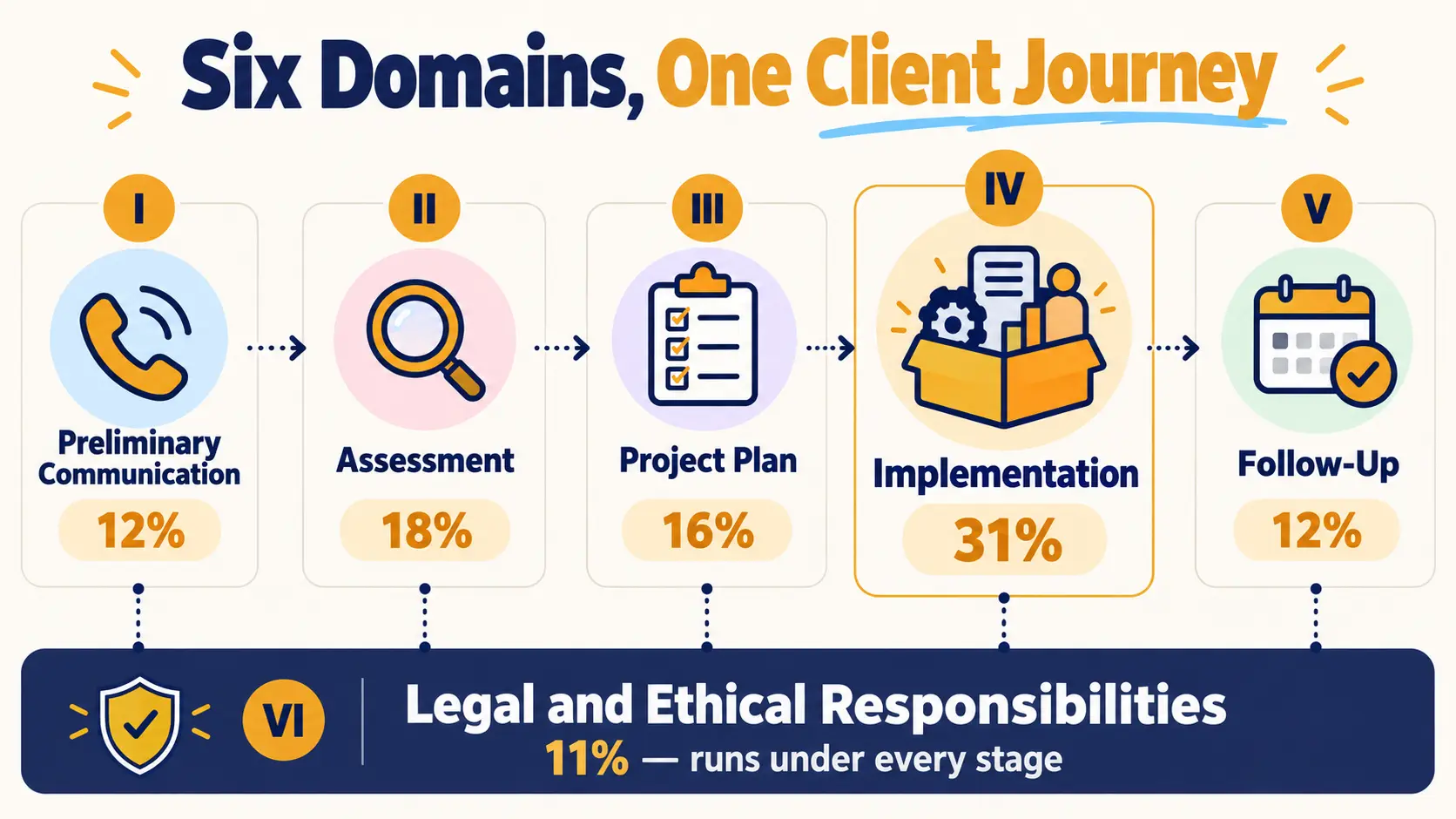
The BCPO exam content outline has six domains with published weights. Five of them follow a single client engagement in order; the sixth — ethics and legal responsibilities — runs underneath all of them. This course follows the same order.
| Domain | Weight | In plain terms | Lessons |
|---|---|---|---|
| I — Preliminary Communication | 12% | The first conversations: goals, people, readiness, rates | 2–3 |
| II — Assessment | 18% | Understanding the client, the space, outside factors and budget | 4–6 |
| III — Project Plan Development | 16% | Scope, priorities, tasks, resources, timeline and cost | 7–9 |
| IV — Project Implementation | 31% | Doing the work and teaching the skills | 10–15 |
| V — Follow Up and Maintenance | 12% | Checking that changes worked and lasted | 16 |
| VI — Legal and Ethical Responsibilities | 11% | The Code of Ethics, confidentiality, records and privacy | 17–18 |
Seven Principles That Answer Most Questions
The exam has six domains, but a small set of principles decides the right answer again and again. Learn these now, and every later lesson will feel like an application of them:
| Principle | What it means | Where you'll see it |
|---|---|---|
| Don't skip stages | Communication and assessment come before planning; planning before hands-on work | Lessons 2–10 |
| The client decides | The organizer recommends and explains; the client chooses — about belongings, priorities, budget and pace | Every domain |
| Safety first | Hazards and risks come before appearance or speed — raised with the client, referred where needed | Lessons 5–7 |
| Stay within scope | Work within an organizer's competence; refer health, legal, financial and specialist work | Lessons 5, 8, 17 |
| Confidentiality and consent | Information, images and stories stay private unless the client explicitly agrees | Lessons 2, 17, 18 |
| Honesty and transparency | Fees, changes, problems and financial interests are disclosed early | Lessons 3, 9, 15, 17 |
| Teach, don't just do | Systems fit the client and the client can keep them going after the organizer leaves | Lessons 11–16 |
How to Answer Scenario Questions
Most CPO questions describe a client situation and ask what the organizer should do first, next, or what is best or most appropriate. Often more than one option sounds sensible. A simple routine helps:
- 1. Spot the key wordFirst, next, best, most appropriate, least likely. It changes which correct-sounding option is actually right.
- 2. Place it in the client journeyWhich domain is this? If communication or assessment hasn't happened yet, hands-on answers are usually premature.
- 3. Apply the core principlesSafety first. The client decides. Stay within scope and refer when needed. Teach the process, don't just do it.
- 4. Eliminate, then chooseRemove options that skip steps, take decisions away from the client, or step outside an organizer's role.
On timing: 125 questions in two hours is a little under a minute each. Answer what you can, flag anything you're unsure about, and come back. Every question might be scored, so never leave one blank.
What the questions look like
| Question type | Typical stem | What it's testing |
|---|---|---|
| Sequence | "What should the organizer do first?" | Whether you know the order of the client journey |
| Best judgement | "What is the most appropriate response?" | Applying the principles when several options sound reasonable |
| Knowledge | "Which of these is a productivity skill?" | Definitions and outline terms |
| Exception | "Which is NOT a reason to decline a client?" | Careful reading — the "wrong" option is the answer |
A worked example
"A client's adult son calls to book sessions to clear his mother's spare room while she is away visiting family. What should the organizer do first?"
- Key word: first — a sequence question.
- Journey stage: a first call — Domain I, Preliminary Communication. Nothing has been assessed or agreed.
- Principles: the client decides — and the client is the mother, whose room and belongings these are, not the son who's booking (Lesson 2).
- Eliminate: booking the session, bringing donation bags, or asking the son what can go all skip the stage and the client. The best answer is to arrange to speak with the mother about her goals and agreement before anything is scheduled.
Common distractor patterns
| A tempting option that… | Is usually wrong because |
|---|---|
| Jumps to hands-on work or buying containers | It skips communication, assessment or planning |
| Has the organizer decide "to save time" | The client decides |
| Quietly fixes, absorbs or hides a problem | Problems and costs are disclosed early |
| Names a condition or gives advice outside organizing | Stay within scope; refer |
| Treats the person paying as the client | The client is whose space and belongings are involved |
| Uses absolute words — "always", "never", "all" | Organizing answers usually depend on the client — be wary of rigid rules |
How to use this course
Each lesson lists the outline items it covers, ends with a scenario spotlight and a scored knowledge check, and has downloadable notes and slides. Domain cram sheets and the one-page Client Journey Map sit on the course hub. When you've finished all 18 lessons, the 125-question practice exam uses the official domain weights and the real time limit.
Planning your study time
- Follow the weights. Domain IV is 31% of the exam — give its six lessons proportionally more time. Domains I and V are 12% each.
- Don't treat ethics as separate. Domain VI is 11% on paper, but ethical judgement sits inside questions from every domain.
- Practise reasoning, not recall. After each knowledge check, explain to yourself why each wrong option is wrong. That's the skill the exam rewards.
- Connect it to real work. If you're logging client hours, map each project onto the client journey as you go.
- Finish with timed practice. Take the full practice exam under real conditions, then use the domain breakdown to target your review.
10 questions in the style of the CPO exam. Score 70%+ to mark this lesson complete.
- Professional organizers work with spaces, things, information and time — and teach clients to keep it up.
- The CPO® credential is operated by the BCPO; it reflects paid client experience, an exam and a code of ethics.
- Eligibility currently includes documented paid organizing hours (1,000 within five years, per NAPO) — confirm on napo.net.
- 125 questions (100 scored), two hours, scaled pass/fail, three testing windows a year, renewed every three years.
- Six domains follow one client journey; Domain IV (Implementation) is the heaviest at 31%.
- Seven principles decide most answers: don't skip stages, the client decides, safety first, stay within scope, confidentiality and consent, honesty, teach don't just do.
- For scenario questions: spot the key word, place it in the journey, apply the principles, then eliminate — and watch for familiar distractor patterns.
Before moving to Lesson 2:
- Write the six domains and their weights from memory, then check them against the table above.
- Think of an organizing job — yours or a client's — and map it onto the five journey stages.
- Try the four-step routine on the knowledge-check questions below.
- Bookmark the course hub so you can find the cram sheets and Client Journey Map later.