Every project starts with conversation, not sorting. In the first contact the organizer learns what the client hopes for and expects, what's been getting in the way, and who else is involved — partners, family, colleagues, landlords, and sometimes someone other than the person paying. Open questions, careful listening and a non-judgemental tone set up everything that follows.
Domain I, Preliminary Communication, makes up 12% of the CPO® exam. It covers everything that happens before a project is agreed — often a phone or video call, sometimes a short first visit. This lesson covers the first three outline items: discussing perceived goals and expectations (I.A), identifying challenges and concerns (I.B), and identifying all the individuals involved (I.C). Lesson 3 covers readiness, rates and deciding whether to work together.
The first conversation does two jobs at once. It gathers information — what the client wants, what's in the way, who's involved — and it starts a relationship. Many people who contact an organizer feel embarrassed or overwhelmed, and the way the organizer listens on that first call shapes whether the client feels safe enough to be honest later.
On the exam, this domain is where "what should the organizer do first?" questions are most often decided. If the organizer hasn't yet understood the client's goals and the people involved, the answer is almost never hands-on work, buying supplies or giving advice.
Free on YouTube Subscribe to get every lesson video in this course SubscribeThe Shape of a First Conversation
Organizers run first calls differently, but most follow a similar arc. Knowing it helps on the exam, because questions often ask what belongs at a particular point.
| Stage | What happens | Outline item |
|---|---|---|
| Welcome | Put the client at ease; explain how the call will go; mention confidentiality | — |
| Goals | What they want, why now, how they'll know it's worked | I.A |
| Expectations | Pace, involvement, the organizer's role, cost | I.A |
| Obstacles | What's been in the way; past attempts; worries about the process | I.B |
| People | Who uses the space, who decides, who's paying, who else has a say | I.C |
| Next steps | Readiness, rates and policies, and whether to proceed | I.D–F (Lesson 3) |
Most of the call is the client talking. A useful rule of thumb is that the organizer listens far more than they speak. The organizer isn't trying to solve anything yet. They're trying to understand.
Perceived Goals (I.A)
Notice the word perceived in the outline. What a client says they want on a first call is their current view of the problem and its solution. It's a starting point, not a brief. Clients often describe a solution they've already pictured rather than the need behind it.
| The client says… | A follow-up question | The need it might reveal |
|---|---|---|
| "I need more storage." | "What happens now when you look for something?" | Finding things quickly — which may mean less stuff, not more space |
| "I want it to look like the pictures online." | "What do you like about those pictures?" | Calm, visual order — or simply clear surfaces |
| "Just help me throw things away." | "What would you like to be able to do in this room?" | Using a room for its purpose again — a guest room, a workspace |
| "I need to be more organized at work." | "Tell me about a day when it didn't go well." | Meeting deadlines; managing interruptions; a paper backlog |
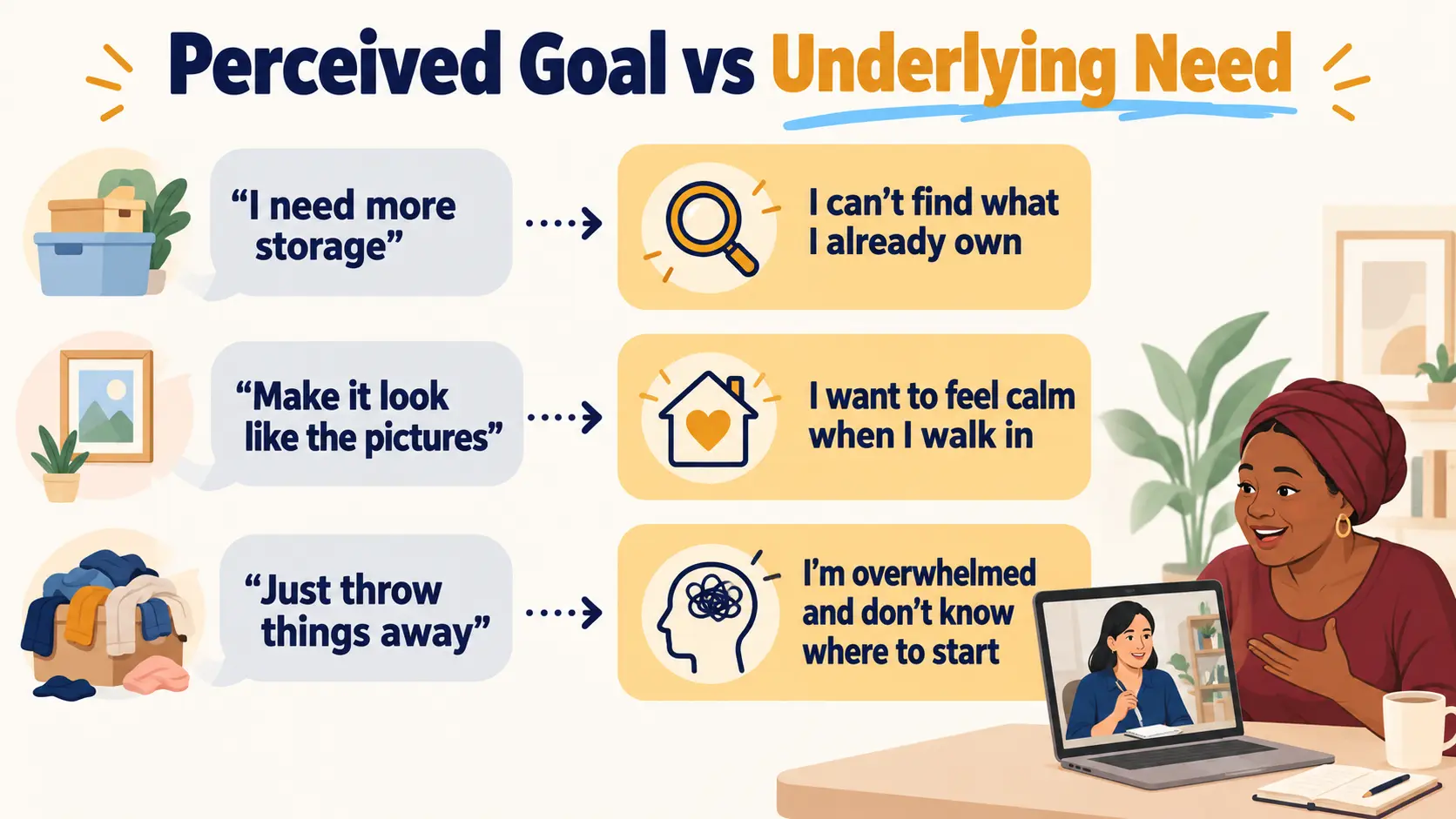
Questions that turn a perceived goal into a concrete one
- "What would this space look and feel like when it's working for you?"
- "What would you be able to do that you can't do now?"
- "How will you know we've done a good job?"
- "Why now — what made you reach out this week?"
That last question is worth special attention. "Why now?" often reveals a trigger: a move, a new baby, a health scare, a relationship change, a visitor, a deadline at work. The trigger tells the organizer about urgency, about emotional weight, and sometimes about who else is involved. A client organizing because a parent has died needs a very different pace from one preparing for a house sale.
The organizer doesn't correct the client's perceived goal ("You don't need more storage"). They explore it until the client can say, in their own words, what success would look like. Those words become the goals written into the plan (Lesson 7) and the measure of success at follow-up (Lesson 16).
Expectations (I.A)
Expectations matter as much as goals. Unspoken ones are a common source of disappointment later. Surfacing them early lets the organizer set realistic ones before anything is agreed:
| An unspoken expectation | A realistic picture to share |
|---|---|
| "It'll take one afternoon." | Time depends on volume and decision speed — an estimate comes after assessment |
| "You'll do it while I'm at work." | The client makes the decisions about their belongings, so they'll be involved |
| "You'll tell me what to throw away." | The organizer guides and asks questions; the client decides |
| "You'll clean too." | Organizing and cleaning are different services; a cleaner can be a referral |
| "It'll look like a magazine." | The aim is a system that works and lasts for the client's real life |
The organizer doesn't need to resolve every expectation on the first call. Pace and cost, for example, are discussed properly in Lesson 3 and estimated after assessment (Lesson 9). The point here is to bring expectations into the open so nothing comes as a surprise.
Challenges and Concerns (I.B)
Next, the organizer learns what's been getting in the way and what worries the client about the process. The outline names both, and they're different:
- ChallengesPractical obstacles: lack of time, limited space, a recent move or life change, too many belongings, disagreement at home, physical limits, past attempts that didn't last.
- ConcernsWorries about the process itself: being judged, being made to throw things away, cost, privacy, someone seeing the home, or losing control of their belongings.
Asking about past attempts
Asking about past attempts is one of the most useful things an organizer can do on a first call. Three questions cover it:
- "What have you tried before?"
- "What worked, even for a while?"
- "What made it stop working?"
The answers point straight at habits and obstacles the plan will need to address. A client whose labelled boxes worked until they ran out of room has a volume problem. One whose filing system worked until their partner started using the office has a shared-system problem. Past attempts also stop the organizer recommending something that has already failed — and they show respect for the effort the client has already made.
Responding to concerns
Concerns deserve a direct, honest answer — often on the first call itself, because an unanswered worry can stop a client going ahead at all.
| The concern | An honest reassurance |
|---|---|
| "You'll think I'm disgusting." | Organizers work without judgement; many people feel this way before starting |
| "You'll make me get rid of everything." | Every decision about belongings is the client's |
| "I don't want anyone to know." | What's shared stays confidential, from this first call onwards |
| "It'll cost a fortune." | Fees will be explained clearly and in writing before any work; an estimate follows assessment |
Reassurance must be true. An organizer shouldn't promise a fixed price, a deadline or a result they can't yet know. "I'll explain exactly how fees work before we agree anything" is honest. "It won't cost much" isn't.
Sometimes a challenge mentioned on the call hints at something beyond organizing — a health condition, safety concerns, or signs of hoarding. The organizer notes it respectfully, without labelling or diagnosing, and explores it further during assessment (Lesson 5) and in deciding whether to proceed (Lesson 3).
Identifying Everyone Involved (I.C)
Organizing projects rarely involve only one person. Outline item I.C asks the organizer to identify all the individuals involved, because each of them can help or stall the project.
| Who | Why they matter |
|---|---|
| The client | The person whose space, belongings or time are being organized — and who makes the decisions about them |
| The person booking or paying | Sometimes not the client (an adult child, an employer, an executor). Their role and expectations must be clear |
| Other household members | Partners, children or housemates who share the space and will need to use and maintain the system |
| Colleagues or managers | In business settings, company policies and shared systems involve other people |
| Others with a say | Landlords, building managers, caregivers or other professionals already supporting the client |
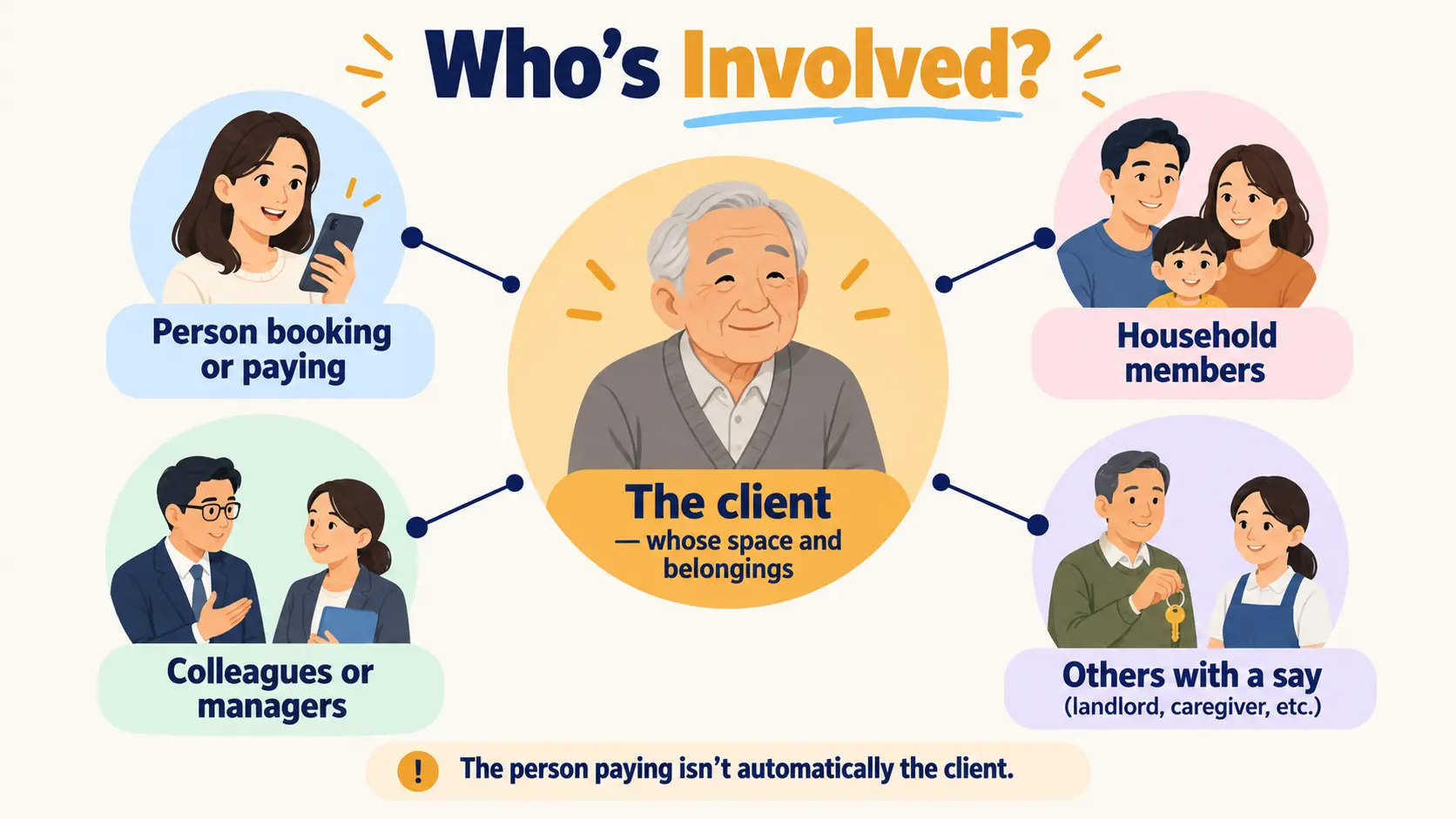
The person who pays isn't automatically the client
This distinction comes up again and again on the exam. When an adult child arranges sessions for a parent, the parent's home and belongings are the ones affected. The organizer needs the parent involved in the conversation and agreeing to the work — not just informed of it. The same applies when an employer pays for an employee's office to be organized, or when an executor arranges the clearing of an estate where family members have an interest.
This has a confidentiality side too. What the client shares belongs to the client. The person paying doesn't automatically get a report of everything that happens. What will be shared, and with whom, is agreed with the client up front.
Different settings, different people
- Households: who uses each space, who will maintain the system, and whose belongings are in it. A child's room involves the child.
- Workplaces: the individual, their manager, IT or facilities teams, and company policies on documents and data.
- Moves and estates: family members, executors, estate agents, movers and timelines set by others.
- Supported living: caregivers, social workers or health professionals who already support the client — involved only with the client's agreement.
Early on, the organizer should also find out who makes decisions, and whether the people involved agree with each other. Disagreement isn't a reason to stop. It's something to understand before starting, and Lesson 3 covers how to handle it.
Communication Skills for the First Conversation
Domain I questions often test communication itself. The skills are simple to describe and take practice to do well:
| Skill | Sounds like | Not like |
|---|---|---|
| Open questions | "Tell me about a typical morning." | "Are mornings hard?" |
| Active listening | Letting the client finish; a pause before responding | Planning your answer while they talk |
| Reflecting | "So the morning rush is the hardest part — is that right?" | Moving straight on to solutions |
| Summarizing | "Let me check I've got the main points…" | Assuming you've understood |
| Neutral language | "The table is holding a lot of paper at the moment." | "Wow, this is a mess." |
Closed questions still have a place — for confirming facts like addresses, dates or who lives in the home. The skill is knowing which to use when: open questions to explore, closed questions to confirm.
Confidentiality starts at first contact. What a client shares on the first call is private, and notes are kept securely for the assessment stage. Many organizers use a short intake form or checklist so nothing important is missed. Whatever the format, the information gathered here feeds directly into Domain II, Assessment.
Exam Traps for I.A–C
| If an answer… | …it's probably wrong because |
|---|---|
| Starts sorting, buying or advising on the first call | Domain I comes before any hands-on work |
| Accepts "I need more storage" at face value | A perceived goal needs exploring |
| Tells the client their goal is wrong | Explore, don't correct |
| Promises a price or deadline on the first call | Not knowable before assessment |
| Mixes up challenges and concerns | Obstacles vs worries about the process |
| Treats the payer as the client | The client is whose belongings are affected |
| Shares details with the client's family | Confidentiality from first contact |
| Uses yes/no questions to explore goals | Open questions invite the real story |
10 questions in the style of the CPO exam. Score 70%+ to mark this lesson complete.
- Preliminary Communication (Domain I) is 12% of the exam and comes before any assessment, hands-on work or advice.
- Clients start with perceived goals — often a pictured solution. Explore with open questions (including "why now?") until the client can describe success in their own words.
- Surface expectations early — pace, involvement, the organizer's role, cost — and never promise what can't yet be known.
- Challenges are practical obstacles; concerns are worries about the process. Ask what they tried, what worked and what stopped working; answer concerns honestly.
- Identify everyone involved and who decides. The person booking or paying isn't automatically the client, and doesn't automatically see the client's information.
- Use open questions to explore and closed ones to confirm; listen, reflect, summarize, stay neutral — and keep everything confidential from first contact.
Before moving to Lesson 3:
- Write five open questions you'd ask on a first call about a cluttered home office, including a "why now?" question.
- Rewrite one perceived goal ("I need more storage") as two possible underlying needs.
- List everyone who would be involved if you reorganized your own kitchen — and who would decide.
- Complete the knowledge check above and review any question you missed.