Before any work begins, the organizer gauges how ready and committed each person involved really is, explains rates and policies clearly, and makes a deliberate decision about whether a professional relationship should be established at all. Taking on a client who isn't ready, or a project beyond the organizer's skills, helps no one. Declining or referring — respectfully — is a professional skill, not a failure.
Lesson 2 covered the first half of Domain I — goals, concerns and the people involved. This lesson finishes the domain with three outline items: identifying each individual's readiness and commitment (I.D), communicating rates and policies (I.E), and determining whether a professional relationship should be established (I.F).
Together they decide whether a project starts on solid ground. A client who isn't ready, terms that weren't made clear, or a project the organizer shouldn't have taken on are behind many of the problems that surface later in Domains III to V. Getting these three items right prevents them.
The last item surprises some candidates. The exam expects organizers to make a real decision at this point — and sometimes the right decision is not to take the work, or to refer it to someone better suited.
Free on YouTube Subscribe to get every lesson video in this course SubscribeReadiness and Commitment (I.D)
Wanting an organized home and being ready to do the work are different things. Organizing asks a lot of a client: time, energy and a long series of decisions, some of them emotional. The outline asks the organizer to gauge readiness for each individual involved — not just the person who made the call.
What readiness is made of
- MotivationThe client wants change for their own reasons, not only because someone else is pushing.
- CapacityThey have the time, energy and health to take part now — or a realistic plan for when they will.
- Willingness to decideThey expect to make decisions about their own belongings, with support.
- Support around themThe people they live or work with are on board, or at least willing to talk.
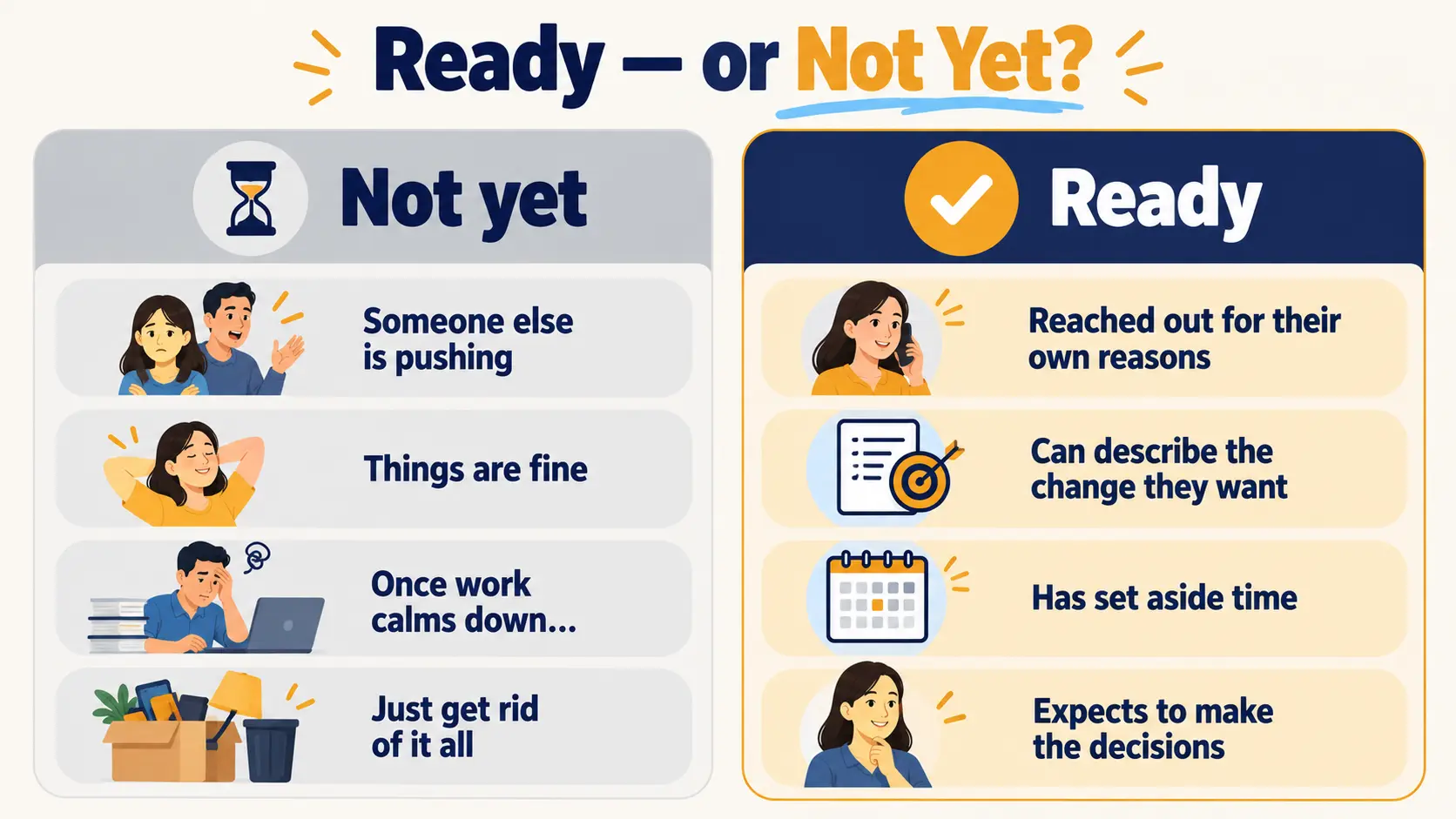
| Signs of readiness | Signs a client may not be ready yet |
|---|---|
| The client reached out themselves, for their own reasons | Someone else is pushing for the project |
| They can describe what they want to change | "Things are fine" — the goal belongs to someone else |
| They've set aside time for sessions | "Once work calms down…" with no timeframe |
| They expect to make decisions themselves | They want someone to "just get rid of it all" without involvement |
| Household members are on board, or willing to talk | Open disagreement about whether there's a problem at all |
Readiness is a stage, not a yes-or-no
A widely used way to describe change is that people move through stages — from not yet seeing a need, to thinking about it, to preparing, to acting, to maintaining. The stage tells the organizer what kind of help is useful right now:
| Stage | The client might say | What helps |
|---|---|---|
| Not yet seeing a need | "I don't really have a problem." | Respect that; no pressure. Leave information if they'd like it |
| Thinking about it | "I know I should, but…" | Explore what's holding them back; share how the process works |
| Preparing | "I want to start next month." | Agree terms; plan the assessment |
| Acting | "Let's go." | Proceed into Domain II |
| Maintaining | "I want to keep it this way." | Maintenance support (Lesson 16) |
Meeting a client where they are is more effective than pushing them faster than they're willing to go. A client who is "thinking about it" and gets rushed into sessions often stalls, cancels or reverses decisions. The same client, given information and time, may come back ready.
Questions that gauge readiness
- "What's made this feel like the right time?"
- "How much time could you realistically give to this each week?"
- "How do you feel about making decisions about your things as we go?"
- "How do the other people at home feel about this?"
- "If we started, what might get in the way?"
When readiness differs between people
In households, readiness often differs. When one partner is ready and the other isn't, the organizer:
- Explores each view with curiosity, without taking sides.
- Looks for common ground — a shared goal, such as calmer mornings, or a space both agree on.
- Considers a starting point both accept, such as spaces that belong to the willing partner.
- Doesn't proceed as if everyone has agreed.
The same applies at work, where a manager may want an employee's office organized and the employee may not. And children's spaces involve children, at a level suited to their age.
Communicating Rates and Policies (I.E)
Clients deserve to know what they're agreeing to before any work starts. This is a matter of informed consent, not just good business: a client can't truly agree to work if they don't know the terms.
- Fee structureHourly, per session, package or project-based — and what's included (planning time, travel, supply shopping, removal runs) and what's extra.
- Session termsMinimum session lengths, scheduling, and what happens if a session runs over.
- Cancellation and reschedulingNotice periods and any fees.
- PaymentWhen and how payment is due; deposits; how supply purchases are handled.
- Confidentiality and other policiesHow client information and photos are handled, and any policies on items removed from the home.
Policies prevent the most common disputes
| A common dispute | The policy that prevents it |
|---|---|
| "I didn't know travel was charged." | A clear list of what's included and what's extra |
| "You charged me for a session I cancelled." | A cancellation policy with a stated notice period |
| "I thought the containers were included." | A supplies policy: who buys, who pays, any handling fee |
| "The session ran over and I wasn't asked." | Session terms: what happens if a session runs over |
| "You posted photos of my house." | A photo and confidentiality policy, with consent in writing |
Principles for communicating terms
- In writing — a service agreement or written policies the client can read and keep.
- Clear and complete — a transparent fee structure, with what is and isn't included, beats a low-sounding number that grows later.
- Before any work begins — not after the first session, and not only "if the client asks".
- Without pressure — no "book today" discounts or urgency tactics; the client decides freely, with time to read the terms.
- Consistent — the same terms for similar clients, applied fairly.
When someone other than the client is paying, the payment terms are agreed with the payer — but that doesn't give the payer access to the client's confidential information (Lesson 2). Contract, consumer and tax rules vary by country and region, so organizers check the local requirements for their agreements.
Deciding Whether to Work Together (I.F)
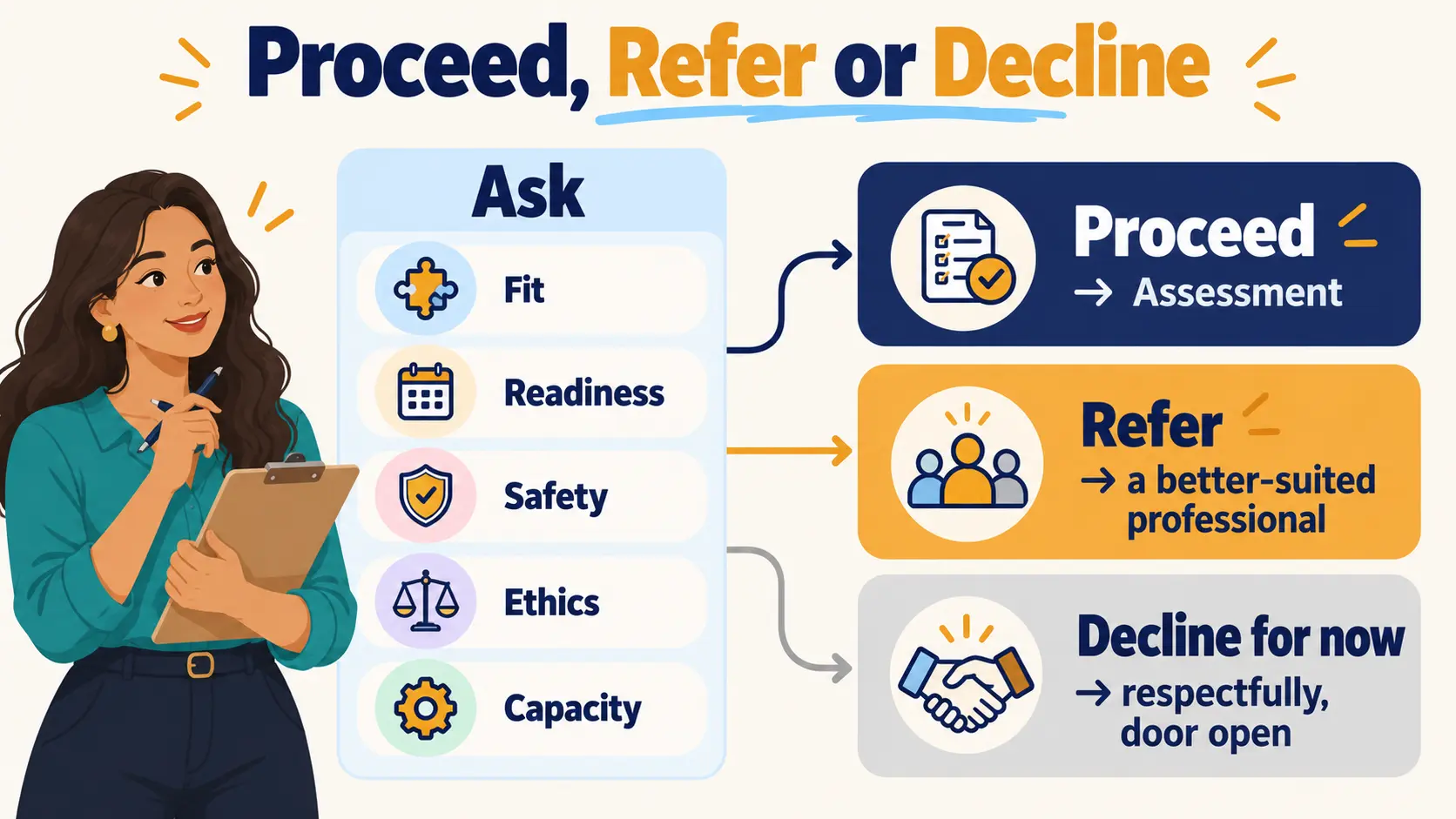
Outline item I.F asks the organizer to determine whether a professional relationship should be established. By the end of preliminary communication, the organizer should be able to answer five honest questions:
- Fit: Do my skills and experience match what this client needs?
- Readiness: Is the client — and is the household — ready to take part?
- Safety: Can the work be done safely, or does it need other professionals first?
- Ethics: Is there a conflict of interest, or anything that would compromise my objectivity?
- Capacity: Do I have the time to serve this client well?
- ProceedAgree the terms and move into Domain II, Assessment.
- ReferThe need is real but someone else is better suited — another organizer with a specialty, or a different kind of professional.
- Decline (for now)The client isn't ready, or the project isn't right. Decline respectfully and leave the door open where appropriate.
Applying the five questions
| Situation | The deciding factor | Likely decision |
|---|---|---|
| A client keen to start, time set aside, a project within your skills | All five questions answered well | Proceed |
| A severe hoarding situation and you have no experience of it | Fit and safety | Refer to a specialist organizer, possibly alongside other professionals |
| A close friend's business asks you to organize its finance office | Ethics — objectivity and confidentiality | Consider carefully; refer if objectivity would be compromised |
| An adult child books for a parent who says no | Readiness — the client hasn't agreed | Don't proceed; explain kindly, and leave the door open |
| A large project with a fixed deadline you can't meet | Capacity | Refer, or agree a realistic scope with the client |
What isn't a reason to decline
Disagreeing with the client's taste, or with what they want to keep, is not a reason to turn them away. Those are the client's decisions. Organizers decline when a project isn't workable, isn't safe, or isn't a good fit — not because the client would keep more than the organizer would. Nor should declining be based on assumptions about a client's background, culture, age or circumstances.
Referring and declining well
- Be honest about why, in a way that respects the client: "This needs someone with experience I don't have."
- Be kind — the client may have found it hard to call at all.
- Be helpful — suggest other organizers, professionals or resources where possible.
- Leave the door open where appropriate: "If things change, I'd be glad to talk again."
Never simply stop responding, and never quote an inflated price to scare a client off. Both are dishonest, and both leave the client without help.
Exam Traps for I.D–F
| If an answer… | …it's probably wrong because |
|---|---|
| Proceeds because the person who booked is keen | Readiness is gauged for each person |
| Pushes a "thinking about it" client to start now | Meet clients where they are |
| Tells a reluctant partner the clutter is obviously a problem | Explore each view; no judgement |
| Explains fees after the first session | Terms come before any work |
| Quotes low, then adds extras | Clear, complete terms in writing |
| Offers a "book today" discount to close | No pressure tactics |
| Declines because the client keeps too much | What the client keeps is their decision |
| Quotes a high fee to avoid a client | Decline honestly instead |
10 questions in the style of the CPO® exam. Score 70%+ to mark this lesson complete.
- Gauge readiness for each person involved — motivation, capacity, willingness to decide and support around them.
- Readiness is a stage, not a yes-or-no; meet clients where they are rather than pushing faster than they're willing to go.
- When household members disagree, explore each view, find common ground and a starting point both accept — never proceed as if everyone agreed.
- Explain rates and policies before any work begins — clearly, completely, in writing and without pressure — including what's included and what's extra.
- Decide deliberately whether to proceed, refer or decline, using fit, readiness, safety, ethics and capacity.
- Disagreeing with what a client keeps isn't a reason to decline. Refer or decline honestly, kindly and helpfully — never by ghosting or inflating prices.
Before moving to Lesson 4:
- List three signs of readiness and three warning signs you'd listen for on a first call.
- Draft a one-paragraph summary of your own (or an imagined) fee structure, inclusions and cancellation policy.
- Think of two situations where you would refer a client instead of taking the work, and write what you'd say.
- Complete the knowledge check above and review any question you missed.