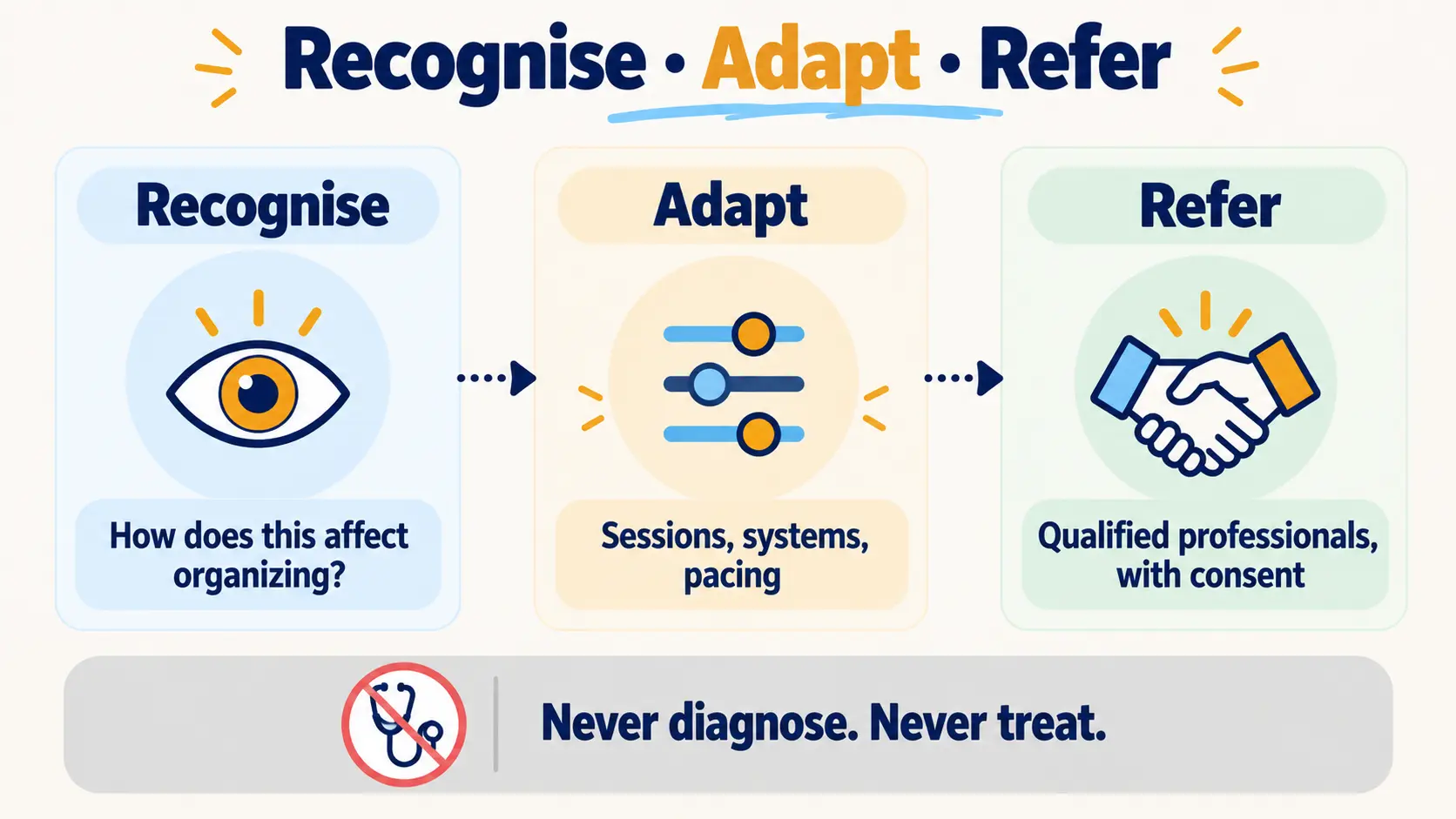
Clients bring their whole lives to an organizing project: their bodies, their health, their age, their beliefs and their culture. The CPO® outline asks organizers to recognise these considerations and adapt how they work — shorter sessions, different storage, more involvement from a care team, deep respect for meaning. It never asks organizers to diagnose or treat. The rule is recognise, adapt, refer.
This lesson finishes the client part of Domain II with the last three outline items: physical considerations (II.A.7), mental-health considerations (II.A.8) and other factors such as age, religion and culture (II.A.9). The outline names examples — injury, illness and limited mobility; ADHD, OCD, hoarding and dementia — so expect exam questions on each.
Organizers work with people at every stage of life, in every state of health, and from every background. A system that's perfect for one client can be unusable for another because of a bad back, a diagnosis that affects attention, a faith tradition about how certain objects are handled, or a lifetime of memories attached to things. Assessment is where the organizer learns about these, so the plan fits the person.
The single most important idea in this lesson: professional organizers don't diagnose or treat health conditions. The exam tests whether you can recognise a consideration, adapt the work to it, and know when to involve other professionals — while keeping the client in charge of their own life.
Free on YouTube Subscribe to get every lesson video in this course SubscribeRecognise, Adapt, Refer
- RecogniseNotice how a consideration might affect organizing — energy, reach, decisions, attachment, safety. Listen to what the client tells you about their own experience.
- AdaptChange how you work: session length and pacing, communication, storage design, who else is involved.
- ReferWhen a need goes beyond organizing — health, safety, mental health — encourage support from qualified professionals, and work alongside them where the client wants that.
What the rule rules out is just as important. An organizer never names a condition the client hasn't shared, never suggests treatments, medication or therapy techniques, and never treats a diagnosis as a reason to take decisions away from the client.
Language that stays in scope
| Within scope | Outside scope |
|---|---|
| "Some clients find shorter sessions work better — would that suit you?" | "You obviously have ADHD." |
| "What's helped you in the past?" | "You should try medication." |
| "I've noticed letting go of these feels very hard. Would it help to talk to someone who specializes in this?" | "This is hoarding disorder." |
| "How would you like us to handle this?" | "Let's just push through — you'll feel better after." |
Health information is also some of the most sensitive information a client can share. It's kept confidential, recorded only as far as the work requires, and never passed to family members without the client's agreement (Lessons 17 and 18).
Physical Considerations (II.A.7)
Injury, illness, chronic pain, limited mobility, low vision or hearing, fatigue, pregnancy and recovery from surgery all affect what a client can comfortably do and use. Physical considerations shape two things: how sessions run and how systems are designed.
| Consideration | Adapting sessions | Adapting systems |
|---|---|---|
| Limited mobility | Client seated; organizer brings items to them | Clear walkways for walkers or wheelchairs; storage within reach |
| Chronic pain or fatigue | Shorter sessions; more breaks; hardest decisions first | Lighter containers with handles; pull-out drawers |
| Low vision | Good lighting; describe items aloud | Large-print, high-contrast or tactile labels; consistent places |
| Hearing loss | Face the client; quieter space; written summaries | Visual cues and reminders |
| Temporary injury or recovery | Plan around healing; the organizer does lifting | Interim set-up now; review once recovered |
Two principles run through all of this. First, the prime reach zone is measured from the client, not from an average person (Lesson 11) — someone using a wheelchair, or who can't raise their arms above their shoulders, has a very different "easy" zone. Second, safety comes first: no stepladders for clients at risk of falls, heavy items stored low, cords and rugs secured.
Ask the client what's comfortable rather than guessing. Many clients know exactly what helps. Occupational therapists and other health professionals can be valuable partners when a client is already working with them.
Mental-Health Considerations (II.A.8)
The outline names ADHD, OCD, hoarding and dementia. For each, the organizer's job is to understand how it can affect organizing and adapt — never to diagnose or treat.
| Consideration | How it can affect organizing | Ways organizers commonly adapt |
|---|---|---|
| ADHD | Attention, time awareness, starting and finishing tasks, "out of sight, out of mind" | Shorter, focused sessions; visible systems; simple categories; clear next steps; timers, routines and working alongside the client ("body doubling") if they find it helps |
| OCD | Distress around order, contamination or discarding; time-consuming routines | Follow the client's lead and pace; don't push through distress; coordinate with their treatment provider if they wish |
| Hoarding | Strong attachment to many items, great difficulty discarding, possible safety and health risks | Client-led, gradual work; safety first; never forced or secret clean-outs; collaborate with specialists and the client's support team |
| Dementia | Memory, routines, recognising items and decision-making | Keep familiar items and layouts; simple labels with words and pictures; involve trusted family or caregivers; keep the client involved |
When a client tells you about a diagnosis
Many clients will share a diagnosis themselves. When they do, they're the expert on their own experience. Thank them for telling you, ask what has helped and what has made things harder in the past, and agree how you'll adapt. If they're working with a health professional, ask whether they'd like you to coordinate — and only with their consent.
When you notice something the client hasn't mentioned
Sometimes the organizer notices patterns — extreme difficulty discarding, great distress over order, or memory problems — that the client hasn't raised. The organizer doesn't label them. They describe what they notice in practical terms, ask how the client experiences it, adapt the work, and — where it seems the client may need more support than organizing can give — gently encourage them to speak with a qualified professional.
Chronic disorganization
Organizers use the term chronic disorganization for disorganization that has persisted for a long time, undermines daily life, and hasn't improved with the client's own efforts. It's a description used in the organizing field, not a diagnosis. It often goes with other considerations, and it usually calls for slower, more collaborative work — and sometimes for an organizer with specialist training.
Hoarding: safety and consent together
Hoarding questions often test two principles at once. Blocked exits, fire hazards, structural problems or pests need attention. But clearing a home without the client's involvement — often at a family's request — causes serious distress, damages trust and rarely lasts. Effective work tends to be:
- Safety-first: exits, walkways, fire risks and sanitation come before appearance.
- Client-led and gradual: the client makes the decisions, at a pace they can sustain.
- Measured by function and safety, not by how much leaves the house. A clear route to the back door is real progress.
- Collaborative: organizers with specialist experience, mental-health professionals, and local services where needed. Some organizers use visual clutter scales to describe conditions consistently with other professionals.
Where there are concerns about a vulnerable adult, a child or an animal at risk, the organizer involves the appropriate professionals or authorities where they live.
Dementia and decision-making
Dementia can affect a client's ability to make some decisions, and it can change over time. The organizer keeps the client involved as much as possible, works with the trusted family members or caregivers the client relies on, and respects any legal arrangements for decision-making — which vary by country and region. Familiar layouts and routines matter more than efficiency: moving everything to a "better" place can leave a person with dementia unable to find anything.
When a client is distressed
Organizing touches emotional ground. If a client becomes very distressed — or talks about feeling hopeless — the organizer pauses, responds with care, doesn't try to counsel, and encourages the client to reach out to a qualified professional or someone they trust. If there's any immediate risk, contact local emergency services.
Age, Religion and Culture (II.A.9)
Belongings carry meaning, and that meaning is shaped by age, faith, culture, family history and life events. The organizer's job is to understand it, not to override it.
| Factor | What it can mean for organizing | A good question |
|---|---|---|
| Children | Systems they can use themselves; age-appropriate say in their own things | "Where would you look for your art supplies?" |
| Older adults | Downsizing, a lifetime of memories, decisions about inheritance, a slower pace | "Which of these would you like family to have?" |
| Religion | Rules about handling, placement or disposal of texts and objects | "How should these be handled and stored?" |
| Culture and family | Gifts that are hard to let go; items that belong to the wider family; keeping for future generations | "Is this yours to decide, or does family need a say?" |
| Life events | Bereavement, divorce or illness make belongings emotionally heavier | "Would it help to set these aside for now?" |
Two cautions run through this item. Minimalism isn't a universal goal — keeping many things can be a valued tradition, not a problem to fix. And don't generalize from age, faith or background to an individual. Two clients of the same faith, culture or generation can have completely different views about their belongings.
The practical rule is the same throughout: don't assume — ask. "How would you like these handled?" respects the client and avoids mistakes that can't be undone.

Exam Traps for II.A.7–9
| If an answer… | …it's probably wrong because |
|---|---|
| Identifies "the likely condition" to target the plan | Organizers don't diagnose |
| Suggests coping techniques or medication | Organizers don't treat |
| Refuses any client who mentions their health | Recognise, adapt, refer |
| Puts everyday items high for a client who can't reach | The reach zone is measured from the client |
| Clears a home while the client is in hospital | Safety and consent go together |
| Removes "obvious rubbish" without asking | Still the client's decision |
| Tells family about the client's diagnosis | Health information is confidential |
| Calls chronic disorganization a diagnosis | It's a field description |
| Groups religious items to reduce clutter | Don't assume — ask |
Lesson 10 covers how these considerations shape decision-making during hands-on work, and our guide to letting go of sentimental clutter looks at attachment in everyday terms.
10 questions in the style of the CPO® exam. Score 70%+ to mark this lesson complete.
- The rule for this lesson: recognise, adapt, refer. Organizers never diagnose or treat — and health information stays confidential.
- Physical considerations shape both sessions (shorter, seated, safer) and systems (reach measured from the client, weight, walkways, labels). Ask, don't guess.
- For ADHD, OCD, hoarding and dementia: understand the effect on organizing, ask what has helped, adapt, and collaborate with professionals — with the client's consent.
- Chronic disorganization is a field description, not a diagnosis — long-standing, affecting daily life, resistant to self-help.
- In hoarding situations, safety and consent go together: safety first, client-led, measured by function — never forced or secret clean-outs.
- Age, religion, culture and life events shape what belongings mean. Minimalism isn't universal and individuals differ — don't assume, ask.
Before moving to Lesson 6:
- Write your own one-sentence version of "recognise, adapt, refer" you could use with a client.
- List three session and three system adaptations for a client recovering from a hip operation.
- Think of one belonging in your family with cultural or religious meaning, and how you'd want an organizer to ask about it.
- Complete the knowledge check above and review any question you missed.