Domain III turns assessment into a plan, and it starts by going back to the client: reviewing what was learned, agreeing exactly what the project will and won't include, putting objectives in order, and breaking the work into tasks with clear owners. A plan built with the client — not handed to them — is one they understand, agree with and are more likely to follow.
Domain III, Project Plan Development, is 16% of the CPO® exam. It's the bridge between understanding a client (Domains I and II) and doing the work (Domain IV). The domain has eight outline items. This lesson covers the first four — reviewing assessment findings (III.A), determining scope (III.B), prioritizing objectives (III.C) and determining tasks (III.D). Lesson 8 covers resources and referrals, and Lesson 9 covers the timeline, cost and final plan.
The thread running through all four items is shared ownership. The organizer brings expertise — what usually works, what tends to go wrong, what's safe — and the client brings the final say about their own home, time and money. On the exam, the best answers in Domain III almost always have the organizer recommending and explaining, and the client deciding.
Free on YouTube Subscribe to get every lesson video in this course SubscribeReviewing the Findings (III.A)
Planning starts by going back to the client. Before anything is committed, the organizer summarizes what the assessment found and checks it with the client. It's tempting to skip this and go straight to a plan — the organizer has seen the space and has ideas. But a plan built on a misunderstanding fails however well it's designed, and the client is the only person who knows how they really live.
What to review
| Finding | What to check with the client |
|---|---|
| Goals | Are these still the right goals, in your words? Has anything changed since we first spoke? |
| People involved | Who uses these spaces, and who needs a say in decisions? |
| Habits, styles and skills | "You said you like to see things, and that mornings are hardest — is that right?" |
| Physical and personal considerations | Session length, reach, energy, how belongings should be handled |
| The space | What works already, what doesn't, and any hazards noticed |
| External factors and budget | Deadlines, building or workplace rules, family dynamics, budget limits |
How to present findings
The review is a conversation, not a report. Some practices make it work:
- Start with strengths. "Your bookshelves already work well — everything's grouped and easy to reach" tells the client the organizer noticed what's going right, and builds trust for the harder findings.
- Use neutral, specific language. "The dining table is currently holding post and school papers" describes. "The dining table is a disaster" judges.
- Invite correction. Ask "Does that match how it feels to you?" after each main finding, not just once at the end.
- Handle sensitive findings with care. Observations that touch on health, hoarding or family conflict are raised respectfully, in private, and without labels. The organizer describes what they've seen and how it affects the plan — they never diagnose (Lesson 5).
When the client sees it differently
Sometimes the client disagrees with a finding. Lesson 4 described the gap between a client's perception and the organizer's observation. III.A is where that gap gets resolved. The organizer listens, asks what the client's experience is, and updates the finding. On matters of preference and daily life — what's used, what matters, what feels overwhelming — the client's experience is the better evidence. The one area where the organizer keeps raising a concern, gently and clearly, is safety. Even then, the aim is shared understanding, not winning the argument.
Confirming goals as outcomes
The review is the moment to turn goals into outcomes the client will recognize when they happen. "A calmer entryway" becomes "the family can find keys, bags and shoes and leave on time." These outcomes shape the scope and priorities that follow. They also become the measure of success at follow-up (Lesson 16), so it pays to write them down in the client's own words.
Determining Scope (III.B)
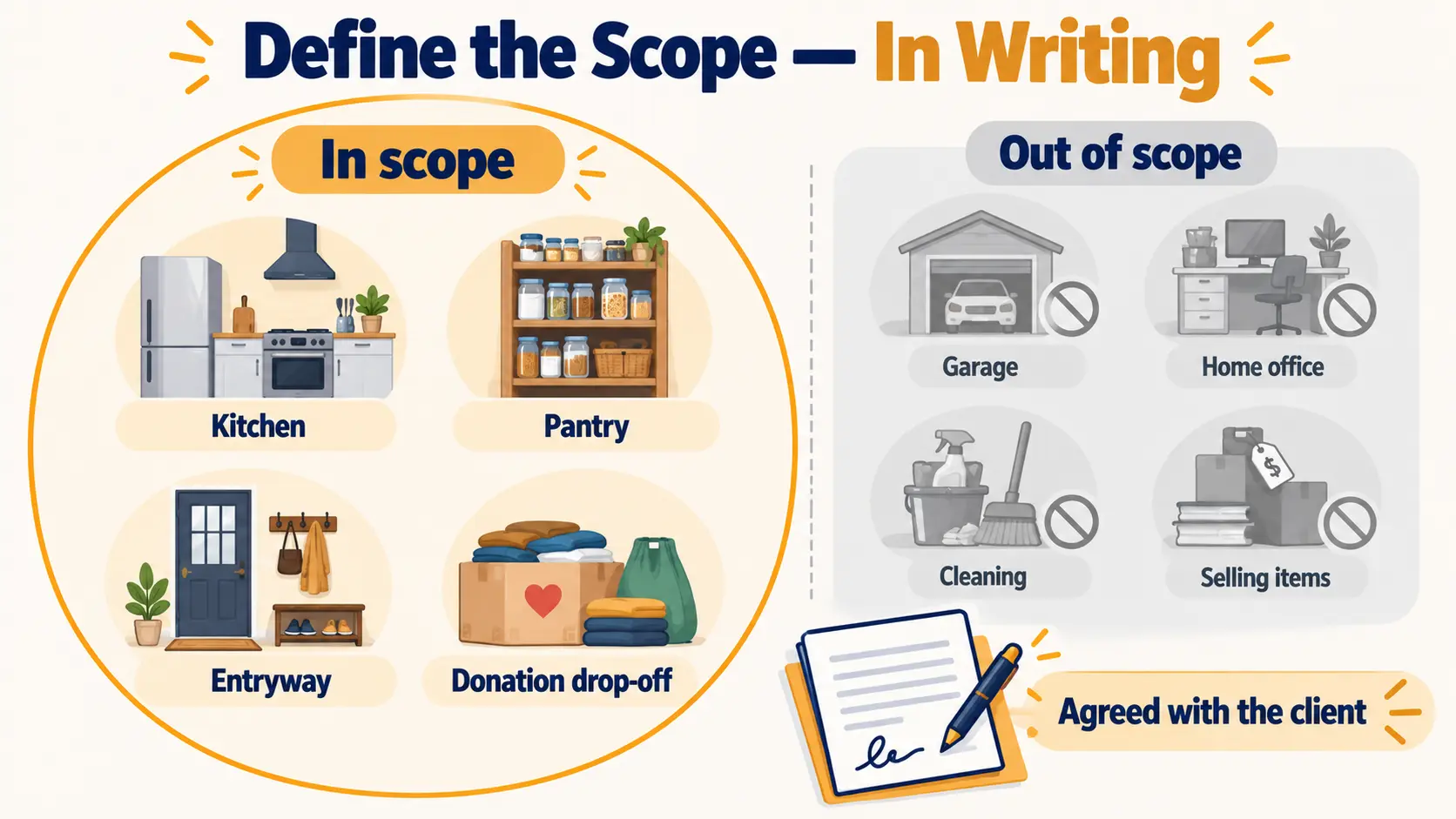
Scope defines exactly what the project includes — and what it doesn't. A clear scope sets shared expectations. It also becomes the reference point when new requests come up later (Lesson 14 covers scope creep).
| A scope statement covers | Example |
|---|---|
| Spaces included | Kitchen, pantry and entryway |
| Spaces excluded | Garage and home office (may be a later phase) |
| Services included | Hands-on sessions, supply shopping, donation drop-off |
| Services excluded | Cleaning, furniture assembly, selling items |
| Deliverables | A working system for each space, labelled, plus a short maintenance routine |
Why exclusions matter as much as inclusions
"I assumed you'd do the garage too" is one of the most common sources of friction in organizing projects. People fill gaps with their own assumptions, and two people's assumptions rarely match. Writing down what's excluded — spaces, and also services such as cleaning, selling items or assembling furniture — removes the gap. It isn't negative or defensive. It's simply clear.
Scope has to fit the constraints
A scope is only useful if it can be delivered. It has to fit within everything Domain II uncovered:
- Budget — what the client can afford in fees, supplies, vendors and removal (Lesson 6).
- Time — any deadline, and the client's realistic availability.
- The client's energy and capacity — how much decision-making is realistic (Lesson 5).
- The organizer's competence — anything that needs a specialist, such as electrical work, legal paperwork or mental-health support, stays outside the organizer's scope and becomes a referral (Lesson 8).
When everything the client wants won't fit, the answer is usually phasing: an agreed Phase 1 now, with remaining spaces as a later phase. Phasing keeps the project realistic without dismissing what the client wants.
Defining "done"
Deliverables describe what the client will have when the project ends. Vague deliverables ("an organized kitchen") invite disagreement. Specific ones are checkable: "a zoned kitchen with everyday items within reach, labelled pantry categories, and a ten-minute evening reset the client can do without help." A good deliverable usually includes the system itself and the client's ability to keep it going.
Scope is written down and agreed with the client — or, where several people are involved, with the decision-maker agreed in Domain I (Lessons 2 and 3).
Prioritizing Objectives (III.C)
Most projects can't do everything at once. Prioritizing puts objectives in a sensible order. The organizer explains the reasoning so the client can decide with full information.
- Safety firstBlocked exits, trip hazards, unstable stacks and anything risky come before everything else.
- Deadlines and urgencyA move date, guests arriving, a sale or a new baby.
- Impact on daily lifeSpaces used every day — the kitchen, the entryway — often make the biggest difference.
- Early winsA small, visible success builds momentum and confidence, especially for overwhelmed clients.
- DependenciesSome areas must be done first — clearing a spare room to create a staging area, for example.

A worked example
Kwame works from home and has three spaces he'd like organized: his home office, the kitchen and the garage. There's no deadline. The garage has boxes stacked against the only route to the back door, and the office is where he spends eight hours a day.
| Space | Safety | Daily impact | Early win? | Dependency |
|---|---|---|---|---|
| Garage — back-door route | Yes — blocked exit | Low | Clearing the route is quick | Creates a staging area for the rest |
| Home office | No | Very high | Desk surface in one session | Needs somewhere for overflow to go |
| Kitchen | No | High | Possible | None |
A sensible recommendation is to clear the route to the back door first — a short, safety-driven task that also creates a staging area. Then the office, for its daily impact, then the kitchen, with the rest of the garage as a later phase. Notice that "do the garage first" doesn't mean organizing the whole garage first. Priorities apply to objectives, so the safety objective can be separated from the larger garage project.
When criteria pull in different directions
- Safety outranks everything, including the client's preferred starting point, and the organizer explains why.
- A fixed deadline usually outranks daily impact, because missing it has consequences the client can't undo.
- For an overwhelmed or hesitant client, an early win may come before the highest-impact space. Momentum matters, and success in a less emotional area builds the skills and confidence for harder ones.
- Dependencies can override everything except safety. You can't put books on shelves that haven't been installed.
The organizer recommends; the client decides
This is the principle the exam returns to again and again. The organizer's job is to recommend an order and explain the reasoning clearly. The client's job is to decide. If the client prefers a different order, the organizer listens to why — often there's a reason the organizer didn't know, like a family event or an emotional readiness issue — and adapts where it's reasonable. Safety is the exception: the organizer is clear about the risk and the reasoning. If a serious hazard makes it unsafe to work, the organizer addresses it — including referring to the right professionals — rather than quietly working around it (Lessons 3 and 6).
Determining Tasks (III.D)
Each objective is then broken into tasks — the concrete steps that will achieve it. Tasks are where a plan becomes something people can actually do.
| # | Task (objective: "the family leaves on time in the morning") | Owner |
|---|---|---|
| 1 | Gather all shoes, bags and coats from around the house into the hallway | Client, before session 1 |
| 2 | Sort by person and season; edit outgrown and unused items | Organizer and client, session 1 |
| 3 | Measure the hallway and the items staying | Organizer, session 1 |
| 4 | Approve hooks and a shoe rack within the supply budget | Client |
| 5 | Install hooks at each family member's height | Handyperson (vendor) |
| 6 | Set up zones and labels; agree a nightly bag-packing routine | Organizer and family, session 2 |
Good tasks share four qualities:
- Specific: "Sort pantry food into categories and check dates", not "do the pantry".
- Owned: each task has an owner — the organizer, the client, a family member or a vendor. Tasks for other people are agreed with the client first.
- Sequenced: tasks that others depend on come first — consolidating before sorting, measuring before buying, booking a donation pick-up before a big decluttering day.
- Realistic: sized to the client's energy and time, especially between-session tasks.
Between-session tasks
Between-session tasks can keep costs down, keep momentum going and build the client's skills — but only if they're designed well:
- Small and clear: "Sort this one drawer of papers into action and reference by Thursday" works; "do your filing" doesn't.
- A clear finish line: the client knows exactly what "done" looks like.
- Matched to skills: only tasks the client has already practised with the organizer.
- Reviewed: checked at the start of the next session.
When a task doesn't get done, treat it as information, not failure. Find out what got in the way — time, energy, an unclear instruction, an emotionally hard category — and resize or redesign the task. Repeatedly unfinished tasks may mean the plan's pace needs adjusting (Lesson 15).
With scope, priorities and tasks agreed, the plan still needs its resources, timeline and costs. Lessons 8 and 9 complete it.
Exam Traps for III.A–D
| If an answer… | …it's probably wrong because |
|---|---|
| Orders supplies or schedules sessions before reviewing findings | Planning starts with the review |
| Insists the organizer's observations are more objective | The review is a two-way check |
| Leaves scope verbal, or lists only what's included | Unwritten or one-sided scope breeds assumptions |
| Promises every space within the deadline | Scope must fit the constraints; phasing is better |
| Includes electrical, legal or therapy work in scope | Outside the organizer's competence — refer |
| Starts where the client pointed first, ignoring a hazard | Safety first, explained and agreed |
| Imposes the order without discussion | The organizer recommends; the client decides |
| Sets "do your filing" as homework | Tasks must be specific and realistic |
10 questions in the style of the CPO exam. Score 70%+ to mark this lesson complete.
- Domain III (16%) turns assessment into an agreed plan; this lesson covers III.A–D.
- Start by reviewing findings with the client — strengths first, neutral language, a two-way check that corrects misunderstandings.
- Confirm goals as outcomes in the client's words; they become the measure of success at follow-up.
- Define scope in writing — spaces and services included and excluded, and specific deliverables — fitted to budget, time, energy and competence; phase what won't fit.
- Prioritize by safety first, then deadlines, daily impact, early wins and dependencies. The organizer recommends and explains; the client decides.
- Break objectives into specific, owned, sequenced and realistic tasks; design between-session tasks the client can finish, and treat unfinished ones as information.
Before moving to Lesson 8:
- Write a five-line scope statement for organizing one area of your home, including what's excluded and what "done" means.
- Rank three spaces in your home using the prioritization criteria above, and note where the criteria conflict.
- Break one objective into five specific tasks, each with an owner.
- Complete the knowledge check above and review any question you missed.