A plan needs the right resources: organizing and productivity tools, technology, furniture and equipment, referrals to other professionals, and a clear exit route for everything that leaves the home. The organizer recommends resources that fit the client's needs, skills and budget, discloses any financial interest in a recommendation, and plans removal before the sorting starts — so outgoing items actually go.
Outline item III.E, identify and recommend resources, is a single item with six parts: organizational tools and supplies, productivity tools, technology tools, furniture and equipment, referrals, and removal options — donation, disposal, selling and shredding. It gets its own lesson because every part comes up on the exam.
Two ideas run through the whole lesson. The first is fit over features: the right resource is the one this client will actually use, in this space, within this budget — not the newest product or the organizer's favourite. The second is the client's interest comes first. Many III.E questions have an ethics angle: is the organizer recommending what's best for the client, and are they open about any financial interest in the recommendation?
Free on YouTube Subscribe to get every lesson video in this course SubscribeTools, Technology, Furniture and Equipment
| Resource type | Examples | Choose based on |
|---|---|---|
| Organizational tools and supplies | Containers, drawer dividers, shelf risers, labels, file folders | Measurements, the category's volume, visibility needs (Lesson 11) |
| Productivity tools | Planners, wall calendars, timers, task lists, inbox trays | How the client plans and what they'll actually use (Lesson 12) |
| Technology tools | Scanners and scanning apps, cloud storage, password managers, shared calendars | The client's technology skills and existing devices (Lesson 4) |
| Furniture and equipment | Shelving units, filing cabinets, desks, hooks, step stools, label makers | Space, safety, lease rules and budget (Lesson 6) |
The fit test
Before recommending anything, the organizer can run through five questions. If a resource fails any of them, it's probably the wrong recommendation:
- Does the plan need it? Every resource should serve an agreed objective. "It would look nice" isn't an objective.
- Does the client already own something that works? Shop the house first — spare baskets, an unused bookcase, a drawer of folders.
- Will this client actually use it? Consider their habits, learning and behavioural styles and skills from assessment (Lesson 4). A visual client may abandon an opaque filing system; a client who never opens apps won't keep a digital task list.
- Does it fit the space and keep people safe? Measurements, weight limits, reach, anchoring and any building or lease rules.
- Is it within the agreed budget? If it isn't, the client hears the options and decides (Lesson 15).
Technology tools need extra care
Technology can transform paper and productivity systems, but it fails more often than physical tools because it adds a learning curve. Before recommending an app, scanner or cloud service, consider:
- Skills and confidence — can the client use it without the organizer there? If not, is training part of the plan?
- Existing devices and accounts — the best tool is often one the client already has. Their phone's calendar may beat a new planning app.
- Who supports it later — when it stops syncing or the client forgets a password, who helps?
- Ongoing costs — subscriptions add up, so they belong in the budget conversation.
- Data security — sensitive documents need secure storage and strong sign-in (Lesson 18).
For example, a client who loves writing things down and finds apps stressful may be better served by a paper planner and a wall calendar than by the most capable app on the market. The goal is a system the client keeps using, not the most sophisticated one.
Furniture and equipment: safety and access
Furniture recommendations carry safety responsibilities. Tall shelving should be anchored to the wall. Heavy items belong low. A step stool with a handrail is safer than climbing on a chair. Walkways stay clear. For clients with physical considerations (Lesson 5), recommendations should support reach, grip and mobility — pull-out shelves, lever handles, lighter containers. In rented homes or workplaces, check what's allowed before recommending anything that drills into walls.
Recommending without bias
Every organizer has favourite products, and some have affiliate links, brand partnerships or discounts. None of these is wrong in itself — but none of them should decide the recommendation. Good practice is to:
- Recommend on fit, using the five questions above.
- Offer more than one option where reasonable, at different price points.
- Disclose any financial interest — commission, affiliate income, a referral fee or a relationship with the supplier.
- Let the client choose, including choosing to buy elsewhere.
Referrals
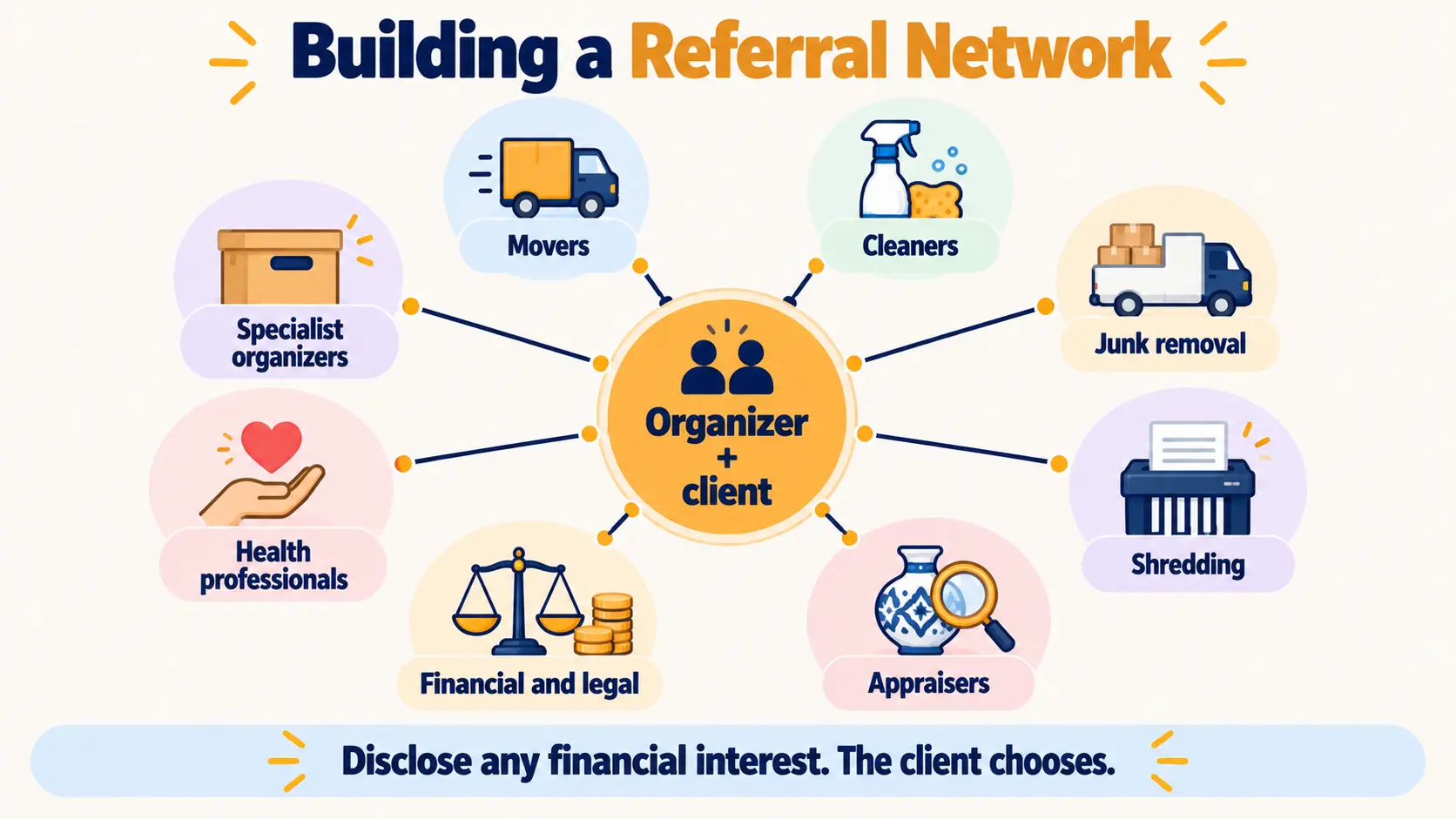
Many projects need help from other professionals. Referring well is a mark of professionalism, not a weakness. It keeps the organizer within their competence and gets the client the right expertise.
When to refer
| The need | Refer to |
|---|---|
| Moving, cleaning, repairs, installation, junk removal | Movers, cleaners, handypeople, removal services |
| Valuing or selling antiques, collections, an estate | Appraisers, auction houses, estate-sale and consignment specialists |
| "How long must I keep this?" or financial and legal questions | Accountants, lawyers, financial professionals |
| Device set-up, data recovery, security problems | IT specialists |
| Health, mobility, mental-health or safety concerns | Doctors, occupational therapists, mental-health professionals, social services — with the client's agreement (Lesson 5) |
| A specialty the organizer doesn't offer | Organizers who specialize in, for example, chronic disorganization, digital organizing or relocation |
Building a network you can trust
A referral reflects on the organizer, so providers are vetted before they're recommended. Useful checks include:
- Appropriate qualifications, licensing or insurance where their field requires it.
- References, reviews or direct experience of their work.
- Experience with similar clients — older adults, hoarding situations, relocations.
- Respect for confidentiality, and reliability on timing.
Strong networks have more than one option in each category, so the client has a real choice. They're also kept up to date: a provider who let a client down is reviewed, not quietly recommended again.
Making a referral well
- Explain why the referral would help, in terms of the client's goals.
- Get the client's agreement — especially for health or support services, which should never be arranged behind the client's back.
- Offer options rather than booking one provider on the client's behalf.
- Share information only with consent. Introducing the client to a provider doesn't mean passing on everything learned in assessment.
- Coordinate and follow up where agreed, so the provider's work fits the plan and timeline (Lesson 9).
Financial interests in referrals
Some providers pay referral fees or offer commissions. If the organizer accepts one, it must be disclosed so the client can weigh the recommendation, and the client must remain free to choose someone else. A referral fee should never decide which provider is recommended (Lesson 17 covers conflicts of interest in depth).
Removal Options
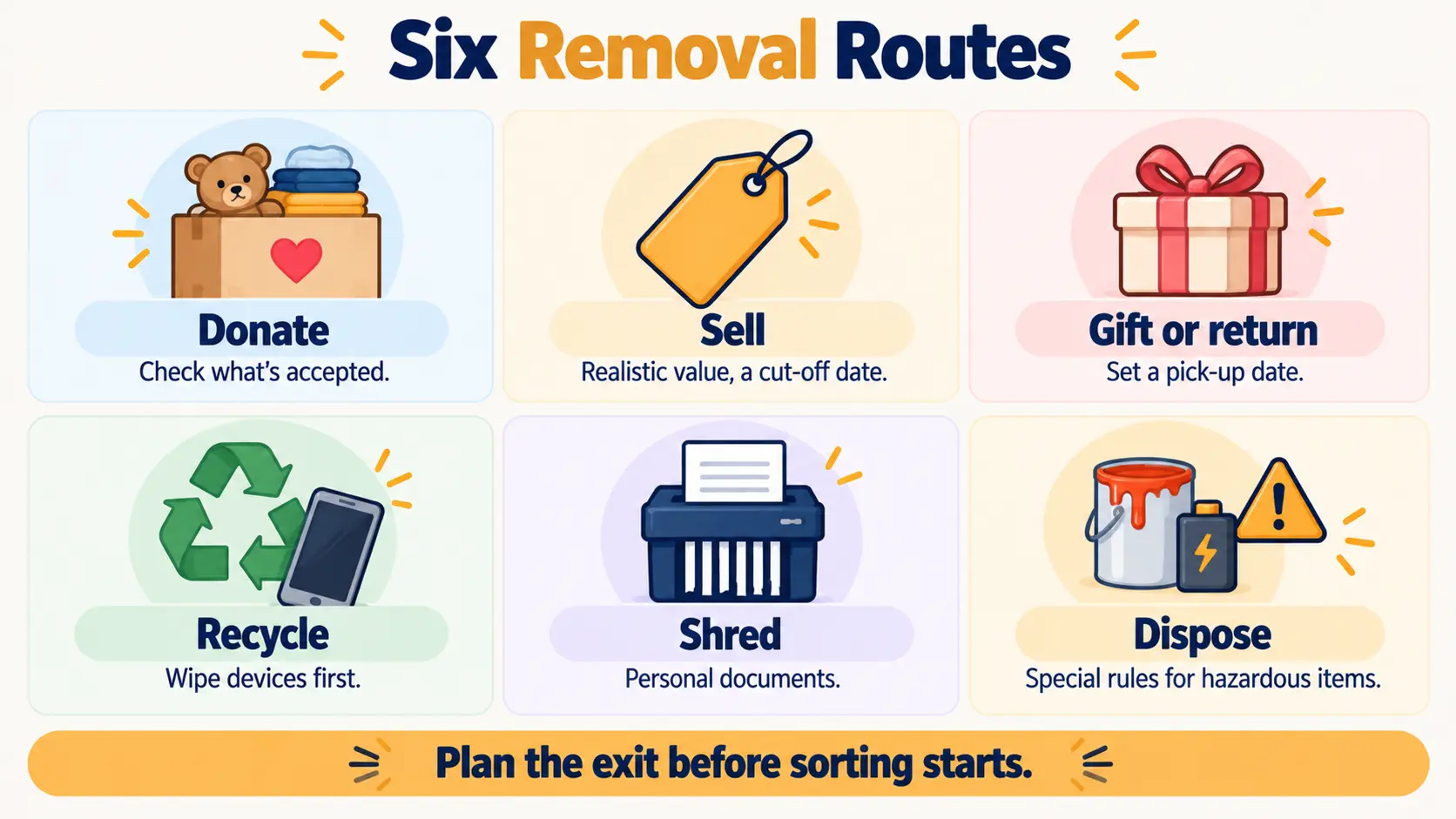
Every item that leaves needs somewhere to go. The outline names four removal routes — donation, disposal, selling and shredding — and good plans add gifting and recycling. The key point for the exam: plan removal before sorting starts. If outgoing items have no route out, they pile up in a hallway, get re-examined, and often find their way back into cupboards.
| Route | Good for | Plan ahead |
|---|---|---|
| Donate | Usable items in good condition | Check what local organizations accept; book pick-up or drop-off |
| Sell | Items with real resale value | Realistic values, time and effort; a deadline after which unsold items are donated |
| Gift or return | Items belonging to, or wanted by, family and friends | Agree a date for collection |
| Recycle | Paper, glass, metal, textiles, electronics | Local recycling rules; wipe data from devices first |
| Shred | Documents with personal or financial information | Secure shredding service or a cross-cut shredder |
| Dispose | Broken, unusable or hazardous items | Special rules for paint, batteries, chemicals, medicines and electronics |
Matching items to routes
A quick sequence of questions sends each item to the right place:
- Does it contain sensitive information? Documents go to shredding; devices are backed up and wiped first.
- Is it hazardous? Paint, chemicals, batteries and medicines go through the proper local channels — never household waste.
- Does someone specific want it? Gift or return, with an agreed collection date.
- Does it have real resale value? Consider selling — realistically.
- Is it usable and in good condition? Donate, to an organization that actually accepts it.
- Otherwise: recycle what can be recycled, and dispose of the rest responsibly.
Selling — an honest conversation
Many clients overestimate resale value and underestimate the time selling takes: photographing, listing, answering messages, arranging collection. Options include consignment shops, auctions, online marketplaces and estate sales, each with different fees, effort and timing. The organizer shares realistic information and the options, and the client decides. A cut-off date works well — anything unsold by then is donated — so sale items don't become a new pile of clutter. For items that may be valuable, an appraiser gives the client a sound basis for deciding.
Donating responsibly
Donation is only helpful if the organization can use what it receives. Check what each one accepts, in what condition, and when. Broken, stained or recalled items aren't donations — they're the charity's disposal problem. If the client wants a record of donations for their own purposes, the organizer can help them keep one. Questions about the tax treatment of donations go to the client's tax adviser.
Who decides, and who handles
The client decides where each item goes. The organizer may handle drop-offs or book collections if that's in the agreed scope. When sensitive documents leave the home for shredding, it's good practice to keep a record (Lesson 18). One boundary is absolute: the organizer doesn't take client items for themselves, even when offered. That's a conflict of interest, covered in Lesson 17. Removal rules vary by location, so organizers check what's accepted and required locally rather than assuming.
Exam Traps for III.E
| If an answer… | …it's probably wrong because |
|---|---|
| Buys new containers before checking what the client owns | Shop the house first |
| Recommends a complex app to a client who avoids technology | Tools must match the client's skills |
| Recommends the product that pays the organizer most | Fit comes first; financial interests are disclosed |
| Answers a tax or legal question to save a referral | Outside competence — refer |
| Books a provider without asking the client | Offer options; the client chooses |
| Keeps a referral fee private | Disclose so the client can weigh the advice |
| Plans removal once the pile is too big | Plan removal before sorting starts |
| Arranges donation because selling "isn't worth it" | Realistic information — then the client decides |
| Donates a laptop without wiping it | Back up and securely erase first |
Our guides to mindful consumption and sustainable living on a budget cover the everyday side of keeping things out of landfill.
10 questions in the style of the CPO® exam. Score 70%+ to mark this lesson complete.
- III.E covers tools and supplies, productivity and technology tools, furniture and equipment, referrals, and removal options.
- Fit over features: does the plan need it, does the client own something already, will they use it, is it safe, is it in budget?
- Technology needs extra care — skills, existing devices, support, ongoing costs and data security.
- Refer when a need goes beyond organizing or your competence; vet providers, offer options, get agreement and share information only with consent.
- Disclose any financial interest in a product or referral; the client chooses.
- Plan removal before sorting: shred, wipe, handle hazards properly, gift, sell realistically with a cut-off date, donate what's usable — and check local rules.
Before moving to Lesson 9:
- Run the five-question fit test on one organizing product you own.
- List three local places that accept donations, and what each one does and doesn't take.
- Write down five types of professional you'd want in a referral network, and one vetting question for each.
- Complete the knowledge check above and review any question you missed.