The plan comes together in three final steps: a realistic timeline built around the client's deadlines, energy and dependencies; a clear cost estimate covering fees, supplies, vendors and removal; and a written plan the client reviews and approves before implementation begins. Estimates are honest ranges, changes are agreed before they happen, and the plan stays a living document.
This lesson completes Domain III with the last three outline items: establishing a project timeline (III.F), estimating cost — consulting fees, supplies and vendors (III.G) — and finalizing the project plan (III.H). By now the organizer has reviewed the assessment with the client, agreed the scope and priorities, broken the work into tasks (Lesson 7) and lined up resources, referrals and removal routes (Lesson 8). What's missing is when it will happen, what it will cost, and a single written plan the client can say yes to.
These three items look administrative, but they carry a lot of the exam's judgement questions. A timeline that ignores the client's energy, an estimate given before assessment, or extra work started without agreement are all classic wrong answers. After this lesson the project moves into Domain IV, Implementation, which Lessons 10–15 cover.
Free on YouTube Subscribe to get every lesson video in this course SubscribeEstablishing a Timeline (III.F)
A timeline turns the task list from Lesson 7 into dates and sessions. A good one is realistic for this client — not for an average client, and not for the organizer's ideal week. It's built from five inputs:
- DeadlinesMove dates, a house sale, visiting family, a new baby, the start of a school year. With a fixed deadline, plan backward from it.
- The client's energy and availabilitySession length and frequency sized to stamina, decision-making capacity and schedule (Lessons 5 and 13).
- DependenciesVendor bookings, deliveries, donation pick-ups, and tasks that must happen before others.
- Between-session tasksRealistic time for the client to complete their own tasks between visits.
- BufferTasks usually take longer than planned, and illness, difficult decisions and vendors cause delays. Build slack in.
Planning backward from a fixed deadline
When there's a date that can't move — the removal truck arrives, the keys are handed over — the organizer starts at the deadline and works back. Each step asks: what must be finished before this can happen, and how long will it realistically take? Here's a simplified example for a client moving out in five weeks:
| When | What must be done | Why it sits here |
|---|---|---|
| Move day | Movers load; organizer supervises labelled boxes | The fixed deadline |
| Week 5 | Buffer; pack daily-use items last | Absorbs delays without touching the deadline |
| Week 4 | Pack rooms that are already edited; confirm movers | Only edited rooms get packed — no paying to move clutter |
| Week 3 | Donation pick-up; sale items collected; shredding service | Removal routes need lead time (Lesson 8) |
| Weeks 1–2 | Sort and edit, hardest categories early; book vendors | Decisions take the longest and set the volume to move |
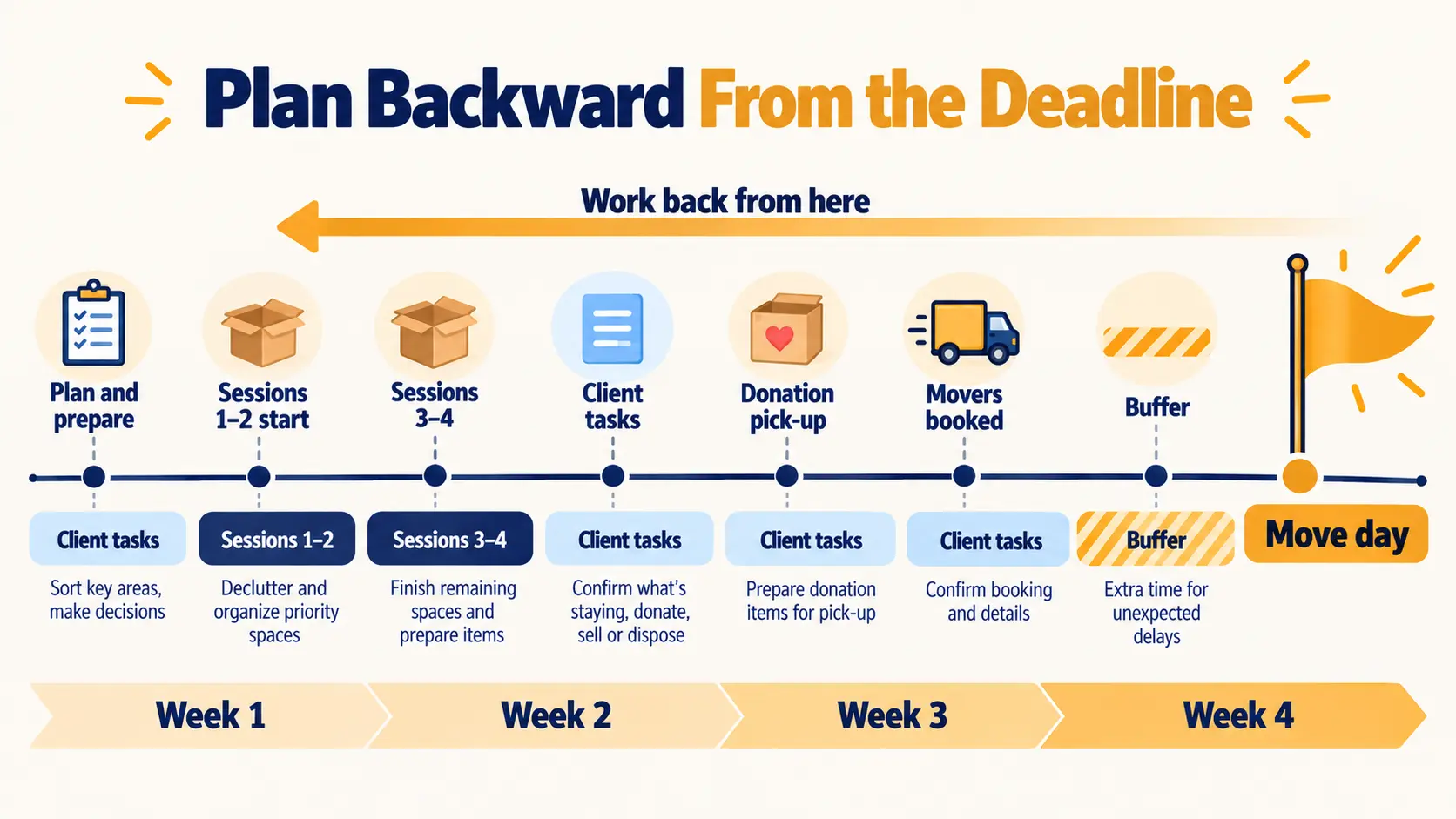
Notice two things. The buffer sits before the deadline, not after it. And the slowest, most decision-heavy work goes first, because it sets the volume for everything that follows.
Sizing sessions to the client
Session length and frequency come from the assessment, not from the organizer's preferred booking pattern. Decision-making is tiring, and most clients make poorer decisions as fatigue builds. Some common adjustments:
- Shorter, more frequent sessions for clients with limited stamina, chronic pain or attention differences, or when the material is emotionally heavy, such as a late parent's belongings.
- Longer sessions where the work is physical and momentum helps — clearing a garage with a client who has the energy for it.
- Gaps between sessions long enough for between-session tasks, donation drop-offs and deliveries, but short enough that momentum isn't lost.
- The client's calendar — work, caring responsibilities, religious and cultural observances, school terms.
Dependencies and sequencing
Some tasks can't start until others finish. Shelving has to be installed before the books go back. A filing system can't be set up until the paper has been sorted. A consignment shop may only accept seasonal items at certain times. Vendors need booking ahead, and deliveries arrive on their schedule, not yours. A timeline that ignores dependencies looks fine on paper and collapses in week two.
How much buffer?
There's no fixed percentage. The more unknowns, the more buffer: a first-time client, a large volume of sentimental items, several decision-makers, or vendors the organizer hasn't used before all call for more slack. A client who decides quickly, with a small, well-defined space, needs less. What the exam cares about is that buffer exists and that the timeline is realistic.
Estimating Cost (III.G)
The outline names three cost areas — consulting fees, supplies and vendors — and a complete estimate adds removal and disposal, so the client sees the whole picture before deciding.
| Cost area | Typically includes |
|---|---|
| Consulting fees | Estimated sessions × rate (or a package or project fee), planning time, travel |
| Supplies | Containers, shelving, labels and furniture still needed after shopping the house |
| Vendors | Movers, cleaners, handypeople, shredding, storage, appraisers |
| Removal and disposal | Junk removal, recycling or hazardous-waste fees |
Fee structures
Organizers charge in different ways, and the estimate should make clear which one applies. The exam won't test rates — they vary widely by location and specialty, so no currency figures appear in this course — but it does expect you to know the common structures and to explain them openly.
| Structure | How it works | Worth explaining |
|---|---|---|
| Hourly | Time on site × hourly rate | Minimum session length; whether planning, shopping and travel are billed |
| Package | A set number of hours or sessions for a set fee | What happens if the hours run out or go unused |
| Project fee | One fee for a defined scope | Exactly what's in scope — and how changes are priced |
| Maintenance / retainer | Regular sessions after the main project | Frequency, notice period, what each visit covers |
Whatever the structure, the terms were explained before work began (Lesson 3). The estimate applies them to this project.
What drives the time estimate
Consulting fees usually depend on time, and time depends on factors the organizer only fully understands after assessment:
- Volume — how much there is, and how much of it needs a decision.
- Decision speed — some clients decide in seconds; others need time with each item.
- Category difficulty — paper and sentimental items are slow; kitchen utensils and linens are quick.
- People involved — every extra decision-maker adds discussion time.
- Access and physical factors — stairs, distance to the car, storage off-site, the client's own physical needs.
Honest ranges and stated assumptions
Because so much depends on decision speed and volume, a good estimate is a range with its assumptions written down: "Eight to twelve sessions, assuming the garage stays out of scope and donation pick-ups happen weekly." When an assumption changes, everyone can see why the estimate changes too.
Supplies are estimated after shopping the house, so the client only buys what's still needed. Vendor costs come from the vendors' own quotes. Make clear whether the client pays vendors directly or through the organizer, and disclose any commission, referral fee or mark-up (Lessons 8 and 17).
When the estimate won't hold
Estimates are estimates. When the organizer can see the project will exceed it — more volume than expected, slower decisions, a vendor's price rise — the client hears about it early, with the reason and the options, and approves any spending beyond the agreed estimate before it happens. Lesson 15 covers tracking the budget during implementation.
When the Plan Needs to Change
Scope changes are the most common way a well-made plan goes wrong — not because change is bad, but because it isn't agreed. The process is simple:
| Step | What the organizer does |
|---|---|
| 1. Acknowledge | Welcome the request: "Happy to look at the garage with you." |
| 2. Explain the impact | Extra sessions, extra cost, and any effect on the agreed priorities or deadline |
| 3. Agree in writing | The client decides — add it now, add it as a later phase, or leave it out |
| 4. Update the plan | Revise the timeline, estimate and task list so the plan stays accurate |
Not every change comes from the client. A delayed delivery, a vendor cancellation, an illness or a new deadline all change the plan too. The response is the same: tell the client promptly, explain the effect, and adjust together. Lesson 14 covers scope creep in more depth.
Finalizing the Plan (III.H)
The final step pulls everything from Domain III into one written plan that the client reviews and approves. A complete plan typically includes:
- The client's goals, in their own words
- Scope — what's included and excluded
- Priorities and the order of work
- Tasks, with owners
- Resources, referrals and removal routes
- Timeline and session schedule
- Cost estimate and payment terms
- How progress will be reviewed, and how changes will be handled

Walking the client through it
Handing over a document isn't the same as agreeing a plan. The organizer goes through it with the client, in plain language, section by section. Good practice is to invite questions, check understanding ("What do you see as the first thing we'll tackle?"), and adjust anything that doesn't feel right. A plan the client doesn't understand is a plan the client won't follow.
Getting approval
The client approves the plan — not the organizer, not a vendor, and not automatically the person who made the first call. Where several people are involved, the decision-maker was agreed back in Domain I (Lessons 2 and 3). Approval is best recorded in writing, alongside the agreed terms, so both sides have the same reference point when questions come up later.
A living document
Approval starts implementation; it doesn't freeze the plan. As the project runs, the plan is updated when priorities shift, when the timeline moves, or when the client agrees a change. Keeping it current means the organizer and client are always working from the same page — literally. It also becomes the baseline for measuring satisfaction in Lesson 15 and effectiveness at follow-up in Lesson 16.
Exam Traps for III.F–H
| If an answer… | …it's probably wrong because |
|---|---|
| Schedules everything in the final week before a deadline | No buffer, no room for decisions or vendor delays |
| Bases the timeline on another client's pace | Timelines are built around this client's energy and availability |
| Gives an exact total before assessment | Without assessment it's a guess; explain the fee structure instead |
| Quotes low to secure the booking | Misleading — and the later "adjustment" breaks trust |
| Starts extra work to keep momentum | Changes to scope, time and cost are agreed first |
| Refuses all changes once the plan is signed | The plan is a living document |
| Lets the organizer finalize the plan alone | The client reviews and approves it |
10 questions in the style of the CPO® exam. Score 70%+ to mark this lesson complete.
- III.F–H complete the plan: timeline, cost estimate and the final, approved plan.
- Build timelines from deadlines (planning backward), the client's energy and availability, dependencies, between-session tasks and buffer.
- Size sessions to the client, put decision-heavy work early, and place buffer before the deadline.
- Estimate consulting fees, supplies, vendors and removal — after assessment, as honest ranges with stated assumptions.
- Agree any change to scope, time or cost with the client before the extra work starts; tell the client early if an estimate won't hold.
- The client reviews and approves the full plan before implementation; it stays a living document.
Before moving to Lesson 10:
- Pick a deadline in your own life and plan one organizing project backward from it, with buffer.
- Write a sample estimate as a range, with two or three stated assumptions.
- Draft a one-page plan outline using the eight headings above.
- Complete the knowledge check above and review any question you missed.