Running the project well is part of the job: managing supplies, vendors and helpers, tracking the budget, keeping the schedule on course, and keeping the client's expectations in line with reality through regular, honest updates. Throughout — not just at the end — the organizer checks how satisfied the client is with the process, timeline and resources, and acts on what they hear.
The last two items in Domain IV are about running the project well: managing the project — resources, budget, schedule and expectations (IV.D) — and evaluating client satisfaction with processes, timeline and resources (IV.E). Lesson 9 produced the plan, the estimate and the timeline. This lesson is about what happens to them once real life starts pushing back.
These items are less about organizing technique and more about professional judgement. Most exam questions here describe something going slightly wrong — a supply costs more, a session runs late, a vendor lets the client down, the client seems unhappy — and ask what the organizer should do next. The answers follow a small set of principles: tell the client early, give them the options, let them decide, and keep the plan current. If you understand why those principles exist, you can answer almost any question in this area.
Free on YouTube Subscribe to get every lesson video in this course SubscribeManaging the Project (IV.D)
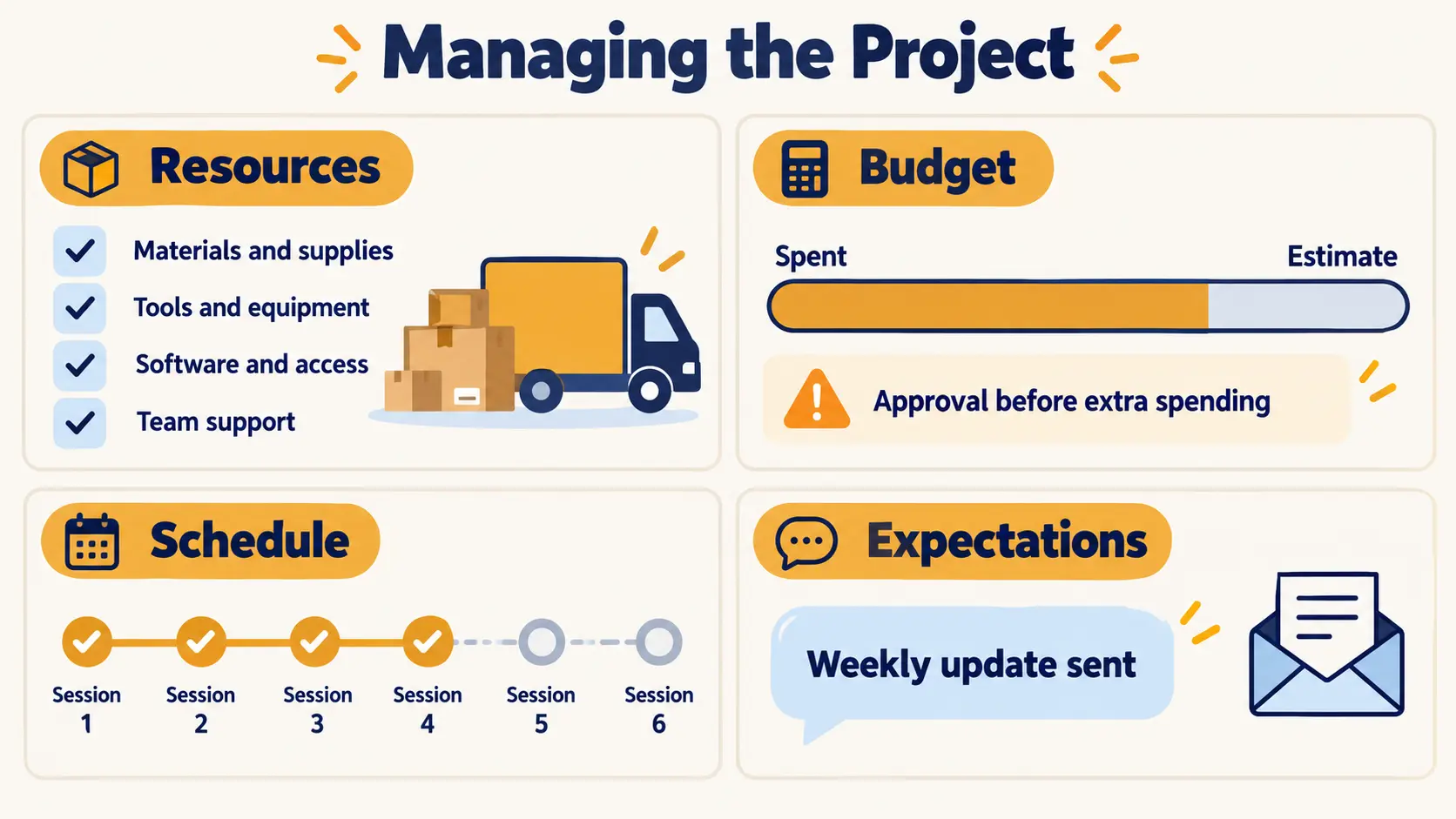
Once implementation starts, the organizer is also the project manager. That doesn't mean controlling the client — it means keeping the moving parts coordinated so the client can concentrate on the decisions only they can make. The outline names four things to manage:
| What to manage | Good practice | What goes wrong without it |
|---|---|---|
| Resources | Supplies ordered and delivered on time; vendors booked and coordinated; any assistants briefed and supervised | Sessions stall waiting for shelving; a stranger turns up at the client's door |
| Budget | Track actual spending against the estimate; keep receipts; get approval before any spending beyond what was agreed | A surprise on the final invoice — the fastest way to lose a client's trust |
| Schedule | Session agendas; progress checked against the timeline; adjust early when things slip | The deadline arrives with half the work undone |
| Expectations | Regular, honest updates; no surprises on cost, time or results | A competent project that still feels like a failure to the client |
Resources: supplies
Supplies were chosen during planning — after shopping the house (Lesson 11) — so implementation is mostly logistics. Who orders, who pays, and where do deliveries go? Will the supplies arrive before the session that needs them? What happens to unused or unsuitable items — can they be returned, and who handles it? Small details like these decide whether a session is productive or spent waiting. A good habit is to confirm every delivery the day before the session that depends on it.
Resources: vendors
Movers, cleaners, handypeople, shredding services and donation collectors all bring their own schedules and standards. The organizer books and coordinates them as agreed in the plan, makes sure they have what they need (access, timing, parking, what to take and what to leave) and briefs them on anything sensitive. Whether the client contracts the vendor directly or through the organizer, the client should know who is coming and why.
When a vendor causes a problem — a late delivery, a no-show, a scratched doorframe — the organizer tells the client promptly, explains what happened and helps resolve it. The instinct to fix things quietly so the client never knows feels helpful but isn't: the client is entitled to know what happens in their home, and a problem they discover later damages trust far more than one they hear about straight away.
Resources: helpers and assistants
Larger projects often involve assistants, subcontracted organizers or the client's own family. Three principles cover almost every exam question:
- The client knows who will be in their home. Introduce helpers in advance — names, roles and when they'll be there.
- Everyone follows the same standards. Confidentiality, conduct and respect for the client's decisions apply to every member of the team, certified or not. Many organizers use a written confidentiality agreement with assistants.
- The organizer stays responsible. Delegating a task doesn't delegate accountability. The organizer briefs helpers on the client's preferences and boundaries, supervises their work, and answers for any mistakes.
Family helpers need a little extra thought. A daughter helping her father sort his garage can be a great asset — or can start making decisions that are his to make. Agree with the client beforehand what the helper's role is, and keep decisions with the client (Lesson 2).
Budget: transparency, not just arithmetic
Budget management is mostly about transparency. Track spending against the estimate, keep receipts, return what isn't needed, and share updates at agreed points. A simple tracker is enough:
| Cost area | Estimate | Spent so far | Status |
|---|---|---|---|
| Consulting sessions | 8–10 sessions | 5 sessions | On track |
| Supplies | Agreed supply budget | About 70% used | Pantry containers still to buy — check before ordering |
| Vendors | Shredding + donation pick-up | Shredding done | Pick-up booked for next week |
| Removal | One junk-removal load | Not yet | Garage volume may need a second load — raise with client |
The rule the exam tests most often is simple: get the client's approval before spending beyond what they agreed — even when the amount is small. The reason isn't the money. It's that the budget is the client's decision, and spending past it without asking quietly takes that decision away. The same logic rules out the "helpful" alternatives: substituting cheaper items without saying so, absorbing the cost and resenting it, or adding it to the final invoice and hoping it isn't noticed.
"Beyond what was agreed" includes more than the total. Overspending in one cost area, adding a new cost area (a second junk-removal load), or a vendor's price going up all need a conversation. Notice the tracker above flags the garage before the money is spent. That is what good budget management looks like.
Schedule: agendas and early warnings
A short agenda at the start of each session keeps everyone aligned. It has three parts: what we'll work on today, what you'll need to decide, and what happens before next time. At the end of the session, a quick look at progress against the timeline tells you whether the project is on course.
Slippage rarely arrives all at once. Watch for the early signs:
- Decisions taking noticeably longer than expected — often a sign the material is harder emotionally than anyone predicted.
- Between-session tasks not getting done.
- Deliveries or vendors running late.
- Sessions being cancelled or shortened, or the client tiring earlier than planned.
When you see them, raise them early, while there are still good options: extending the timeline, adding sessions, re-prioritizing so the most important spaces are finished first, moving some work into a later phase, or adjusting session length. The client chooses. What the organizer must not do is catch up by making decisions for the client, rushing them, or quietly cutting the follow-up stage to hit the original date. Each of those protects the schedule by sacrificing the outcome.
Expectations: the no-surprises rule
Expectations were set in Domain I and written into the plan in Domain III, but they need active care during implementation. Clients commonly misjudge four things:
- PaceSpaces often look worse mid-project, while everything is out and being sorted. Say so before it happens.
- The organizer's roleAn organizer isn't a cleaner, a mover or a decision-maker. Reminders keep roles clear.
- CostThe estimate was a range. Regular updates stop the final figure being a shock.
- The resultFunctional, maintainable systems, not a magazine shoot. Link results back to the client's goals.
When news is unwelcome, a simple structure helps: what happened, what it means, the options, your recommendation — and the client's decision. It's honest, it's calm, and it keeps the client in control.
Evaluating Client Satisfaction (IV.E)
The outline names three areas to evaluate. They're worth memorizing — an exam question may simply ask which three areas IV.E covers:
| Area | What it covers | Example question |
|---|---|---|
| Processes | How the sessions work and feel: pace within sessions, communication, how decisions are supported | "How did today's way of working feel for you?" |
| Timeline | Overall pace and progress: session frequency, length, the speed of the project | "Is the pace of the project working for you, or should we adjust it?" |
| Resources | Supplies, tools, vendors and helpers | "How are the new containers working day to day?" |
Notice what's not on the list: how pretty the space looks, or how many bags left the house. Satisfaction is about the client's experience of the work. Whether the work achieved the client's goals over time is effectiveness, which is checked at follow-up (Lesson 16).
When to ask
Satisfaction is evaluated throughout the project, not just at the end. An end-of-project survey is useful, but it only tells you what you could have fixed. A two-minute check-in at the end of each session catches problems while there's still time to act. Natural milestones — finishing a room, a change of phase — are good moments for a slightly fuller conversation.
How to ask
Many clients won't volunteer criticism. They like the organizer, they feel vulnerable about their home, or they don't want to seem ungrateful. So the way you ask matters:
- Open and specific beats closed and general. "What's one thing that would make the next session work better?" invites a real answer. "You're happy with everything, aren't you?" invites a polite yes.
- Make it safe to be honest. Say why you're asking: "I adjust how I work for every client, so tell me what isn't working."
- Offer more than one channel. Some clients find it easier to write than to say it face to face. A short form or message after a session works well.
Reading the signals
Dissatisfaction doesn't always come in words. Repeated cancellations, between-session tasks left undone, short answers, or a client who seems drained can all signal that something isn't working — or can mean something else entirely. The professional response is to notice and ask, gently and without assuming: "I've noticed the last couple of sessions have felt harder. How is the process working for you?"
Acting on feedback
Feedback that changes nothing teaches clients not to give it. Close the loop: thank them, agree a specific change, make it, and check whether it helped.
| The client says… | A good adjustment |
|---|---|
| "Sessions feel rushed." | Fewer tasks per session, more time for decisions, or shorter, more frequent sessions |
| "I'm exhausted by the end." | Shorter sessions, a break mid-session, the hardest category at the start |
| "I don't know what's happening next." | A written agenda and a brief summary after each session |
| "The bins are too heavy to lift down." | Lighter containers or a lower shelf — check against the physical needs from assessment |

Handling complaints
A complaint is feedback with urgency attached, and handling it well can strengthen the relationship. A reliable sequence:
- Listen fully, without interrupting or defending.
- Acknowledge the client's experience: "I can see why that was upsetting."
- Clarify what happened and what the client would like.
- Agree an action — what will change, and by when.
- Follow through, and check back that it's resolved.
When the complaint involves a genuine mistake — an item sent to donation that the client meant to keep, a helper who shared details they shouldn't have — the organizer takes responsibility, tells the client honestly what happened and does what they reasonably can to put it right. Minimizing, blaming the helper, or explaining why it wasn't really your fault all make things worse.
Testimonials and reviews
It's fine to ask a satisfied client for a testimonial or review. Using their words, name or photos of their home publicly requires their explicit consent, and their words should be used as given, not edited into something they didn't say. Confidentiality doesn't end when the client is happy (Lesson 17).
Exam Traps for IV.D–E
| If an answer… | …it's probably wrong because |
|---|---|
| Buys the item because the overspend is small | Any spending beyond what was agreed needs approval first |
| Quietly substitutes a cheaper option | Hides a change from the client; the decision was theirs |
| Fixes a vendor problem without telling the client | The client is entitled to know what happens in their home |
| Treats assistants as exempt from confidentiality | Everyone on the team follows the same standards |
| Catches up by deciding for the client | Protects the schedule by sacrificing the client's control |
| Cuts follow-up to meet the original date | Hides the slippage and removes a key stage |
| Asks for feedback only at the end | Too late to fix anything |
| Asks "You're happy, aren't you?" | A leading question invites a polite yes, not the truth |
| Publishes a glowing review without asking | Testimonials need explicit consent |
10 questions in the style of the CPO® exam. Score 70%+ to mark this lesson complete.
- IV.D covers managing resources, budget, schedule and expectations; IV.E covers client satisfaction with processes, timeline and resources.
- Coordinate supplies, vendors and helpers; the client knows who is coming, everyone follows the same confidentiality and conduct standards, and the organizer stays responsible.
- Track spending against the estimate and get approval before any spending beyond what was agreed — however small.
- Use session agendas, watch for early signs of slippage, and agree an adjusted plan with the client — never catch up by deciding for them or cutting follow-up.
- No surprises: what happened, what it means, the options, your recommendation — and the client's decision.
- Check satisfaction throughout with open questions, act on what you hear, handle complaints without defensiveness, and get consent before using testimonials.
Before moving to Lesson 16:
- Draft a three-part session agenda you could share at the start of a session.
- Write one open feedback question each for processes, timeline and resources.
- Script how you'd tell a client that a vendor delivery is delayed by a week, using the five-part structure.
- Complete the knowledge check above and review any question you missed.