Even the best plan meets resistance. Mid-project, organizers use communication skills — negotiating, clarifying and influencing ethically — to keep work moving, and they handle the most common obstacles: procrastination, perfectionism and scope creep. The aim is never to push the client harder, but to understand what's in the way and adjust, while keeping the client in control and the project within its agreed limits.
Lessons 10–13 covered the organizing and productivity fundamentals. This lesson covers what happens when the work meets real life: applying communication skills to carry out the plan — negotiating, clarifying and influencing (IV.B) — and addressing challenges and obstacles such as procrastination, perfectionism and scope creep (IV.C).
No plan survives contact with a real home unchanged. Clients hesitate, change their minds, get tired, disagree with their partners and ask for "just one more thing". None of this means the project is failing. It means the organizer's communication skills are now doing as much work as their organizing skills.
On the exam, these questions usually test the same balance: keep the project moving, but never at the cost of the client's autonomy or the agreed plan. The wrong answers tend to fail in one of two directions — pushing the client too hard, or letting the project drift without comment.
Free on YouTube Subscribe to get every lesson video in this course SubscribeCommunication Skills to Carry Out the Plan (IV.B)
The outline names three skills: clarify, negotiate and influence. Each builds on the listening skills from Domain I (Lesson 2).
Clarify
Clarifying means checking what the client means before acting. It matters most with belongings, because a misunderstanding about what to discard can't be undone. Vague words are the danger signs: "tidy", "old stuff", "the usual", "get rid of the rubbish".
| Technique | Sounds like |
|---|---|
| Ask for examples | "When you say 'old stuff', could you show me a couple of things you mean?" |
| Paraphrase | "So everything in this box goes to donation, except the photo albums — is that right?" |
| Define the word | "Does 'tidy' mean cleared surfaces, or everything put away?" |
| Confirm next steps | "Before Thursday, you'll sort the top drawer — and I'll book the donation pick-up." |
| Summarize at the end | "Today we cleared the pantry floor and agreed the categories. Next time: the cupboards." |
Negotiate
Negotiating means finding workable middle ground — between the client's wishes and the space, between household members, or between the plan and a new request. Good negotiation looks past positions ("I'm keeping all of them") to interests (why they matter), then looks for options that serve those interests:
| The tension | A negotiated option |
|---|---|
| Forty mugs; one small cupboard | "Could we keep the ten you use most here, and store the rest in the loft?" |
| One partner wants the spare room as an office, the other as a guest room | A desk with a fold-out bed; a shared calendar for when guests visit |
| A new request versus the agreed plan | Add it as a later phase, or swap it for a lower priority (Lesson 9) |
The organizer never "negotiates" a client into discarding something. Negotiation is about arrangements and priorities. What a client keeps is still their decision.
Influence — ethically
Influence means helping the client see how a choice connects to their own goals. It's legitimate and often necessary. Pressure isn't. The line between them is a frequent exam theme:
| Ethical influence | Pressure |
|---|---|
| "You said you wanted the desk clear for your studies — would this pile help with that?" | "You obviously don't need this." |
| Asking questions that help the client decide | Making the decision for them |
| Offering choices: "This shelf or the loft?" | Rushing: "Quick, keep or go?" |
| Sharing information neutrally: "Most charities don't accept these." | Guilt or comparisons: "What would your guests think?" |
| Respecting "no" | Asking the same question until the client gives in |
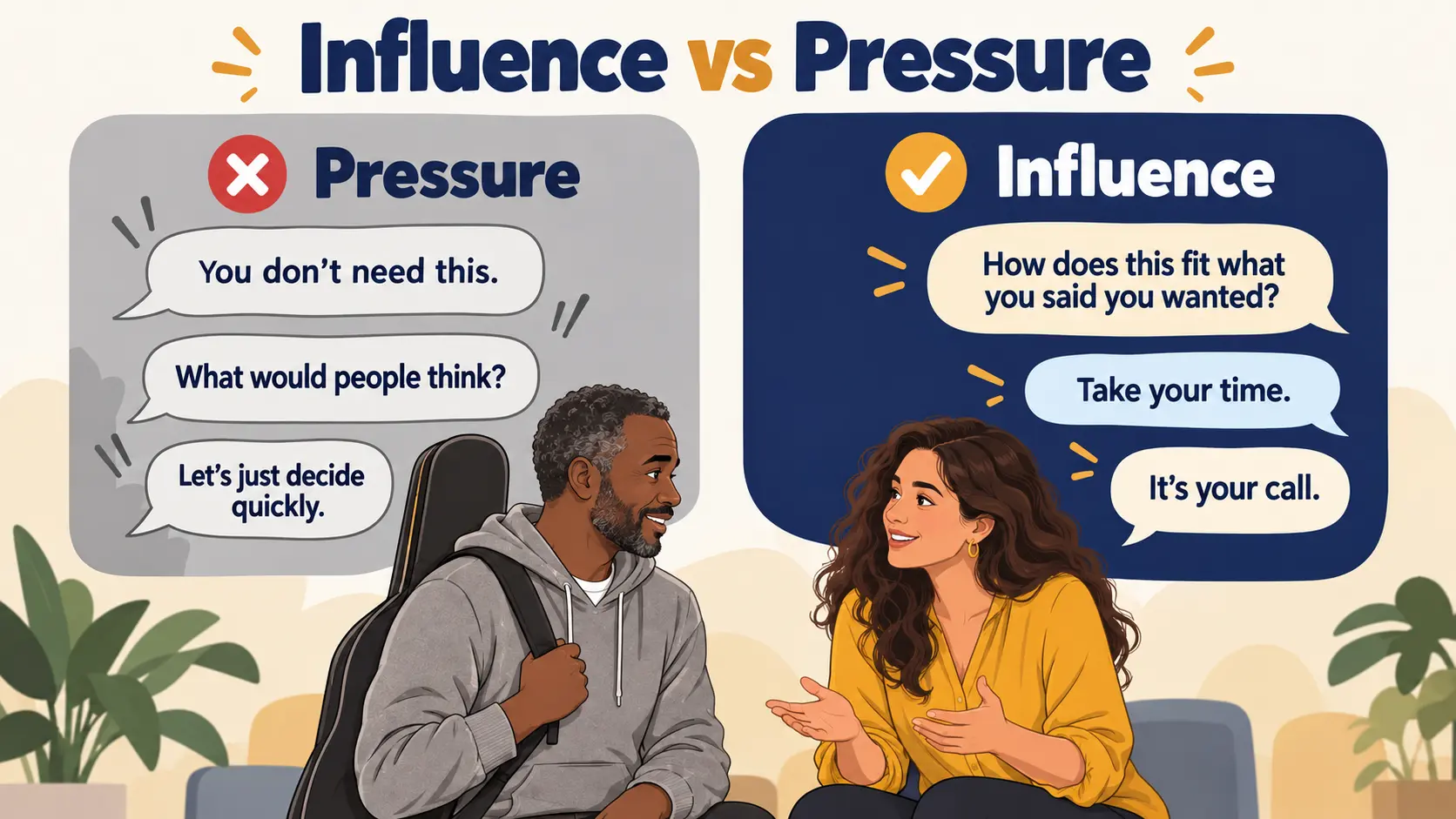
Pressure isn't just unethical — it doesn't work. Decisions made under pressure tend to be reversed, items get retrieved from donation bags, and the client stops trusting the organizer with harder decisions. Influence keeps the decision with the client, so it lasts.
Common Obstacles (IV.C)
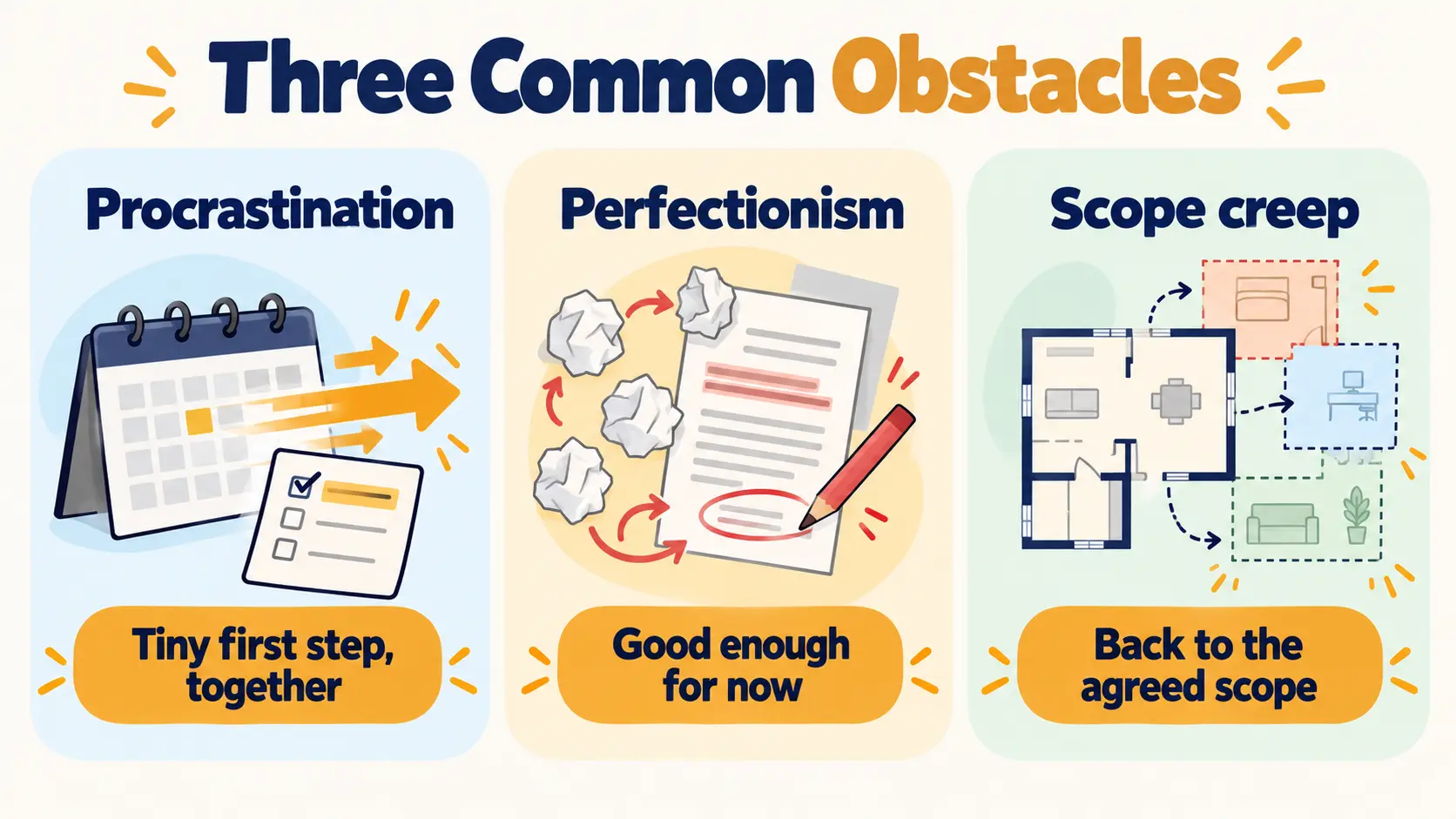
The outline gives three examples — procrastination, perfectionism and scope creep. Each has a recognisable pattern and a set of practical responses.
Procrastination
Postponed sessions, between-session tasks that never get started, "I'll do it when I have a free weekend". Procrastination usually has a reason, and the reason points to the response:
| What's really in the way | What usually helps |
|---|---|
| The task feels too big | A small, specific first step: "Just the top drawer" |
| The next step is unclear | Spell it out: what, where, and when it counts as done |
| A decision feels emotionally heavy | Start with an easier category; come back later |
| Fear of doing it "wrong" | Make decisions reversible — a "maybe" box with a review date |
| Low energy or time | Short, time-boxed sessions; working alongside the client |
Telling a client to try harder rarely helps. Understanding what's in the way — without judgement — usually does. Many clients find it far easier to start when someone is working alongside them for a short session. And if postponing becomes a pattern across the project, it may be a sign that the pace or the plan needs adjusting with the client (Lesson 15).
Perfectionism
Endless re-sorting, waiting for the "right" container, a session spent relabelling one shelf, a project that never starts because the perfect system hasn't been found. Perfectionism can look like dedication, but it often stops progress — and it can make systems too complex to keep up.
- Acknowledge the care behind it: "You clearly want this to work well."
- Name the trade-off: "We have an hour left — keep going on labels, or move to the pantry as planned?"
- Time-box: "Ten more minutes on this, then the pantry?"
- Good enough for now: simple systems that can be refined later, once they've been used.
The choice stays with the client. The organizer doesn't take over the task to speed things up, and doesn't label the client a perfectionist.
Scope creep
"While you're here, could you also…" — spaces, tasks or services added bit by bit. New requests aren't a problem in themselves; they often mean the client is pleased with the work. The problem is adding them without agreement, because each addition quietly stretches the timeline and the budget.
| Step | Sounds like |
|---|---|
| Welcome it | "I'd be happy to look at the spare room." |
| Refer to the scope | "It's not in what we agreed, so let's look at what it would involve." |
| Explain the impact | "It would add about two sessions and some supply costs." |
| Agree and update | "Shall we add it now, as a later phase, or leave it?" — then update the plan (Lesson 9) |
Note the difference between scope creep and a change of priority within scope. If the client wants to do the agreed kitchen before the agreed hallway, that's a reordering, not new work. It still needs a conversation, but it doesn't change time or cost.
Other Mid-Project Challenges
Changed minds
A client can change their mind about their belongings at any point, even after agreeing to donate something. The organizer respects it without comment or sighing. The item can be revisited later if the client wishes. Agreeing in advance when donations will leave the house helps, because it gives the client a natural point to reconsider.
Household disagreements
When household members disagree mid-project, the organizer facilitates and doesn't take sides: clarify each person's goals, look for options everyone can accept, and agree how shared decisions will be made. Belongings that belong to one person are that person's decision. If a disagreement can't be resolved, the work can focus on areas that aren't in dispute while the household talks it through.
Decision fatigue and emotional moments
Decisions get harder as a session wears on. Signs include slower decisions, keeping everything, or irritability. Take a break, switch to an easier task, or end the session early (Lesson 10). If distress goes beyond normal reluctance, follow the guidance in Lesson 5.
Unexpected discoveries
| Discovery | What the organizer does |
|---|---|
| Cash, jewellery or valuables | Pause, show the client immediately, and set aside somewhere safe that they choose |
| Important documents | Show the client; set aside for the paper system or the relevant professional |
| A hazard | Stop work in that area; raise it; refer (Lesson 6) |
| Something sensitive or personal | Pause; let the client decide how it's handled; keep it confidential |
| A concern about someone's safety | Follow the guidance in Lesson 5 — appropriate professionals or authorities |
The principle is consistent: pause, tell the client, decide together. Never pocket, discard or act on a discovery without the client knowing.
Exam Traps for IV.B–C
| If an answer… | …it's probably wrong because |
|---|---|
| Acts on "get rid of the old stuff" without checking | Clarify before acting |
| Applies gentle pressure until the client agrees | Influence links to goals; pressure undermines autonomy |
| Mentions what guests or family will think | Guilt and comparisons are pressure |
| Takes one partner's side | Facilitate; don't take sides |
| Tells a procrastinating client to try harder | Find what's in the way; small first step |
| Takes over the labelling to save time | Keep the client in control |
| Lets the session drift without comment | Name the trade-off; time-box |
| Starts the extra room to keep the client happy | Use the change process |
| Questions a client who changes their mind | Respect it; revisit later if they wish |
For a deeper look at why projects stall and how energy comes back, see our guide to burnout recovery.
10 questions in the style of the CPO® exam. Score 70%+ to mark this lesson complete.
- IV.B and IV.C cover communication skills mid-project and the common obstacles — keep the project moving without costing the client's autonomy.
- Clarify before acting — examples, paraphrasing, defining vague words; negotiate around interests, not positions; never negotiate a client into discarding.
- Influence only by linking choices to the client's own goals. Pressure — guilt, comparisons, rushing, deciding for them — is unethical and doesn't last.
- Procrastination: find what's really in the way and match the response — small first steps, clear next steps, reversible decisions, time-boxed sessions together.
- Perfectionism: acknowledge the care, name the trade-off, time-box, "good enough for now". Scope creep: welcome it, refer to scope, explain impact, agree and update.
- Respect changed minds, facilitate disagreements without taking sides, watch for decision fatigue, and handle discoveries by pausing and telling the client.
Before moving to Lesson 15:
- Rewrite one pressuring phrase ("You don't need this") as an influencing question linked to a goal.
- Pick a task you've been putting off, name what's really in the way, and define a first step that takes ten minutes or less.
- Write the four sentences you'd use to handle a "while you're here, could you also…" request.
- Complete the knowledge check above and review any question you missed.