An organizing project succeeds when the client can keep it going without the organizer. That takes systems simple enough for daily life and flexible enough to change when life changes; small routines anchored to habits the client already has; a sensible use of their energy, money and health; and clear boundaries and shared responsibility so one person isn't holding the whole system up.
The last four fundamentals in Domain IV look past the day of the organizing session to the weeks and months after it: maintaining systems through sustainability and change (IV.A.10), optimizing personal resources such as energy, money and health (IV.A.11), creating routines and habits (IV.A.12), and setting boundaries and delegating (IV.A.13). They connect directly to Domain V, Follow Up and Maintenance, where the organizer checks whether changes lasted.
Anyone who has tidied a room on Saturday and watched it slide back by Thursday knows the problem these items address. Organizing is an event; staying organized is a habit. The organizer's real goal is to build what keeps the system going when no one is coaching: simple design, small routines, shared responsibility and limits that protect the space. On the exam, the thread linking these items is sustainability: the best answer is usually the one the client can keep doing on their own.
Free on YouTube Subscribe to get every lesson video in this course SubscribeMaintaining Systems: Sustainability and Change
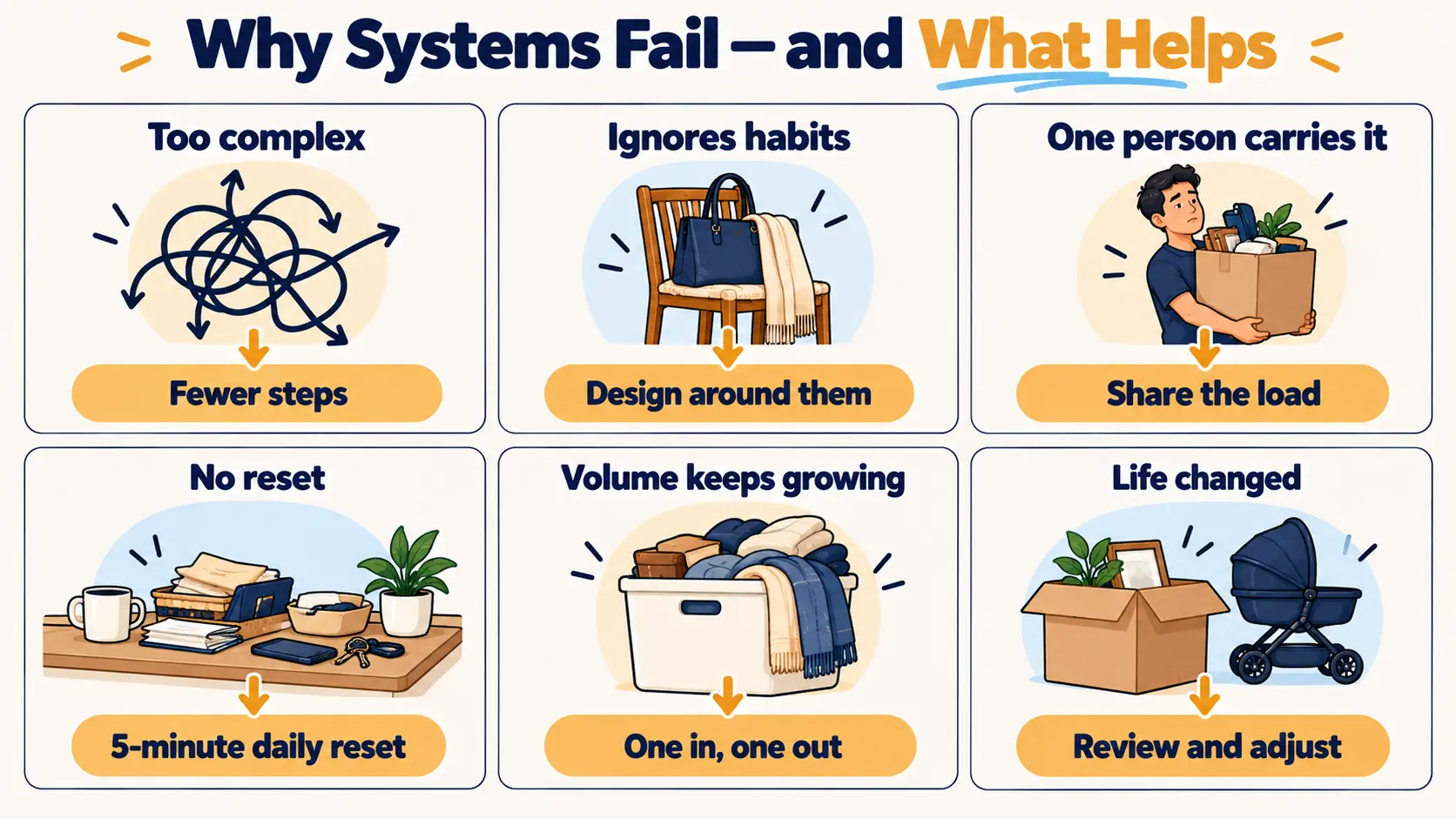
Most organizing systems that fail don't fail on day one. They fade over a few weeks. Knowing the common reasons helps an organizer design against them from the start.
| Why systems fail | What helps |
|---|---|
| Too complex — too many categories, steps or rules | Fewer, broader categories and fewer steps (Lessons 10–11) |
| Doesn't match the client's real habits | Design around what they already do, then test it |
| Depends on one person to keep it up | Involve everyone who uses the space; share responsibility |
| No regular reset | Short daily and weekly reset routines |
| Volume keeps growing | Container limits and "one in, one out" agreements |
| Life changed and the system didn't | Review and adjust the system at major transitions |
That last row matters on the exam. The outline pairs sustainability with change: a new baby, a new job or working from home, a move or downsizing, a child leaving home, a new diagnosis or caring role, retirement, or a loss in the family. Each one changes what a client needs from their space and time. A good organizer treats systems as living — built to be adjusted — and helps clients recognise when it's time to revisit them, rather than seeing an old system breaking down as a personal failure. Our guides to decluttering before a move and the seasonal home reset show this in practice.
Life transitions and what they change
| Transition | What changes | A typical adjustment |
|---|---|---|
| New baby | Volume, routines, sleep and energy | A changing and feeding zone; simpler resets; more delegation |
| Working from home | A space needs to become a workplace | A defined work zone; paper workflow; time boundaries |
| Child leaving home | A room's purpose; belongings left behind | Agree with the young adult what stays; repurpose the room |
| Downsizing or a move | Less space; a deadline | Edit to the new space; plan backward (Lesson 9) |
| New caring role or health change | Physical needs, time, paperwork | Reach, safety and access; a care-paper system (Lesson 5) |
| Bereavement | Emotional weight; another person's belongings | A slower pace; the client decides when (Lesson 10) |
Designing for change from the start
Some choices make a system easier to adapt later: adjustable shelving rather than fixed, broad categories that can absorb new items, labels that are easy to change, and a little spare capacity rather than every container full on day one. Agreeing a natural review point — the start of a school year, a new year, a seasonal reset — helps the client revisit the system before it breaks down.
Optimizing Personal Resources: Energy, Money and Health
Item IV.A.11 asks organizers to help clients make good use of three limited resources. The key is staying within an organizer's role: optimizing how these resources are used in organizing, not giving medical or financial advice.
- EnergySchedule demanding work, like decision-heavy sorting, for the client's best time of day. Size sessions to their stamina, build in breaks, and put lower-effort tasks where energy dips.
- MoneyUse what the client already owns, buy only what the plan needs, and stick to the agreed budget. Organized systems can also reduce waste — fewer duplicate purchases, fewer late fees, less food thrown away. Budgeting advice beyond organizing belongs with the client or a financial professional.
- HealthDesign for comfort and safety: everyday items in easy reach, lighter containers, clear walkways. Respect physical limits during sessions. Health concerns are referred to qualified professionals — never assessed or treated.
| Resource | In scope for the organizer | Refer when… |
|---|---|---|
| Energy | Hardest decisions at the client's best time; shorter sessions; breaks | Exhaustion or focus problems persist → a qualified health professional |
| Money | Shop the house; buy only what's needed; reduce duplicate purchases and late fees | Budgeting, debt or investment questions → a financial professional |
| Health | Reach, weight, walkways, comfortable session pacing | Symptoms, pain or safety concerns → health professionals |
The organizer's own resources count too. Sessions that run too long exhaust both people and lead to poorer decisions — another reason to plan realistic session lengths in the project plan.
Creating Routines and Habits
Routines are what keep a system working between visits. A routine doesn't need to be long; it needs to be regular and easy.
How habits form
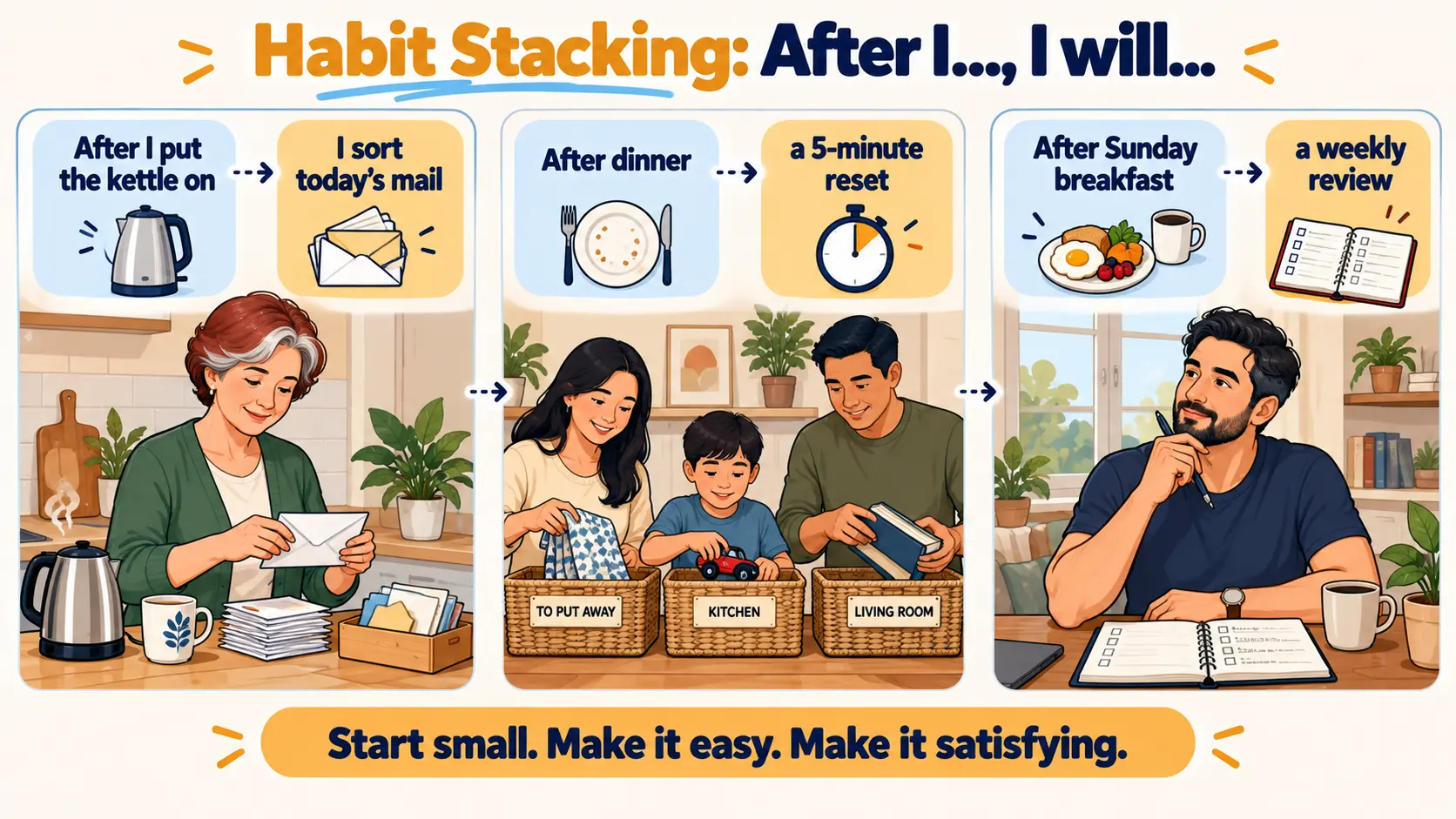
A common way to describe a habit is a loop: a cue (something that triggers the behaviour), the routine itself, and a reward (something that makes it feel worth doing). Organizers use that loop to make new habits easier:
- Anchor it to an existing habit — sometimes called habit stacking. "After I put the kettle on, I sort today's mail." The existing habit becomes the cue.
- Start small. A five-minute evening reset that actually happens beats an hour-long Sunday clean-up that doesn't.
- Make it easy and visible. Reduce the steps (Lesson 11), keep the tools where the habit happens, and use visual reminders.
- Make it satisfying. A clear surface, a tick on a checklist, or a shared moment as a family all reinforce the routine.
- Daily reset (5–15 minutes)Return items to their homes, clear key surfaces, set up the launch pad for tomorrow.
- Paper and email routineProcess the inbox tray and email on a set schedule (Lesson 12).
- Weekly reviewLook at the calendar and task list, empty the relocate and donate spots, plan the week.
- Seasonal or yearly resetRotate seasonal items, purge reference files, revisit the undecided box.
A worked example: designing a habit with a client
Amir's mail system works on Saturdays but piles up during the week. The organizer and Amir design a habit using the loop:
| Part | Amir's version |
|---|---|
| Cue | Putting his keys on the hook when he gets home — something he already does every day |
| Routine | Two minutes at the mail station beside the hook: recycle junk, put the rest in the action folders |
| Make it easy | Recycling bin and folders within arm's reach of the hook — no extra steps |
| Reward | A clear counter when he walks into the kitchen |
When a routine lapses
Every routine lapses sometimes — a busy week, an illness, a holiday. Missing one day isn't failure. The useful questions are whether the routine is too big, the cue too unreliable, or the steps too many. Organizers encourage clients to restart without guilt and to shrink the routine if it keeps slipping. A two-minute habit that survives beats a twenty-minute one that doesn't.
Routines are personal. Some clients like checklists and trackers; others prefer a loose rhythm. As with every other part of Domain IV, the organizer suggests and the client chooses. For more on building routines that stick, see our guides to a step-by-step morning routine and a wind-down routine that works.
Setting Boundaries and Delegating
The final fundamental in this group is about limits and shared work. Both protect the system — and the client — from overload.
Boundaries
Boundaries are agreed limits that protect space, time and attention. Examples an organizer might help a client set include:
- Space boundaries: the guest room stays a guest room, not overflow storage; the dining table is cleared before dinner.
- Volume boundaries: one in, one out; the container is the limit.
- Time boundaries: email checked at set times; work stops at a set hour when working from home.
- Digital boundaries: fewer notifications and app limits (see our digital minimalism guide).
- Commitment boundaries: learning to say no to requests that don't fit the client's priorities from Lesson 12.
Delegating
No system should depend on one person. Delegation spreads the work — inside the household and, where it makes sense, outside it:
- Involve everyone who uses the space in designing the system, so it makes sense to them too.
- Make responsibilities clear and visible — a shared chart, assigned zones, or labelled "homes" that anyone can follow.
- Match tasks to ability — young children can put toys in picture-labelled bins; teenagers can own their laundry routine.
- Consider outside help such as cleaning, grocery delivery or a bookkeeper, if it suits the client's budget and goals.
Delegating by age and ability
| Who | Tasks that often suit them |
|---|---|
| Young children | Toys into picture-labelled bins; shoes on the rack; own bag on their hook |
| Older children | Unloading the dishwasher into labelled zones; packing their school bag at night |
| Teenagers | Their own laundry and room reset; a shared-space zone each week |
| Partners and adults | Owning whole zones or routines — paperwork, the weekly shop, the evening reset |
| Outside help | Cleaning, grocery delivery, a bookkeeper — if it fits the budget and goals |
Delegation works when tasks are defined ("toys in the bins before dinner", not "help tidy"), shown once, checked gently at first — and when the person who used to do everything accepts that others may do it differently. Re-doing a child's tidying teaches them not to bother.
The organizer's role is to facilitate, not to take sides in household disagreements. Where family dynamics affect the project (identified back in Domain II), the organizer helps the people involved reach their own agreements.
Exam Traps for IV.A.10–13
| If an answer… | …it's probably wrong because |
|---|---|
| Blames the client when a system fades after a life change | Life changed — adjust the system |
| Reorganizes the space exactly as before | Find why it failed; simplify |
| Adds more categories and rules to a failing system | Complexity is a common cause of failure |
| Gives budgeting or medical advice | Optimize within organizing; refer the rest |
| Relies on alarms or willpower for a new routine | Anchor it to an existing habit |
| Sets a two-hour weekly clean-up | Start small — a five-minute reset |
| Gives one person stricter rules to enforce | No system should depend on one person |
| Takes a side in a household disagreement | Facilitate — the family agrees |
10 questions in the style of the CPO® exam. Score 70%+ to mark this lesson complete.
- Systems fail when they're too complex, habit-blind, one-person, reset-free, growing — or unchanged by life. Design against each from the start.
- Treat systems as living: review and adjust them at major life transitions, and build in flexibility — adjustable storage, broad categories, changeable labels, a review point.
- Optimize energy, money and health within organizing; refer health and financial questions to the right professionals.
- Habits: anchor to an existing habit, start small, make it easy and visible, make it satisfying — and treat lapses as a reason to shrink the routine, not as failure.
- Daily, weekly and seasonal resets keep systems working between visits; boundaries protect space, volume, time, attention and commitments.
- Delegate so no system depends on one person — defined tasks matched to age and ability; the organizer facilitates and never takes sides.
Before moving to Lesson 14:
- Think of one system in your home that has faded. Which of the six failure reasons fits best?
- Write one habit stack for yourself using the cue–routine–reward table: "After I ___, I will ___ (for five minutes or less)."
- Pick one task in your household that could be delegated, and define it clearly enough for someone else to do.
- Complete the knowledge check above and review any question you missed.