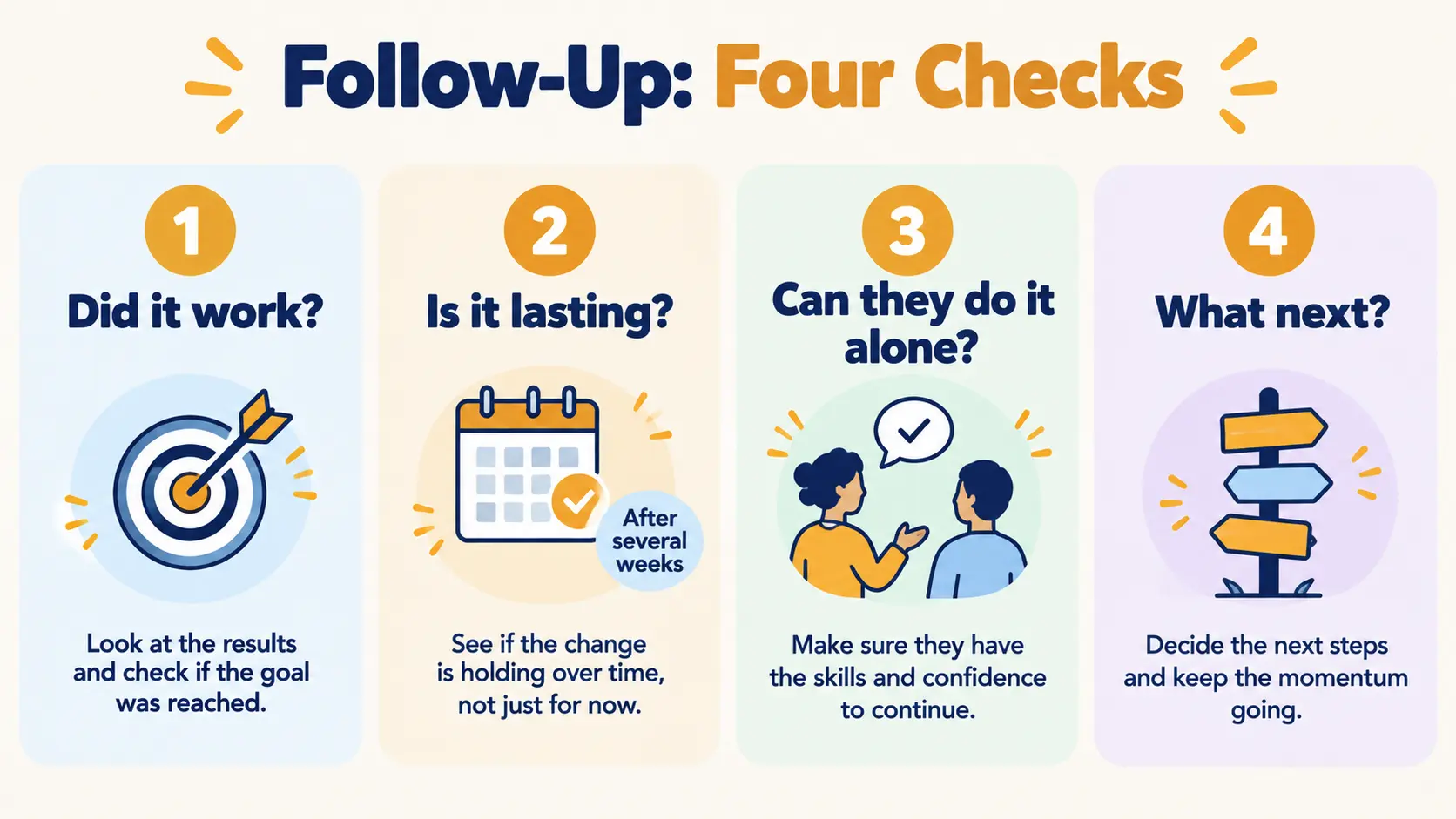
Follow-up is where the organizer finds out whether the project really worked. Weeks after the hands-on sessions, the organizer checks four things with the client: did the changes do what the client wanted, are they lasting, can the client keep them going without help, and what should change next. A slipped system isn't a failure — it's information for adjusting it, without judgement.
Domain V, Follow Up and Maintenance, is 12% of the CPO® exam — the same weight as Preliminary Communication, and it all fits in one lesson. It has four outline items: evaluating the effectiveness of changes (V.A), their sustainability (V.B), the transference of skills (V.C), and making recommendations — modifications and resources (V.D).
The exam treats follow-up as a core part of the job, not an optional extra. A space can look transformed on the last day of a project and be back to its old state a month later. The only way to know whether the work really helped is to come back once ordinary life has tested it. Follow-up is how an organizer learns whether the project worked, why parts of it didn't, and what would make the change last.
One distinction is worth holding onto. Satisfaction (IV.E, Lesson 15) is the client's experience of the work while it's happening. Effectiveness (V.A) is whether the work achieved the client's goals once the organizer has gone. A client can enjoy every session of a project that doesn't last — and Domain V is designed to catch that.
Free on YouTube Subscribe to get every lesson video in this course SubscribePlanning the Follow-Up
Follow-up is planned into the project from the start, not arranged only if the client calls with a problem. It appears in the plan approved in Domain III (Lesson 9), with its timing and format agreed with the client.
| Decision | Good practice |
|---|---|
| When | Usually some weeks after hands-on work, once systems have been used in everyday life. Some organizers add a short check-in after the first week to catch early problems. |
| Format | Whatever the client agrees to — a visit, phone call, video call or message. Some clients prefer not to have the organizer in their home again, and that's their choice. |
| Who's involved | Everyone who uses the systems, where possible. A shared system can only be evaluated by the people who share it. |
| Boundaries | Scheduled, never unannounced. Respectful of privacy. A genuine check on the client's progress, not a sales call. |
Preparing
Before the follow-up, the organizer reviews the plan: the client's goals written as outcomes in their own words (Lesson 7), the systems set up, the routines agreed, and anything left unfinished. These are the yardsticks. Without them, follow-up drifts into a general chat about how things are going.
A simple structure
- Open warmly and explain the purpose: to see what's working and adjust what isn't.
- Ask what's working — start with progress, in the client's words.
- Ask what's hard — which parts are difficult to keep up, and when.
- Observe and teach back — look at the systems in use and ask the client to show how they handle them.
- Adjust what has slipped, together.
- Recommend next steps, and agree what happens next.
Effectiveness: Did It Work? (V.A)
Effectiveness is measured against the client's own goals. It isn't about how many bags left the house, how many containers were installed, or how good the space looks in photos. Those are activity measures. They describe the work, not its results.
| The client's goal | An effectiveness question | A weak measure |
|---|---|---|
| "Get out of the house on time" | "How many mornings last week did you leave on time?" | Number of hooks installed |
| "Stop missing bills" | "Have any bills been late since we set up the system?" | Bags of paper shredded |
| "Cook without clearing the counter" | "Can you start cooking straight away now?" | Before-and-after photos |
| "Feel calmer at home" | "When do you notice feeling calmer — or not?" | How tidy the room looks today |
The best evidence combines what the client reports, what the organizer observes, and specific recent examples: "The last time you needed your passport, how long did it take to find?" Specific questions get past polite generalities.
Effectiveness is often partial. The entryway may be working while the paperwork goal isn't yet met. That's useful information — it tells the organizer exactly where the recommendations in V.D should focus.
Sustainability: Is It Lasting? (V.B)
A sustainable system is one the client keeps using without effort. Things go back to their homes, reset routines happen, and the space stays functional through ordinary weeks. Some slippage by follow-up is normal. What matters is how the organizer responds to it.
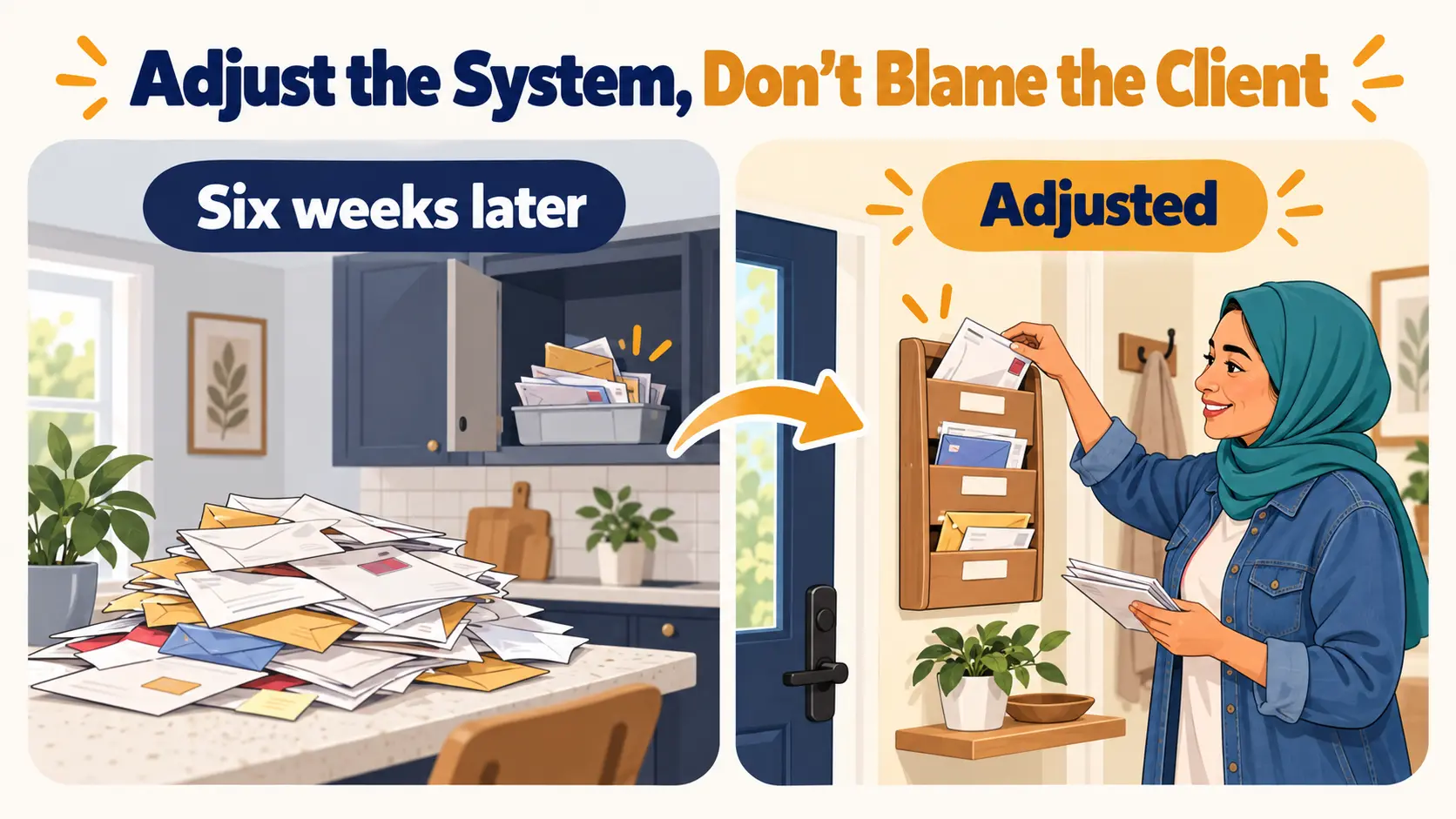
A slipped system is information
The exam rewards a calm, curious, non-judgemental response. When a system has slipped, the organizer's job is to find out why — because the reason points straight to the fix:
| Why it slipped | What you might see | A likely adjustment |
|---|---|---|
| Too many steps | Items left "next to" their home | Remove a step: open bins instead of lidded boxes |
| Wrong location | A pile where things actually land | Move the system to the landing spot |
| Unclear categories or labels | Items in the wrong place | Simpler categories, clearer labels |
| One-person system | Works for one person, not the household | Involve everyone; redesign for shared use (Lesson 13) |
| No reset routine | Gradual drift over weeks | A short daily or weekly reset tied to an existing habit |
| Volume creep | Containers overflowing | Revisit the container limit; a regular edit |
| Life changed | New job, new baby, a loss, working from home | Review the whole system against the new routine |
"Try harder" is never the answer. Neither is resetting the same system and hoping for a different result — if it didn't fit real life the first time, it won't the second.
When the client blames themselves
Clients often apologize at follow-up: "I'm just not an organized person." That belief can undo the confidence the project built. The organizer acknowledges the feeling, points to what is working, and reframes the slip as a design problem: the system didn't fit — so they'll change the system. This isn't just kindness. It's accurate, and it keeps the client engaged in adjusting rather than giving up.
Skill Transfer: Can the Client Do It Alone? (V.C)
Domain IV was about teaching, transferring and applying organizing skills. V.C checks whether that happened. The skills that matter fall into four groups:
- MaintainPut things back, run the reset routine, process incoming mail.
- AdaptDecide where a new item goes, and why.
- DecideMake keep-or-let-go decisions using the criteria practised together.
- PlanUse the productivity routines — the weekly review, the calendar, the task list.
The teach-back
The most reliable check is a teach-back: the client shows or explains how they would do something, using a real task. "Here's today's mail — walk me through what you'd do with it." "You've just bought a new blender — where would it go, and why?" Asking "Do you remember how the system works?" only tests whether the client is willing to say yes.
A good teach-back means the organizer watches without jumping in, praises specific things the client does well, and only then fills any gaps. If the client can maintain the system but can't adapt it to new items, the skill has partly transferred — and that's exactly what to work on next.
When the skill hasn't transferred
The answer isn't to repeat the same explanation more slowly. Teach it differently, matched to the client's learning style (Lesson 4): show rather than tell, practise together, or leave a visual cue such as a photo of the "reset" state taped inside a cupboard door. Simplify the system if the skill it demands is too complex. The goal is independence: a client who can keep things going, and adapt them, without the organizer.
Making Recommendations (V.D)
Recommendations are based on what follow-up revealed, and made in the client's interest. The outline names modifications and resources; in practice there are four kinds:
| Recommendation | When it fits | Example |
|---|---|---|
| Modification | A system mostly works but one part doesn't | Clearer labels; moving the mail sorter to the door |
| Resource | A tool, guide, template or referral would help | A wall calendar; a referral to an accountant for retention questions |
| Maintenance support | The client wants regular help to keep systems going | Seasonal resets or periodic check-ins |
| Next phase | Goals remain, or spaces were left out of scope | "The kitchen works — shall we look at the paperwork next?" |
Principles for recommending
- Evidence-based — every recommendation links to something follow-up showed.
- Smallest effective change first — a modification that keeps what works usually beats a new system.
- In the client's interest — maintenance sessions are offered because they help, not as an automatic upsell. Any financial interest in a product or referral is disclosed (Lessons 8 and 17).
- Within competence — needs beyond organizing become referrals.
- The client decides which recommendations to take up.
Life changes and wellbeing
Systems are built for a particular life, and lives change. A new job, working from home, a new baby, an older parent moving in or a bereavement are all reasons to review whether systems still fit — at follow-up and at any later check-in. And if a client shares that they're struggling more generally, the organizer responds with care. Where it's appropriate, they gently encourage the client to seek professional support, staying within the organizer's role (Lesson 5).
Closing the project
Follow-up is also a natural ending point. Summarize the progress against the goals, acknowledge the client's work, agree any next steps, and make sure the client knows how to get in touch. A clear close respects the client's independence — which was the aim all along.
Exam Traps for Domain V
| If an answer… | …it's probably wrong because |
|---|---|
| Follows up only if the client calls with a problem | Follow-up is planned into the project |
| Drops in unannounced to see how things look | Scheduled, agreed format, respects privacy |
| Measures success in bags, containers or photos | Effectiveness = the client's goals |
| Tells the client to try harder | A slipped system is information |
| Resets the same system unchanged | Find out why, then adjust |
| Has the organizer demonstrate the system again | A teach-back is the client showing |
| Recommends maintenance sessions to every client | Only when it serves the client |
| Says nothing because the client says she's happy | Raise what you observe — gently |
Our guide to the seasonal home reset is a simple example of maintenance a client can do on their own.
10 questions in the style of the CPO exam. Score 70%+ to mark this lesson complete.
- Domain V (12%) covers effectiveness, sustainability, skill transfer and recommendations — what happens after the organizer leaves.
- Plan follow-up into the project: some weeks after hands-on work, in a format the client agrees to, with everyone who uses the systems.
- Measure effectiveness against the client's own goals — what they can now do — not bags, containers or photos.
- A slipped system is information: find out why, adjust it without judgement, and reframe self-blame as a design problem.
- Check skill transfer with a teach-back on a real task — maintain, adapt, decide, plan — and reteach differently if needed.
- Recommend modifications, resources, maintenance support or next phases — evidence-based, smallest change first, in the client's interest — and review systems when life changes.
Before moving to Lesson 17:
- Write three follow-up questions that measure effectiveness against a client's goals.
- Think of a system of your own that slipped, find the real reason in the table above, and choose an adjustment.
- Try a teach-back on a friend or family member: explain one system, then ask them to show you with a real task.
- Complete the knowledge check above and review any question you missed.