Every CPO® agrees to the BCPO Code of Ethics, and the exam tests whether you can apply it to real situations. The recurring themes are conflicts of interest, confidentiality, honest fees and services, and representing your skills and credentials accurately. When in doubt, the ethical choice puts the client's interests first, is transparent, and is something you'd be comfortable explaining to the client — and to the board.
Domain VI, Legal and Ethical Responsibilities, is 11% of the CPO® exam — but it runs underneath every other domain. This lesson covers recognising the BCPO Code of Ethics (VI.A) and applying it to practice (VI.B) — specifically conflicts of interest, confidentiality, fees and services, and accurate representation of skills. Lesson 18 covers intellectual property, records, privacy and cybersecurity.
Organizers work in people's homes, handle their private papers and help them make decisions about things that matter deeply to them. Clients often can't easily check the organizer's work or advice. That imbalance is exactly why a professional code exists: it gives clients a reason to trust a stranger with their home.
A note on sources: the Code of Ethics is published by the BCPO, and candidates agree to it when they apply. This lesson summarizes its recurring themes in our own words — read the official, current version on napo.net before your exam.
Free on YouTube Subscribe to get every lesson video in this course SubscribeRecognising the Code of Ethics (VI.A)
Most professional codes for organizers come back to the same ideas. On the exam, you won't usually be asked to recite the Code. You'll be given a situation and asked what an ethical organizer would do.
| Recurring theme | In practice |
|---|---|
| Integrity and honesty | Truthful about fees, qualifications, results and mistakes |
| The client's interests first | Advice isn't shaped by what benefits the organizer |
| Confidentiality | Information, images and the client relationship itself stay private |
| Competence | Work within your skills; refer the rest |
| Respect | For clients' autonomy and dignity, for colleagues, and for the profession |
| Compliance | Follow the laws and regulations where you work |
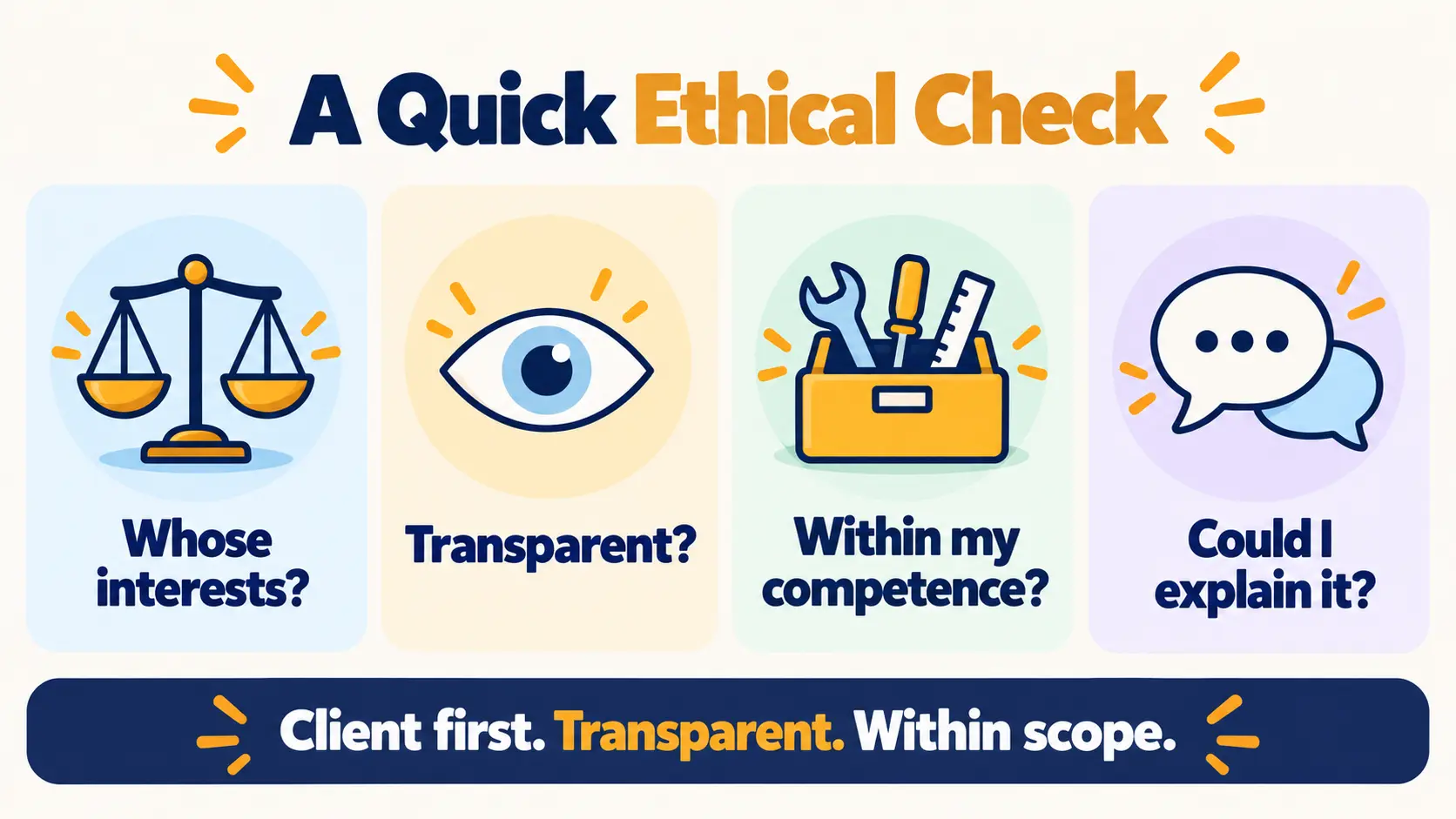
- Whose interests does this serve?If the answer is mainly the organizer's, look again.
- Is it transparent?Would the client know about it, and agree, if they had all the facts?
- Is it within my competence?Am I qualified to do this, or should I refer?
- Could I explain it comfortably?To the client — and to the certification board.
Ethics runs under every domain
Many exam questions that look like they're about another domain are really ethics questions. Learning to spot the ethical angle is half the skill:
| Domain | The hidden ethics question |
|---|---|
| I — Preliminary Communication | Are rates explained honestly, up front? Is the paying relative treated as the client? |
| II — Assessment | Is the organizer diagnosing? Observing without permission? |
| III — Project Plan | Is a referral fee disclosed? Is specialist work kept out of scope? |
| IV — Implementation | Is extra spending approved? Are assistants bound by confidentiality? |
| V — Follow Up | Is maintenance recommended because it helps, or as an upsell? |
Conflicts of Interest (VI.B.1)
A conflict of interest exists when the organizer's own interests could influence — or appear to influence — the advice they give or the decisions they help a client make. The appearance matters: even if the organizer would never let a commission sway them, a client who later learns about it may doubt every recommendation.
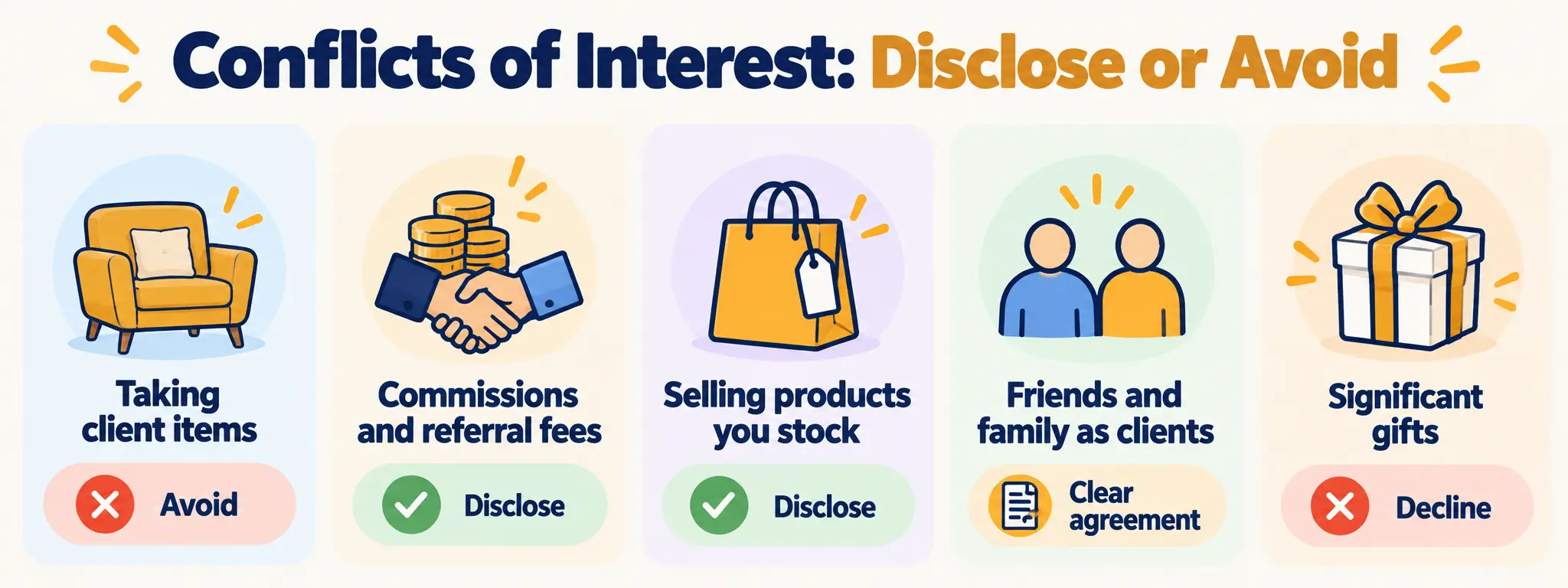
| Situation | Why it's a conflict | Ethical handling |
|---|---|---|
| Taking or buying a client's items | The organizer benefits from what the client lets go | Avoid — decline, even when offered |
| Commissions or referral fees | Recommendations may favour what pays the organizer | Disclose; the client chooses freely |
| Selling products the organizer stocks | Incentive to recommend purchases | Disclose; recommend only what the plan needs |
| Friends or family as clients | Personal and professional roles blur | Clear agreements on fees, roles and confidentiality — or refer |
| Accepting significant gifts | Can create obligation or favouritism | A consistent gift policy; decline anything significant |
| Working for two people with opposing interests | e.g. a separating couple dividing belongings | Stay strictly neutral and transparent with both — or decline |
Disclose or avoid?
The two tools are disclosure (telling the client, so they can decide with all the facts) and avoidance (not taking on the conflicting role at all). A useful test is whether disclosure would genuinely let the client protect their own interests:
- Disclose when the client can weigh the information and still choose freely — a referral fee, a product you sell. Disclose before the recommendation, plainly, and ideally in writing.
- Avoid when the conflict is built into the client's decisions themselves — taking items they discard, or buying their valuables. No amount of disclosure removes the incentive to encourage them to let go.
Confidentiality (VI.B.2)
Organizers see more of a client's life than almost any other professional: their home, their paperwork, their relationships, their struggles. Confidentiality is the default, and it continues after the project ends.
- Information: what clients share, and what the organizer sees or finds, stays private — including the fact that someone is a client.
- Stories: even anonymous stories can identify a client, especially in a small community or a niche profession.
- Photos and testimonials: shared only with the client's explicit consent. A name removed from a caption isn't consent.
- Helpers: assistants and subcontractors follow the same standard (Lesson 15).
| Someone asks… | An ethical response |
|---|---|
| The client's daughter: "How bad is Mum's house?" | "I'd encourage you to ask your mum — I keep what clients share private." |
| A referring friend: "How's it going with Sam?" | "Thanks so much for the referral" — and nothing about the work |
| A neighbour: "Are you working at number 12?" | Neither confirm nor deny |
| Your marketing: "Can we use that great before-and-after?" | Only with the client's explicit, written consent |
Exceptions are narrow — for example where the law requires disclosure, or someone's safety is at serious risk (Lesson 5) — and they vary by location. Organizers should know the rules where they work.
Fees and Services (VI.B.3)
Ethical fees are agreed in advance, billed honestly and easy to understand (Lessons 3 and 9). In practice:
| Situation | Ethical handling |
|---|---|
| A session ends early | Bill according to the written terms — no rounding up beyond them |
| Extra shopping or admin time | Charged only if the agreement says so, or the client agreed first |
| A scope change | Time and cost agreed before the extra work starts |
| A rate increase | Notice given in advance — never applied to work already agreed |
| An invoice | Itemized and clear — no padding, no surprise charges |
On services, organizers offer only what they're competent and qualified to provide. Tax, legal and financial advice, electrical or structural work, and therapy belong to other professionals, so the organizer refers (Lesson 8). Saying "I'm not the right person for that, but here's who is" is an ethical strength, not a weakness.
Accurate Representation of Skills (VI.B.5)
Clients rely on what organizers say about themselves, and they usually can't verify it. Accurate representation means:
- Credentials: use CPO® only once it has been officially awarded, as BCPO permits — and keep it current through recertification. Passing the exam isn't the same as being awarded the credential, and phrases like "CPO pending" or "certified organizer" used as workarounds still misrepresent.
- Memberships: belonging to a professional association isn't the same as holding a credential, and neither implies the organization endorses your business.
- Experience and specialties: described honestly — no claiming expertise in chronic disorganization, estates or digital security without the training and experience to back it up.
- Services requiring other qualifications: not offered or implied.
- Results: no guarantees the organizer can't control. "Your home will never be cluttered again" isn't an honest promise.
- Marketing: testimonials used as given and with consent; before-and-after photos real and consented; no invented reviews.
Exam Traps for VI.A–B
| If an answer… | …it's probably wrong because |
|---|---|
| Accepts a valuable item because the client offered | A conflict of interest — avoid it |
| Keeps a commission private because the price is the same | Disclose so the client can weigh the advice |
| Posts photos because no faces are shown | Explicit consent is required |
| Tells a worried relative about the client's home | Confidential without the client's agreement |
| Shares a story after the project ends | Confidentiality continues |
| Bills the full slot when the terms say otherwise | Bill only what was agreed |
| Gives "general" tax tips | Work within competence — refer |
| Uses CPO® after passing, before award | Claim credentials only once awarded |
| Promises the home will never be cluttered again | No guarantees you can't control |
10 questions in the style of the CPO exam. Score 70%+ to mark this lesson complete.
- Domain VI (11%) runs under every domain; this lesson covers VI.A and VI.B.1–3 and 5. Read the official BCPO Code of Ethics — the exam tests applying it.
- A quick ethical check: whose interests, is it transparent, is it within my competence, could I explain it? Spot the ethics question hidden in other domains.
- Conflicts of interest — real or apparent: disclose what the client can weigh (commissions, products); avoid what's built into their decisions (taking their items).
- Confidentiality is the default and continues after the project — including the fact someone is a client; photos, stories and testimonials need explicit consent.
- Fees are agreed in advance, billed honestly and itemized; services stay within competence, and the rest is referred.
- Claim credentials only once awarded and keep them current; describe skills honestly; no workarounds, implied endorsements or guarantees.
Before moving to Lesson 18:
- Read the current BCPO Code of Ethics on napo.net and note its main headings.
- Write a one-line gift policy you could explain to clients.
- Draft a consent sentence for using before-and-after photos, and a reply to a relative asking about a client.
- Complete the knowledge check above and review any question you missed.