A nutrition coach helps generally healthy people change how they eat — not by handing out rigid meal plans, but through education, goal setting and behavior change support. Coaches work alongside doctors and registered dietitians, and refer anyone with medical needs. The NASM CNC course follows 4 sections and 24 chapters, and the exam is 100 questions in 90 minutes, open-book. That works out to about 54 seconds per question — so the skill that matters most is knowing where to find answers fast, not looking everything up.
Welcome to the first lesson of this free NASM Certified Nutrition Coach study companion. This lesson sets the scene: what the role involves, how the course is organised, and how to prepare for an exam that's open-book but tightly timed. Every lesson in this course matches one NASM chapter — Lesson 1 is Chapter 1, through to Lesson 24.
Free on YouTube Subscribe to get every lesson video in this course SubscribeWhat a Nutrition Coach Does
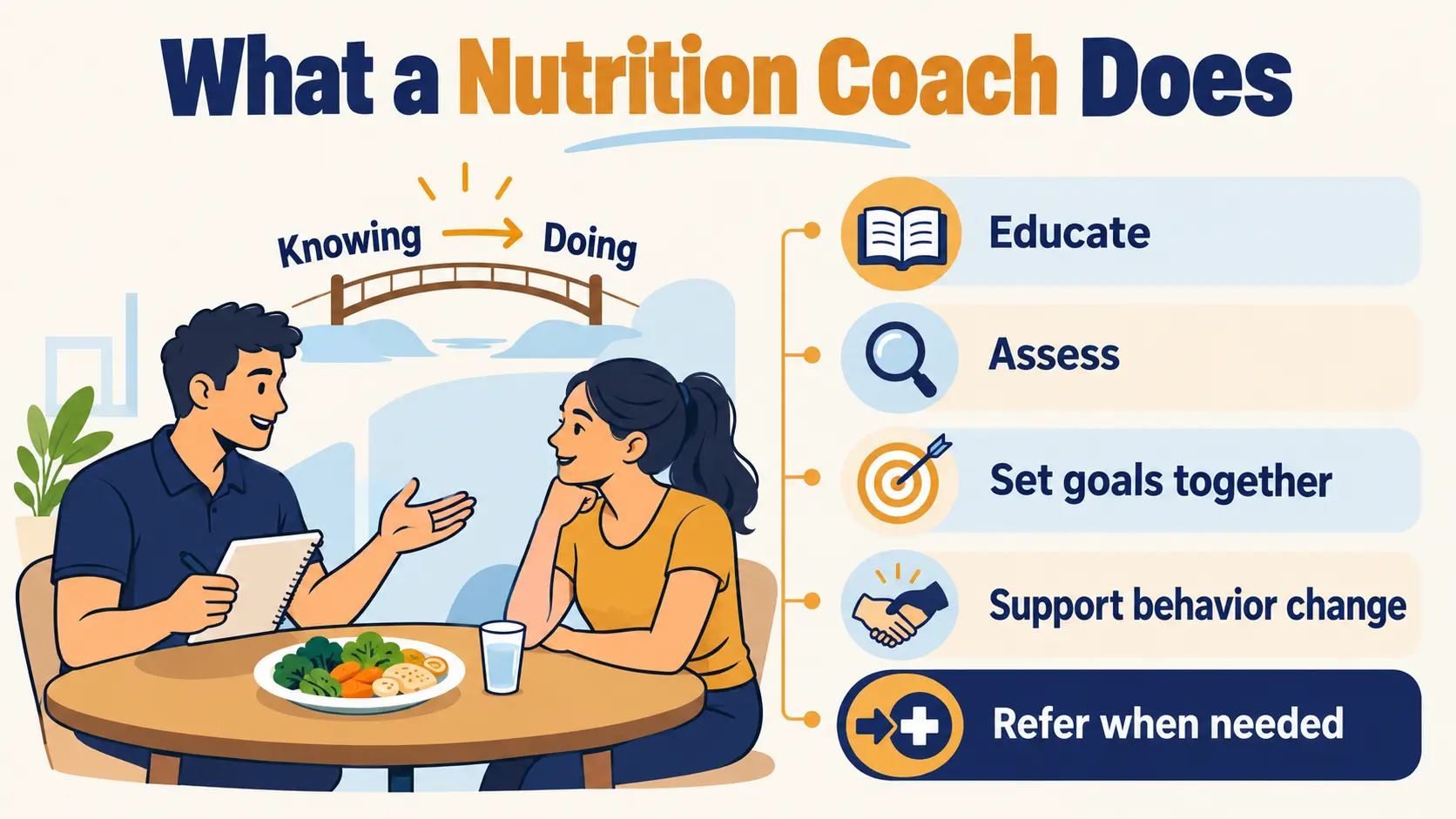
Most people already know they "should" eat more vegetables or fewer sugary drinks. The hard part is doing it consistently, around work, family, culture and budget. That gap between knowing and doing is where a nutrition coach works.
- EducateShare accurate, evidence-based nutrition information in plain language (Lesson 3).
- AssessUnderstand what, when and why a client eats now, and what they want to change (Lesson 18).
- Set goals togetherTurn motivation into small, specific, achievable habits the client chooses (Lesson 17).
- Support behavior changeUse coaching skills such as motivational interviewing to build confidence and consistency (Lessons 14–16).
- Refer when neededRecognise when a client needs a doctor, registered dietitian or mental health professional (Lesson 2).
Why nutrition coaching matters
Poor diet is one of the leading risk factors for ill health worldwide — the Global Burden of Disease study estimated that dietary risks were linked to around 11 million deaths globally in 2017, mainly through heart disease and type 2 diabetes. Information alone rarely changes habits. Coaching helps people turn what they know into what they do, one small change at a time.
Where nutrition coaches work
Nutrition coaches work in gyms and fitness studios (often alongside personal training), online coaching, corporate wellness programmes, and health and wellness businesses. Many personal trainers add nutrition coaching to support their clients' results — within the limits of their scope.
Coaches, Dietitians and Doctors
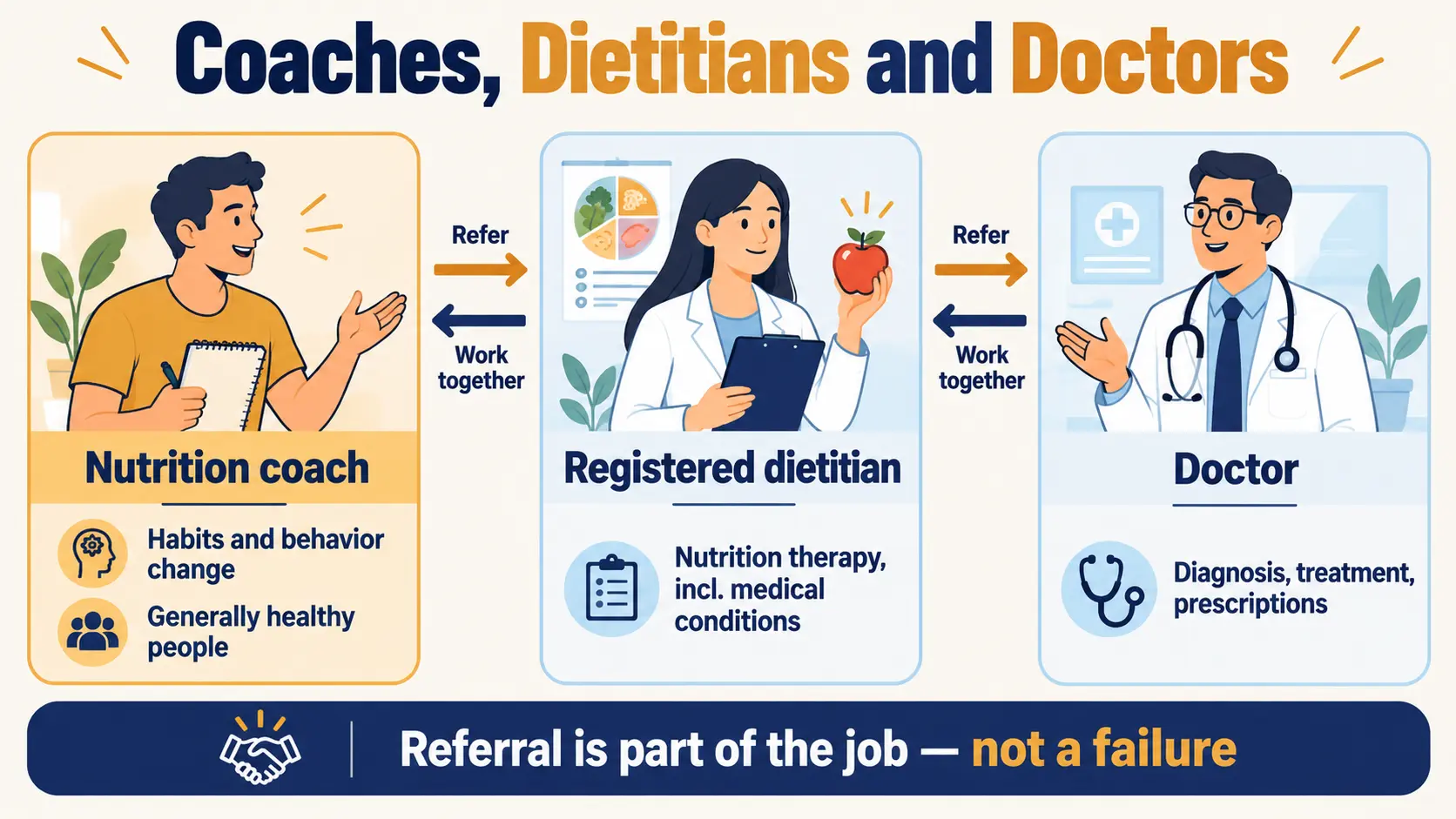
A nutrition coach is one part of a wider team. The exact titles and legal rules differ by country and region (Lesson 2 covers this in detail), but in general terms:
| Nutrition coach | Registered dietitian* | Doctor | |
|---|---|---|---|
| Main focus | Habits and behavior change | Nutrition therapy, including for medical conditions | Diagnosis and medical treatment |
| Typical clients | Generally healthy people | People with or without medical conditions | Anyone with health concerns |
| Can diagnose or treat disease? | No | Provides nutrition therapy for diagnosed conditions | Yes |
| Prescribes medication? | No | No | Yes |
*Or the regulated equivalent title where you live.
Good coaches don't see referral as failure — it's part of the job. When a client's needs go beyond habit coaching, the coach refers and, where appropriate, keeps supporting the client's everyday habits alongside their healthcare team.
Qualities of an effective coach
Knowledge matters, but the best coaches also show empathy, curiosity about each client's life, respect for their culture and choices, a commitment to evidence, and the humility to say "I don't know — let me find out" or "that's a question for your doctor".
How the NASM CNC Course Is Organised
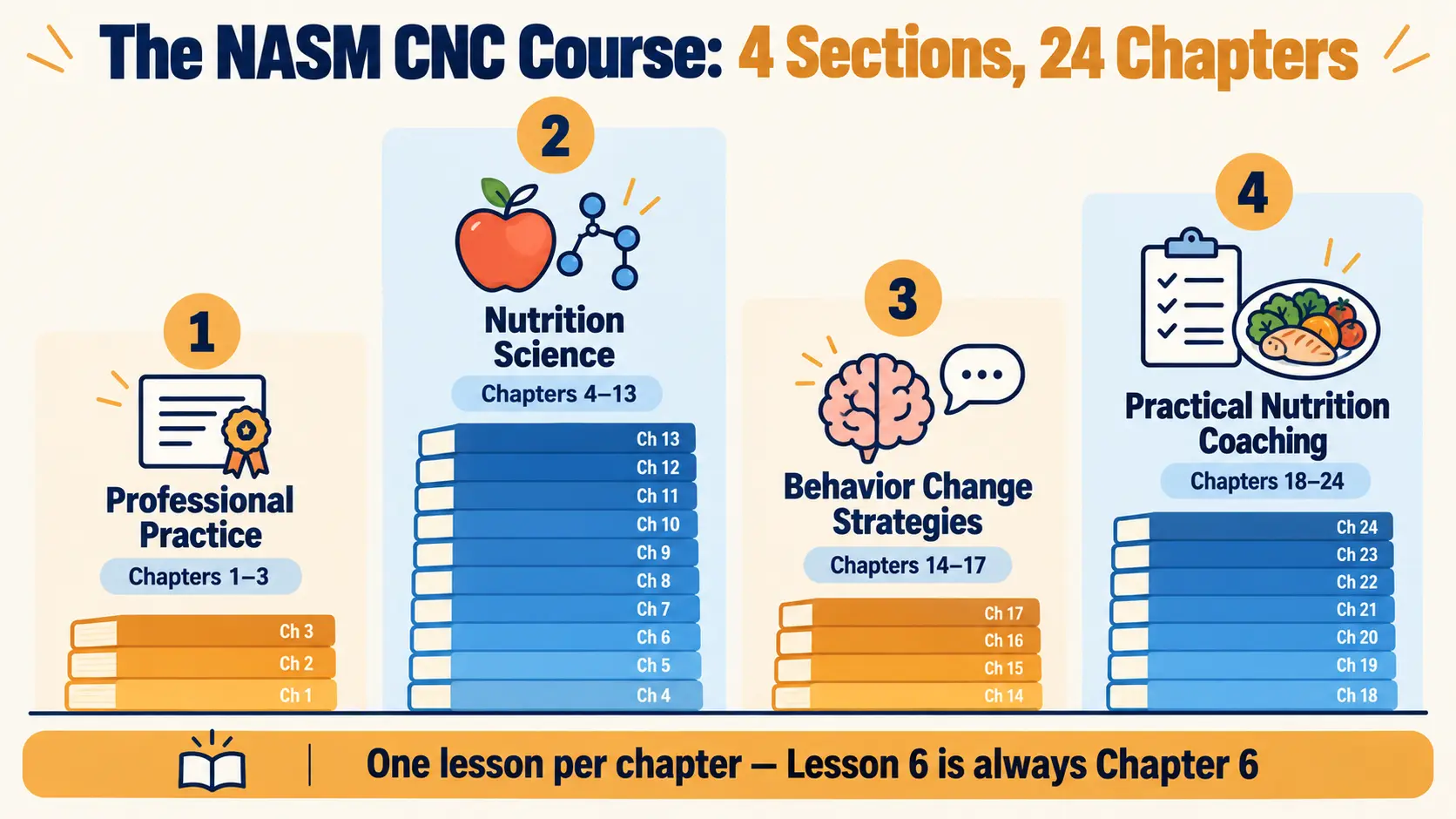
NASM presents the CNC course in 4 sections covering 24 chapters. This study companion follows the same structure, one lesson per chapter:
| Section | Chapters | What it covers |
|---|---|---|
| 1. Professional Practice | 1–3 | The coach's role, scope of practice, and evidence-based practice |
| 2. Nutrition Science | 4–13 | Food influences, energy balance, macronutrients, alcohol, micronutrients, hydration, nutrient timing and supplements |
| 3. Behavior Change Strategies | 14–17 | The psychology of change, coaching communication, motivational interviewing and goal setting |
| 4. Practical Nutrition Coaching | 18–24 | Assessment, labels and portions, real-world eating, diets, hot topics, plateaus and maintenance, and putting it all together |
The CNC Exam at a Glance
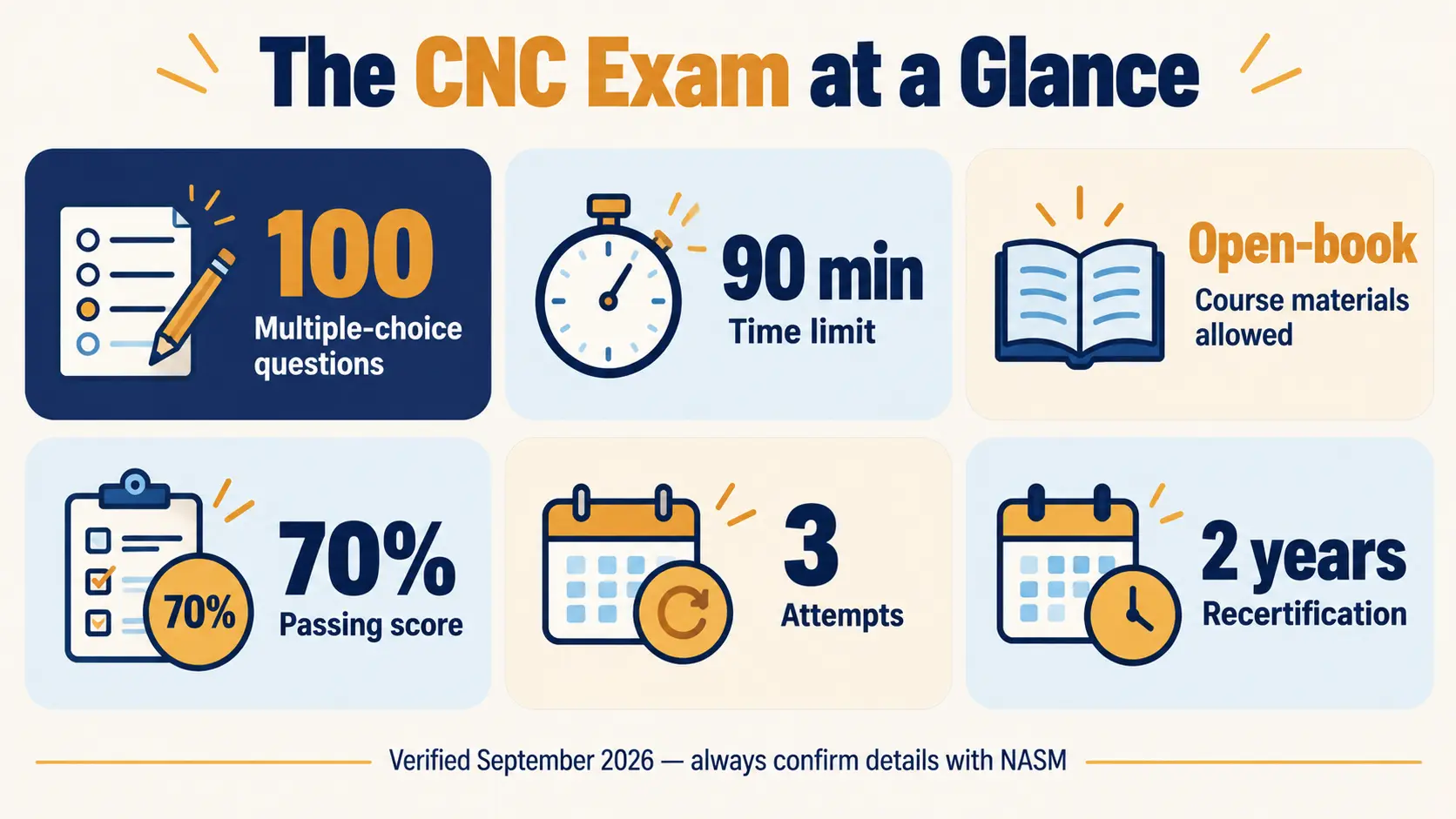
| Feature | Details (verified September 2026) |
|---|---|
| Questions | 100 multiple-choice questions, taken online |
| Time limit | 90 minutes |
| Open-book? | Yes — you can refer to the course materials |
| Passing score | 70% |
| Attempts | Up to 3 |
| Prerequisites | None |
| Recertification | Every 2 years |
Exam details can change, so always confirm the current format, price and policies directly with NASM before you enrol or book.
Strategy for a Timed, Open-Book Exam
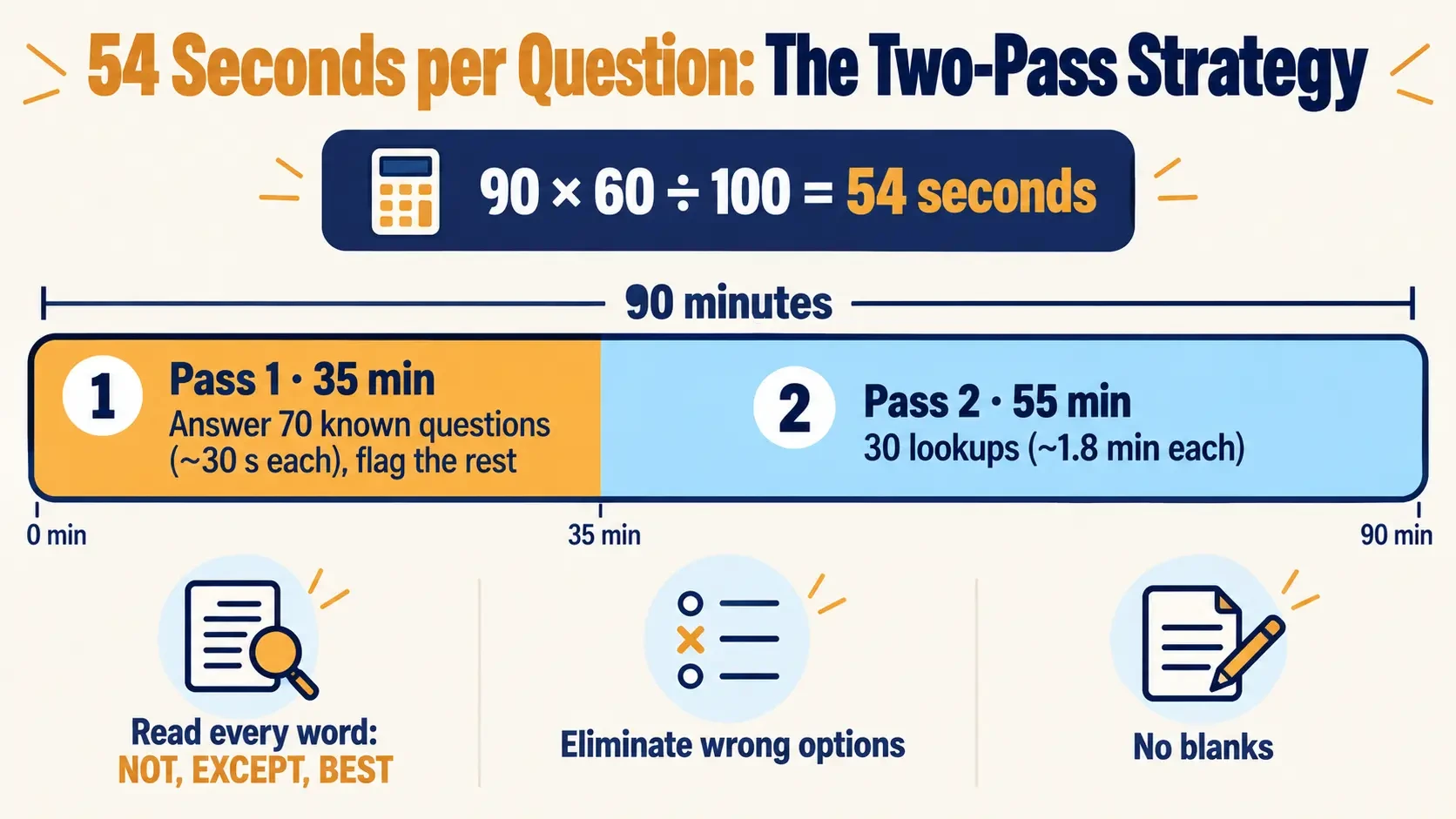
Time per question = total minutes × 60 ÷ number of questions
For the CNC exam: 90 × 60 = 5,400 seconds ÷ 100 = 54 seconds per question. That's enough to read carefully and answer — but not enough to look up most answers. Open-book is a safety net, not a strategy.
- Pass 1: answer what you knowMove quickly through the exam. Answer every question you're confident about and flag any that need a lookup or calculation.
- Pass 2: look up the flagged questionsUse the time you've saved for lookups — giving each one a time limit (for example, about 2 minutes) so one question can't eat your clock.
- Read every wordWatch for NOT, EXCEPT, BEST and FIRST — they change what the question is asking.
- Eliminate, then chooseCross out clearly wrong options first. In scope questions, the answer that refers out or respects the client's choice is often the best one.
- Don't leave blanksIf there's time left, make your best choice on any question you haven't answered.
For example, if you answer 70 questions in the first pass at about 30 seconds each, that takes 70 × 30 = 2,100 seconds, or 35 minutes. That leaves 90 − 35 = 55 minutes for the remaining 30 questions — about 1.8 minutes each for lookups and calculations.
Know where things are
Because time is short, it pays to know which chapter holds which facts — tables of numbers, formulas and definitions in particular. That's why every lesson in this course ends with an exam lookup tip, and why the course page includes a Chapter Lookup Map that pulls them all together.
How to Use This Course
| In every lesson | How to use it |
|---|---|
| Notes | Read alongside the matching NASM chapter |
| PDF notes and slides | Download for revision and quick reference |
| Knowledge check | 12 exam-style questions; aim for 70% or more |
| Exam lookup tip | The facts most worth finding fast |
| Practice exam | A timed 100-question, 90-minute exam once you've finished the course |
A steady pace works well. For example, studying 3 chapters a week covers all 24 chapters in 24 ÷ 3 = 8 weeks, leaving time for revision and a practice exam before you book.
The situation: Maya is a personal trainer who wants to add nutrition coaching for her clients. She can study about five hours a week.
Study plan: 3 chapters a week → 24 ÷ 3 = 8 weeks of lessons, plus 2 weeks for revision and two timed practice exams.
Exam plan: Pass 1 — answer known questions at about 30 seconds each and flag the rest. Pass 2 — look up flagged questions, about 2 minutes each, using her lookup notes.
Scope: she also notes that clients with medical conditions will be referred to their doctor or a registered dietitian — the topic of Lesson 2.
Thinking about the career side? See Is Nutrition Coaching a Good Side Hustle for Personal Trainers?
12 questions in the style of the CNC exam. Score 70%+ to mark this lesson complete.
- Nutrition coaches help generally healthy people build sustainable habits through education, goals and behavior change support.
- Coaches don't diagnose or treat disease; dietitians provide nutrition therapy and doctors diagnose and prescribe.
- Referral is part of the job — and coaching can continue within scope alongside a healthcare team.
- The CNC course covers 4 sections and 24 chapters; this course maps one lesson to each chapter.
- The exam: 100 questions, 90 minutes, open-book, 70% to pass, up to 3 attempts.
- At ~54 seconds per question, answer what you know first and save lookups for a second pass.
Before moving to Lesson 2:
- Write down why you want to become a nutrition coach — and who you'd like to help.
- Plan your study schedule: how many chapters a week, and your target exam date.
- Start a one-page "lookup notes" sheet you'll add to after each lesson.
- Complete the knowledge check above and review any question you missed.