Precision Nutrition Level 1 opens with coaching philosophy, not nutrition science, for a reason: knowing what a client should eat has almost nothing to do with whether they'll actually do it. This chapter sets the frame for the whole course — self-paced, open-book, cumulatively graded — and introduces the core coaching mindset that Chapters 2 through 5 build on before Unit 2 ever mentions a macronutrient.
Most nutrition certifications open with biology — cells, digestion, energy pathways — and save "how to actually coach a person" for the end, if they cover it at all. PN Level 1 does the opposite. Before a single chapter on nutritional science, the program spends its first unit on how you'll learn the material and how you'll eventually use it with real people. This lesson covers why, and gives you the operating context for everything that follows.
How This Course Works
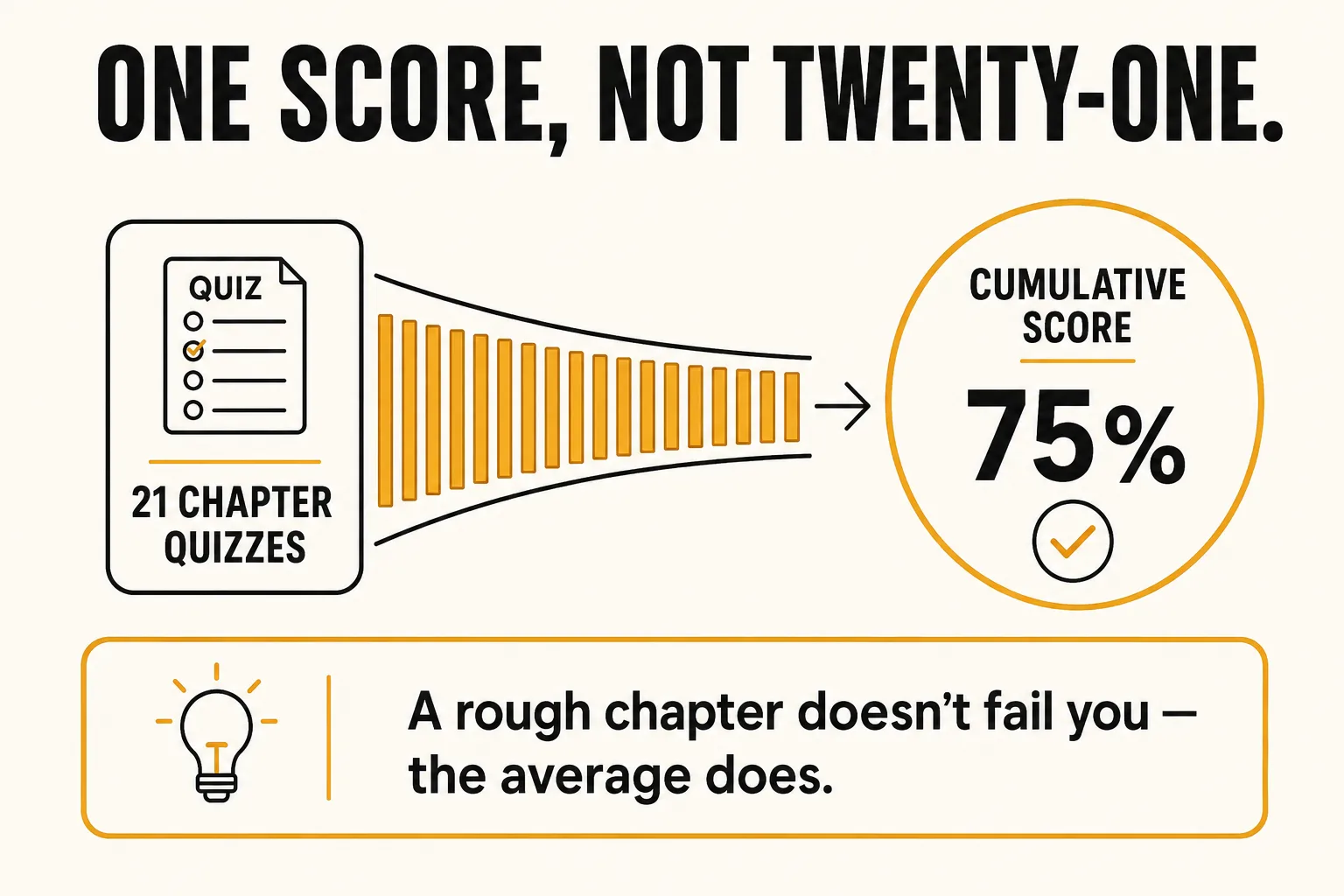
PN Level 1 is self-paced with no deadlines — you can move through it in a few intense weeks or spread it across several months, and nothing about the format penalizes either pace. Each of the 21 chapters ends in a short, open-book exam: 10 questions, no timer, reference material allowed. You don't need to pass each chapter exam individually. Instead, your questions accumulate across the whole program, and you certify by hitting a cumulative score of 75% or better across all 21 combined.
That grading model matters more than it sounds like it should. It means a rough day on one dense chapter — say, one of the biochemistry-heavy chapters in Unit 2 — doesn't sink you, as long as your overall grasp of the material holds up. It also means there's no shortcut to skimming: since every chapter's score counts toward the same total, there's no "safe" chapter to phone in.
Say you score 60% on Chapter 9 (Energy Transformation and Metabolism — a genuinely dense one) but average 85% across the other 20 chapters. Your cumulative score is (60 + 85×20) ÷ 21 ≈ 84%, comfortably above the 75% bar. One bad chapter barely moves the needle. What would actually sink you is a pattern of scoring in the 60s across many chapters — the model punishes broad gaps in understanding, not a single hard day.
| Format detail | What it means for you |
|---|---|
| 21 chapter exams, 10 questions each | 210 questions total across the program |
| Open-book, untimed | You're tested on application and understanding, not memorization under pressure |
| Cumulative 75% pass threshold | One weak chapter score can be offset by stronger ones elsewhere |
| Self-paced, no deadlines | Study on your own schedule, at your own depth |
Why Coaching Comes Before Science
Here's the uncomfortable truth most nutrition education skips past: the average person already knows, roughly, what "eating better" looks like. More vegetables, less ultra-processed food, protein at most meals, some attention to portions. That's not a knowledge gap. What actually derails people is everything downstream of knowing — inconsistent motivation, a life that doesn't cooperate with a rigid plan, an all-or-nothing relationship with "being good," or simply never having had support that adapted to them as an individual.
Picture a client who's told, correctly, to "eat more protein and fewer processed snacks." She already knew that — she's read it in a dozen articles. What she hasn't figured out is what to actually cook on a Tuesday when she's exhausted after work and the only fast option is the vending machine downstairs. The information was never the missing piece. A coach who only restates the advice more confidently hasn't solved anything; a coach who helps her stock her desk drawer with a protein bar and a piece of fruit has.
A coach who only has nutrition facts to offer is, in practice, not that different from a pamphlet. What makes coaching valuable is the part a pamphlet can't do: reading a specific person, adjusting the approach when life gets in the way, and helping someone build habits that survive contact with a bad week. That's the skill Unit 1 is built to introduce, and it's why it comes first — everything you'll learn about macronutrients, energy balance, and metabolism in Unit 2 is only useful to a client once you can actually get them to use it.
Core Coaching Principles You'll See Again and Again
A handful of ideas recur constantly through this course, in nutrition science chapters as much as coaching ones. Getting familiar with them now makes the rest of the material click faster.
- Sustainable beats optimalA "perfect" plan a client abandons after two weeks produces worse results than a "good enough" plan they actually follow for two years. You'll see this exact tradeoff again in Chapter 13 (Water and Fluid Balance) and Chapter 14 (Stress, Recovery, and Sleep), where the "textbook optimal" number is rarely the right target for a specific client.
- Meet the client where they areThe right next step depends on the person in front of you, not a generic template — someone who's never tracked a meal needs a different starting point than someone who's tried five diets already. This is the entire premise of Chapters 16 through 18, which coach Level 1, 2, and 3 clients differently on purpose.
- Progress over perfectionA coaching relationship built around all-or-nothing standards tends to produce more quitting than results. Consistency at 80% beats perfection that only lasts a month. Chapter 19 (Special Scenarios) leans on this heavily when things go sideways — an injury, a holiday, a rough month.
- Evidence-based, not trend-basedNutrition advice should trace back to actual research and real client outcomes, not whatever framework is popular this year. This is why Unit 2's science chapters exist at all — they're the evidence a coach draws on instead of guessing.
- The relationship is the toolTrust and communication determine whether a client acts on your guidance at all — technically correct advice a client doesn't trust is advice that goes unused. Chapter 15 (Coaching in Practice) is built entirely around this idea.
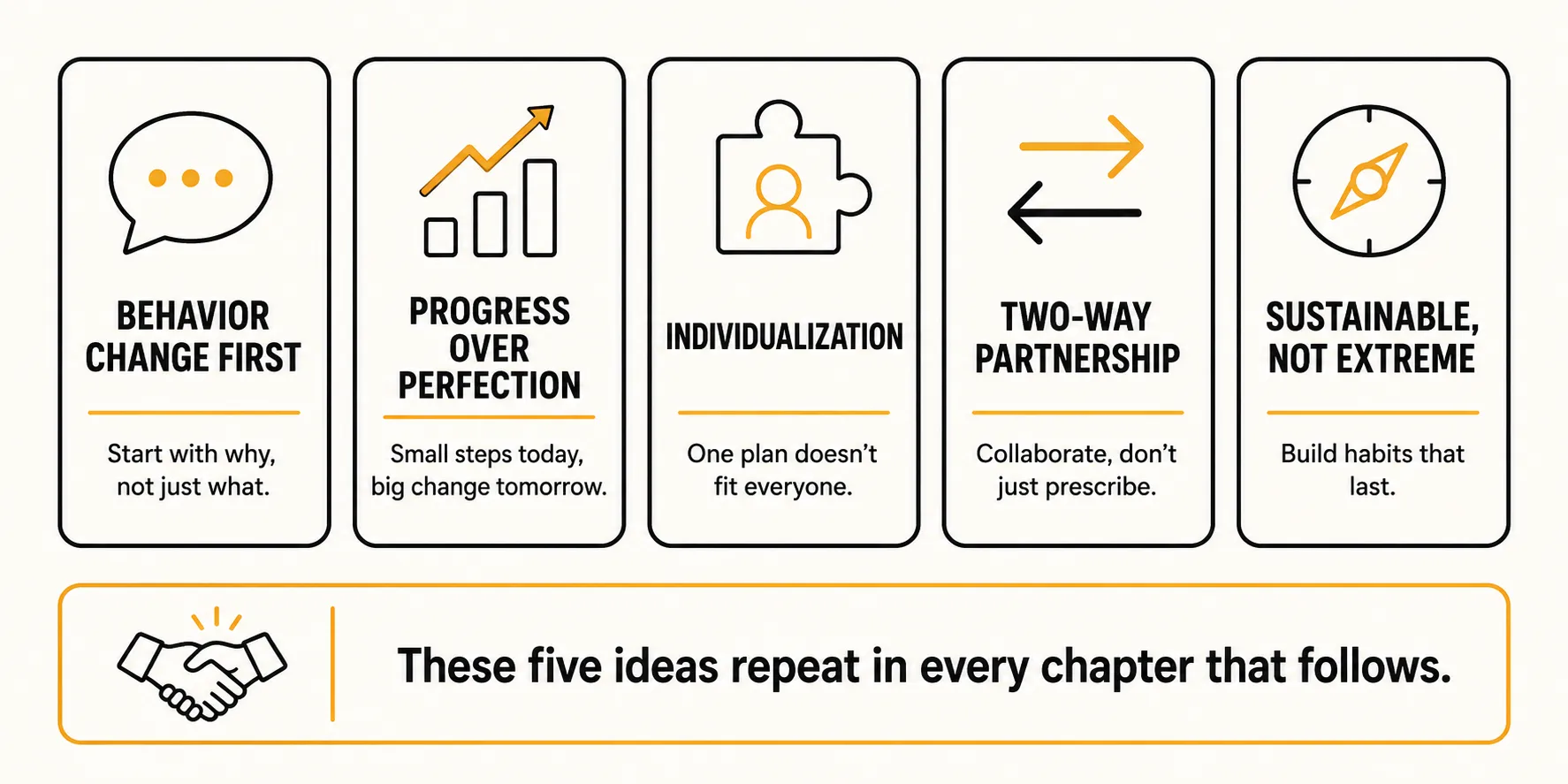
None of these are unique to Precision Nutrition specifically — you'll recognize versions of them from behavior-change psychology generally. What's specific to this course is how consistently it applies them: Unit 3's chapters on coaching clients at different levels, and even the science chapters in Unit 2, keep circling back to "so what does this mean for how you'd actually talk to a client about it."
A Realistic Scenario
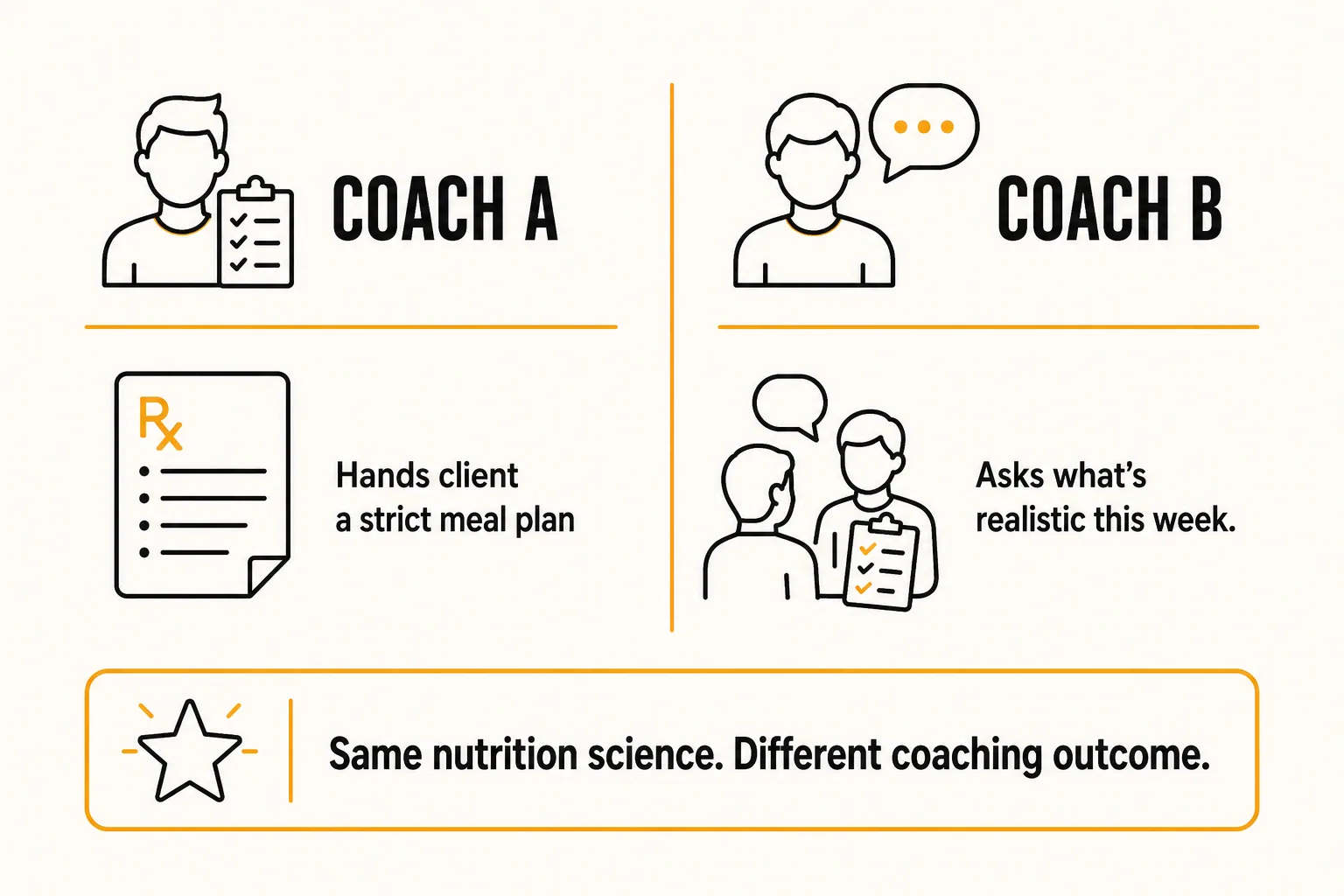
Imagine two new coaches. The first has memorized the exact protein requirement for muscle gain down to the gram, and leads every client conversation with the number. The second knows the same target only approximately, but starts by asking what the client's current meals actually look like, what's realistic for their schedule, and what's tripped them up before.
The first coach is more "correct" in the moment. The second coach is far more likely to still have that client three months later, still eating better than when they started. Neither approach is about knowing less nutrition science — Unit 2 will make sure you know the numbers cold. It's about which skill you lead with. This course spends its first unit making sure coaching comes first, because in the real world, it has to.
8 questions, modeled on PN's real open-book exam style. Score 75%+ to mark this lesson complete.
- PN Level 1 is self-paced with no deadlines, and every chapter ends in a 10-question, open-book, untimed exam.
- You don't need to pass each chapter individually — you certify by hitting a cumulative 75% across all 21 chapters (210 questions) combined.
- The course opens with coaching philosophy before nutrition science because knowledge alone rarely changes behavior — coaching is what closes that gap.
- Core principles that recur throughout the course: sustainable over optimal, meeting clients where they are, progress over perfection, evidence-based practice, and treating the coaching relationship itself as the tool.
- Nutrition science (Unit 2) is only as useful as a coach's ability to get a specific client to actually apply it.
Before moving to Lesson 2:
- Write down one piece of nutrition advice you've personally struggled to stick with, and one reason why — that's the coaching gap this course is training you to close.
- Re-read the five core principles above and pick the one that feels least natural to you. That's worth paying extra attention to as the course continues.
- Think of someone you know who's tried to eat healthier. Would more information have actually helped them, or something else?
- Complete the knowledge check above and review any question you missed.