Behavior change isn't a single decision a client makes and then sticks to — it's an ongoing process, and different clients arrive at different stages of readiness for it. A coach who gives the same advice regardless of where a client actually is will keep hitting resistance that looks like "unmotivated," when it's really just mismatched timing. This chapter gives you a way to read that timing, and to treat a setback as useful information instead of proof the whole thing failed.
Chapter 3 established that curiosity and attentiveness separate good coaches from great ones. This chapter puts that curiosity to a specific use: figuring out where a client actually stands with the change you're asking them to make, and adjusting your approach accordingly rather than assuming everyone is equally ready to act.
Change Isn't a Single Decision
It's easy to picture behavior change as a light switch: a person decides to eat better, and from that point on they either follow through or they don't. In practice, almost nobody experiences it that way. Someone can genuinely want to change their eating habits and still spend weeks or months feeling torn about it before doing anything differently — and that in-between period isn't a lack of willpower, it's a normal part of how people actually change.
This matters for coaching because it's tempting to treat every client the same way: hand them a plan, expect them to follow it, and label them "not ready" or "not motivated" if they don't. A more useful lens is to ask which part of the change process a client is actually in, because the kind of help that works varies enormously depending on the answer.
Where Is This Client, Really?
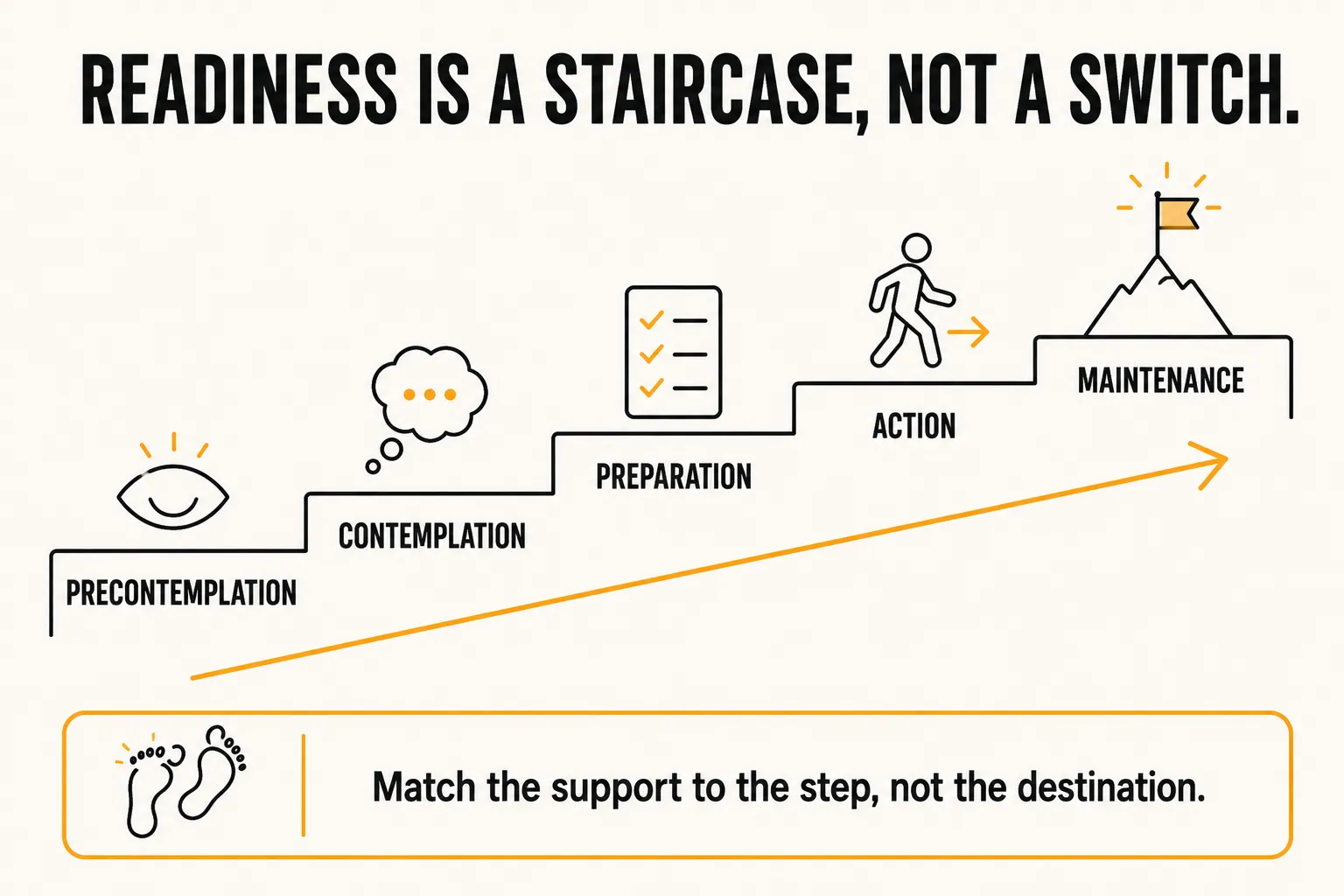
Behavior-change research describes readiness for change as moving through recognizable stages, rather than being a single on/off state. You don't need to treat this as a rigid checklist, but recognizing roughly where a client sits changes what kind of support is actually useful to offer.
- PrecontemplationThe client isn't yet considering a change, or doesn't see it as their problem to solve. Pushing a meal plan here usually backfires — what helps is raising gentle awareness, not handing over a to-do list.
- ContemplationThe client is aware change might help, but is genuinely torn — weighing the effort against the payoff. This is where Chapter 3's "asking over telling" matters most: help them talk through their own ambivalence rather than arguing them out of it.
- PreparationThe client has decided to act and is thinking through specifics. This is the point where concrete planning — what, when, how — actually lands, rather than feeling premature.
- ActionThe client is actively doing the new behavior. Support here looks like troubleshooting real obstacles as they come up, not re-explaining why the change matters.
- MaintenanceThe client has sustained the change for a while and is now working to keep it from unraveling. This is where Unit 3's client-tier chapters (16 through 18) pick the thread back up for longer-term clients.
A client says, "I know I should eat better, I just haven't gotten around to it." A coach who assumes everyone is in the action stage might respond with a detailed weekly meal plan — technically sound, but aimed at a stage the client hasn't reached yet, so it often goes unused. A coach reading this correctly recognizes contemplation, and instead asks, "What's making it feel hard to start?" That question, not a meal plan, is what actually moves a contemplative client toward preparation. The nutrition advice isn't wrong in either case — it's just aimed at the wrong moment.
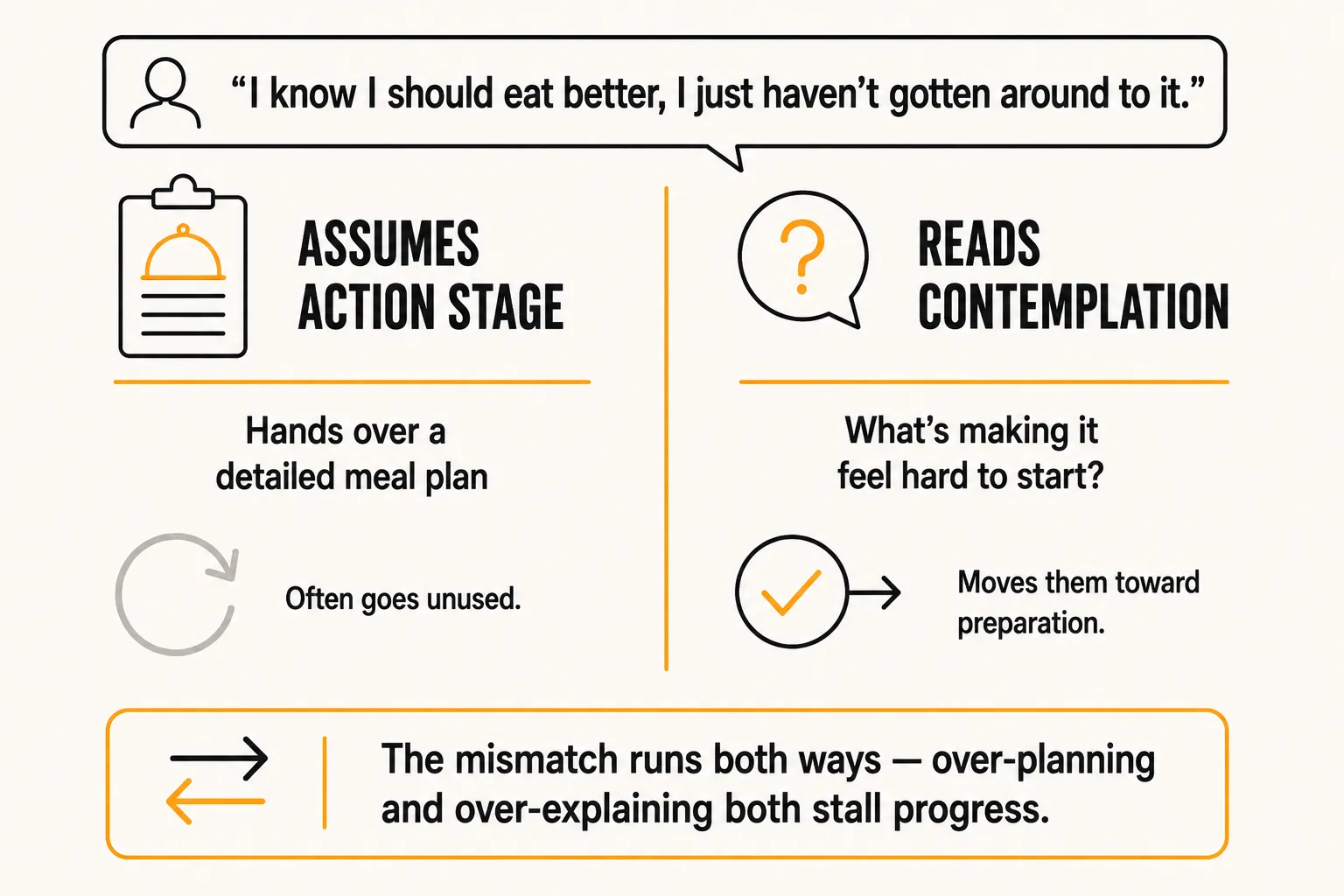
The mismatch runs the other way just as often, and it's easy to miss because it looks like caution rather than a mistake. A client who's been hitting their new grocery and meal-prep routine for three weeks straight — clearly in the action stage — doesn't need another conversation about why eating better matters or a recap of the reasoning behind the plan. She's already living it. A coach who keeps re-explaining the "why" to a client who's already doing the "what" isn't being thorough, they're stalling momentum with information the client has already acted on. What that client actually needs is troubleshooting help for the specific friction she's hitting this week — a coach who asks "what's making the routine easier or harder right now?" is reading the stage correctly; one who launches into the case for eating vegetables again is not.
Setbacks Are Data, Not Failure
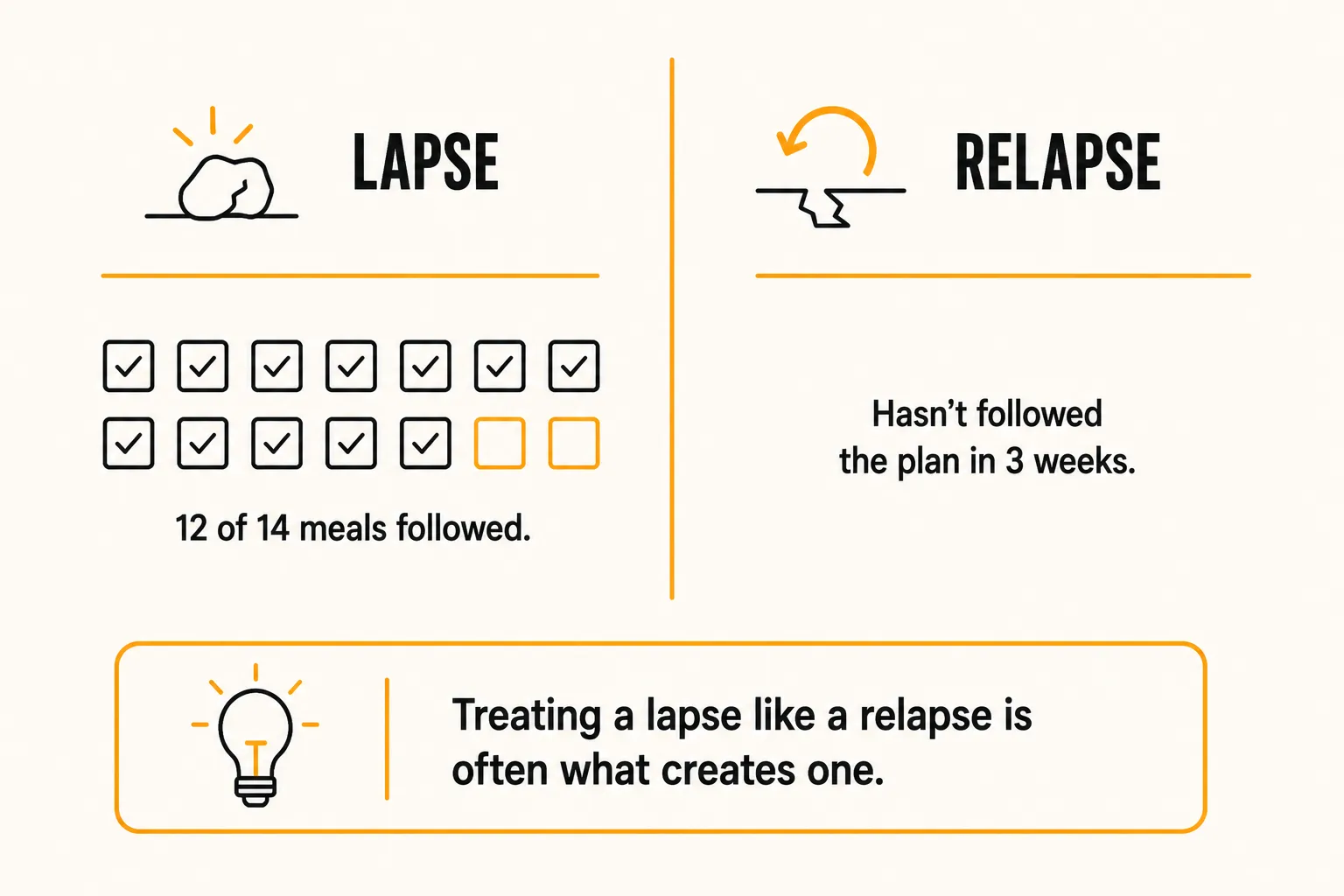
A useful distinction here is between a lapse and a relapse. A lapse is a single slip — one missed workout, one week of ignoring the plan. A relapse is a full return to old patterns, sustained over time. The two get treated as identical far too often, and that's a mistake with real consequences: a client who believes one bad week means the whole effort has failed is far more likely to actually abandon it, turning a lapse into a genuine relapse simply because of how it was interpreted.
A client who planned 14 meals this week and followed through on 12 of them, missing two because of a late work meeting, has had a lapse — two data points out of fourteen, nothing that changes the overall pattern. A client who says they "haven't really followed the plan in three weeks" is describing something closer to a relapse — a sustained drift back to old habits, not a single rough patch. The first conversation is a two-minute check-in: what happened those two days, and does anything need to shift going forward? The second conversation is a longer one: what changed three weeks ago, and is the plan itself still the right one? Responding to the first situation as though it were the second — treating two missed meals as a crisis — is often what pushes a client from the first category into the second.
A coach's job during a setback isn't to minimize it or pretend it didn't happen, but to treat it as information rather than a verdict. What made this week harder than usual? Was the plan realistic to begin with, or did life simply get in the way? This is the same "progress over perfection" principle from Chapter 1, applied specifically to how a coach responds in the moment a client stumbles — because how that moment is handled often determines whether it's the last stumble or the start of a bigger one.
Building a client's confidence that they can recover from a bad week — not just their knowledge of what to eat — is one of the most durable things a coach can do. That confidence, more than any specific piece of nutrition advice, is what determines whether a client is still working toward their goals six months from now.
8 questions, modeled on PN's real open-book exam style. Score 75%+ to mark this lesson complete.
- Behavior change is an ongoing process, not a single decision — clients arrive at different stages of readiness for it.
- The five stages — precontemplation, contemplation, preparation, action, and maintenance — each call for a different kind of support.
- Giving action-stage advice to a client who's still contemplating tends to produce resistance rather than progress, even when the advice itself is correct.
- A lapse (a single slip) and a relapse (a full return to old patterns) are different things — treating every lapse as a relapse can turn a minor setback into a real one.
- Building a client's confidence that they can recover from a bad week is one of the most durable things a coach can do.
Before moving to Lesson 5:
- Think of a change you've personally tried to make. Which stage were you in when it actually started to stick — and what helped you get there?
- Practice identifying a stage of readiness from a single sentence: write down what a precontemplation, contemplation, and action-stage client might each say out loud about the same goal.
- Recall a time a small setback felt like a bigger failure than it needed to. What would treating it as "information, not a verdict" have looked like in the moment?
- Complete the knowledge check above and review any question you missed.