There is no single "best diet." Mediterranean-style eating, lower-carb approaches, plant-forward patterns, and several others all show up in the research producing good outcomes — the common thread isn't the specific foods, it's whether the approach is adequate, balanced, nutrient-dense, sustainable, and something the person can actually stick to. A coach's job isn't to pick the "correct" diet and defend it; it's to judge, with a client's own data, whether their current approach is actually working for them.
Chapter 4 covered how to help a client move through the process of change. This chapter closes out Unit 1 by asking a more basic question underneath all of that: once a client is ready to change what they eat, what are they actually changing it toward? The honest answer is less specific than most people expect, and that's by design.
There's No Single Best Diet
Nutrition debates online often sound like a war between competing religions — one camp insists carbohydrates are the problem, another insists it's ultra-processed food, another insists it's meat, another insists it's a lack of "whole foods" broadly defined. What tends to get lost is that when researchers compare well-designed versions of very different dietary patterns — Mediterranean-style, lower-carbohydrate, plant-forward, and others — the outcomes are often surprisingly similar, especially once you account for how well people actually stuck to each one.
That last part matters more than it sounds like it should. A "theoretically superior" diet a client abandons after three weeks produces zero results. A "merely good" diet a client follows for two years produces real ones. This is the same principle from Chapter 1 — sustainable beats optimal — applied specifically to the question of which foods a client eats, rather than how a coach behaves.
Part of why these debates get so heated has little to do with the actual evidence. Dietary identity — "I'm a low-carb person," "I'm plant-based" — is a real source of belonging for a lot of people, and social platforms tend to reward the most extreme, confident version of any position rather than the more accurate, boring answer that several approaches work fine. A coach who's absorbed one of these identities without noticing it is at risk of debating a client instead of helping them, defending a food philosophy in a conversation that was supposed to be about that specific person's results.
What "Good" Actually Means
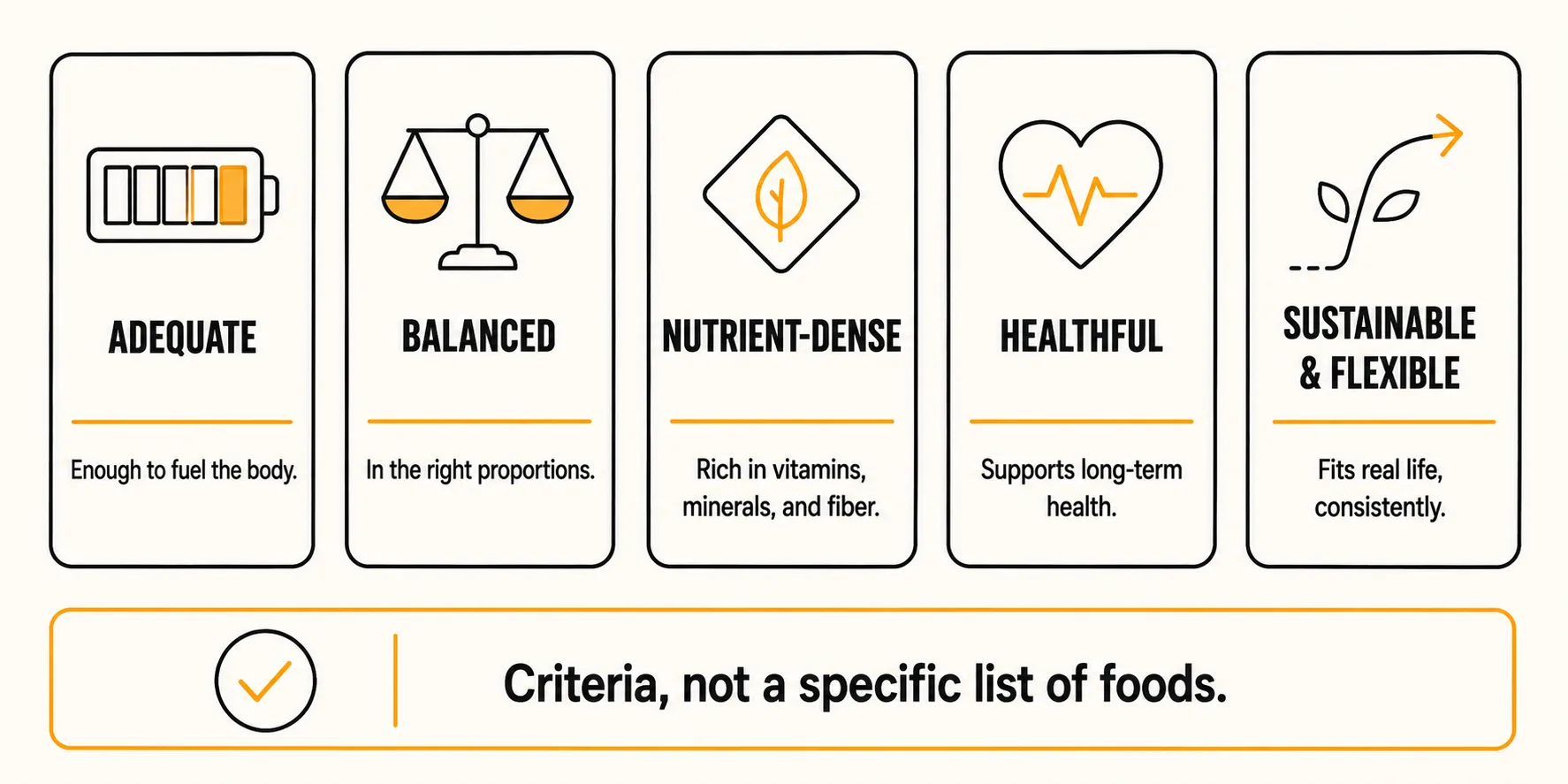
If there's no single correct diet, "good nutrition" has to be defined by criteria an eating pattern meets, rather than by a specific list of foods. A handful of these criteria show up across nearly every credible framework, and Unit 2's science chapters exist largely to give you the tools to actually evaluate them for a real client.
- AdequateProvides enough energy and nutrients for the person's needs — under-eating isn't automatically "clean" or virtuous. Chapter 10 (Energy Balance) gives you the tools to judge this properly.
- BalancedNo single nutrient or food group is so dominant or absent that it creates problems elsewhere. Chapter 11 (Macronutrients) is where this gets concrete.
- Nutrient-densePrioritizes foods that deliver a lot of nutritional value per calorie, without banning less nutrient-dense foods outright. Chapter 12 (Micronutrients and Whole Foods) builds directly on this.
- HealthfulSupports long-term health markers rather than undermining them for the sake of short-term results.
- Sustainable and flexibleFits the person's actual life — culture, budget, schedule, food preferences — closely enough that they can keep doing it. This is where Chapter 1's "sustainable beats optimal" and Chapter 3's "meet the client where they are" both apply directly.
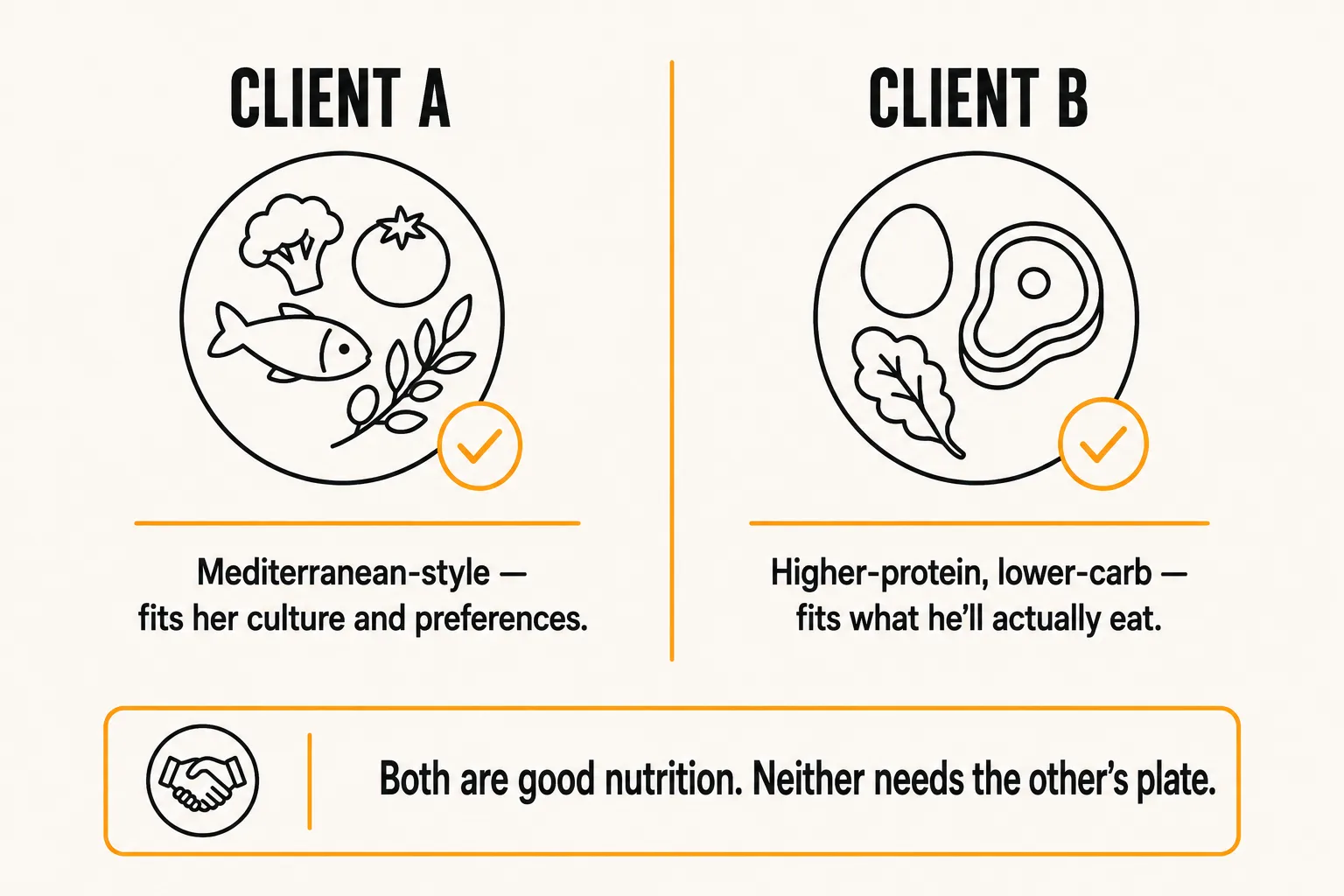
One client thrives on a Mediterranean-style pattern — lots of vegetables, olive oil, fish, whole grains — because it fits her culture, her cooking habits, and her preferences. Another client, who dislikes most vegetables and grew up eating a higher-protein, lower-carbohydrate diet, thrives on a very different plate that leans on meat, eggs, and non-starchy vegetables. Both diets are "good nutrition" for the person eating them: both are adequate, balanced for that person's needs, nutrient-dense within their own food preferences, and — critically — both are ones each client will actually keep eating in five years. Neither client needs to be talked into the other's plate.
Judge by Data, Not by Dogma
If two very different diets can both be "good," how do you know if a specific client's current approach is actually working? Not by checking it against a philosophy, but by tracking the person's own data over time: energy levels, mood, hunger and fullness cues, sleep, training performance, adherence, and — where available — objective markers like bloodwork. An approach that looks correct on paper but leaves a client exhausted, constantly hungry, or unable to sustain it past a month isn't good nutrition for that person, regardless of how defensible it sounds in an argument.
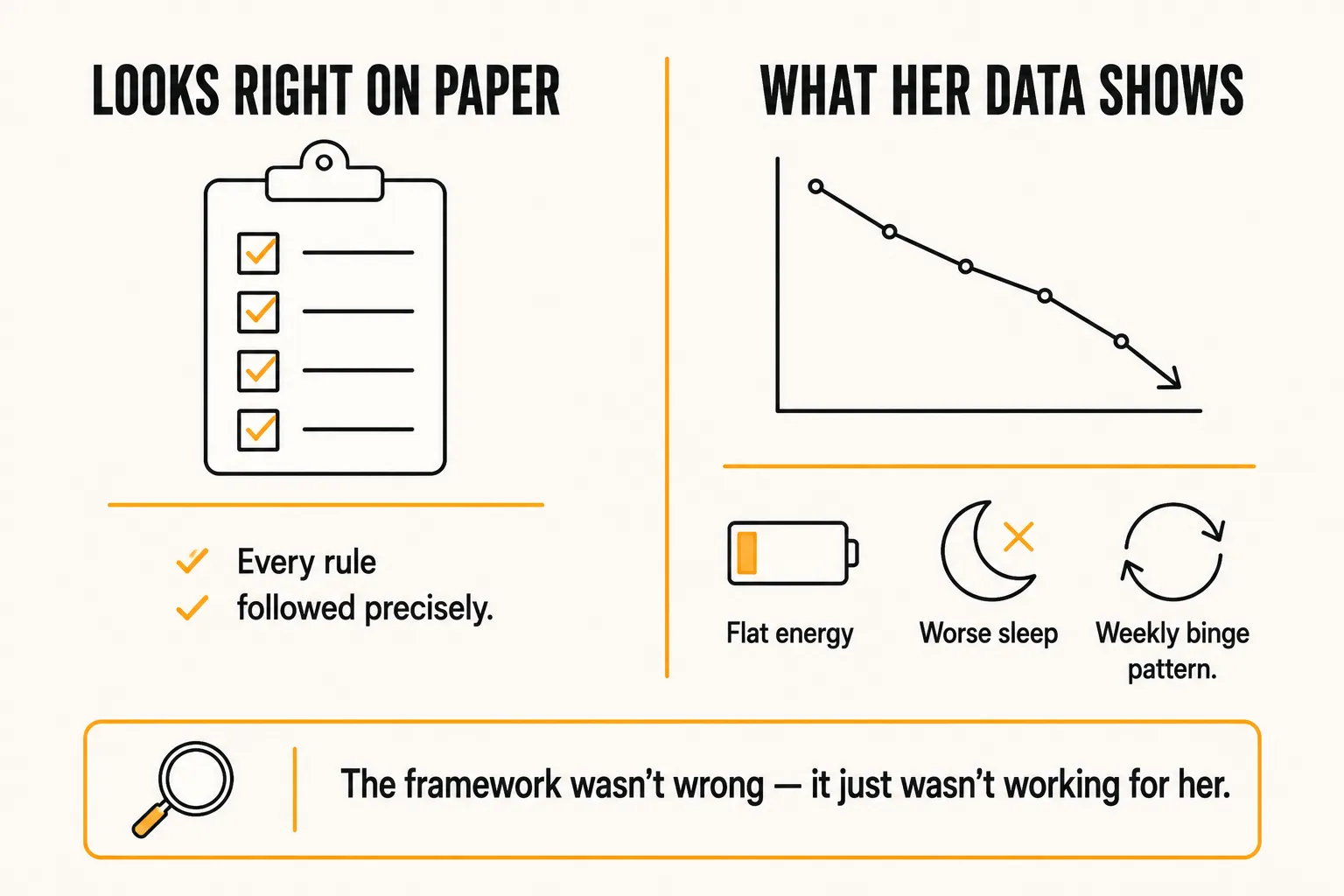
Take a client following a popular, highly restrictive framework to the letter — cutting out entire food groups, hitting every rule precisely. On paper, it checks every box the framework itself claims matters. But her actual data tells a different story: flat energy by mid-afternoon most days, worsening sleep, and a pattern of restricting all week followed by a Saturday binge that undoes most of the week's intended deficit. Nothing about the framework is "wrong" in the abstract — plenty of people do fine on it. But for this client, with this data, it isn't working, and no amount of the framework's own internal logic changes that. The fix isn't a stricter version of the same plan; it's a different plan entirely, chosen because of what her data actually shows.
This is also the antidote to dietary tribalism. A coach who's personally attached to one dietary philosophy is at risk of fitting the client to the diet instead of the diet to the client — the opposite of what Chapter 3 called curiosity over assumption. Data doesn't care which camp is "right" in an online debate; it just shows whether this specific person, eating this specific way, is actually doing better.
This closes out Unit 1. Starting with Chapter 6, Unit 2 shifts from coaching philosophy into the nutritional science itself — cells, digestion, metabolism, energy balance, macronutrients, and micronutrients. Everything in that unit exists to answer one practical question this chapter has now set up: given what "good" actually means, and given this specific client's data, what should change?
8 questions, modeled on PN's real open-book exam style. Score 75%+ to mark this lesson complete.
- There's no single "best diet" — well-designed versions of very different eating patterns produce comparable results once adherence is accounted for.
- "Good nutrition" is defined by criteria an eating pattern meets — adequate, balanced, nutrient-dense, healthful, sustainable, and flexible — not by a specific list of foods.
- Two clients can each be eating "good nutrition" while following very different, even opposite, dietary patterns.
- Whether an approach is working should be judged by a client's own data — energy, mood, hunger, adherence, objective markers — not by how closely it matches a dietary philosophy.
- This closes Unit 1; Unit 2 (starting Chapter 6) provides the nutritional science tools to apply these criteria to a real client's plan.
Before moving to Unit 2:
- Think of a dietary approach you personally believe is "best." Can you name a criterion from this chapter it might fail for someone with a different life or preferences than yours?
- List three pieces of data (beyond the scale) you'd track to judge whether a client's nutrition approach is actually working.
- Notice the next time you see an online nutrition debate framed as one "correct" diet versus everyone else being wrong. Which of the six criteria is the argument actually about?
- Complete the knowledge check above and review any question you missed.