PN Level 1's self-paced, no-deadline format is a real advantage, but only if you supply the structure the course doesn't impose on you. Chapter 2 isn't filler before the "real" content starts — it's where you decide the pace you'll actually sustain across 21 chapters, and commit to applying each concept as you learn it rather than stockpiling knowledge to use later. Both choices affect your cumulative exam score more than any single chapter's content does.
Chapter 1 covered why this program leads with coaching, not science. Chapter 2 is more practical: it's about how you, specifically, are going to get through 21 chapters without losing momentum somewhere around chapter nine. That sounds like a small logistical question. It isn't. More students who start a self-paced certification stall out from a bad plan than from the material being too hard.
A Flexible Format Cuts Both Ways
PN Level 1 has no deadlines, no fixed cohort schedule, and no penalty for taking five months instead of five weeks. For most adult learners juggling a job, family, and everything else, that flexibility is genuinely valuable — you're not forced to cram chapter nine the same week your kid has a school play. But flexibility has a quiet cost: it removes the external structure that usually keeps people moving. A university course has a syllabus with due dates. A self-paced course has whatever structure you build for yourself, and nothing else.
This is the same "sustainable beats optimal" principle from Chapter 1, applied to the process of studying itself rather than to nutrition advice. A study plan you can't actually stick to — three chapters a week for two straight months — will likely produce worse outcomes than a slower plan you follow consistently, because half-finished courses don't teach anything at all.
Choosing a Pace You'll Actually Keep
There's no single correct speed for this course, but there is a wrong way to pick one: guessing. Before you start Chapter 3, it's worth deciding roughly how many chapters per week you're realistically going to commit to, based on the time you actually have — not the time you wish you had.
| Pace | Rough timeline (21 chapters) | Best fit for |
|---|---|---|
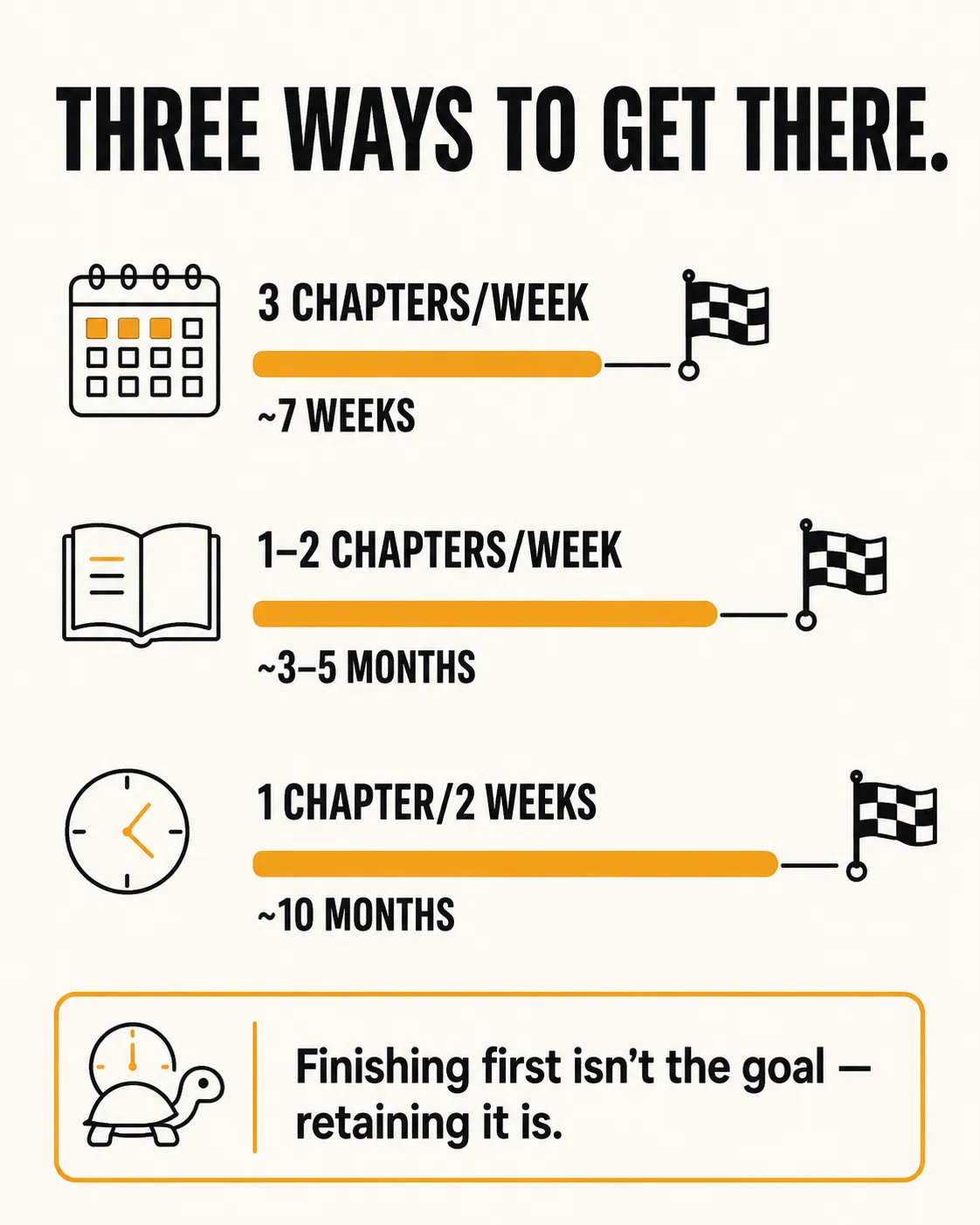
| 3 chapters / week | ~7 weeks | Full-time students or coaches transitioning careers with dedicated study blocks |
| 1–2 chapters / week | ~11–21 weeks (3–5 months) | Working professionals studying evenings or weekends |
| 1 chapter / 2 weeks | ~10 months | Anyone studying around an already packed schedule, prioritizing consistency over speed |
Say two students both start PN Level 1 on the same day. Student A reads four chapters every Sunday afternoon, finishing in about five weeks. Student B commits to one chapter every few days, spread across evenings, finishing in about eleven weeks — more than twice as long. If Student A's rushed pace means retaining roughly 65% of each chapter's material by the time of the cumulative exam, while Student B's spaced pace means retaining closer to 85%, Student B's cumulative score comes out meaningfully higher despite studying "slower." Finishing first isn't the goal — passing at 75%+ cumulative is, and retention, not speed, is what gets you there.
None of this means slower is automatically better — a pace that's too slow has its own failure mode, where you forget Chapter 3 by the time you reach Chapter 14. The goal is a pace that's fast enough to keep concepts connected to each other, but slow enough that you're not just recognizing words without absorbing them.
Learn It, Then Use It
The single highest-leverage habit in this course is applying each chapter's material before moving to the next one, instead of reading straight through and circling back "later." Later rarely comes. Application doesn't require a paying client — it can be as simple as trying a technique on yourself, walking a friend through a concept in your own words, or writing a short hypothetical case study and reasoning through how you'd coach it.
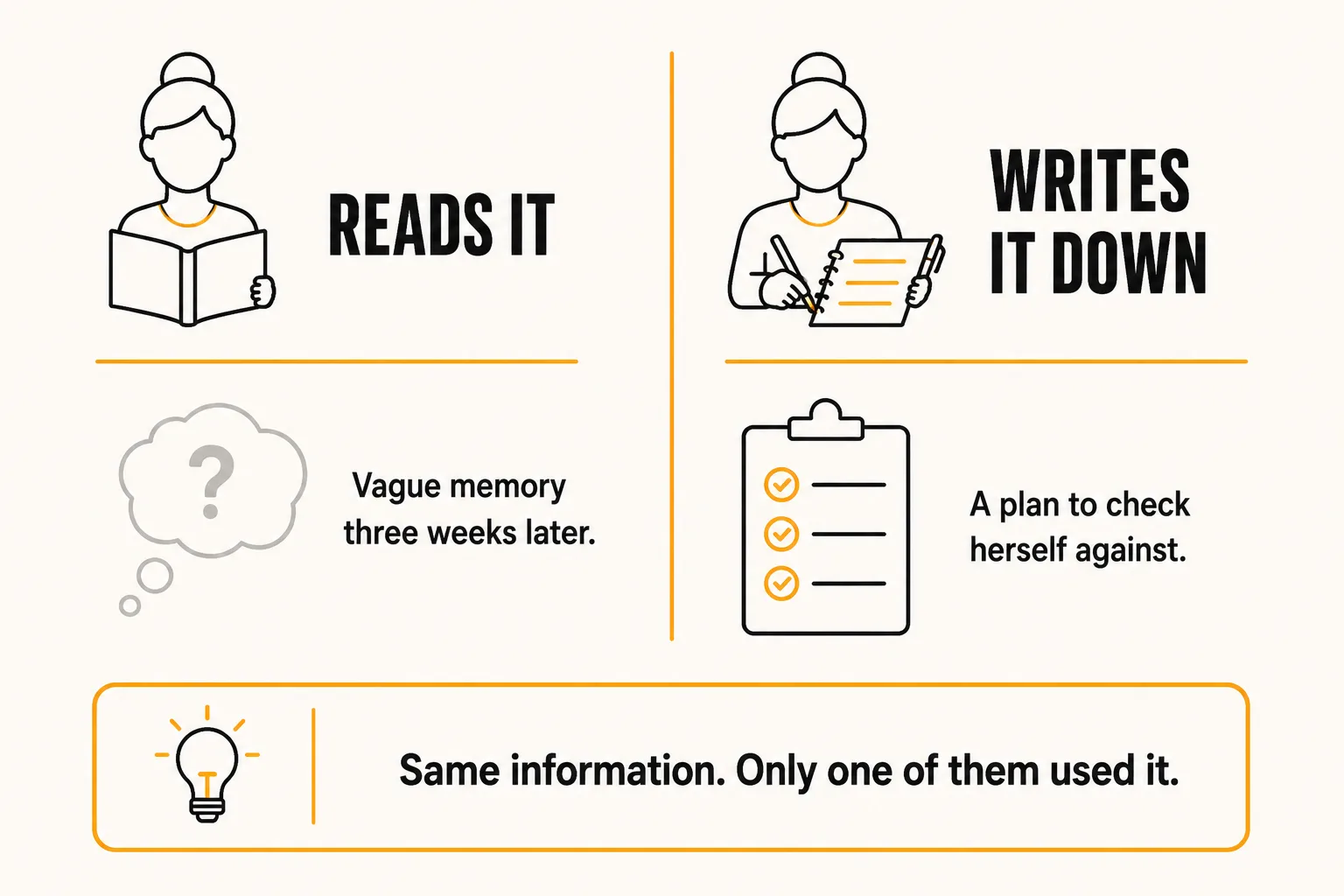
Consider a student who reads Chapter 2's material on pacing and immediately writes down her own realistic weekly plan, versus a student who reads the same material, agrees it sounds sensible, and moves on without ever writing anything down. Three weeks later, the first student has a plan she can check herself against when she falls behind. The second student has a vague memory that pacing was "important" and no way to notice she's already drifted. The information was identical. Only one of them used it.
This habit compounds. By the time you reach Unit 3's client-coaching chapters (Chapters 16 through 18), you'll be applying frameworks to real or practice clients — that's much easier if "apply this immediately" is already your default response to new material, rather than a skill you're learning for the first time under exam pressure.
- Active recall over re-readingClosing the material and trying to explain a concept from memory builds retention far better than reading it a second time. Use the knowledge-check quiz at the end of each lesson this way — attempt it before reviewing your notes, not after.
- Spaced reviewA short weekly check-in on the last two or three chapters keeps earlier material from fading before the cumulative exam. This matters more in Unit 2, where each chapter builds directly on biochemistry introduced a few chapters earlier.
- Write before you checkBefore consulting notes on an exam question, write down your best answer first. It reveals exactly where your understanding is thin, which is more useful than getting the answer right by lookup alone.
- Apply immediately, not eventuallyEvery chapter has at least one idea you can try the same week you learn it — on yourself, a friend, or a hypothetical client. Chapters 16 through 18 assume this is already a habit by the time you reach them.
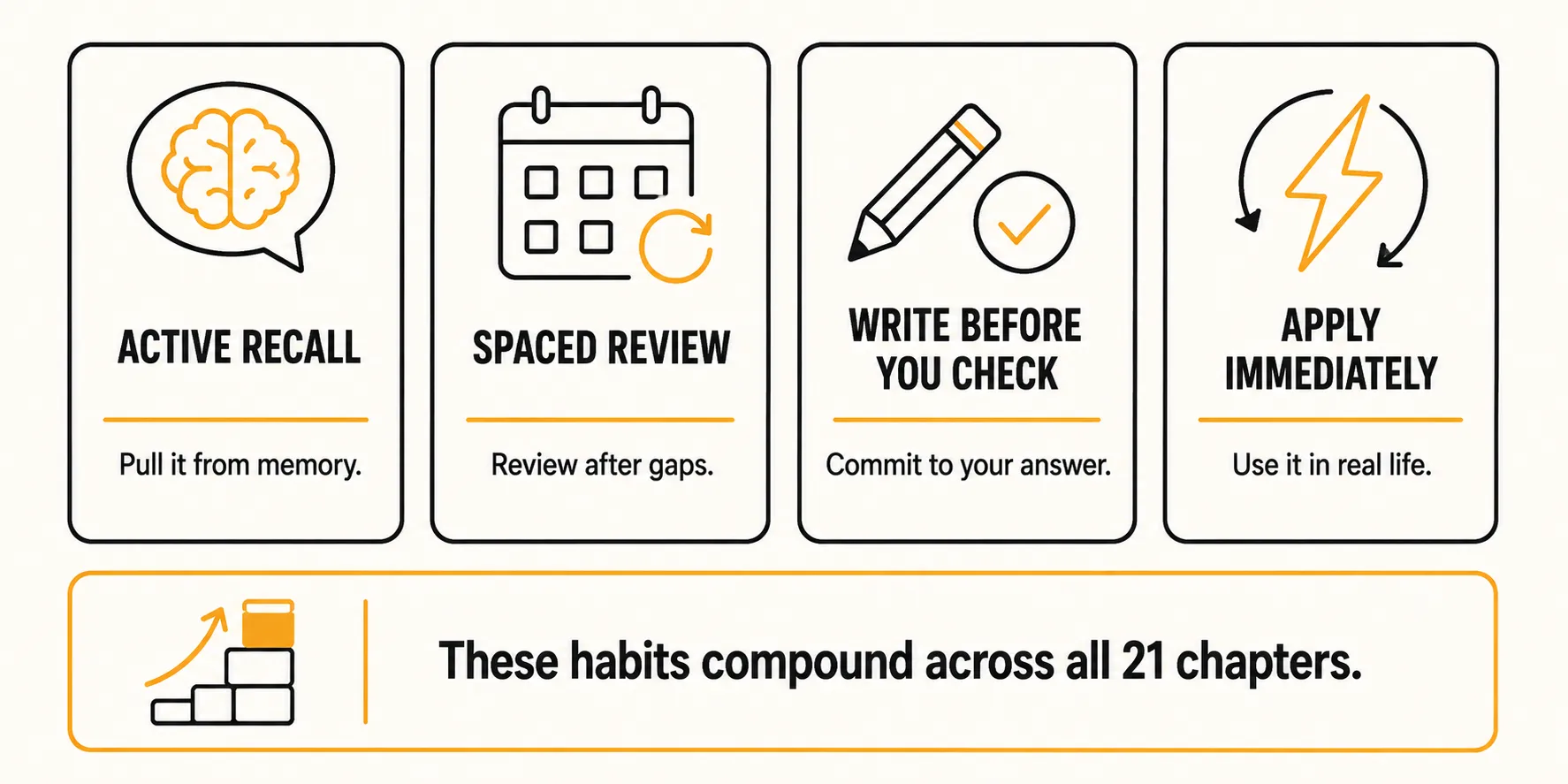
None of these habits require more total study time than reading passively does — they just redirect the same hours toward retention instead of exposure. That distinction is worth remembering every time the course feels slower than you'd like: slower-but-retained beats faster-but-forgotten, every time it's tested by a cumulative exam.
8 questions, modeled on PN's real open-book exam style. Score 75%+ to mark this lesson complete.
- PN Level 1's self-paced, no-deadline format is a real benefit, but it removes external structure — you have to supply your own pace and plan, or momentum tends to fade.
- Choosing a realistic weekly pace before you start (rather than guessing) matters more than choosing the fastest possible pace.
- Slower, spaced study generally beats rushed study for retention — and retention, not speed, is what your cumulative exam score actually rewards.
- Applying each chapter's material immediately — even on yourself or a hypothetical case, not just a paying client — builds habits that make Unit 3's client-coaching chapters far easier.
- Active recall, spaced review, writing answers before checking them, and immediate application are habits worth building starting now, not later in the course.
Before moving to Lesson 3:
- Pick a realistic weekly pace from the table above and write it down somewhere you'll actually see it again.
- Choose one idea from Chapter 1 or this chapter and apply it this week — on yourself, a friend, or a hypothetical client — rather than filing it away as "good to know."
- Attempt the knowledge check below before reviewing your notes, to practice active recall from the start.
- Complete the knowledge check above and review any question you missed.