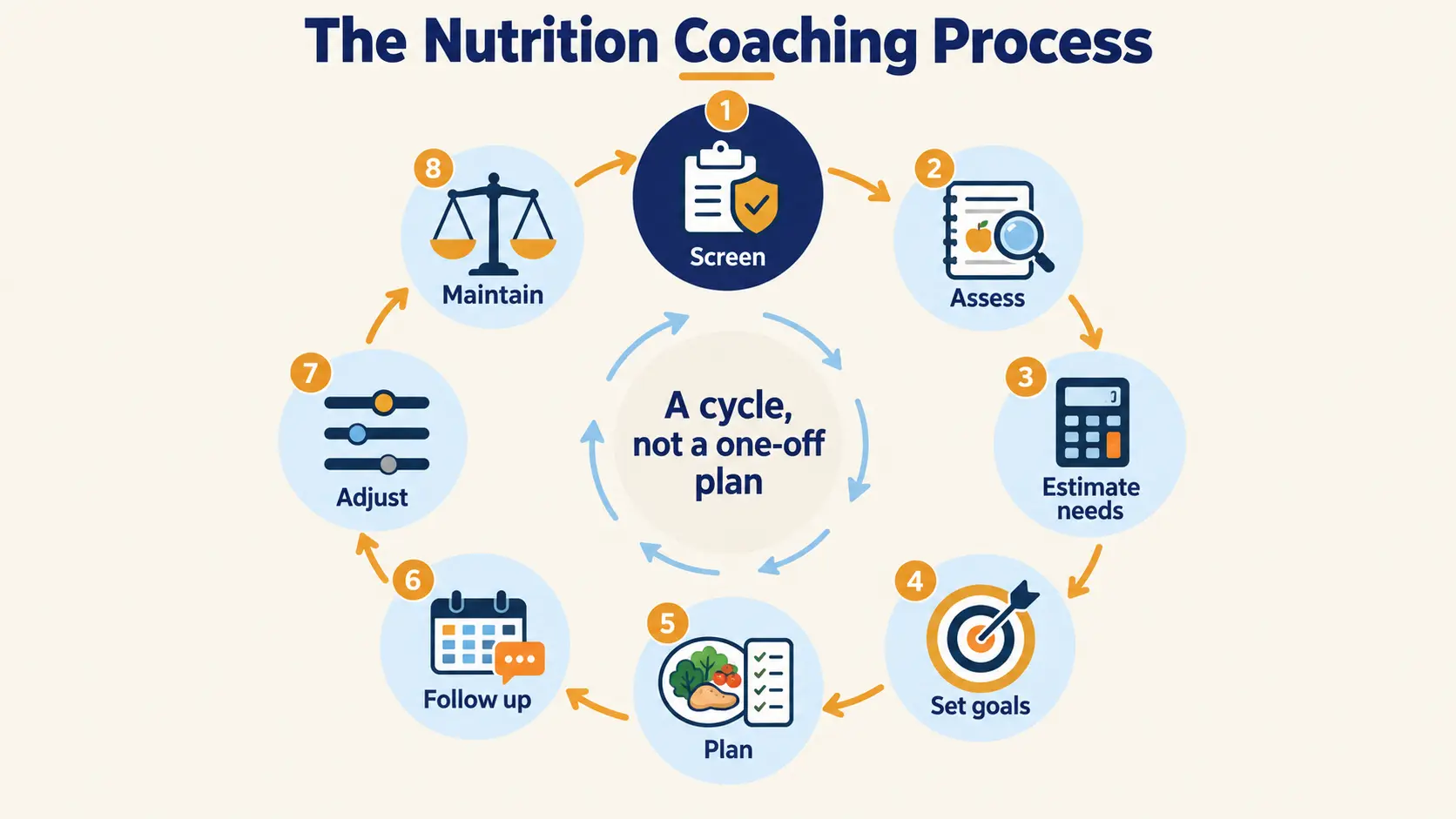
Nutrition coaching is a cycle, not a one-off plan. It starts with intake and screening (and referral when needed), moves through assessment, estimating needs and setting goals, then builds a simple plan the client can actually follow. Regular check-ins provide the feedback for small adjustments, and the end goal is a client who can maintain their results independently. Every number — BMR, TDEE, macros — is a starting estimate; real-world progress is what guides the plan.
This final lesson brings the whole course together. Instead of new theory, it walks through the coaching process from start to finish — and follows one fictional client, Sara, through her first 12 weeks.
Free on YouTube Subscribe to get every lesson video in this course SubscribeThe Coaching Process
| Stage | What happens | Key lessons |
|---|---|---|
| 1. Intake and screening | Health history, medications, goals, consent; identify anything that needs referral | Lessons 14, 15 |
| 2. Assessment | Dietary assessment, body measurements, lifestyle (sleep, stress, activity), readiness to change | Lessons 14, 18 |
| 3. Estimate needs | Energy (BMR and TDEE), protein, fat, carbohydrate, fluids | Lessons 5–8, 11 |
| 4. Set goals | Outcome goal plus one or two process goals; SMART; confidence check | Lesson 17 |
| 5. Build the plan | Simple, habit-based actions — meal structure, portions, environment, shopping | Lessons 19, 20 |
| 6. Follow up | Regular check-ins: adherence, weekly averages, measurements, how the client feels | Lessons 15–17 |
| 7. Adjust | Small changes based on progress; troubleshoot plateaus | Lesson 23 |
| 8. Maintain | Maintenance range, action plan, growing independence | Lesson 23 |
The process is a cycle: what you learn at each check-in feeds back into new goals and small adjustments.
Step 1: Intake and Screening
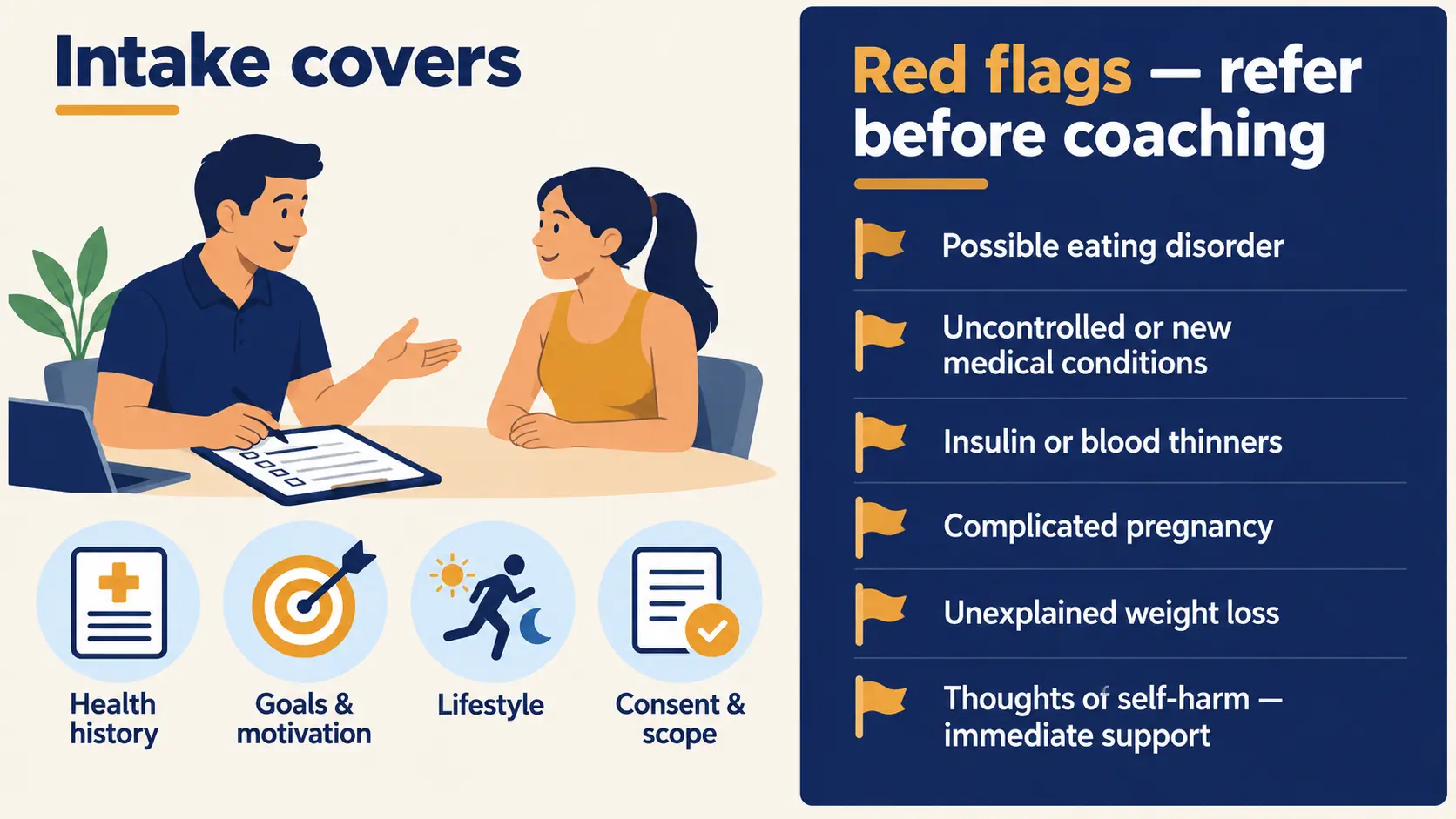
Before any plan, the coach gathers information and checks that nutrition coaching is appropriate and safe.
- Health historyMedical conditions, medications, supplements, allergies and intolerances, pregnancy, surgery.
- Goals and motivationWhat the client wants, why it matters to them, and past attempts (Lesson 16).
- LifestyleWork schedule, cooking skills, budget, culture, family, sleep, stress and activity.
- Consent and scopeExplain what a nutrition coach does and doesn't do, how information is kept private, and when you'll refer.
Step 2: Assessment
Assessment builds the starting picture (Lesson 18): a few days of food records or a 24-hour recall, body measurements the client is comfortable with, and lifestyle factors such as sleep, stress and daily steps. Just as important is readiness to change — someone in precontemplation needs a different conversation from someone preparing to act (Lesson 14). A quick importance and confidence ruler (0–10) helps (Lesson 16).
Step 3: Estimating Needs
Energy
A common way to estimate resting energy needs is the Mifflin-St Jeor equation (weight in kg, height in cm, age in years):
| Equation | |
|---|---|
| Men | BMR = (10 × weight) + (6.25 × height) − (5 × age) + 5 |
| Women | BMR = (10 × weight) + (6.25 × height) − (5 × age) − 161 |
Then estimate TDEE = BMR × activity factor:
| Activity level | Typical factor |
|---|---|
| Sedentary (little or no exercise) | 1.2 |
| Lightly active (light exercise 1–3 days a week) | 1.375 |
| Moderately active (moderate exercise 3–5 days a week) | 1.55 |
| Very active (hard exercise 6–7 days a week) | 1.725 |
| Extremely active (physical job plus hard training) | 1.9 |
For weight loss, a moderate deficit — often about 300–500 kcal a day, aiming for roughly 0.5–1% of body weight a week (Lesson 23) — is a common starting point. These equations are estimates: individual needs can differ by several hundred calories, so real progress over 2–4 weeks is what confirms or corrects them.
Macronutrients
- 1. Protein first (g per kg)Often about 1.2–2.0 g/kg for active adults, toward the higher end during weight loss with resistance training (Lesson 6).
- 2. Fat as a percentage of energyOften about 20–35% of total energy (Lesson 8).
- 3. Carbohydrate fills the restRemaining energy ÷ 4 kcal per gram (Lesson 7).
- ConversionsProtein and carbohydrate ≈ 4 kcal/g; fat ≈ 9 kcal/g.
Not every client needs numbers. Many do better with hand portions, the plate method or simple habits (Lesson 19). Numbers are a tool — use them when they help the client.
Steps 4 and 5: Goals and the Plan
Pair one outcome goal with one or two process goals the client chooses, written SMART and checked for confidence (Lesson 17). The plan itself should be simple: a few habits, a basic meal structure, portion guides, and environment and shopping changes (Lessons 19–20). Start with the habit that's most important and most achievable — not everything at once.
Steps 6–8: Follow-Up, Adjust and Maintain
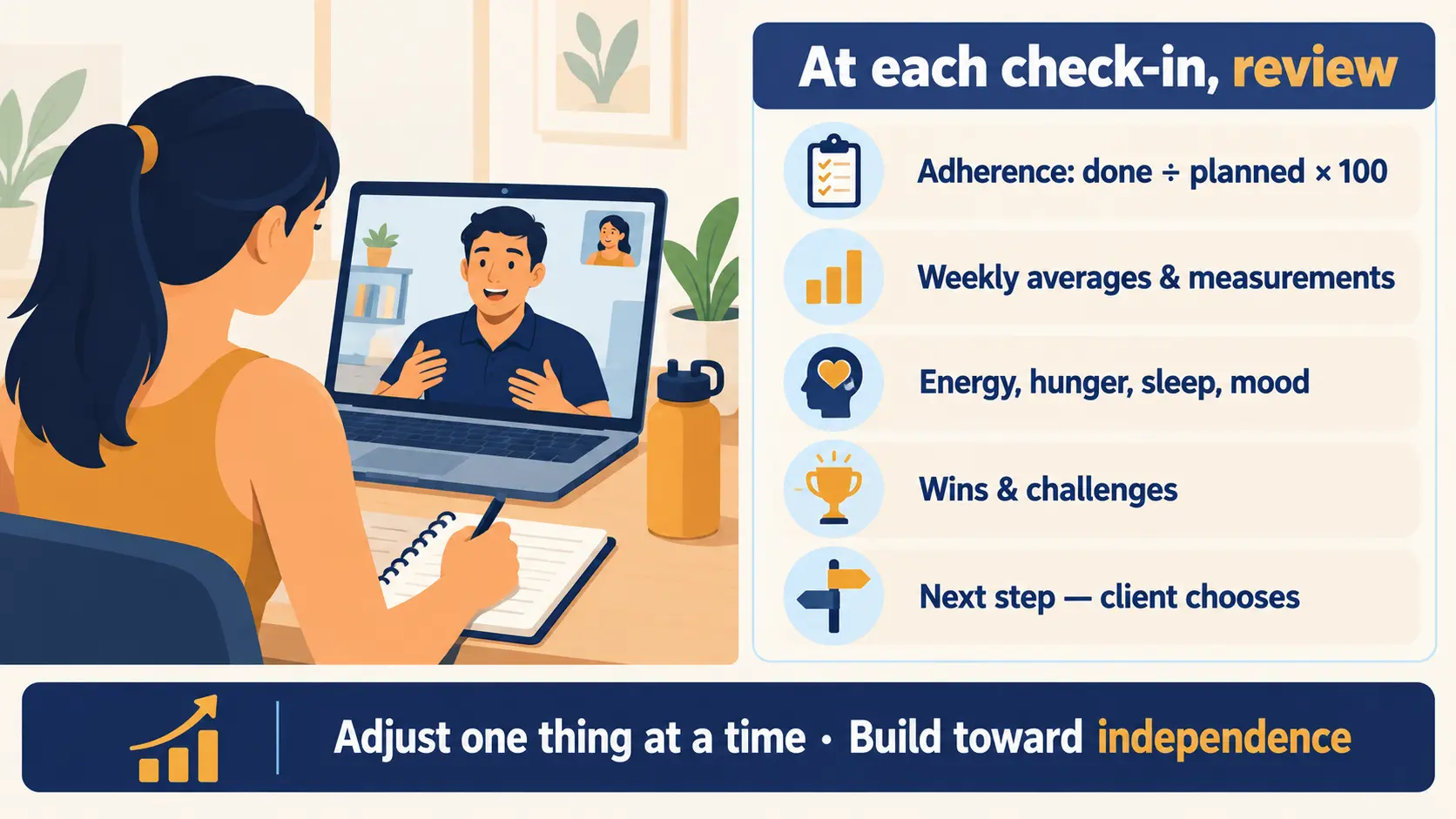
| At each check-in, review… | Why |
|---|---|
| Adherence (done ÷ planned × 100) | Shows whether the goal is the right size (Lesson 17) |
| Weekly average weight and/or measurements | Shows the trend, not daily noise (Lessons 18, 23) |
| Energy, hunger, sleep, mood | Signals whether the plan is sustainable |
| Wins and challenges | Builds self-efficacy and finds barriers (Lesson 15) |
| Next step | Keep, adjust, or add a goal — chosen by the client |
Check-ins are often weekly or every two weeks at first, becoming less frequent as habits settle. Adjustments should be small and one at a time (Lesson 23). Over time, the aim is independence: a client with a maintenance range, an action plan and the skills to manage without the coach.
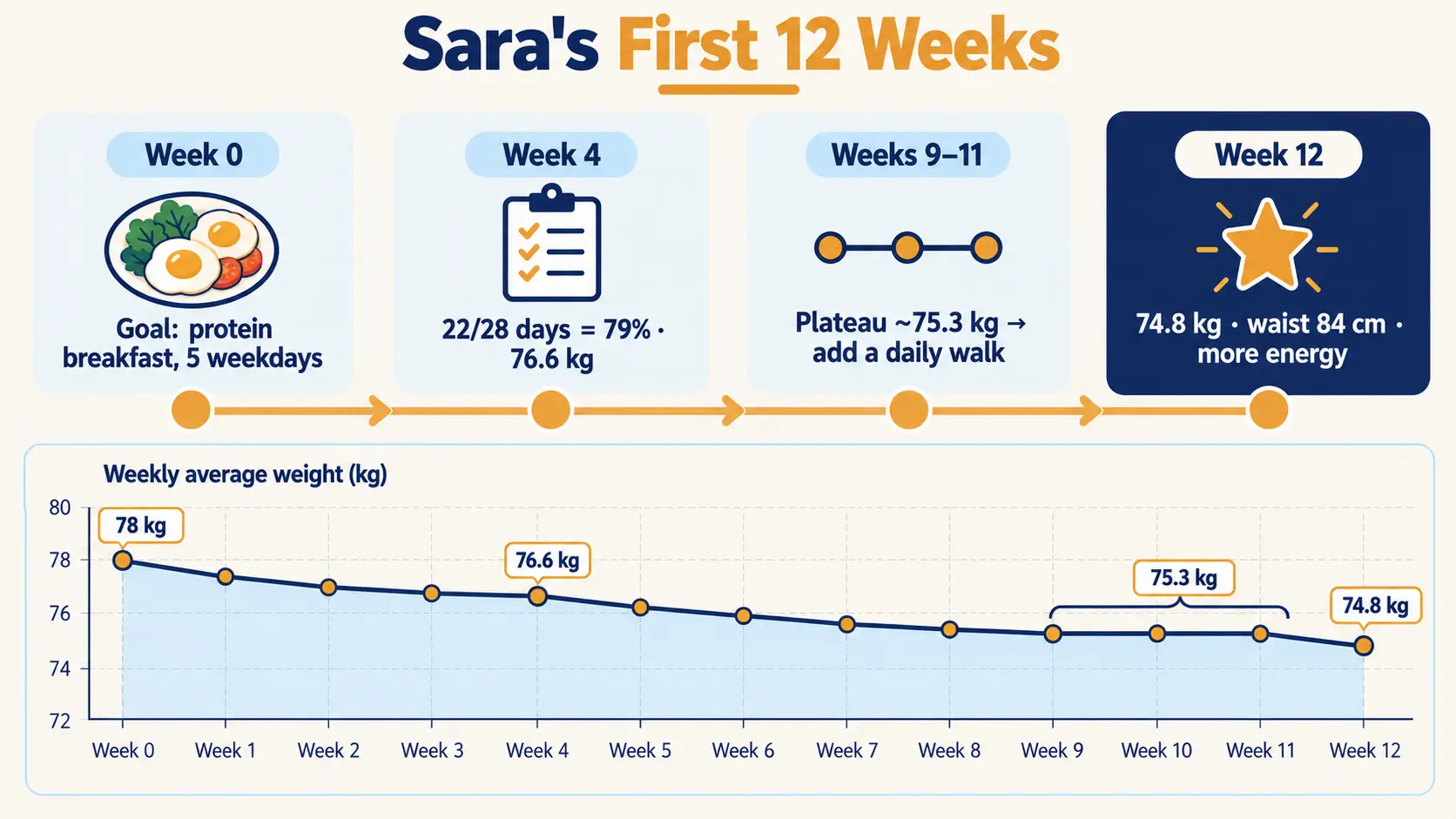
Worked Example: Sara's First 12 Weeks (Fictional Client)
Sara: 38, office worker, two children. 165 cm, 78 kg. Wants "more energy and to lose some weight" — mainly to keep up with her kids.
Screening: no medical conditions or medications; no history of disordered eating. Coaching is appropriate.
Assessment: a 3-day food record shows skipped breakfasts, low protein before dinner, frequent afternoon biscuits and few vegetables. About 5,000 steps a day; strength training twice a week; ~6.5 hours' sleep. Stage of change: preparation. Importance 8/10, confidence 6/10.
Waist: 88 cm (waist-to-height ratio 88 ÷ 165 ≈ 0.53).
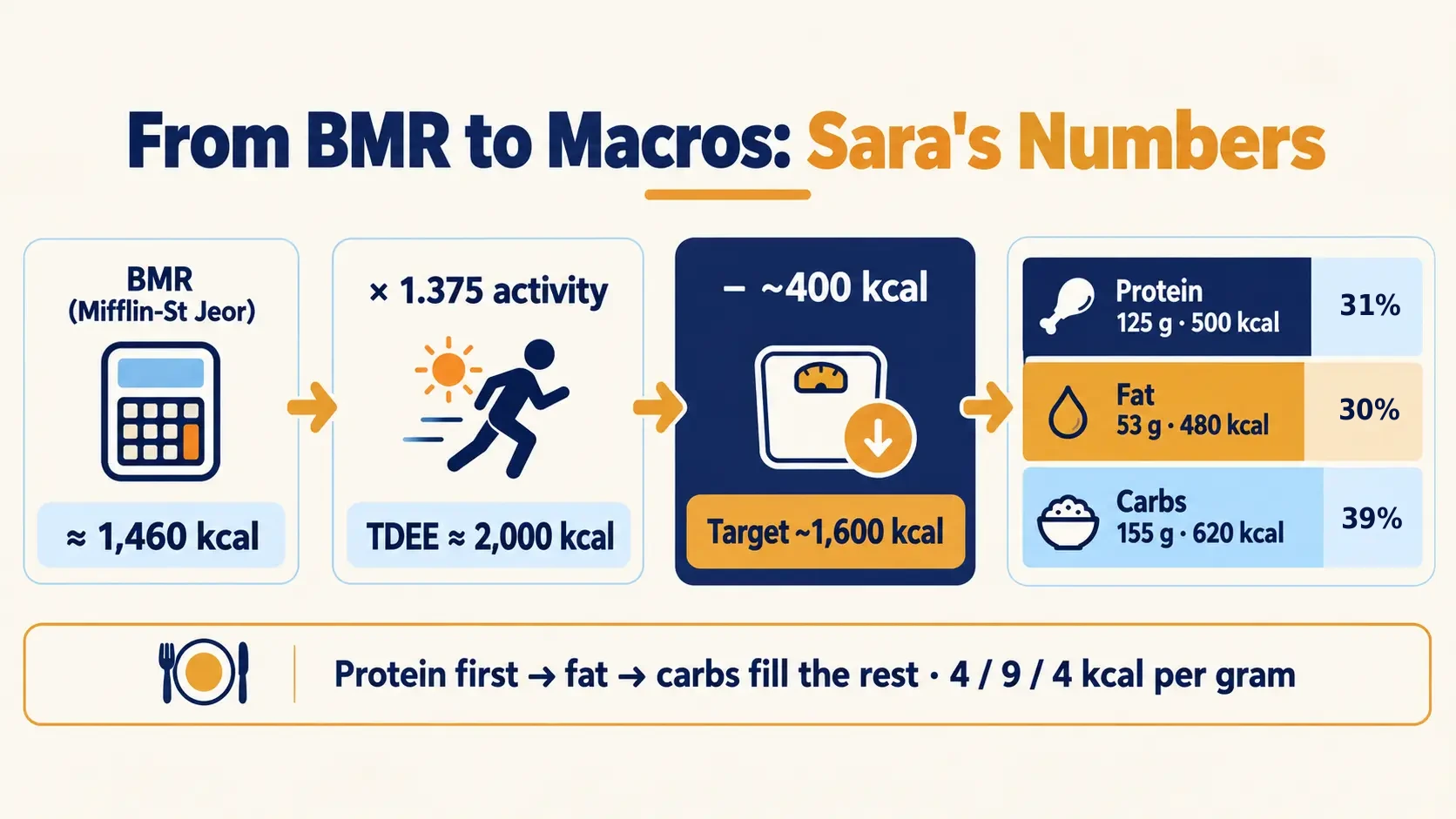
BMR (women): (10 × 78) + (6.25 × 165) − (5 × 38) − 161 = 780 + 1,031 − 190 − 161 ≈ 1,460 kcal.
TDEE: 1,460 × 1.375 (lightly active) ≈ 2,000 kcal.
Energy target: about 400 kcal below → ~1,600 kcal a day (roughly 0.4 kg a week, about 0.5% of body weight).
Macros: protein 1.6 g/kg × 78 ≈ 125 g (500 kcal); fat 30% of 1,600 = 480 kcal ÷ 9 ≈ 53 g; carbohydrate (1,600 − 500 − 480) = 620 kcal ÷ 4 = 155 g.
Goals: outcome — lose about 5 kg over 4–6 months. Process — a protein-rich breakfast on 5 weekdays (confidence 8/10). Sara prefers hand portions to tracking numbers, so the macro targets guide the coach's suggestions rather than her daily logging.
Week 4: breakfast on 22 of 28 days → 22 ÷ 28 × 100 ≈ 79% adherence. Weekly average 76.6 kg. Afternoon biscuits are less frequent. She adds a second goal: fruit and yogurt as her afternoon snack.
Weeks 9–11: weekly averages stay flat around 75.3 kg. The check-in finds her steps have slipped to about 4,000. She chooses a 15-minute walk after school drop-off (Lesson 23).
Week 12: weekly average 74.8 kg, waist 84 cm, energy "much better", sleep 7 hours. Next: keep going toward her goal, with check-ins moving to every two weeks — and a maintenance plan to follow.
12 questions in the style of the CNC exam. Score 70%+ to mark this lesson complete.
- Coaching is a cycle: screen, assess, estimate needs, set goals, plan, follow up, adjust and maintain.
- Screening comes first — refer red flags before coaching, and keep watching for them.
- Estimate BMR (Mifflin-St Jeor), multiply by an activity factor for TDEE, and set a moderate deficit if weight loss is the goal.
- Set protein first (g/kg), then fat (% of energy), then carbohydrate fills the rest.
- Keep the plan simple and habit-based; numbers are a tool, not a requirement.
- Check in regularly, adjust one thing at a time, and build toward independence.
To finish the course:
- Work through the full process for a made-up client — from intake to their first check-in.
- Calculate BMR, TDEE and a macro split for yourself or a sample client.
- Revisit the exam lookup tips from every lesson and note your weakest topics.
- Complete the knowledge check above and review any question you missed.