Good goals turn motivation into action. Outcome goals (such as losing 5 kg) give direction, but process goals — the daily and weekly behaviors that lead there — are what clients control and practise. Write them SMART: specific, measurable, achievable, relevant and time-bound. Check the client's confidence, plan for obstacles, track adherence, and adjust regularly: make goals smaller when adherence is low, and add the next step when a habit is solid. The client chooses the goal; the coach helps shape it.
Lesson 16 ended with the fourth process of motivational interviewing: planning. This lesson is about how to turn a client's motivation into goals that actually work — and how to keep them working over weeks and months.
Free on YouTube Subscribe to get every lesson video in this course SubscribeWhy Goals Work
Goal-setting theory, developed by psychologists Edwin Locke and Gary Latham, found that specific, challenging-but-achievable goals lead to better performance than vague "do your best" goals. Goals work by directing attention, increasing effort, encouraging persistence, and prompting people to find strategies.
They work best when the person is committed to the goal (it matters to them and they helped choose it), gets regular feedback on progress, and when complex goals are broken into smaller steps.
Outcome vs Process Goals
| Outcome goals | Process (behavior) goals | |
|---|---|---|
| What they describe | A result | The actions that lead to a result |
| Examples | "Lose 5 kg in 6 months." "Reduce my waist by 5 cm." | "Eat vegetables at lunch and dinner on 5 days a week." "Walk for 20 minutes after dinner 4 times a week." |
| Control | Only partly in the client's control — bodies, life and biology vary | Fully in the client's control |
| Role | Gives direction and meaning | Drives day-to-day progress; the focus of weekly coaching |
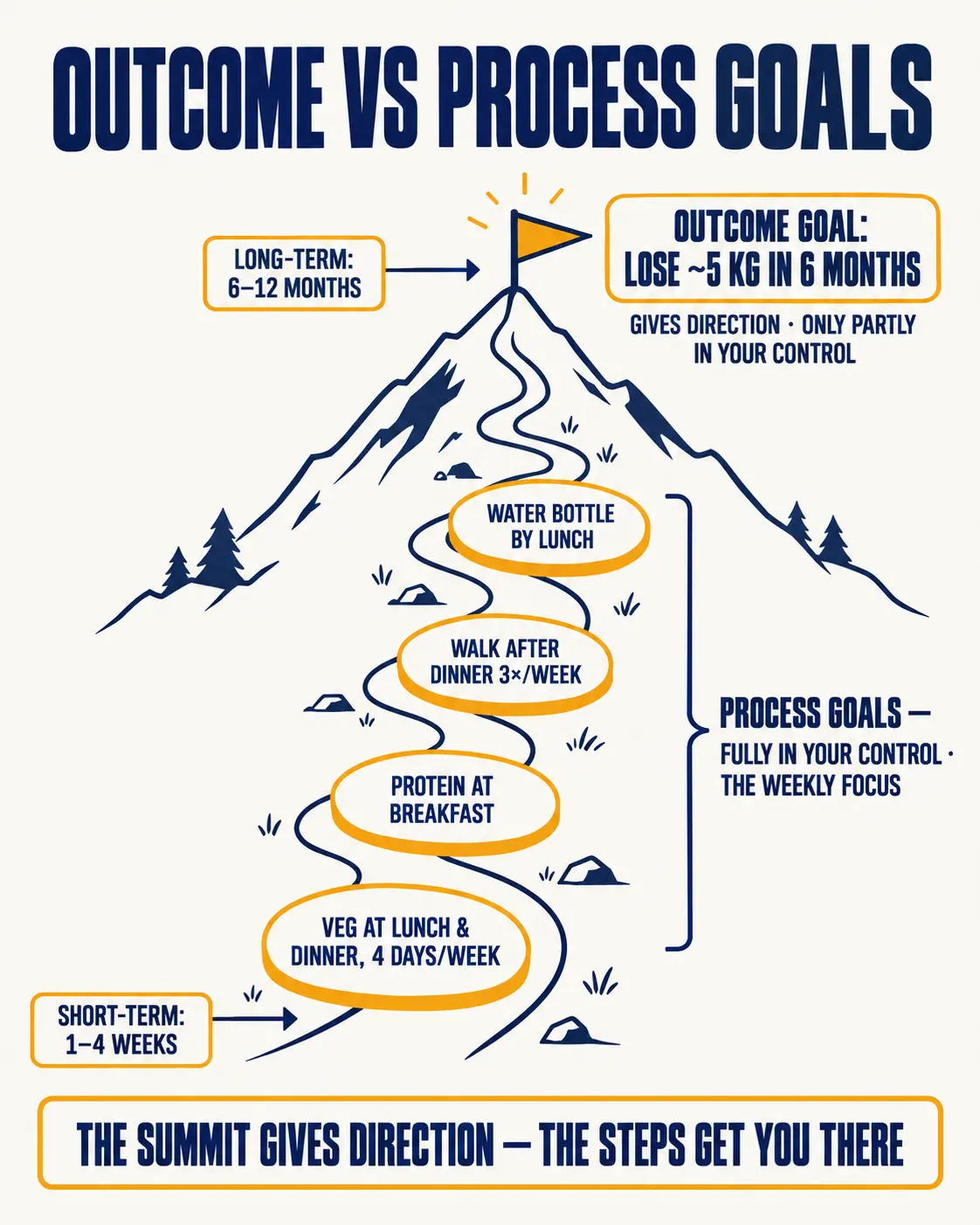
Both have a place. The outcome goal answers "where are we going?"; process goals answer "what will I do this week?". Coaches usually build weekly goals around process goals, because clients can succeed at them even when the scale doesn't move — which builds self-efficacy (Lesson 14).
Short-term and long-term goals
A long-term goal (often 6–12 months) sets the direction. Short-term goals (usually one to four weeks) are the stepping stones. Short-term goals give quick wins and frequent feedback; long-term goals keep them connected to something the client cares about.
Approach vs avoidance goals
Approach goals describe something to do ("Have fruit as my evening snack"). Avoidance goals describe something to stop ("Stop eating crisps at night"). Approach goals are generally easier to act on and feel more positive, so coaches often reframe "stop" goals into "do" goals.
Writing SMART Goals
| Letter | Meaning | Question to ask |
|---|---|---|
| S | Specific | Exactly what will you do? |
| M | Measurable | How will you know you've done it? |
| A | Achievable | Is it realistic right now, with your schedule and resources? |
| R | Relevant | Does it connect to what you want and value? |
| T | Time-bound | How often, and by when will you review it? |
- Vague: "Eat healthier."SMART: "Eat a piece of fruit with breakfast on at least 5 days each week for the next 4 weeks."
- Vague: "Drink more water."SMART: "Fill my 1-litre bottle each morning and finish it by lunch on workdays this month."
- Vague: "Stop eating junk."SMART (and approach): "Pack a homemade lunch 3 days a week for the next 2 weeks."
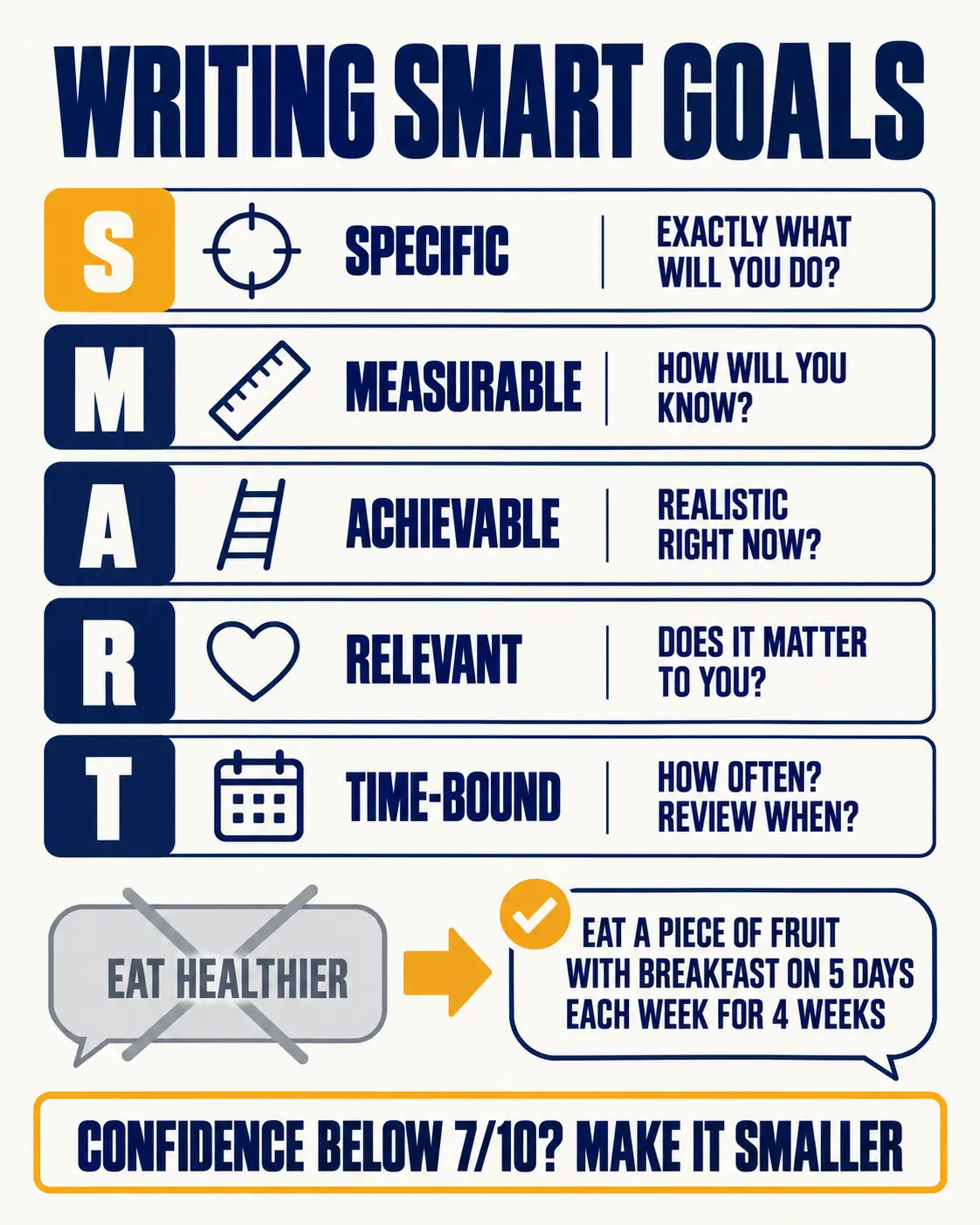
Some coaches extend this to SMARTER — adding Evaluate and Readjust — as a reminder that goals should be reviewed and changed as needed.
Check confidence before committing
Before finalising a goal, ask: "On a scale of 0 to 10, how confident are you that you can do this?" If the answer is below about 7, make the goal smaller or easier — many coaches aim for a 9. It's better for a client to succeed at a small goal than fail at a big one.
Planning for Obstacles
Most goals fail at predictable moments — a late meeting, a family event, a bad night's sleep. Planning for these in advance makes success far more likely.
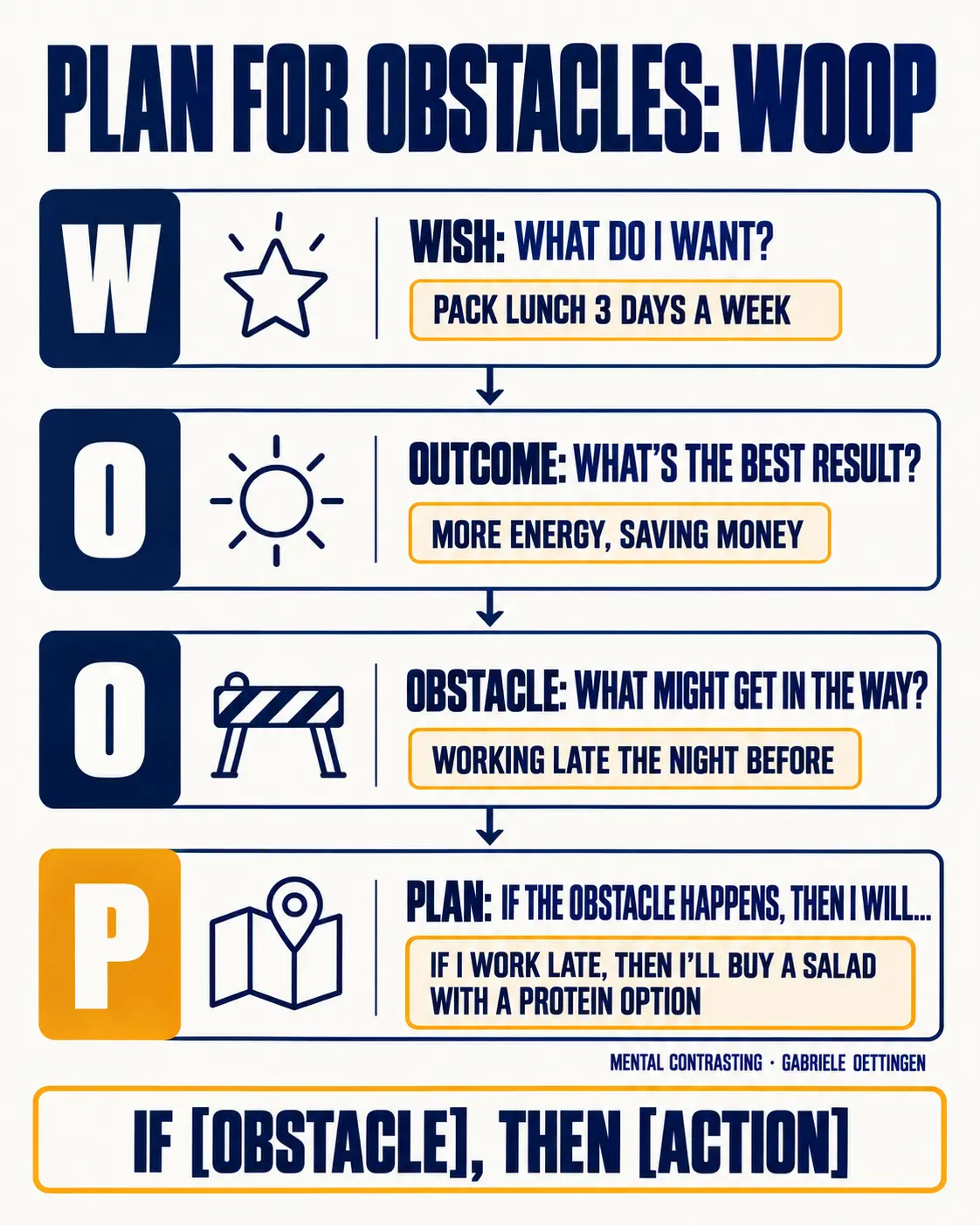
- If–then plans"If I work late and miss lunch prep, then I'll buy a salad with a protein option near the office." (Lesson 14)
- WOOP (mental contrasting)Wish (what do I want?), Outcome (what's the best result?), Obstacle (what inside me or around me might get in the way?), Plan (if the obstacle happens, then I will…). Developed by psychologist Gabriele Oettingen.
Tracking Progress
Tracking gives the feedback that makes goals work. Choose methods that match the goal and the client — and that the client is happy to use.
| Method | Best for | Notes |
|---|---|---|
| Habit tracker / checklist | Process goals | A simple tick each day the behavior is done |
| Food log or photos | Awareness of eating patterns | Useful short-term; can feel burdensome long-term (Lesson 18) |
| Body weight | Weight-related outcome goals | Look at weekly averages or trends — daily weight shifts with fluid, food and salt |
| Measurements and progress photos | Body composition changes | Waist and other circumferences (Lesson 18) |
| Non-scale wins | Motivation and wellbeing | Energy, sleep, mood, strength, how clothes fit, cooking confidence |
Measuring adherence
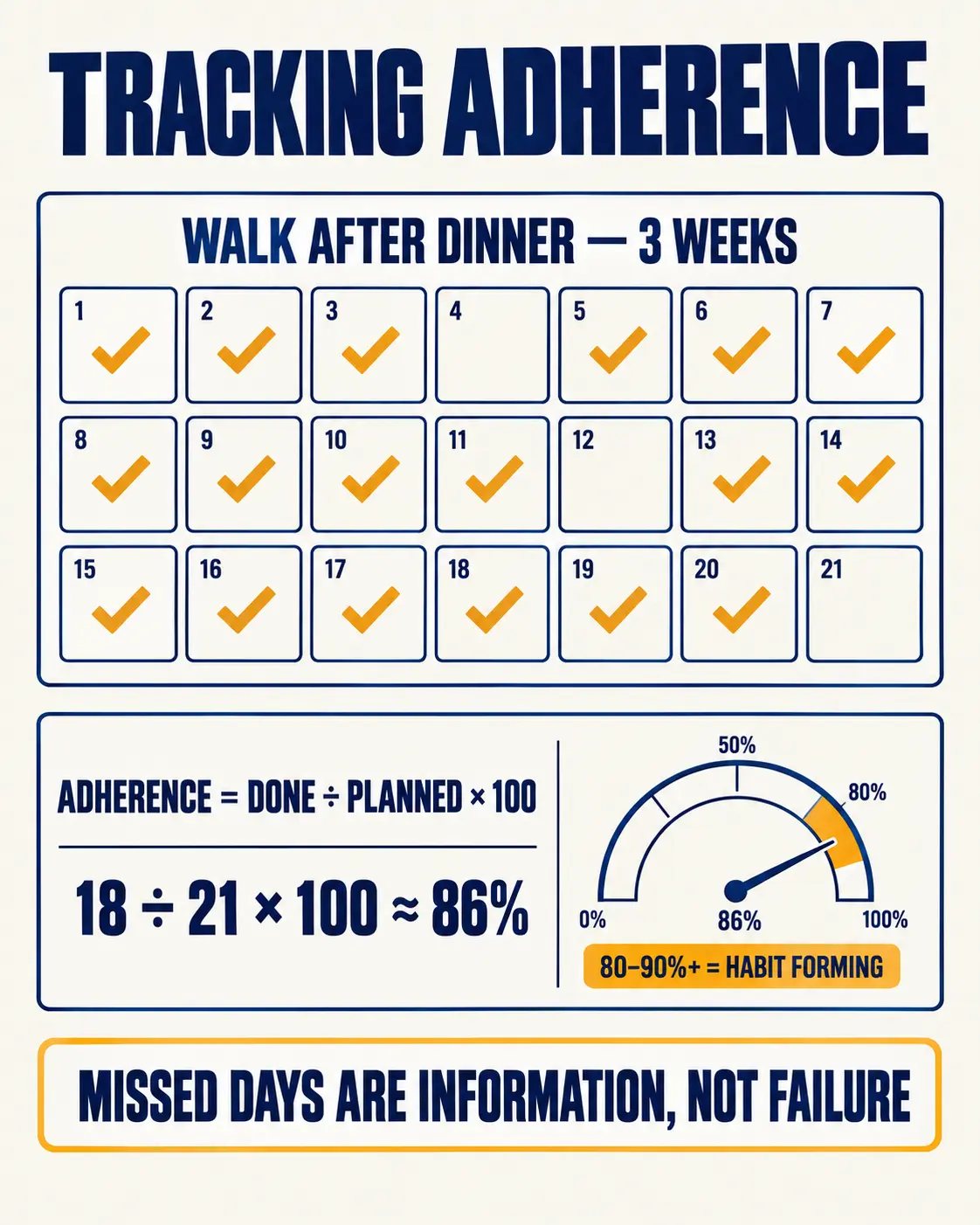
Adherence is how consistently the planned behavior is done:
Adherence (%) = times the behavior was done ÷ times it was planned × 100
For example, walking after dinner on 18 of 21 planned days = 18 ÷ 21 × 100 ≈ 86%.
Reviewing and Adjusting Goals
Goals should be reviewed regularly — often weekly or every two weeks. The review is collaborative: the client reflects on what worked, and chooses what to do next.
| What you see | What it suggests | Next step |
|---|---|---|
| Low adherence (roughly under 70–80%) | The goal is too big, or a barrier is in the way | Make it smaller, remove the barrier, or pick a different goal |
| High adherence (roughly 80–90%+) and it feels easy | The habit is forming | Keep it, and add one new goal |
| High adherence, but the outcome isn't moving | The behavior may not be enough on its own | Adjust the behavior itself (for example, portion sizes) — see Lesson 23 |
| Life has changed (travel, illness, new job) | Old goals may no longer fit | Pause or scale back; set a "maintenance" goal |
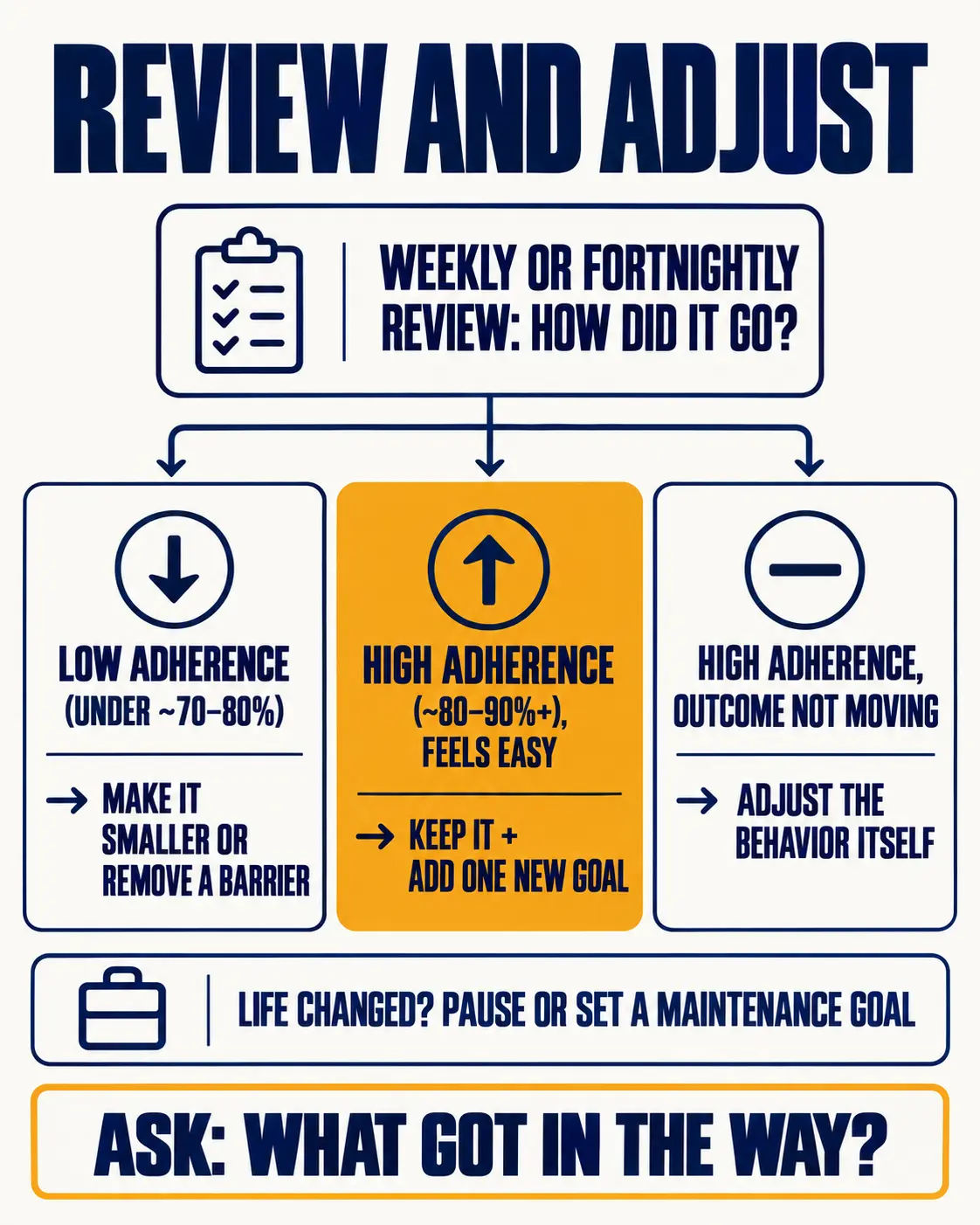
Missed goals are information, not failure. Asking "What got in the way?" (Lesson 15) turns a setback into a better plan.
Long-term outcome goal: Nikhil wants to lose about 5 kg over the next 6 months so he has more energy to play football with his kids.
First process goal: "Eat vegetables with lunch and dinner on 5 days a week for 2 weeks." Confidence: 6/10. They shrink it to 4 days a week — confidence 9/10.
Obstacle plan: "If the office canteen has no vegetable dish, then I'll add the salad bar side."
Two-week review: he managed 7 of 8 planned days → 7 ÷ 8 × 100 ≈ 88% adherence, and says it now feels routine.
Next step: keep the vegetable goal and add a second one he chooses — a palm-sized portion of protein at breakfast on 4 days a week.
For more on the psychology behind goals, see NBHWC Lesson 6: Motivational Interviewing 4.0 & Goal-Setting Theories.
12 questions in the style of the CNC exam. Score 70%+ to mark this lesson complete.
- Specific, challenging-but-achievable goals beat "do your best"; commitment and feedback make them work.
- Outcome goals give direction; process goals are the behaviors clients control and practise each week.
- Pair long-term goals with short-term stepping stones; prefer approach goals over avoidance goals.
- Write goals SMART and check confidence — below about 7/10, make the goal smaller.
- Plan for obstacles with if–then plans or WOOP; track adherence (done ÷ planned × 100) and non-scale wins.
- Review regularly: low adherence → smaller goal; high adherence → add the next step. Medical targets → doctor.
Before moving to Lesson 18:
- Turn one vague goal of your own into a SMART process goal.
- Rate your confidence 0–10 and shrink the goal until it's at least a 7.
- Write one if–then plan for the most likely obstacle.
- Complete the knowledge check above and review any question you missed.