Motivational interviewing (MI) is a collaborative way of talking about change that draws out the client's own reasons for changing, instead of the coach supplying them. It rests on a spirit of partnership, acceptance, compassion and evocation. Most people feel two ways about change — that ambivalence is normal. The coach listens for change talk (desire, ability, reasons, need, commitment, activation, taking steps), strengthens it with OARS, and rolls with pushback rather than arguing. The biggest mistake is the expert trap: taking over as the one with all the answers.
Lesson 15 introduced the core communication skills — OARS. Motivational interviewing puts those skills to work with a specific purpose: helping people resolve their mixed feelings about change and find their own motivation to act. It's one of the most researched coaching approaches, used across nutrition, exercise, smoking, alcohol and many other health behaviors.
Free on YouTube Subscribe to get every lesson video in this course SubscribeWhat Motivational Interviewing Is
Motivational interviewing is a collaborative, person-centred way of talking about change, developed by psychologists William Miller and Stephen Rollnick. It strengthens a person's own motivation and commitment by drawing out their reasons for change — not by persuading, warning or lecturing.
The key insight: when a helper argues for change, the person tends to argue back for staying the same. When the person hears themselves voice their own reasons for change, they're more likely to act. MI is not a trick to make people do what the coach wants — the direction of change comes from the client's own goals and values.
The Spirit of MI
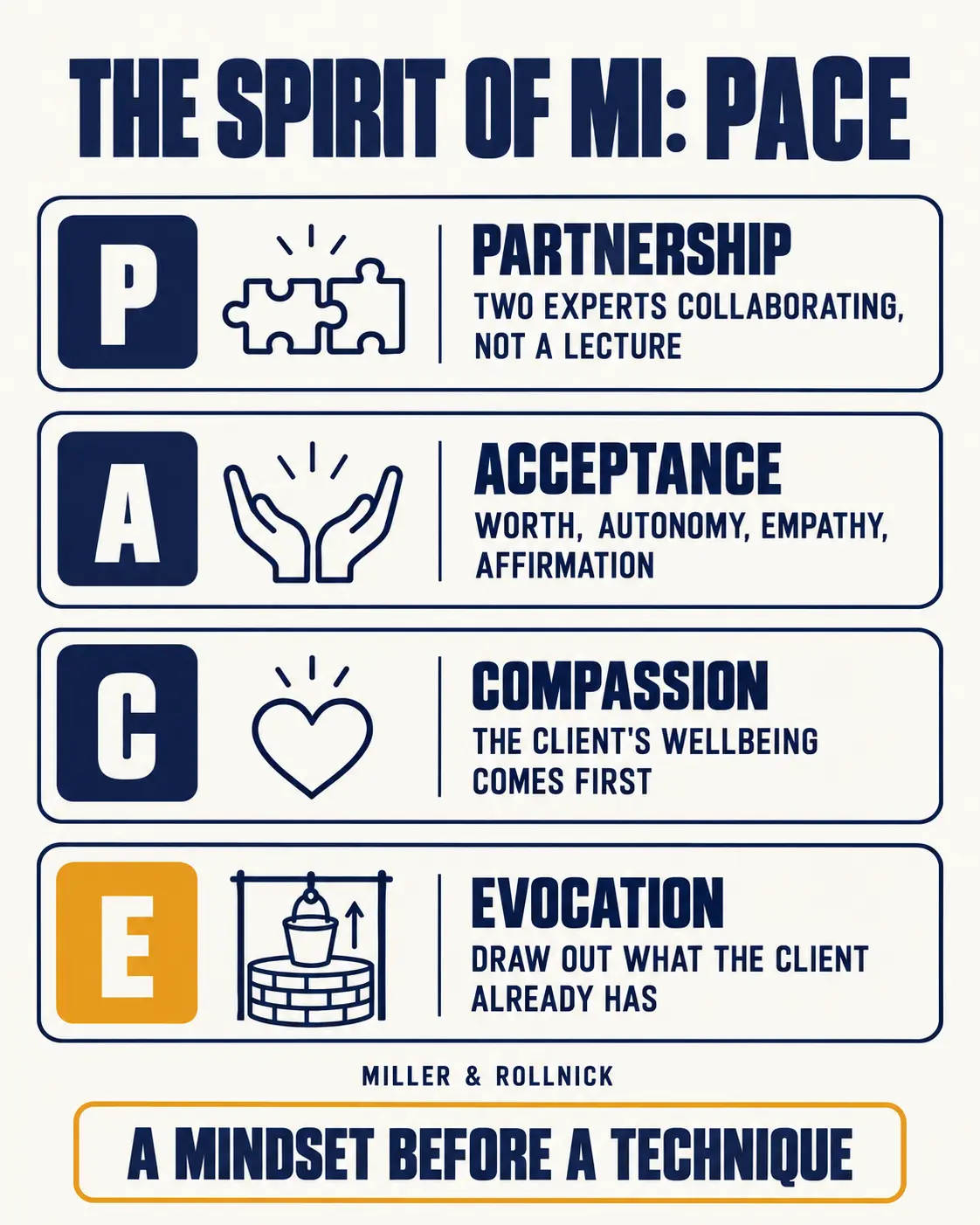
MI is a mindset before it's a set of techniques. Its underlying "spirit" is often remembered as PACE:
- PartnershipAn active collaboration between two experts — the coach on behavior change, the client on their own life. Not a lecture.
- AcceptanceRespecting the person's worth and autonomy, offering accurate empathy and affirming strengths — without having to approve of every choice.
- CompassionActively putting the client's wellbeing and needs first, not the coach's agenda.
- EvocationDrawing out the motivation, ideas and strengths the client already has, rather than installing them from outside.
Core principles
Earlier descriptions of MI summarise its approach as four principles — still common on exams:
| Principle | What it means in practice |
|---|---|
| Express empathy | Use reflective listening to understand the client's view without judging it |
| Develop discrepancy | Help the client notice the gap between their current behavior and what they value or want |
| Roll with resistance | Don't argue or push; reflect and invite new perspectives instead |
| Support self-efficacy | Build the client's belief that they can change (Lesson 14) |
You may also see these summarised as RULE: Resist the righting reflex, Understand the client's motivations, Listen with empathy, and Empower the client.
The Four Processes
An MI conversation moves through four overlapping processes. The most recent (2023) edition of Miller and Rollnick's book calls them the four tasks — the structure is the same. Each builds on the one before, though coaches often loop back.
| Process | The question it answers | What the coach does |
|---|---|---|
| 1. Engaging | Can we work together? | Builds trust and rapport with OARS |
| 2. Focusing | What are we talking about? | Agrees on a clear direction or target behavior with the client |
| 3. Evoking | Why would the client change? | Draws out the client's own motivation — their change talk |
| 4. Planning | How will they do it? | Helps the client build a specific plan they own (Lesson 17) |
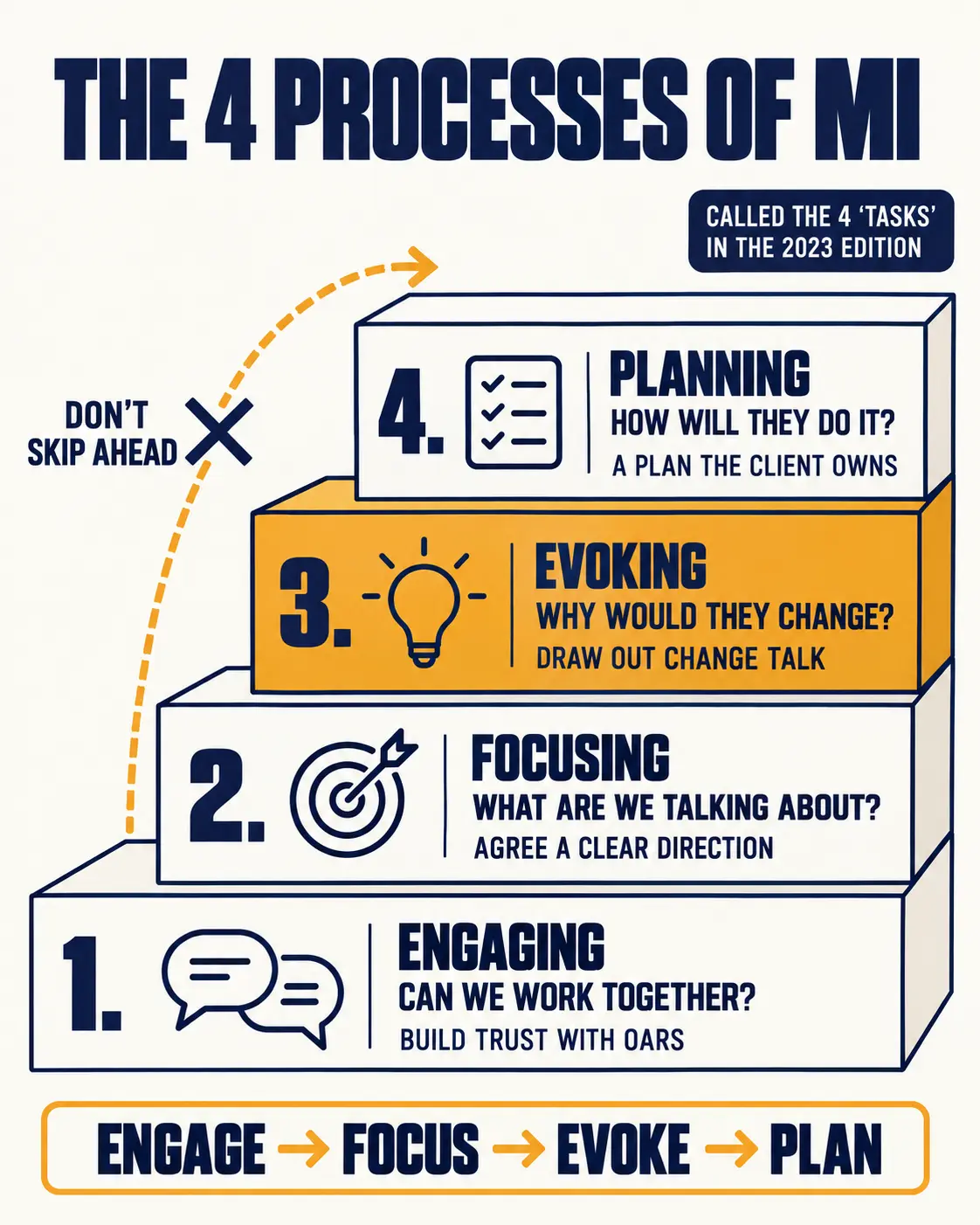
Jumping straight to planning before engaging and evoking is one of the most common mistakes — the plan may be sound, but the client isn't committed to it.
Ambivalence
Ambivalence means feeling two ways about something at the same time: "I want to eat better, but I love my evening snacks." It's a normal, expected part of change — not denial or a lack of willpower. People often stay stuck because both sides feel equally strong.
A decisional balance exercise helps a client look at both sides — the benefits and costs of changing, and the benefits and costs of staying the same:
| Benefits | Costs | |
|---|---|---|
| Staying the same | "Takeaway is easy after a long day." | "I feel sluggish and I'm spending a lot." |
| Changing | "More energy; saving money." | "Cooking takes time I don't feel I have." |
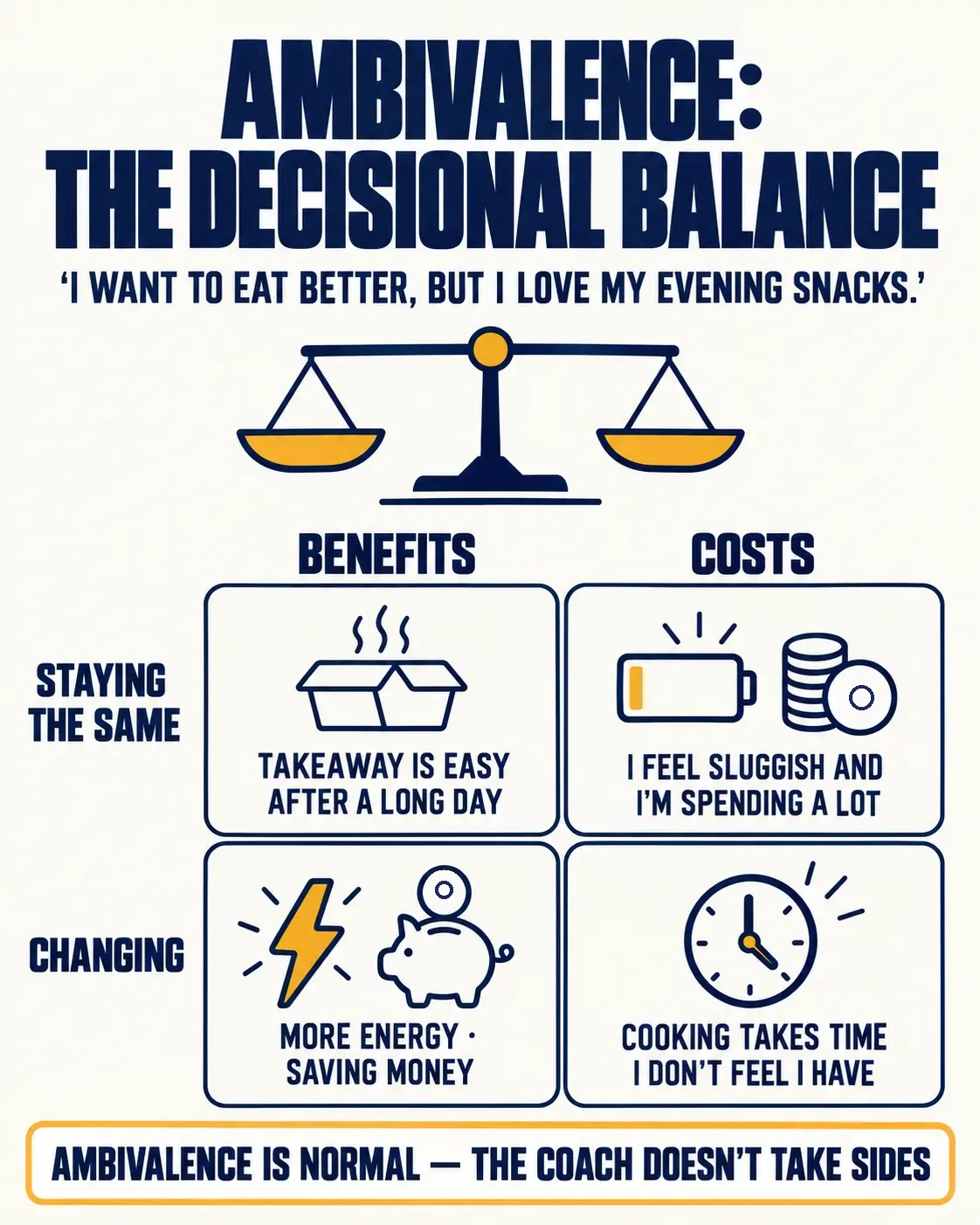
The coach doesn't argue for either side — the goal is for the client to see the whole picture and explore it. Developing discrepancy happens naturally when the client notices how the current behavior conflicts with what they value.
Change Talk and Sustain Talk
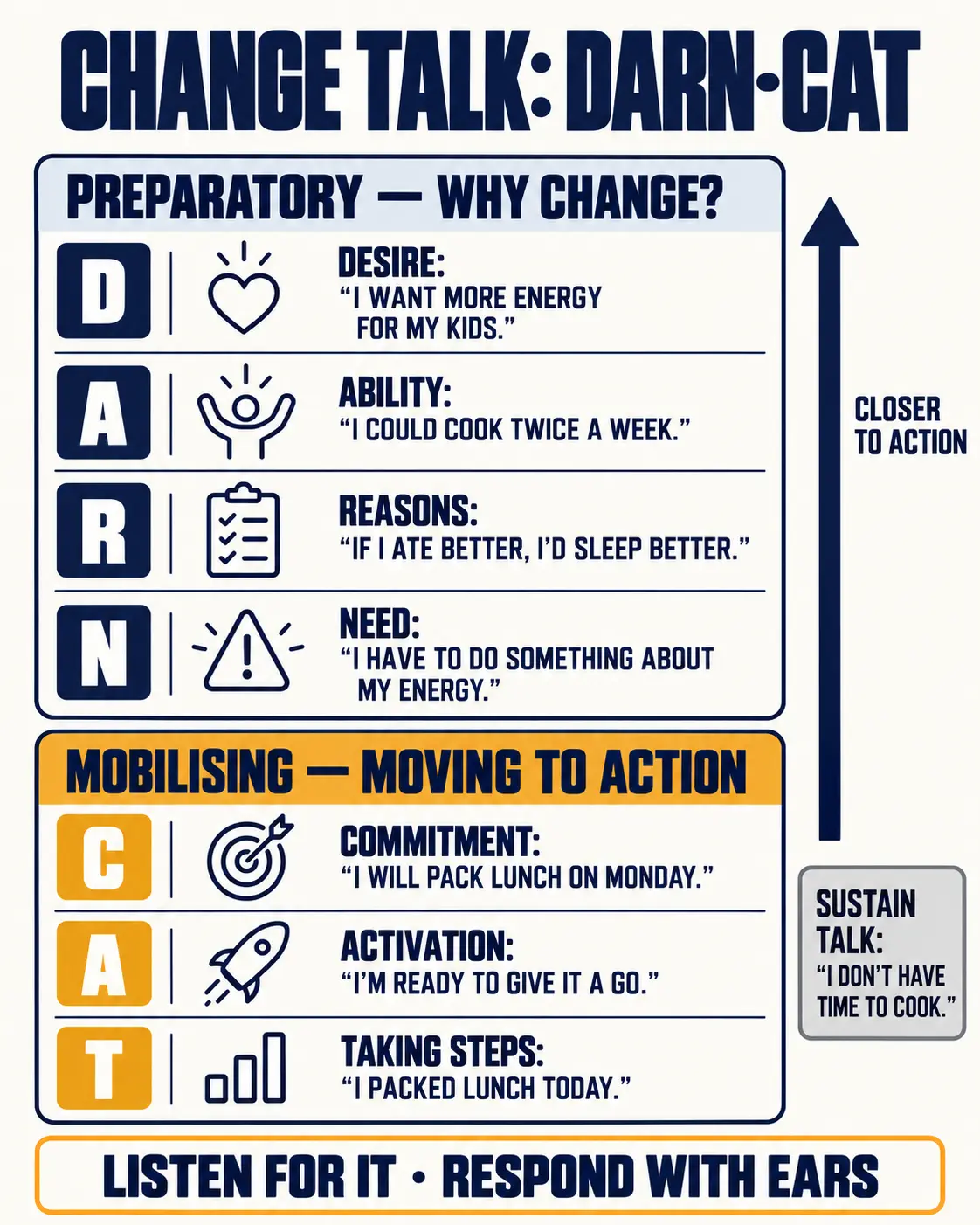
Change talk is anything the client says in favour of change. Sustain talk is anything in favour of staying the same ("I don't have time to cook"). Both are normal. The more change talk a client voices, the more likely they are to change — so MI coaches listen for it and invite more of it.
Change talk is often remembered as DARN-CAT:
| Type | Example | |
|---|---|---|
| Preparatory (why change?) | Desire | "I want to have more energy for my kids." |
| Ability | "I could probably cook twice a week." | |
| Reasons | "If I ate better, I'd sleep better." | |
| Need | "I have to do something about my energy." | |
| Mobilising (moving to action) | Commitment | "I will pack my lunch on Monday." |
| Activation | "I'm ready to give it a go." | |
| Taking steps | "I bought a lunchbox and packed lunch today." |
- Evocative open questions"What would be better if you ate more regular meals?" "What makes this important to you now?"
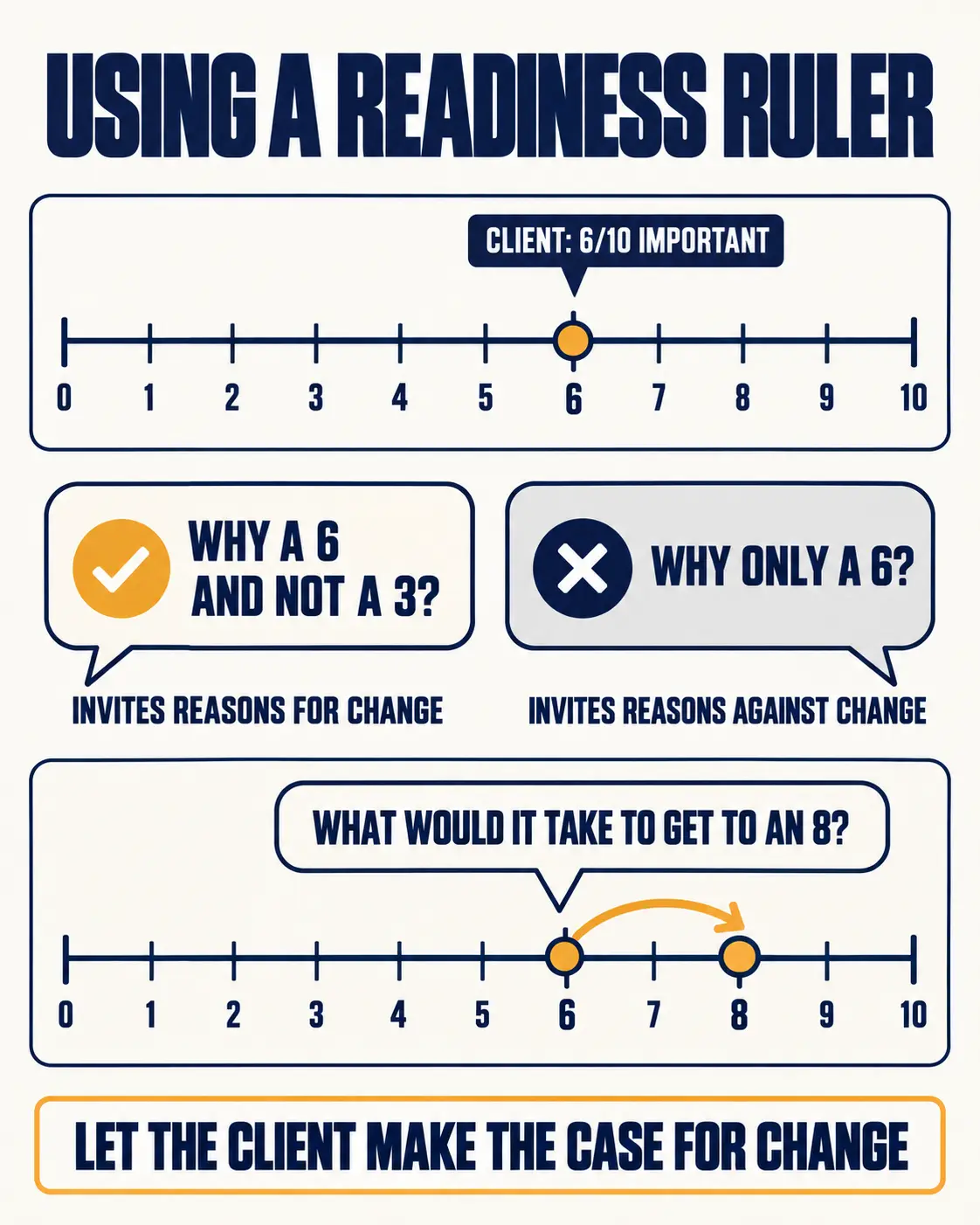
- Readiness rulersAfter "How important is this, 0–10?", ask "Why a 6 and not a 3?" — the client explains their reasons for change. Then "What would it take to get to an 8?" Never ask "Why only a 6?", which invites sustain talk.
- Looking forward and back"How would you like things to be a year from now?" "What was different when you felt your best?"
- Exploring values"What matters most to you in life? How does eating fit with that?"
Responding to change talk — EARS: Elaborate ("Tell me more about that"), Affirm, Reflect and Summarise. Collecting several change-talk statements into one summary — a "bouquet" — lets the client hear their own case for change.
Rolling With Discord
When the conversation becomes tense — the client argues, interrupts or disengages — MI calls this discord (older editions called it "resistance"). It's a signal to change approach, not to push harder. Useful responses:
- Simple reflection: "You're not sure this is the right time."
- Double-sided reflection: "On one hand, sugary drinks get you through the afternoon; on the other, you'd like to cut back." It captures both sides of the ambivalence.
- Emphasising autonomy: "It's completely your decision."
- Reframing: Client: "I've failed at every diet." Coach: "You've kept trying, even when it was hard."
- Shifting focus: moving away from a sticking point to something the client cares about.
Common Traps to Avoid
| Trap | What it looks like |
|---|---|
| Expert trap | The coach takes over as the one with all the answers, diagnosing and prescribing. The client becomes passive. |
| Question–answer trap | A string of questions that feels like an interrogation, with few reflections. |
| Premature focus trap | Jumping to the coach's priority before understanding what matters to the client. |
| Labelling trap | Using labels like "emotional eater" or "sugar addict" that clients may resist. |
| Blaming trap | Focusing on who or what is at fault instead of what to do next. |
| Chat trap | Friendly small talk that never moves towards change. |
Engaging: Sanjay mentions he drinks three sugary colas a day. Coach: "They've become part of your routine." (reflection)
Focusing: Coach: "Would it be okay to talk about the colas today, or is something else more pressing?" Sanjay agrees to focus on them.
Evoking: Sanjay rates importance 6/10. Coach: "Why a 6 and not a 3?" Sanjay: "I get a crash every afternoon, and I want to set a better example for my son." (reasons + desire) Coach: "So cutting back could mean steadier energy and being a role model." (reflection)
Planning: Sanjay: "I could swap the afternoon one for sparkling water." (ability) … "I'll try that this week." (commitment) The coach summarises his reasons and plan, and checks his confidence: 8/10.
For a deeper look at MI and goal-setting, see NBHWC Lesson 6: Motivational Interviewing 4.0 & Goal-Setting Theories.
12 questions in the style of the CNC exam. Score 70%+ to mark this lesson complete.
- MI (Miller and Rollnick) draws out the client's own reasons for change instead of persuading or lecturing.
- Spirit: partnership, acceptance, compassion, evocation. Principles: express empathy, develop discrepancy, roll with resistance, support self-efficacy.
- Four processes: engaging → focusing → evoking → planning. Don't jump straight to planning.
- Ambivalence is normal; a decisional balance explores both sides without the coach taking one.
- Listen for DARN-CAT change talk and strengthen it with EARS; ask "Why a 6 and not a 3?"
- Roll with discord using reflections and autonomy; avoid the expert, question–answer, premature focus and labelling traps.
Before moving to Lesson 17:
- Write one example statement for each letter of DARN-CAT.
- Practise a readiness ruler with a friend: "Why a __ and not a lower number?"
- Write a double-sided reflection for a change you feel mixed about.
- Complete the knowledge check above and review any question you missed.