Most people already know what to eat — the hard part is doing it consistently. Biology, environment, emotions, habits and social life all pull on eating behavior. Effective coaching makes change easier rather than relying on willpower: shaping the food environment, building small habits linked to cues, supporting motivation that comes from within, matching the approach to the client's stage of change, and building confidence through small wins. Signs of disordered eating or mental health concerns are for a doctor or mental health professional.
Section 2 covered what to eat. Section 3 is about how people actually change what they eat — and keep it changed. This lesson lays the foundation: why change is difficult, what drives eating behavior, and the models coaches use to understand where a client is and what will help next.
Free on YouTube Subscribe to get every lesson video in this course SubscribeWhy Change Is Hard
Knowing what to do and doing it are two different things. Several forces work against lasting change:
- BiologyWhen people lose weight, hunger tends to rise and energy use falls slightly (Lesson 5). The body pushes back.
- EnvironmentTasty, energy-dense food is cheap, everywhere and served in large portions.
- HabitsMuch of eating happens on autopilot, triggered by time, place and routine.
- Emotions and stressMany people eat to cope with stress, boredom, tiredness or low mood.
- Thinking patternsAll-or-nothing thinking ("I've ruined today, so I'll start again Monday") turns small slips into big ones.
- Social and cultural lifeFamily meals, work events, celebrations and food traditions all shape what and how much people eat.
Weight stigma — negative attitudes towards people because of their body size — makes all of this harder. It's linked with stress, avoidance of health care and less, not more, healthy behavior. Coaches use respectful, non-judgemental language, focus on behaviors rather than blame, and avoid shaming. For more on why rigid approaches often fail, see why calorie counting doesn't work long-term.
What Drives Eating Behavior
Hunger vs appetite
| Physical hunger | Appetite (psychological hunger) | |
|---|---|---|
| What it is | The body's need for energy | The desire to eat, often for a specific food |
| How it starts | Builds gradually, several hours after eating | Comes on suddenly, often after a cue |
| Signs | Empty or growling stomach, low energy, trouble concentrating | Craving a particular food; triggered by sight, smell, emotion or habit |
| What satisfies it | Most foods | Often only the specific food — and may continue after fullness |
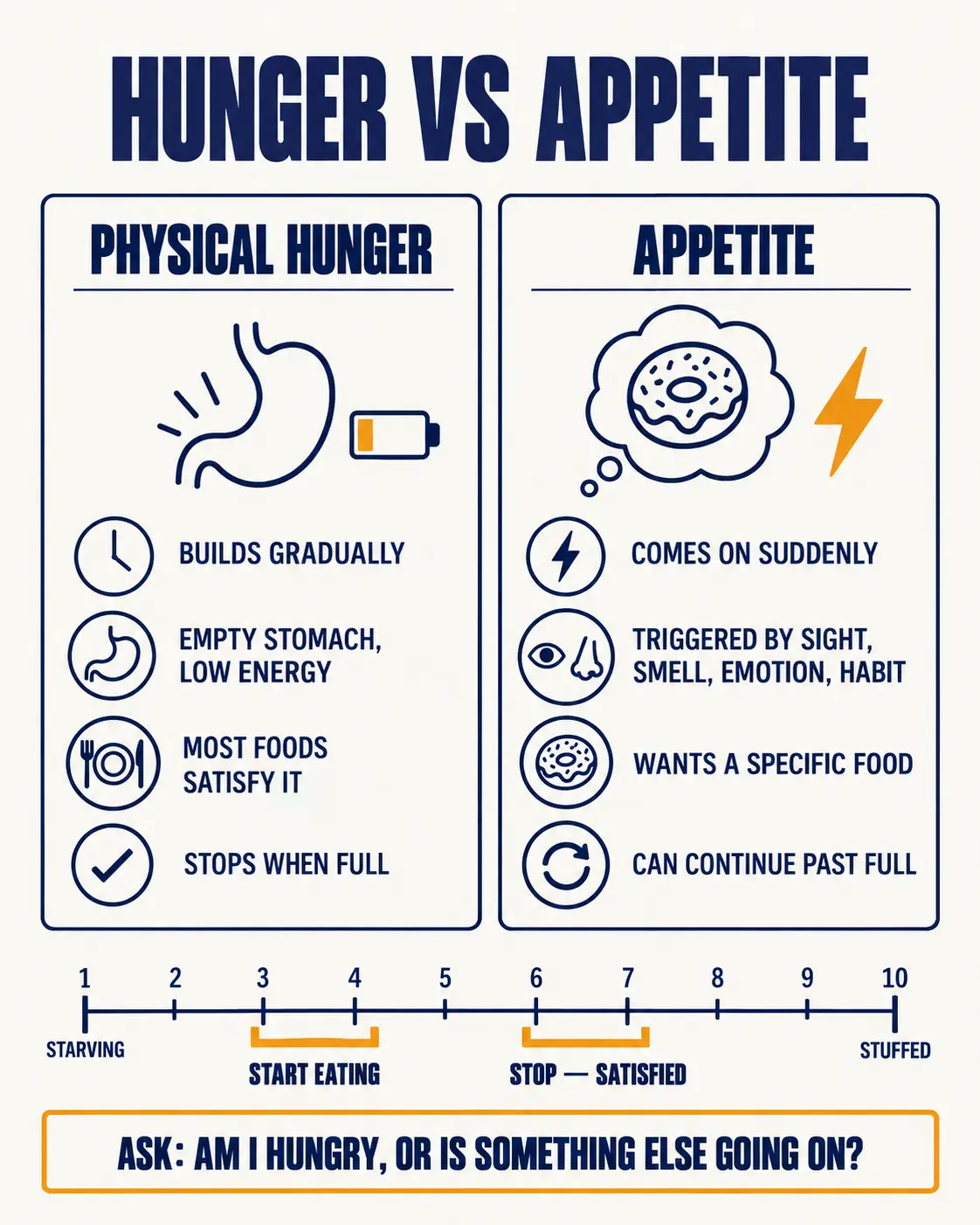
A simple hunger–fullness scale (for example, 1 = starving, 10 = uncomfortably stuffed) helps clients notice these signals — starting a meal around moderately hungry and stopping at comfortably satisfied. Eating slowly and without distractions makes fullness easier to notice; see our tips on mindful eating.
Eating cues
- Internal cues: hunger, fullness, energy levels.
- External cues: the time of day, seeing or smelling food, portion and package size, plate size, advertising, other people eating.
- Emotional cues: stress, boredom, loneliness, tiredness, celebration.
External and emotional cues often lead to eating without physical hunger — sometimes called mindless eating or emotional eating. Occasional emotional eating is normal; it becomes a problem when it's the main way someone copes.
Restraint and the "what-the-hell" effect
Very strict rules ("no sugar ever") can backfire. When a rule is broken, people often think "I've blown it anyway" and overeat — the "what-the-hell" effect. Flexible guidelines ("mostly whole foods, with room for treats") tend to be easier to sustain than rigid ones.
The food environment
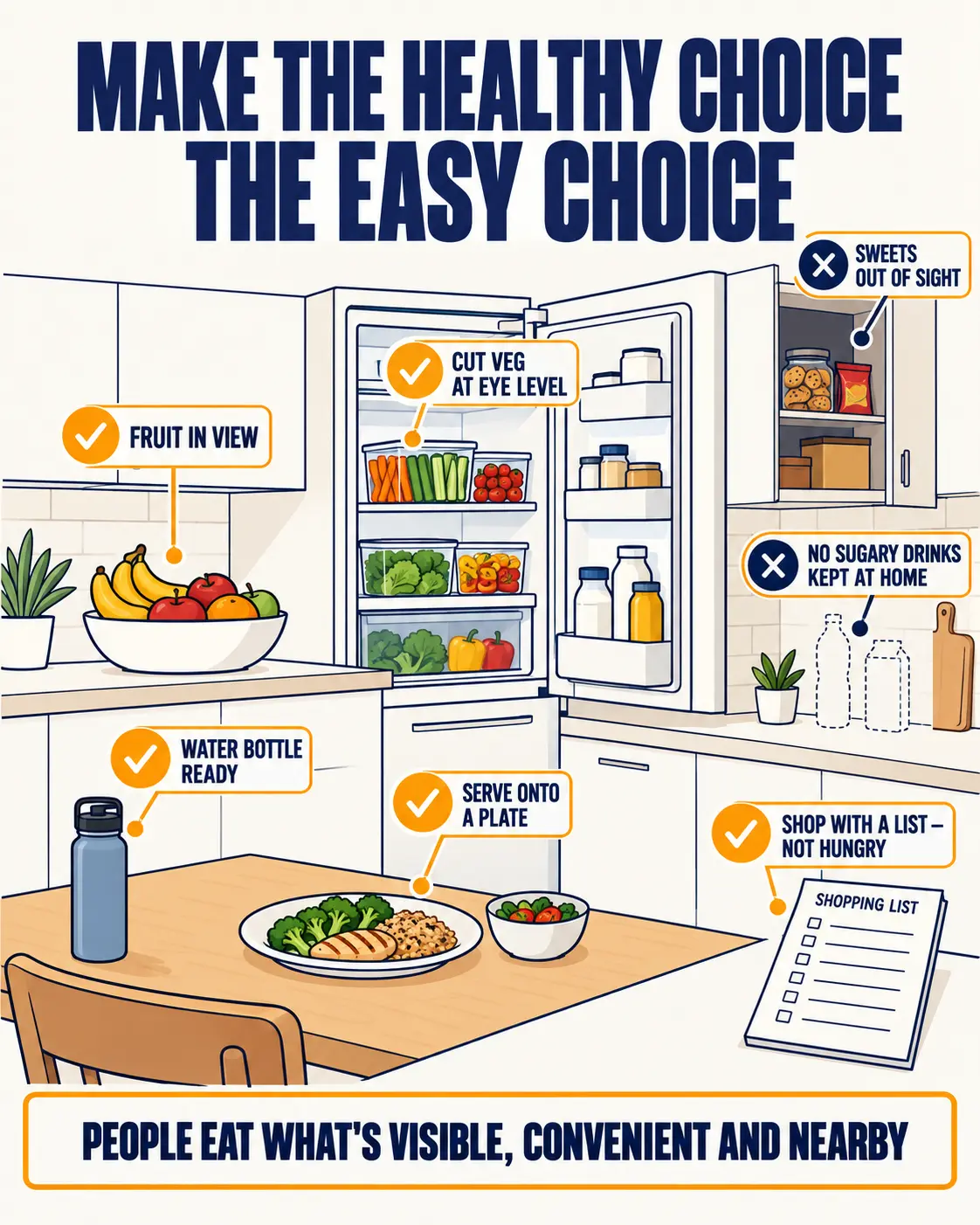
People eat more of what is visible, convenient and nearby. Small changes to the environment make healthier choices the easy default:
| Make healthier choices easier | Make less-helpful choices harder |
|---|---|
| Fruit in a bowl on the counter; cut vegetables at eye level in the fridge | Sweets and crisps in an opaque container, out of sight |
| A filled water bottle on the desk | Not keeping sugary drinks at home |
| Serving food onto a plate, using smaller plates and bowls | Not eating straight from the packet |
| Pre-prepared protein and vegetables ready to go | Not shopping when hungry; using a list |
Motivation and Adherence
Extrinsic motivation comes from outside — rewards, pressure, deadlines or avoiding criticism. Intrinsic motivation comes from within — enjoyment, personal values, or how good a behavior makes someone feel. Extrinsic motivation can help someone get started, but intrinsic motivation tends to last longer.
- AutonomyFeeling in control of one's own choices. Coaches offer options instead of orders: "Which of these feels most doable?"
- CompetenceFeeling capable. Coaches set achievable steps and point out progress.
- RelatednessFeeling connected and supported. A warm, non-judgemental coaching relationship, and support from family or friends.
Adherence — sticking with a plan over time — predicts results better than which plan someone follows. That's why the best plan is usually the one a client can realistically keep doing, and why "progress, not perfection" is a core coaching idea.
How Habits Form
A habit is a behavior done automatically in response to a cue, with little conscious thought. Habits follow a simple loop:
| Step | What it is | Example |
|---|---|---|
| Cue | The trigger — a time, place, feeling or preceding action | Getting home from work |
| Routine | The behavior itself | Opening the snack cupboard |
| Reward | The benefit that makes the loop repeat | A tasty break and a moment to relax |
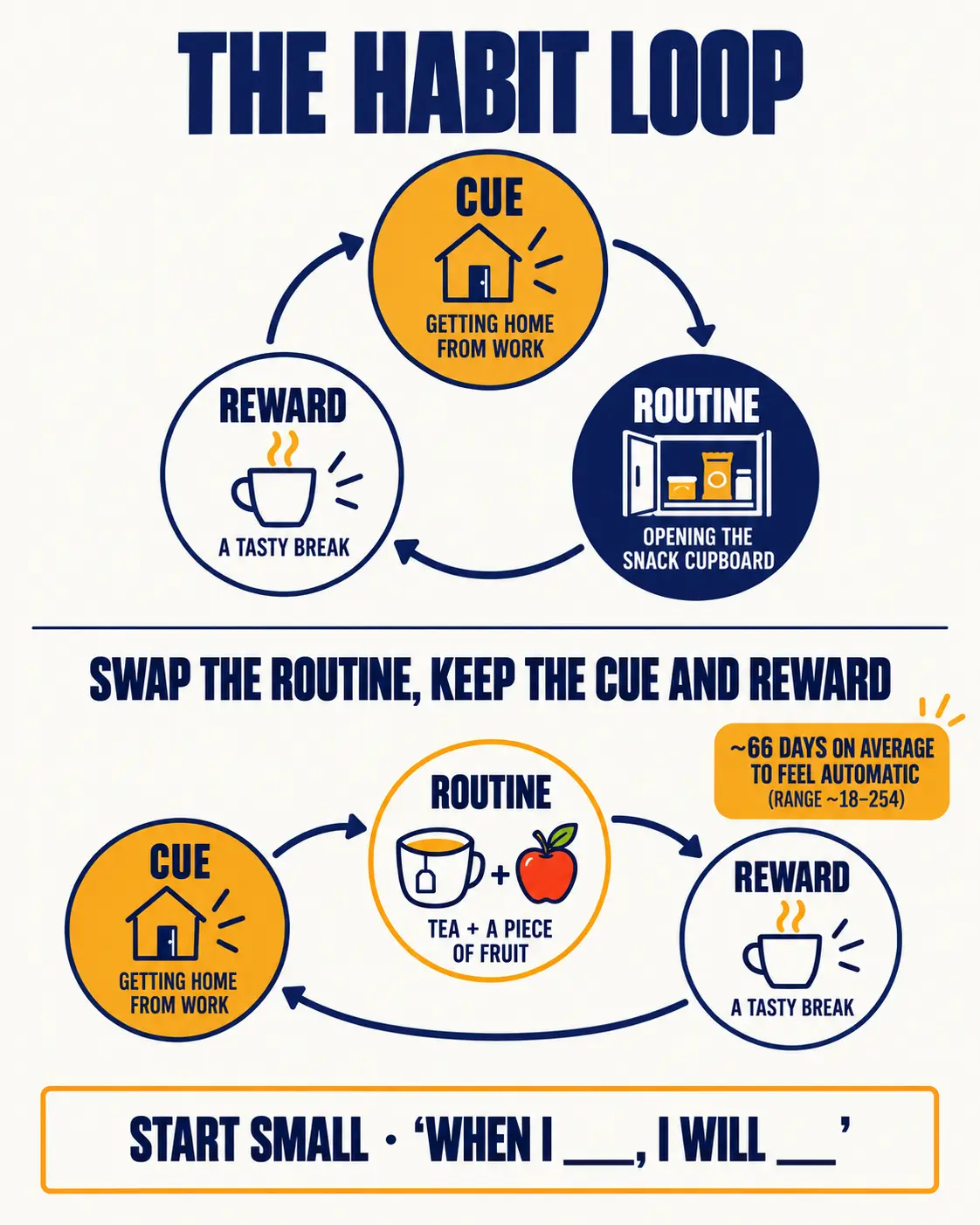
Habits take time. In one well-known study, a new daily behavior took an average of about 66 days to feel automatic — with a huge range of roughly 18 to 254 days. The popular "21 days" figure isn't supported by that research. Missing a single day didn't derail habit formation; consistency over time mattered more.
- Start smallOne manageable change at a time — a behavior the client is at least 9 out of 10 confident they can do.
- Implementation intentions ("if–then" plans)"When I pour my morning coffee, I will fill my water bottle." Linking a behavior to a specific cue makes it far more likely to happen.
- Habit stackingAttach a new habit to an existing one: "After I brush my teeth at night, I'll pack tomorrow's lunch."
- Change the environmentMake the cue for the new habit obvious and the cue for the old one hidden.
- Swap, don't just stopKeep the cue and the reward, change the routine: after work, have a cup of tea and a piece of fruit instead of crisps.
The Stages of Change
The Transtheoretical Model (stages of change) describes how people move towards a new behavior. The timeframes below are commonly used guides. People can move back and forth, and relapse — slipping back to an earlier stage — is a normal part of change, not a failure.
| Stage | What it looks like | How a coach can help |
|---|---|---|
| 1. Precontemplation | Not considering change in the foreseeable future (often defined as the next 6 months). "I don't see a problem." | Build rapport, share information if invited, avoid pushing. |
| 2. Contemplation | Thinking about change, often within the next 6 months, but feeling torn. "I know I should, but…" | Explore pros and cons; help the client connect change to what they value. |
| 3. Preparation | Planning to act soon, often within the next month; may have taken small steps. | Help set small, specific goals and make a plan. |
| 4. Action | Actively changing behavior, for less than 6 months. | Support, problem-solve barriers, celebrate progress. |
| 5. Maintenance | Has kept the change going for 6 months or more. | Plan for high-risk situations; strengthen new habits and identity. |
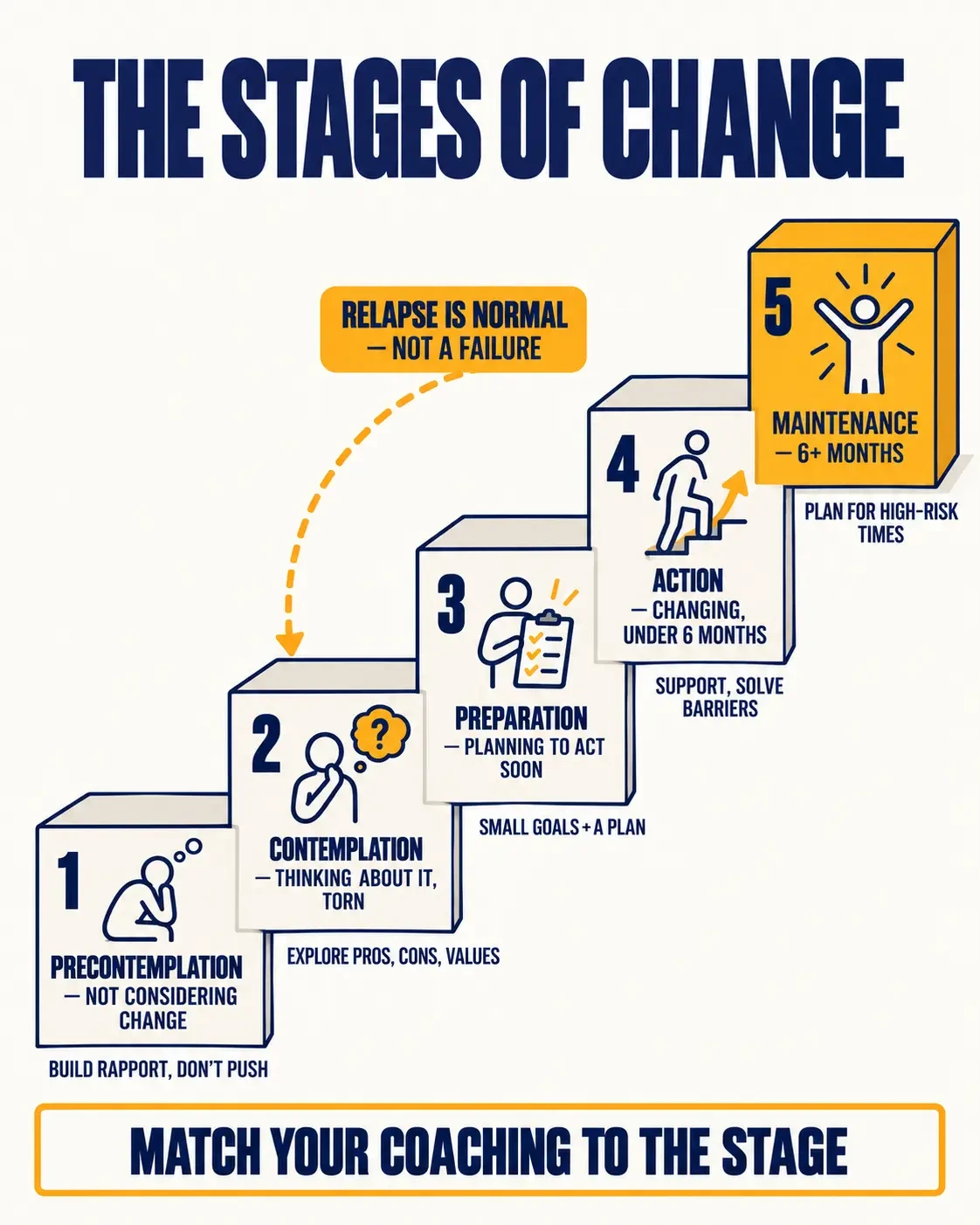
Matching the approach to the stage matters. A detailed meal plan helps someone in preparation, but can push away someone in precontemplation. Some versions of the model also include a sixth stage, termination, when the old behavior no longer tempts the person at all.
Self-Efficacy and Readiness
Self-efficacy is a person's belief in their ability to succeed at a specific task — for example, "I'm confident I can cook dinner at home four nights this week." It strongly predicts whether people start and stick with a change. Psychologist Albert Bandura described four sources:
| Source | What it means | Coaching example |
|---|---|---|
| Mastery experiences (strongest) | Successfully doing the behavior | Start with small goals the client can achieve, then build |
| Vicarious experience | Seeing similar people succeed | Share stories of people in similar situations |
| Verbal persuasion | Encouragement from others | Specific, genuine encouragement: "You planned three lunches this week — that's real progress." |
| Physiological and emotional states | How someone interprets their body and mood | Reframe nerves as normal; notice better energy and sleep |
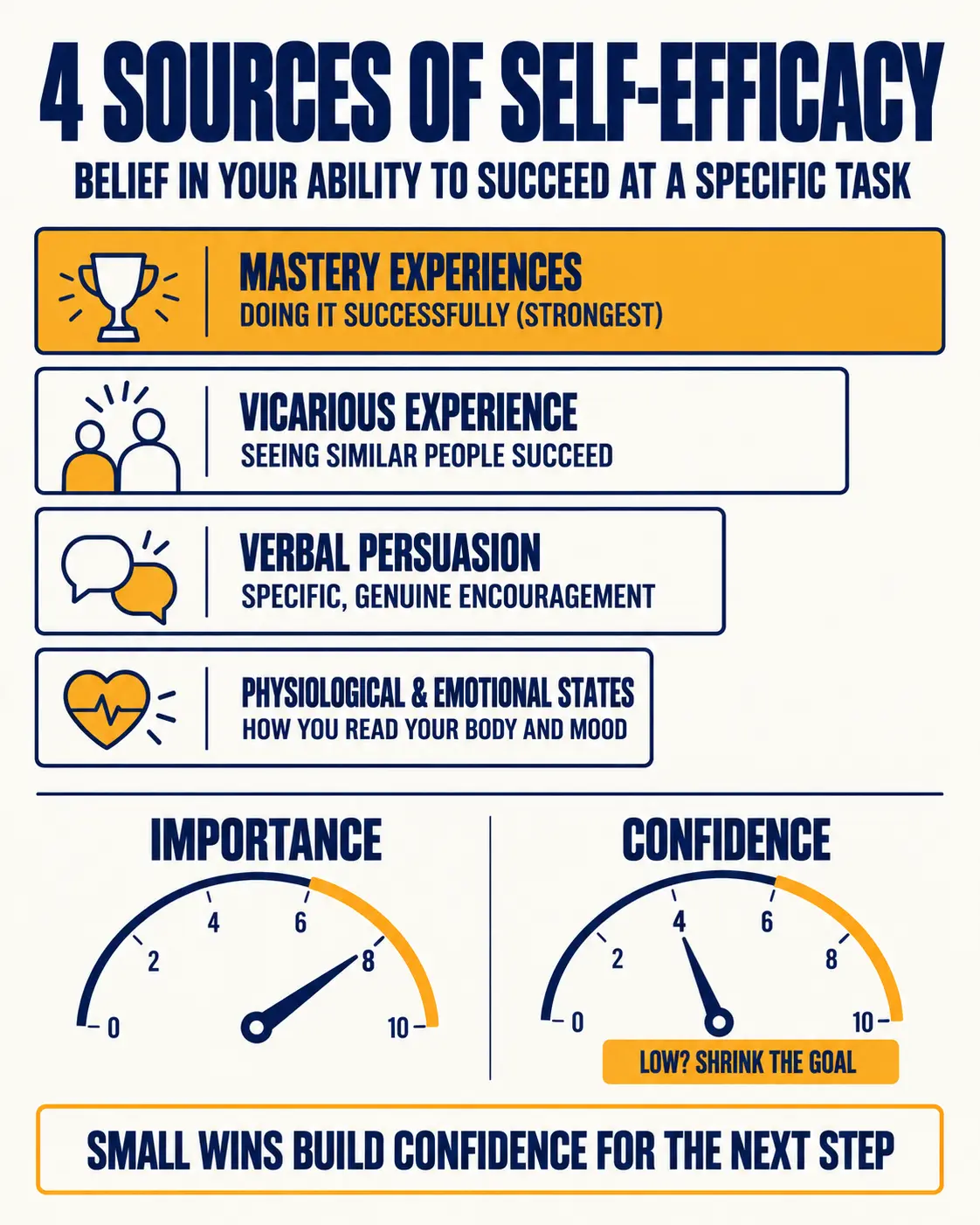
Readiness rulers are a quick way to check readiness: "On a scale of 0 to 10, how important is this change to you?" and "How confident are you that you can do it?" Low importance suggests exploring values and reasons; low confidence suggests making the goal smaller or removing barriers. (Lesson 16 covers how to follow up on these answers.)
Deepa says: "I know I snack a lot at night and I've been thinking about cutting back, but work is crazy right now." That sounds like contemplation — she's aware and considering change, but not ready to act.
Coach's approach: rather than handing her a plan, the coach asks what she'd gain from snacking less and what gets in the way. Deepa rates importance 8/10 and confidence 4/10.
Next step: with high importance but low confidence, they shrink the goal. Deepa chooses one change: "When I finish dinner, I'll make a cup of herbal tea," and moves the biscuits into a high cupboard. Her new confidence rating: 9/10.
Two weeks later: she's done it on most nights — a mastery experience that builds self-efficacy for the next step.
This lesson builds on PN Level 1: Helping People Change and NASM-CPT Lesson 19 — useful extra practice.
12 questions in the style of the CNC exam. Score 70%+ to mark this lesson complete.
- Knowing isn't doing: biology, environment, habits, emotions, thinking patterns and social life all shape eating. Weight stigma makes change harder.
- Hunger is gradual and physical; appetite is sudden and cue-driven. Strict rules can trigger the "what-the-hell" effect.
- Design the environment so healthier choices are visible and easy, and less-helpful ones are hidden.
- Intrinsic motivation lasts longer; support autonomy, competence and relatedness. Adherence beats the "perfect" plan.
- Habits follow cue → routine → reward and take weeks to months (average ~66 days in one study). Start small; use if–then plans.
- Match coaching to the stage of change; build self-efficacy through small wins. Disordered eating or mental health concerns → doctor or mental health professional.
Before moving to Lesson 15:
- Map one of your own eating habits as cue → routine → reward.
- Write an if–then plan for one small change you want to make.
- List the five stages of change in order, with one coaching strategy for each.
- Complete the knowledge check above and review any question you missed.