Knowing nutrition isn't enough — clients change when they feel heard, respected and in charge of their own choices. Good coaches build rapport and show empathy, listen more than they talk, ask open questions, reflect back what they hear, affirm real effort, and summarise. They resist the urge to jump in with advice, ask permission before sharing information, and give feedback that is specific and focused on behavior. The client is the expert on their own life; the coach is the guide.
Lesson 14 explained why change is hard. This lesson covers the skills that make coaching conversations work — the difference between telling someone what to do and helping them decide what they'll do. These skills also set up Lesson 16, on motivational interviewing.
Free on YouTube Subscribe to get every lesson video in this course SubscribeThe Coaching Relationship
Traditional advice-giving is expert-led: the professional diagnoses the problem and prescribes the solution. Coaching is client-centred: the client is the expert on their own life, values and circumstances, and the coach helps them find and follow through on their own solutions — while still sharing nutrition knowledge when it helps.
| Style | What it sounds like | When it fits |
|---|---|---|
| Directing | "Here's what you need to do." | Safety issues, or when the client asks for a clear instruction |
| Guiding | "What would you like to change? Here are some options — which fits you best?" | Most coaching conversations |
| Following | "Tell me more about that." | When the client needs to be heard before anything else |
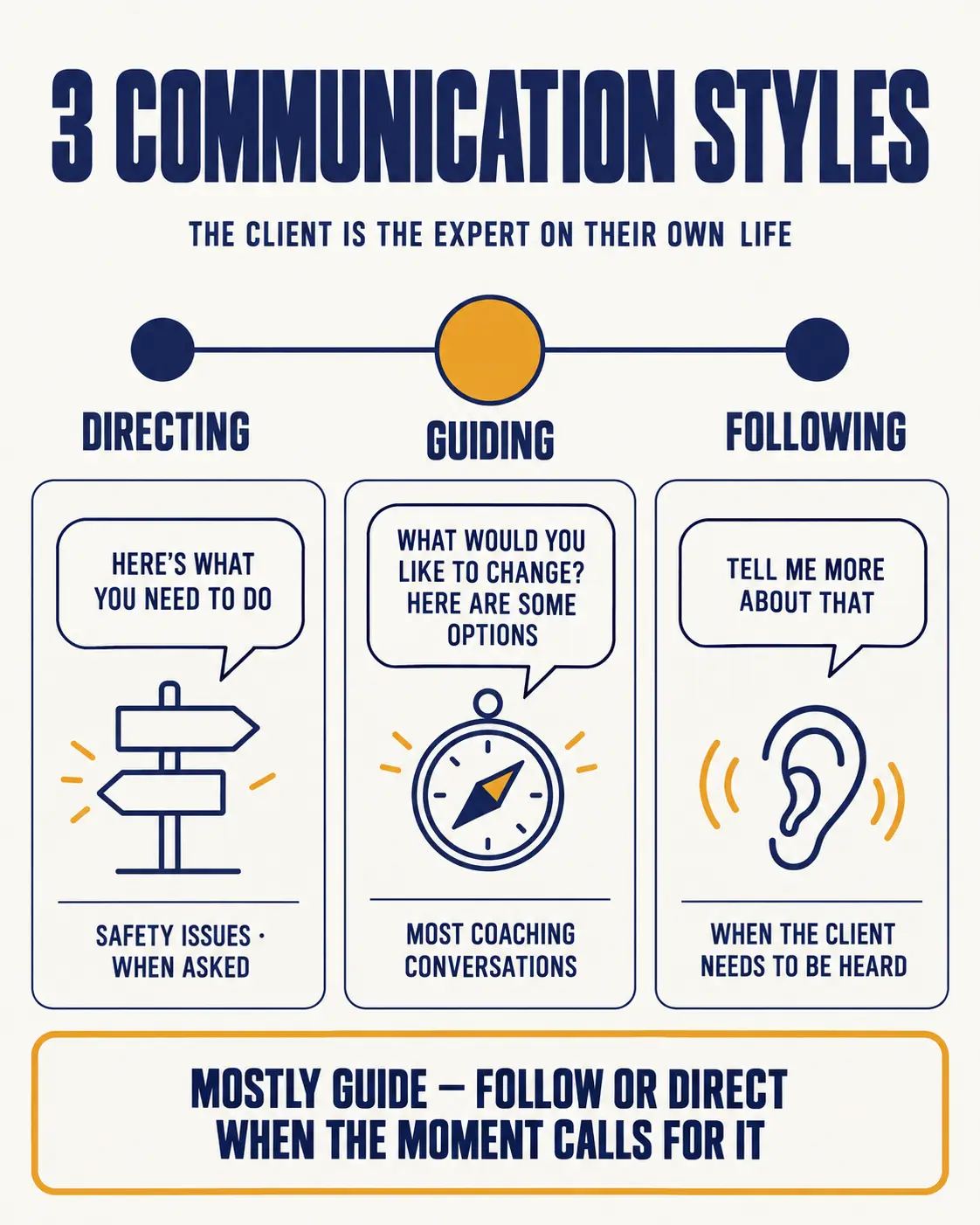
Most effective coaching uses a guiding style, moving into following or directing when the moment calls for it. The relationship itself — often called the working alliance — is built on trust, shared goals and agreement on how to work together.
Rapport and Empathy
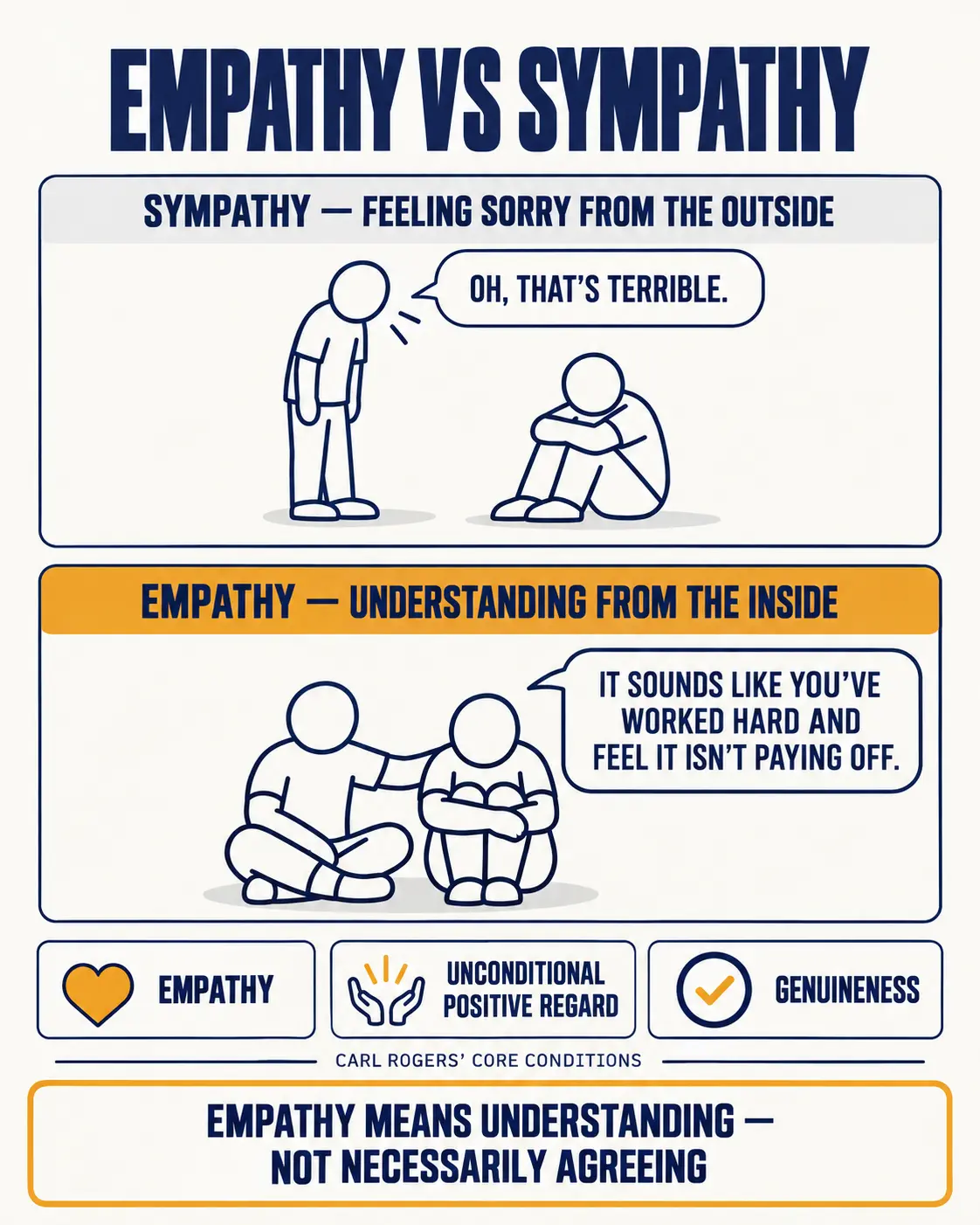
Rapport is a relationship of trust and mutual understanding. Psychologist Carl Rogers described three conditions that help people open up and grow:
- EmpathyTrying to understand the client's experience from their point of view — and showing that understanding.
- Unconditional positive regardAccepting the client as a person without judgement, even when you don't agree with their choices.
- Genuineness (congruence)Being honest and authentic rather than playing a role or giving scripted praise.
Empathy isn't sympathy. Sympathy is feeling sorry for someone from the outside ("Oh, that's terrible"). Empathy is stepping into their shoes ("It sounds like you've been working really hard and feel like it isn't paying off"). Empathy also doesn't mean agreeing with everything — it means understanding.
Cultural humility matters too. Food is tied to culture, religion, family and budget. Coaches ask about a client's food traditions and preferences rather than assuming, and build plans around the foods the client actually eats.
Verbal and Nonverbal Communication
- Verbal: the words used. Plain language beats jargon; non-judgemental words ("choices", "patterns") beat loaded ones ("good" and "bad" foods, "cheating").
- Paraverbal: tone, pace and volume — how something is said.
- Nonverbal: posture, facial expression, eye contact, gestures. Open, relaxed posture and facing the client signal attention.
Nonverbal signals are powerful but easy to misread. Their meaning varies between cultures and individuals — comfortable eye contact in one culture may feel intrusive in another, and crossed arms might simply mean someone is cold. Check your interpretation rather than assuming. In online, phone or text coaching, fewer cues are available, so coaches ask more often how the client is feeling and check understanding.
Active Listening
Active listening means giving the client your full attention and showing that you understand. It is the foundation of every other coaching skill.
| Active listening skill | Example |
|---|---|
| Attending — full attention, open posture, no distractions | Phone away; facing the client or looking at the camera |
| Minimal encouragers | "Mm-hm", "Go on", a nod |
| Clarifying | "When you say 'bad day', what does that usually look like?" |
| Paraphrasing / reflecting | "So evenings are the hardest part." |
| Summarising | "Let me check I've got this right…" |
| Comfortable silence | Pausing a few seconds after a question to let the client think |
- The righting reflexThe natural urge to fix the problem by jumping in with advice. It often makes clients argue for staying the same.
- Planning your replyThinking about what to say next instead of listening.
- Interrupting or finishing sentencesSignals that your ideas matter more than theirs.
- Judging, lecturing or moralising"You know sugar is bad for you, right?"
- Making it about youJumping to your own story before theirs is finished.
Core Skills: OARS
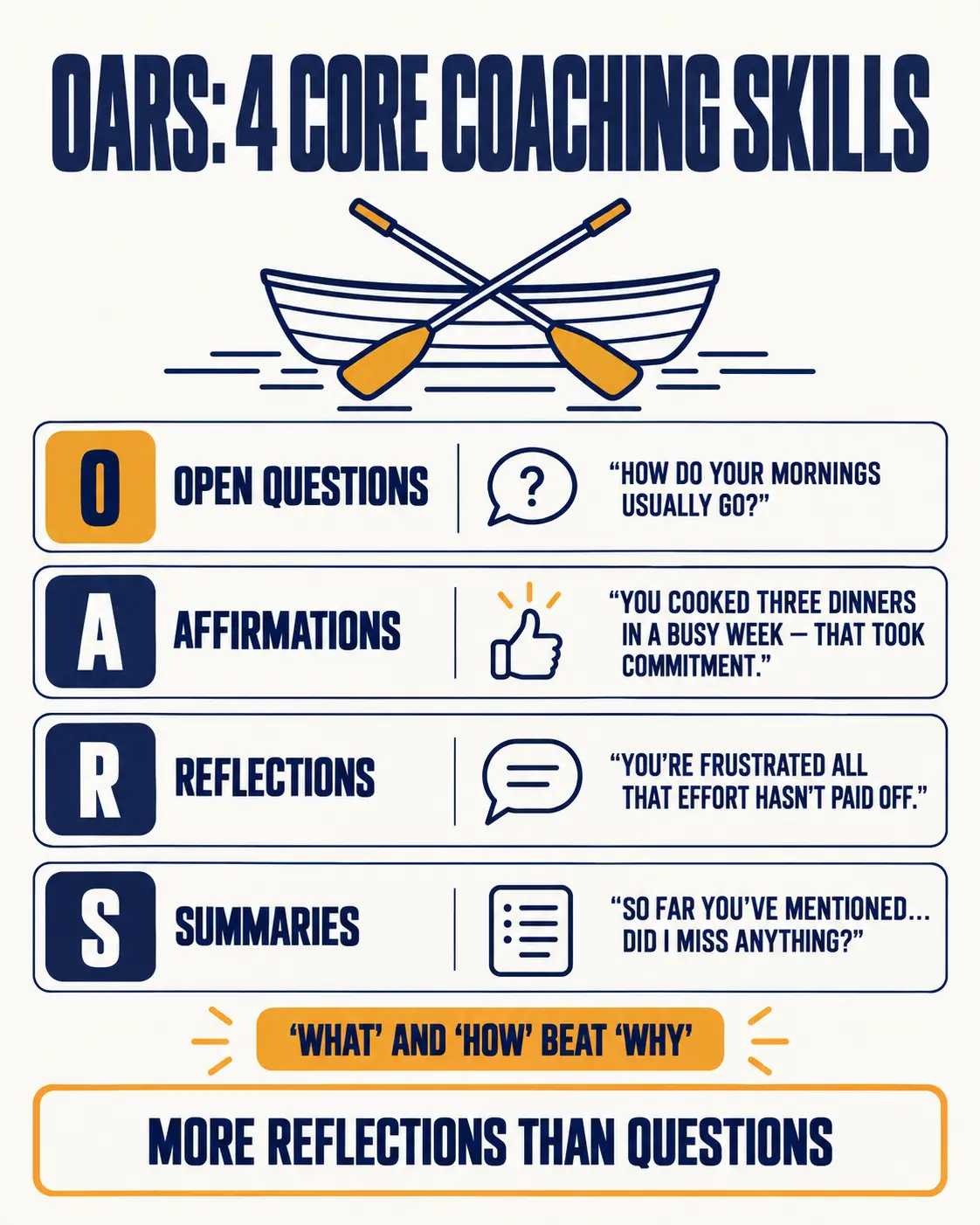
Four core communication skills are often remembered as OARS. They're the building blocks of motivational interviewing (Lesson 16).
O — Open-ended questions
Closed questions can be answered with yes, no or a single fact. Open questions invite the client to explain, explore and think. Coaches use closed questions for specific facts, and open questions for almost everything else.
| Closed | Open |
|---|---|
| "Did you eat breakfast today?" | "How do your mornings usually go?" |
| "Are you drinking enough water?" | "What does drinking water look like across your day?" |
| "Do you want to lose weight?" | "What would you most like to change about how you eat?" |
| "Why didn't you track this week?" | "What got in the way of tracking this week?" |
Notice the last row. "Why" questions can sound like blame and make people defensive. "What" and "how" questions usually get more useful answers.
A — Affirmations
Affirmations recognise the client's genuine strengths, efforts and values. They differ from general praise: praise judges ("Good job!"), while an affirmation notices something specific about the person ("You made time to cook three dinners in a really busy week — that took commitment"). Affirmations build self-efficacy (Lesson 14) and must be sincere.
R — Reflections
A reflection is a statement — not a question — that mirrors back what the client said or meant.
- Simple reflection: repeats or rephrases the content. Client: "I've tried every diet and nothing works." Coach: "You've tried a lot of diets."
- Complex reflection: adds meaning or feeling. Coach: "You're frustrated that all that effort hasn't paid off."
Good reflections show understanding and encourage the client to keep exploring. Many coaches aim to use more reflections than questions, so the conversation doesn't feel like an interrogation.
S — Summaries
A summary pulls together several things the client has said: "So far you've mentioned evenings are hardest, you want more energy for your kids, and you've had success when you prepped lunches. Did I miss anything?" Summaries check understanding, show you've listened, and help move the conversation forward — especially at the end of a session.
Sharing Information and Feedback
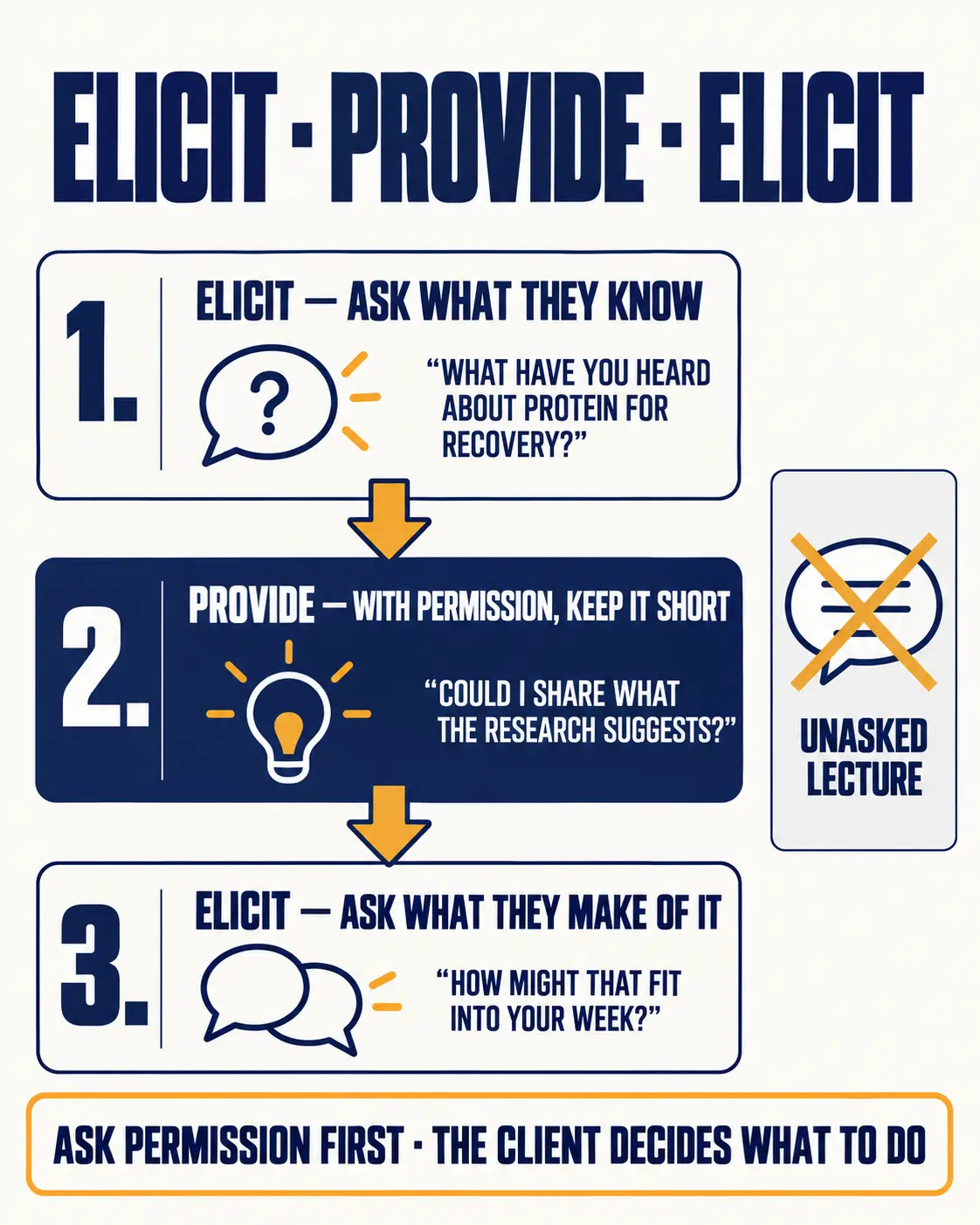
Coaches do share knowledge — the question is how. Unrequested advice often meets resistance. Two simple rules help: ask permission first, and keep it short.
- 1. ElicitAsk what they already know or would like to know: "What have you heard about protein for recovery?"
- 2. ProvideWith permission, offer brief, relevant information or options: "Could I share what the research suggests?"
- 3. ElicitAsk what they make of it: "How might that fit into your week?"
Effective feedback is:
- Specific — "You had protein at breakfast five days out of seven," not "You're doing great."
- About behavior, not the person — "Late-night snacking happened on the nights you skipped dinner," not "You have no willpower."
- Timely and balanced — given soon, noticing what went well as well as what to work on.
- Collaborative — ends with the client choosing what to do next.
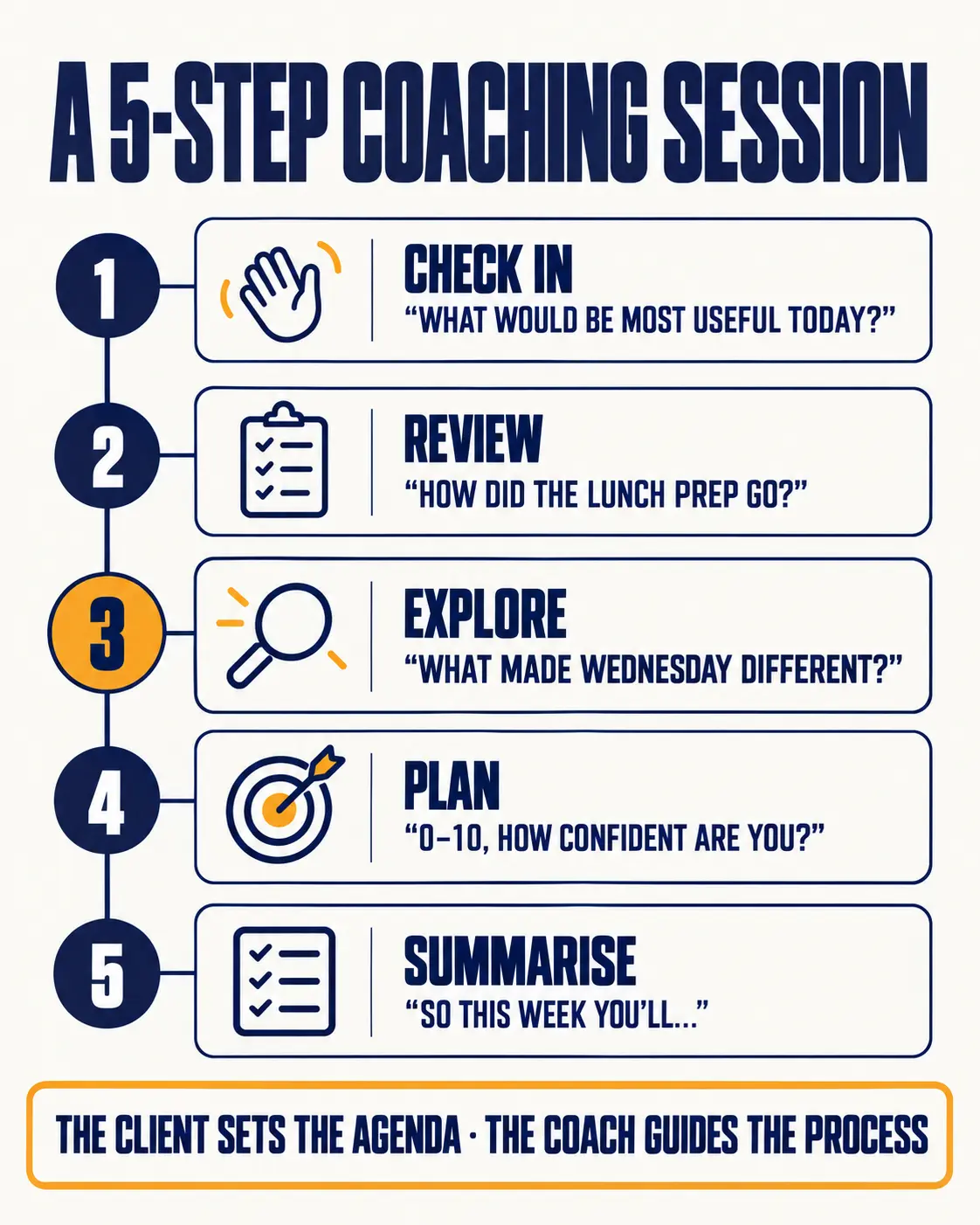
Structuring a Coaching Session
| Stage | What happens | Example |
|---|---|---|
| 1. Check in | Reconnect and set the agenda together | "What would be most useful to focus on today?" |
| 2. Review | Look back at the last goal — wins and challenges | "How did the lunch prep go?" |
| 3. Explore | Listen, reflect and understand what's happening | "What made Wednesday different?" |
| 4. Plan | The client chooses a next step; check confidence | "On a scale of 0–10, how confident are you?" |
| 5. Summarise | Recap key points and the agreed action | "So this week you'll…" |
Kavya says: "I was doing well, then my in-laws visited and I ate everything. I've ruined it."
Directing response (less helpful): "You need to plan better next time. Try to stick to smaller portions when you have guests." — The coach jumps to advice (the righting reflex), and Kavya feels judged.
Guiding response (more helpful): "Having family to stay changed your whole routine, and now you feel like the progress is gone." (complex reflection) … "You'd built some great habits before they came — three weeks of packed lunches." (affirmation) … "What helped you most during those three weeks?" (open question)
Result: Kavya identifies that preparing lunches the night before worked, and chooses to restart that one habit this week. The coach summarises and checks her confidence (8/10).
For more practice, see PN Level 1: What Is a Great Coach? and PN Level 1: Coaching in Practice.
12 questions in the style of the CNC exam. Score 70%+ to mark this lesson complete.
- Coaching is client-centred: the client is the expert on their life; the coach mostly guides, sometimes follows or directs.
- Build rapport with empathy, unconditional positive regard and genuineness. Empathy is understanding, not feeling sorry.
- Nonverbal signals matter but vary by culture — check rather than assume.
- Active listening: attend, encourage, clarify, reflect, summarise, allow silence. Resist the righting reflex.
- OARS: open questions ("what/how" over "why"), specific affirmations, simple and complex reflections, summaries.
- Share information with permission (elicit–provide–elicit); give specific, behavior-focused feedback. Risk of harm → help the client get support right away.
Before moving to Lesson 16:
- Rewrite five closed questions as open ones.
- In your next conversation, try one simple and one complex reflection.
- Practise elicit–provide–elicit on a nutrition topic with a friend.
- Complete the knowledge check above and review any question you missed.