NBHWC opens its content outline with coaching presence for a reason: every other domain in this course — the behavior-change theories, the communication skills, even the ethics content — only works if a coach can actually show up fully in the room first. Presence isn't charisma or having the right thing to say. It's the ability to stay attentive and responsive to what's really happening with a client, moment to moment, instead of running a script. That ability rests on two skills covered in this lesson: noticing your own reactions as they happen (self-awareness), and managing them so they don't take over the session (self-regulation).
If you've ever left a conversation and realized, only afterward, that you spent most of it thinking about what you'd say next instead of actually listening — you already have a rough sense of what coaching presence is the opposite of. Domain 1 carries the single largest weight of any domain on the NBHWC exam, worth a quarter of the entire test, and this lesson covers its foundation: what presence actually is, and the two internal skills — self-awareness and self-regulation — that make it possible to sustain.
What "Coaching Presence" Actually Means
Coaching presence describes the quality of attention a coach brings to a session — fully conscious, flexible, and responsive to whatever the client actually brings, rather than steering the conversation toward a plan the coach walked in with. A coach with strong presence can sit with a client's uncertainty without rushing to resolve it, notice when a conversation has quietly drifted away from what the client actually cares about, and adjust in real time instead of pushing through a prepared agenda.
This is a genuinely different skill from having good advice. A coach can know a great deal about behavior change, nutrition, sleep, or stress management and still coach poorly, because presence isn't about the depth of what you know — it's about whether you're actually tracking the person in front of you while you use it. A coach low on presence tends to interrupt to offer a solution, fill silences that the client needed to think, or steer every answer back toward whatever topic the coach finds most interesting or comfortable.
A client says: "I've tried tracking my meals before, and honestly, it just made me more anxious about food." A coach without much presence hears a logistics problem and jumps to fix it — "Have you tried a simpler app?" A coach working with real presence hears something bigger under the sentence and gets curious about it instead: "What was it about tracking that made things feel more anxious, not less?" Same words, two very different sessions — and only the second one is likely to actually surface what's going on.
Why Presence Is a Trained Skill, Not a Personality Trait
It's tempting to think of presence as something people either naturally have or don't — some coaches just seem to "get" people. But NBHWC-approved training programs teach presence deliberately, through practice sessions, recorded feedback, and structured reflection, precisely because it behaves like any other skill: it degrades under stress, fatigue, or a full caseload, and it improves with deliberate attention. A new coach who feels stiff and script-bound in early practice sessions isn't lacking some innate gift — they're at the normal early stage of learning a skill that gets more automatic with repetition.
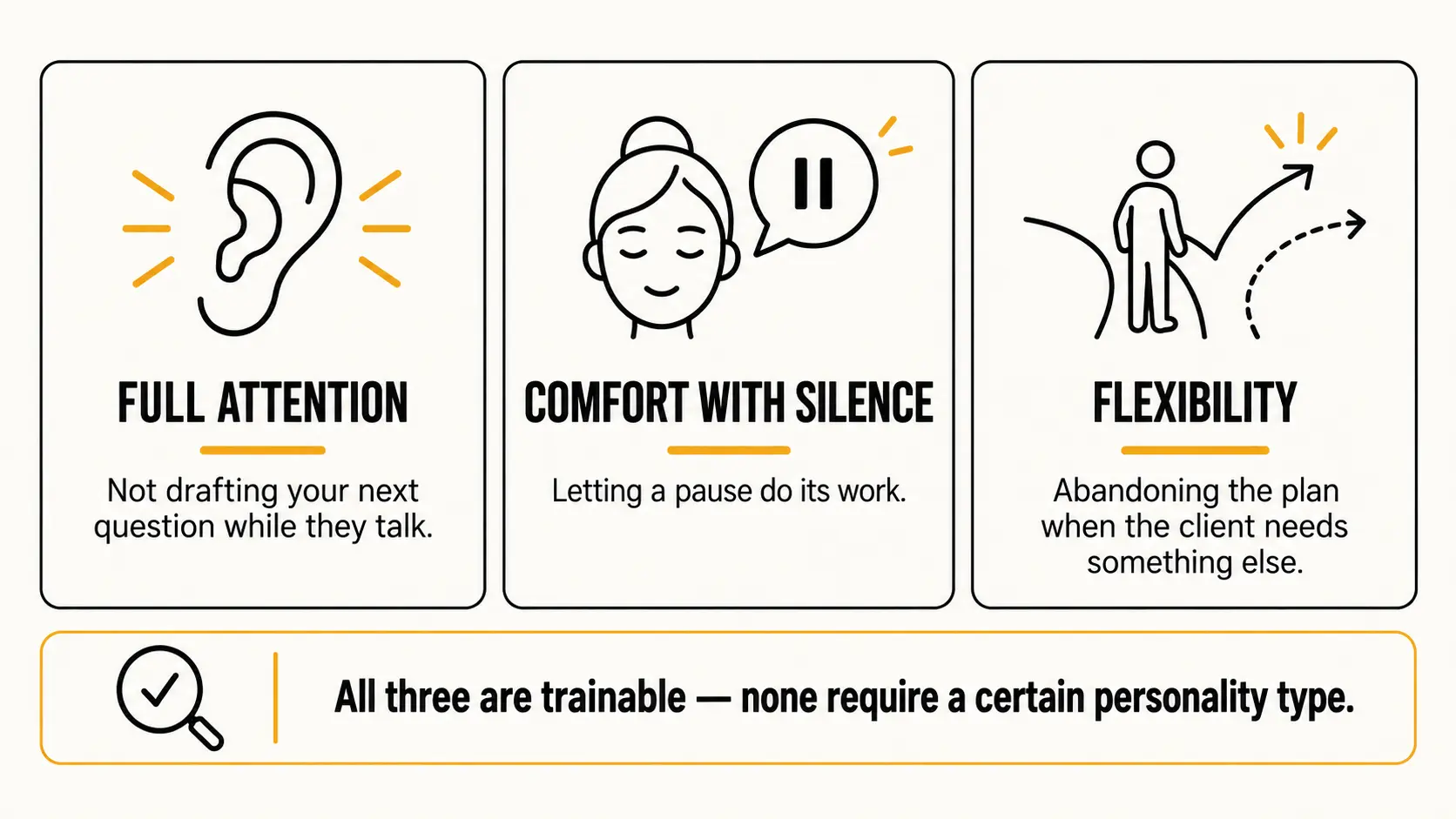
Part of what makes presence trainable is that it has observable components: full attention (not multitasking or mentally drafting your next question while the client is still talking), comfort with silence (letting a pause do its work instead of rushing to fill it), and flexibility (being willing to abandon your planned direction for the session when the client brings something more pressing). Each of those can be practiced and given feedback on individually, which is exactly how approved training programs build the skill over a curriculum, not in a single lecture.
| Low presence looks like... | High presence looks like... |
|---|---|
| Mentally rehearsing your next question while the client is still talking | Actually finishing listening before formulating a response |
| Filling every pause immediately | Letting silence sit long enough for the client to keep thinking |
| Redirecting the client back to your planned agenda | Following what the client brings, even if it derails your plan for the session |
| Offering a solution as soon as a problem is named | Getting curious about the problem before moving toward solving it |
Self-Awareness: Knowing What You're Bringing Into the Room
Self-awareness, in a coaching context, means noticing your own internal reactions as they happen during a session — not analyzing them after the fact, but catching them in real time. That includes noticing when a client's situation triggers a strong opinion in you, when you feel a pull to rescue someone from discomfort they actually need to sit with, or when your own values about health, food, or exercise are quietly shaping what you consider a "good" goal for someone else.
This matters more than it might sound like it should, because every coach carries some version of a personal belief system about what healthy living looks like — and left unexamined, those beliefs leak into sessions as subtle steering. A coach who personally believes morning workouts are the "right" way to build a fitness habit may, without meaning to, keep nudging a night-owl client toward a 6am routine that was never going to fit that client's actual life. Self-awareness is what lets a coach catch that pull before it becomes the direction of the session.
- Self-awarenessNoticing your own reaction, assumption, or bias as it's happening — the internal "catch." On its own, this is a private, internal event; the client may never know it occurred.
- Self-regulationWhat you do once you've noticed it — managing the reaction so it doesn't leak into your tone, your questions, or the direction you steer the session. This is the visible, behavioral half of the pair.
- Countertransference-style biasA catch-all for the ways a coach's own history, values, or unresolved feelings about a topic (weight, food, exercise, discipline) color how they respond to a client working on that same topic. Coaches don't need clinical training to recognize this in themselves — just the habit of asking "is this reaction about them, or about me?"
- RescuingJumping in to solve, soothe, or resolve a client's discomfort before they've had a chance to sit with it and find their own way through — often driven by the coach's own discomfort with silence or difficulty, not the client's actual need.
Self-Regulation: Managing It Once You've Noticed It
Noticing a reaction is only half the skill. Self-regulation is what a coach does with that noticing — choosing, in the moment, not to let an internal reaction dictate the next question or comment. This isn't about suppressing genuine feeling or pretending not to have reactions; it's about having enough of a pause between noticing and responding that the coach's next move is still in service of the client, not the coach's own discomfort, opinion, or need to feel useful.
A common failure mode is subtle rather than dramatic. A coach doesn't need to lecture a client to steer them — a slightly disappointed tone after a client reports skipping their planned workouts, a too-quick "that's okay!" that shuts down a client's own reflection, or consistently spending more time on the parts of a session the coach finds interesting are all forms of unregulated reaction showing up as behavior. None of these look like an obvious mistake from the outside, which is exactly why self-regulation has to be an active, ongoing practice rather than something a coach assumes they're already doing well.
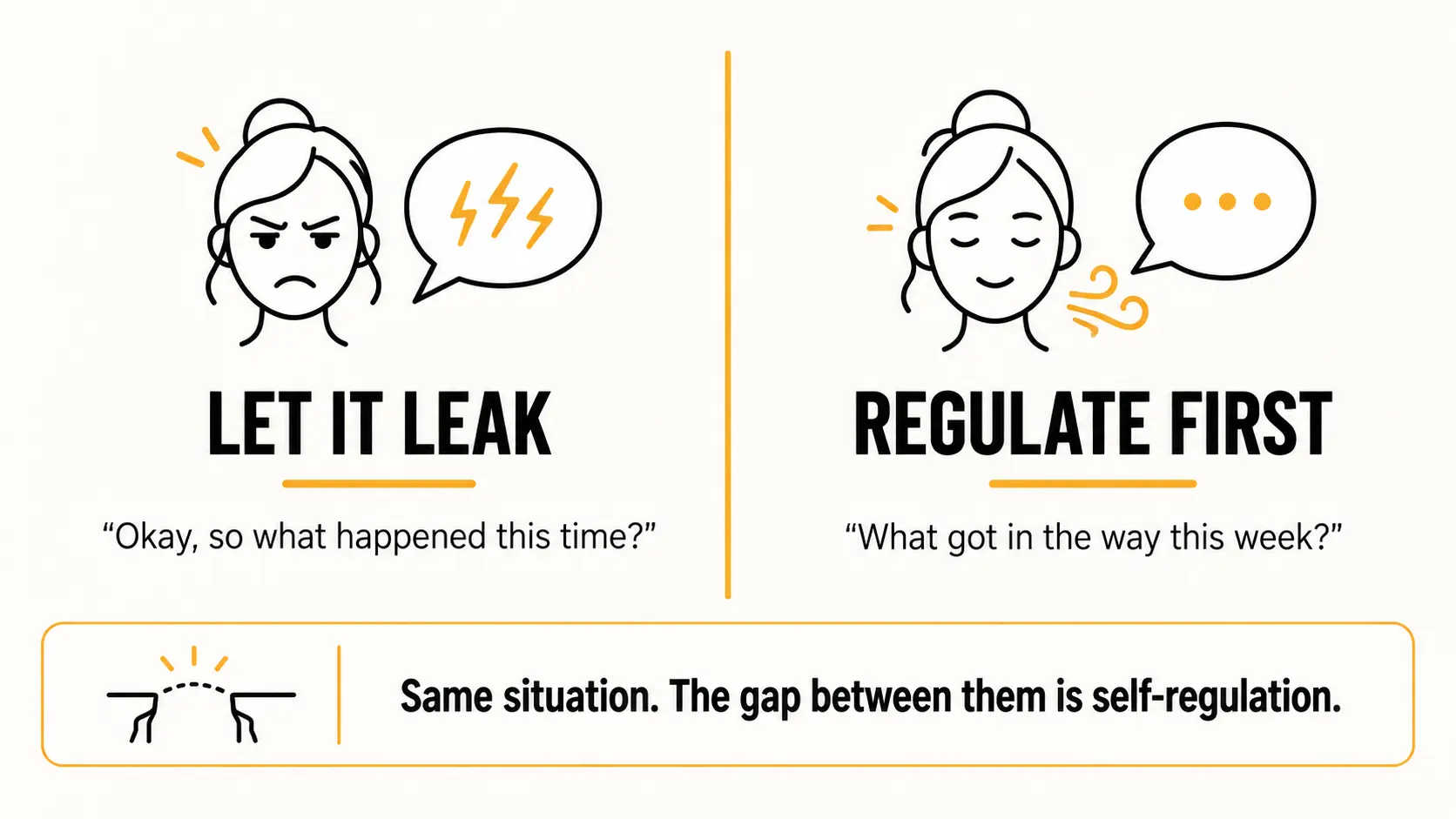
A client reports, for the third week running, that they didn't do the walking routine they'd committed to. A coach who notices a flicker of frustration (self-awareness) has a choice in the next three seconds: let it leak into a slightly clipped "okay, so what happened this time?" — or take a breath and ask, genuinely curious, "What got in the way this week?" Both questions are grammatically similar. Only one of them is likely to get an honest answer instead of a defensive one. The gap between them is self-regulation.
Where This Fits (and Where It Doesn't)
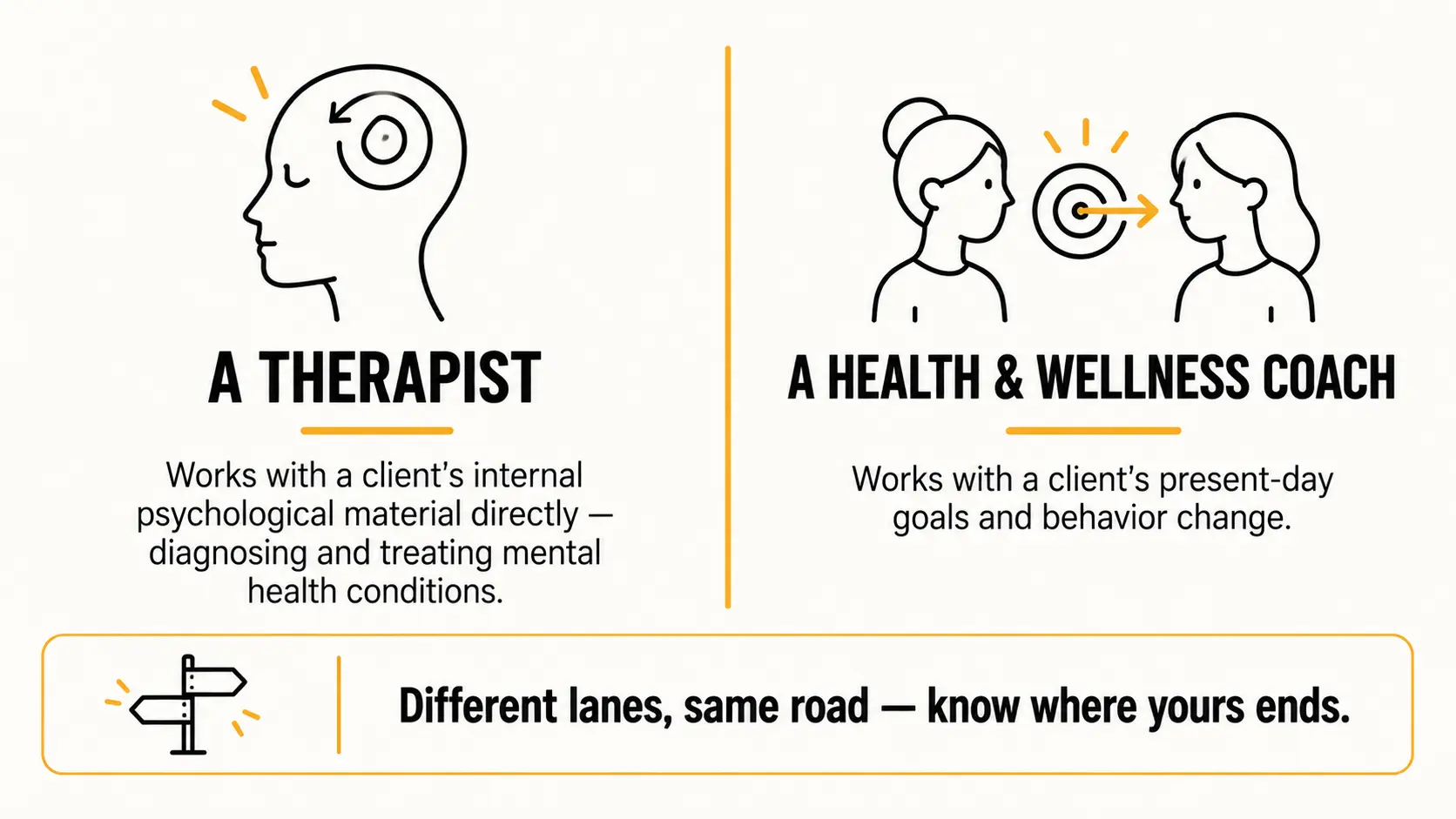
It's worth being precise about scope here, since self-awareness and self-regulation sound like they belong to therapy as much as coaching. They don't overlap the way it might seem. A therapist works with a client's internal psychological material directly — processing past experiences, diagnosing and treating mental health conditions. A health and wellness coach works with a client's present-day goals and behavior change, and uses self-awareness and self-regulation purely in service of staying useful to that process — not as a tool for exploring the client's inner life. Recognizing that boundary, and referring a client onward when something is outside a coach's scope, is itself covered later in Domain 4's ethics content — this lesson is about the coach's own internal skill, not about client-facing scope decisions.
8 questions on coaching presence, self-awareness, and self-regulation. NBHWC doesn't publish a fixed pass/fail line for its own exam, so this knowledge check doesn't invent one either — you'll get a raw score and a rationale for every question instead.
- Coaching presence is the quality of attention a coach brings to a session — full, flexible, and responsive to the client, not a fixed script.
- Presence is a trainable skill with observable components (full attention, comfort with silence, flexibility) — not a fixed personality trait.
- Self-awareness is noticing your own reactions, assumptions, and biases as they happen during a session.
- Self-regulation is managing that reaction so it doesn't steer the session toward the coach's own agenda, opinions, or discomfort.
- Self-awareness and self-regulation are coaching skills used in service of the client's goals — not a substitute for the psychological work of therapy, and staying inside that boundary is its own ethical responsibility, covered later in Domain 4.
Before moving to Lesson 2:
- Think of a recent conversation — coaching or otherwise — where you caught yourself thinking about your response before the other person finished talking. What pulled your attention away?
- Write down one personal belief you hold about "healthy" habits (diet, exercise, sleep, etc.) that you'd need to consciously set aside if a client's goals didn't match it.
- Practice sitting with silence for a full five seconds after someone finishes a sentence before you respond, in one real conversation this week.
- Complete the knowledge check above and review the rationale for any question you missed.