A coaching relationship isn't just a friendly container for giving good advice in — it's the actual mechanism that makes change possible. Decades of research on helping relationships (coaching, counseling, medicine, teaching — going back to psychologist Carl Rogers' work on what makes any of them work) keep landing on the same three conditions: unconditional positive regard, empathy, and congruence. NBHWC tests this directly, under its own name for it: building a growth-enhancing relationship. This lesson breaks down what each condition actually looks like in a session, how trust and rapport show up as specific behaviors rather than just "being nice," and why a coach's job is to partner with a client rather than direct them.
Lesson 1 covered presence — the quality of attention a coach brings into a session. This lesson covers what that attention is actually in service of: the relationship itself. A large body of research on helping relationships keeps finding the same thing, across very different fields — the quality of the relationship predicts whether someone actually changes at least as much as which specific technique gets used on them. NBHWC's content outline names this as its own tested competency inside Domain 1, worth real points on the exam, and this lesson is about what makes a relationship the kind that actually helps someone change, rather than one that just feels pleasant.
What Makes a Relationship "Growth-Enhancing"?
Picture two different ways a helper can respond when someone brings them a problem. In the first, the helper listens just long enough to identify the issue, then supplies the fix — a meal plan, a workout schedule, a budgeting app. The relationship exists mainly to transfer the helper's expertise into the other person's life. Call this the expert model: it's how most consulting, most medical visits, and most "just tell me what to do" advice-giving actually works, and it's not wrong, exactly — it's just not what coaching is built to do.
A growth-enhancing relationship is structured differently. Its goal isn't to hand the client a finished answer; it's to create the conditions under which the client does the work of figuring out their own answer, and — just as importantly — builds the confidence and skill to keep doing that work after the coaching relationship ends. This doesn't mean the coach withholds knowledge or refuses to ever give information. It means the relationship itself, not the information inside it, is what's doing most of the work. That's a genuinely different job than being the smartest person in the room.
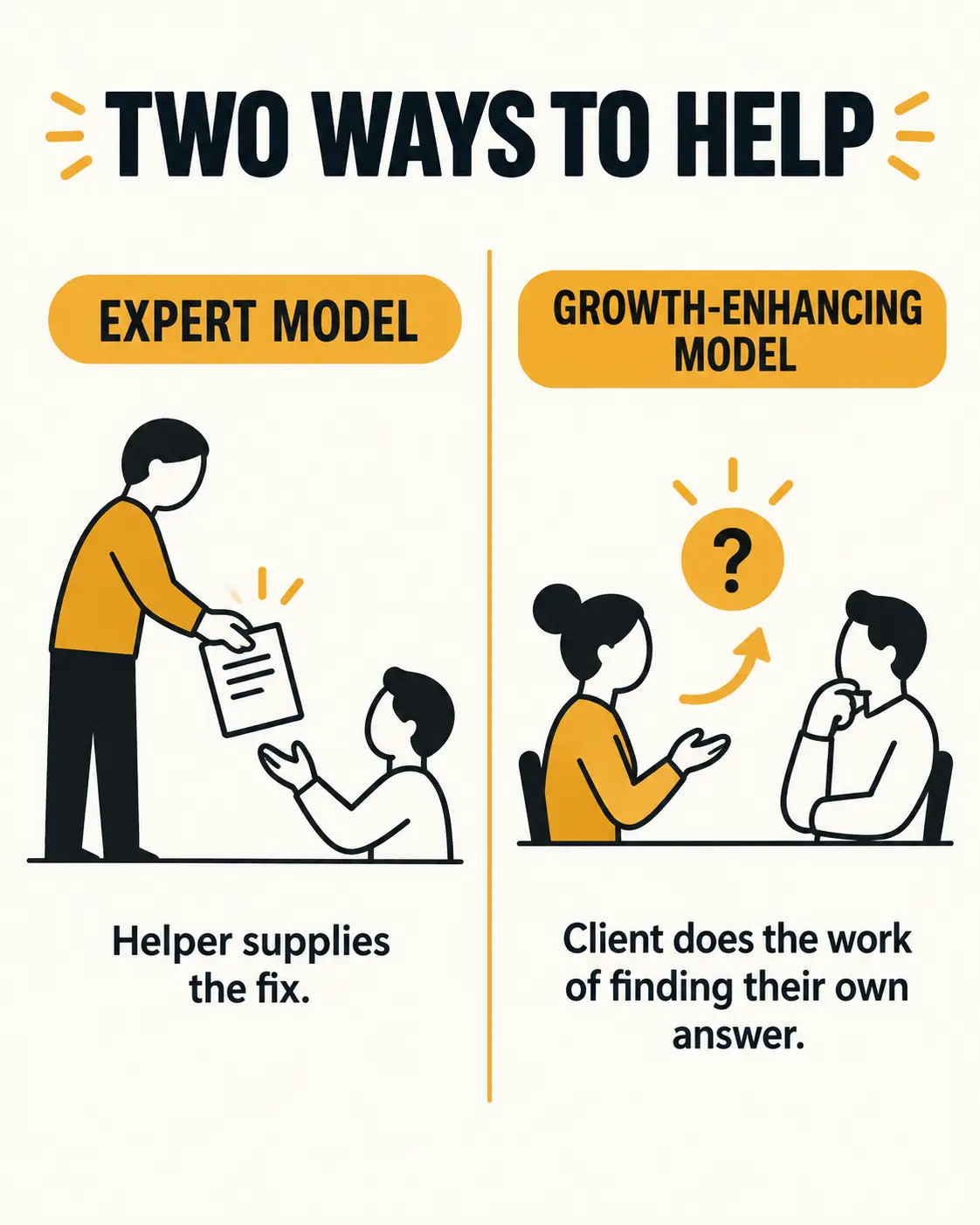
A client says: "I keep failing at this diet." An expert-model response jumps straight to a fix: "Here's a meal plan that's actually realistic — let's swap in these three things." A growth-enhancing response stays with the client a moment longer: "You've said 'failing' a couple of times now — what does failing actually look like for you here?" The second response doesn't solve anything on the spot. But it's far more likely to surface the real obstacle — maybe it's not the diet at all, but a belief that any slip-up means total failure — and that insight belongs to the client, which is exactly where change that actually lasts tends to come from.
The Three Conditions That Make a Relationship Growth-Enhancing
In the 1950s, psychologist Carl Rogers set out to answer a very practical question: across every kind of helping relationship, what actually makes the difference between one that helps someone grow and one that doesn't? He landed on three conditions, and they've since become foundational not just in therapy but across coaching, teaching, medicine, and — directly — NBHWC-approved health and wellness coach training. They're worth learning by name, because the exam tests them, but they're far more useful as a working checklist for your own sessions.
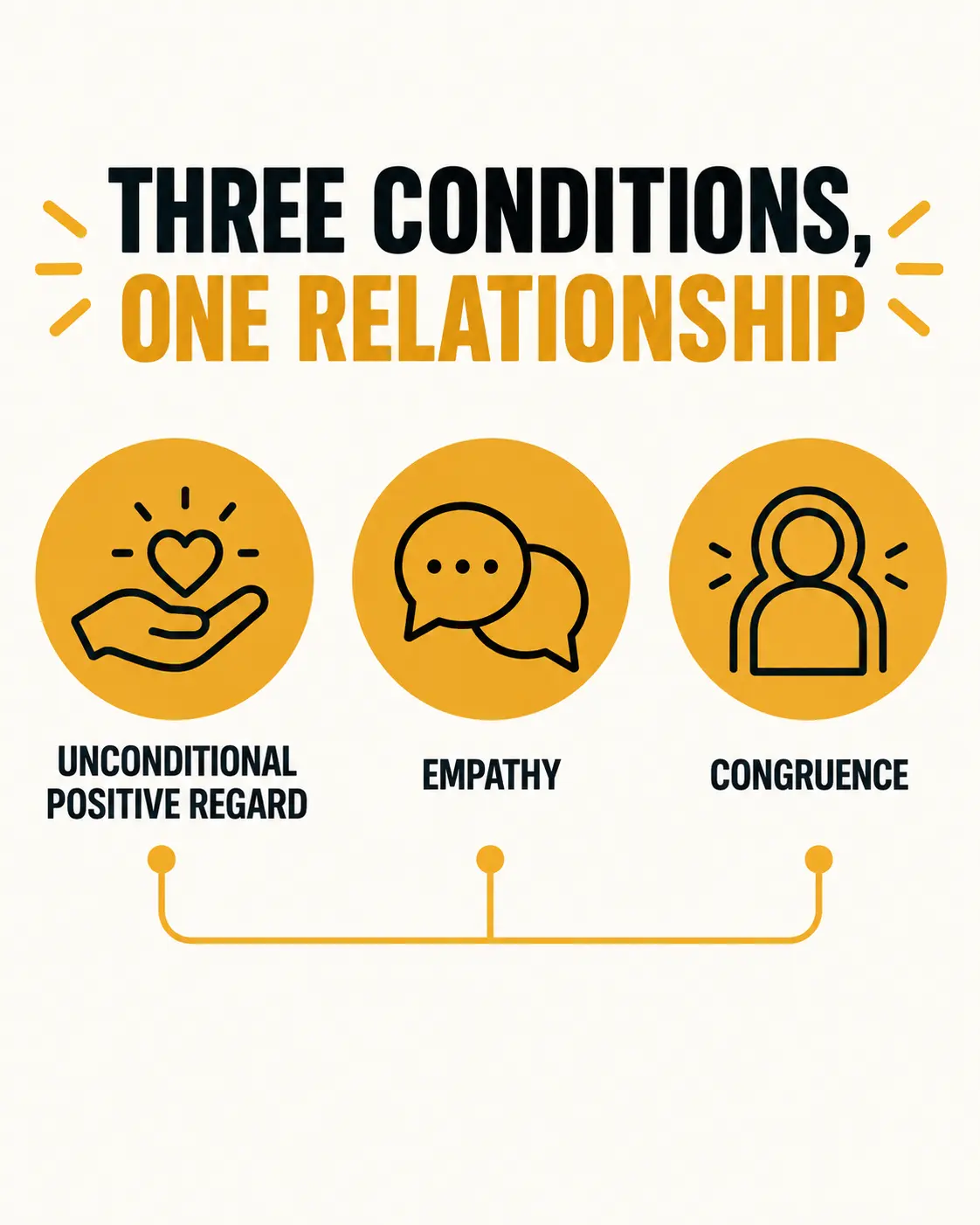
- Unconditional positive regardAccepting the client as a person of worth, independent of their choices, setbacks, or how "well" they're doing this week. It is not the same as approving of every behavior — a coach can hold full respect for the person while still being honest that a pattern isn't working.
- EmpathyAccurately understanding a client's experience from their point of view — not the coach's — and reflecting that understanding back clearly enough that the client feels understood, not just heard.
- CongruenceBeing genuine and internally consistent as a coach, rather than performing a "coach persona" that doesn't match what's actually going on. Clients tend to notice the gap even when they can't name it — a tone that doesn't match the words is rarely as invisible as it feels from the coach's side.
The condition that trips people up most is unconditional positive regard, because it sounds like it should mean "never disagree, never push back, always validate." It doesn't. Imagine a client who wants to stop exercising entirely and only focus on diet, against what the coach might personally consider a balanced plan. Unconditional positive regard means the coach still respects that client fully as a capable adult making their own choice — while still being free to share relevant information or ask a genuinely curious question about the reasoning. What it rules out isn't honesty; it rules out withdrawing warmth or respect as a reaction to a choice the coach doesn't personally agree with.
Trust and Rapport: What They Actually Look Like Session to Session
Presence and the three conditions above are mostly internal — they describe a coach's attention and attitude. Trust and rapport are what those internal states produce on the outside: the specific, observable behaviors that either build a client's confidence in the relationship or quietly erode it, one session at a time.
| Rapport-eroding looks like... | Rapport-building looks like... |
|---|---|
| Correcting a client's account of their own week | Letting the client's account stand, even if the coach remembers a detail differently |
| Assuming what the client "should" want to work on today | Asking directly what the client wants to focus on |
| Jumping in with the likely reason a lapse happened before the client explains it | Waiting for the client's own explanation first |
| Running the same fixed agenda regardless of how the client shows up that day | Checking in on where the client actually is before diving into the plan |
A client arrives to a session clearly rushed and distracted after a rough day at work. A rapport-eroding response barrels ahead with the planned agenda anyway. A rapport-building response names what's actually happening and hands the choice back: "You seem like today's been a lot — do you want to stick with the plan, or talk through what's going on first?" Nothing about the coach's expertise changed between those two options. What changed is whether the client learned, in that moment, that this relationship adapts to them. Trust compounds exactly like that, session after session — a client who's been given a real choice once is far more likely to bring the full truth next time too.
Partnership, Not Expertise: Why the Coach Isn't "The Expert" in the Room
This is the distinction that separates coaching from most other helping professions a client might have encountered before: in a growth-enhancing relationship, the client is treated as the expert on their own life — their history, their constraints, their values, what's realistic given everything else going on for them — and the coach is the expert in something narrower but still essential: the process of facilitating change, not the specific answer for that person's specific life.
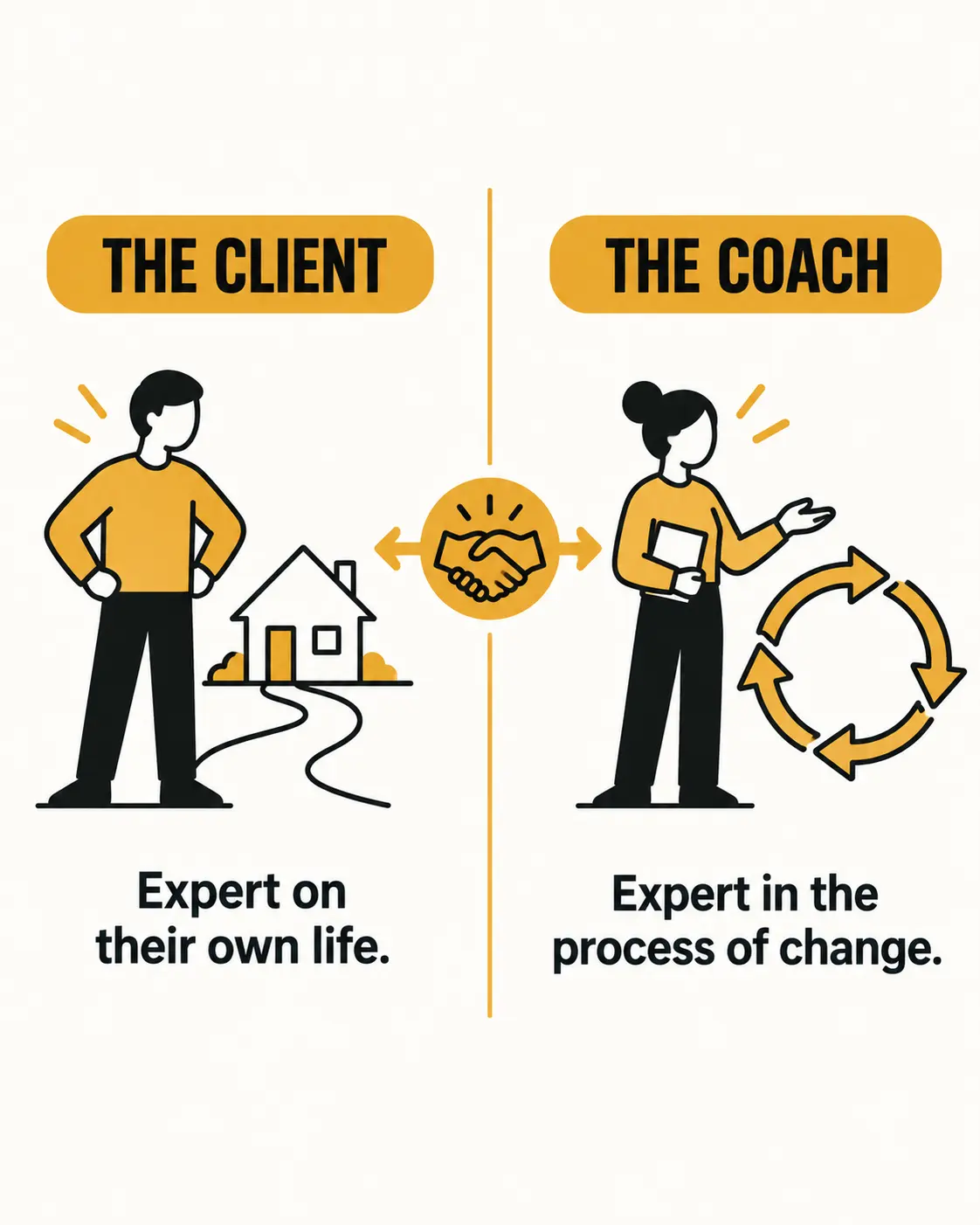
Picture two trainers advising the same busy parent about when to fit in workouts. An expert-model trainer designs the objectively optimal program and hands it over. A partnership-model trainer asks what the actual week looks like — school drop-offs, work calls, the one evening that's genuinely free — and builds around constraints the client understands far better than the trainer ever could from the outside. Both trainers might know the same exercise science. Only one of them is actually working with the information the client alone has access to.
This lesson is about that underlying stance, not yet the specific tools for putting it into practice — the concrete skills for drawing out a client's own motivation and reasoning, like open-ended questions and reflective listening, get their own dedicated lessons later in Domain 3. For now, the thing worth internalizing is simpler: every time a coach catches the urge to just tell a client the "right" answer, that's the moment to ask whether the client already has more of that answer than the coach does.
Where Warmth Meets Structure: This Isn't Friendship
It's worth being precise about what a growth-enhancing relationship is not, because the concept is easy to flatten into "just be nice and supportive all the time." It isn't endless validation, avoiding every hard conversation, or letting sessions drift into unstructured venting because pushing back feels unkind. A relationship built on unconditional positive regard, empathy, and congruence can absolutely include direct, sometimes uncomfortable honesty — the warmth is in how it's delivered, not in whether it gets said at all.
Take a client who has rescheduled the last three sessions in a row. A coach who quietly accommodates every cancellation forever isn't demonstrating warmth — they're avoiding a conversation the client probably needs. A coach who gets visibly frustrated or lectures the client about commitment has lost unconditional positive regard. The growth-enhancing version holds both at once: "I've noticed we've moved this three times now. I want to understand what's getting in the way, because it genuinely matters to me that this works for you." That's accountability delivered inside respect, not instead of it.
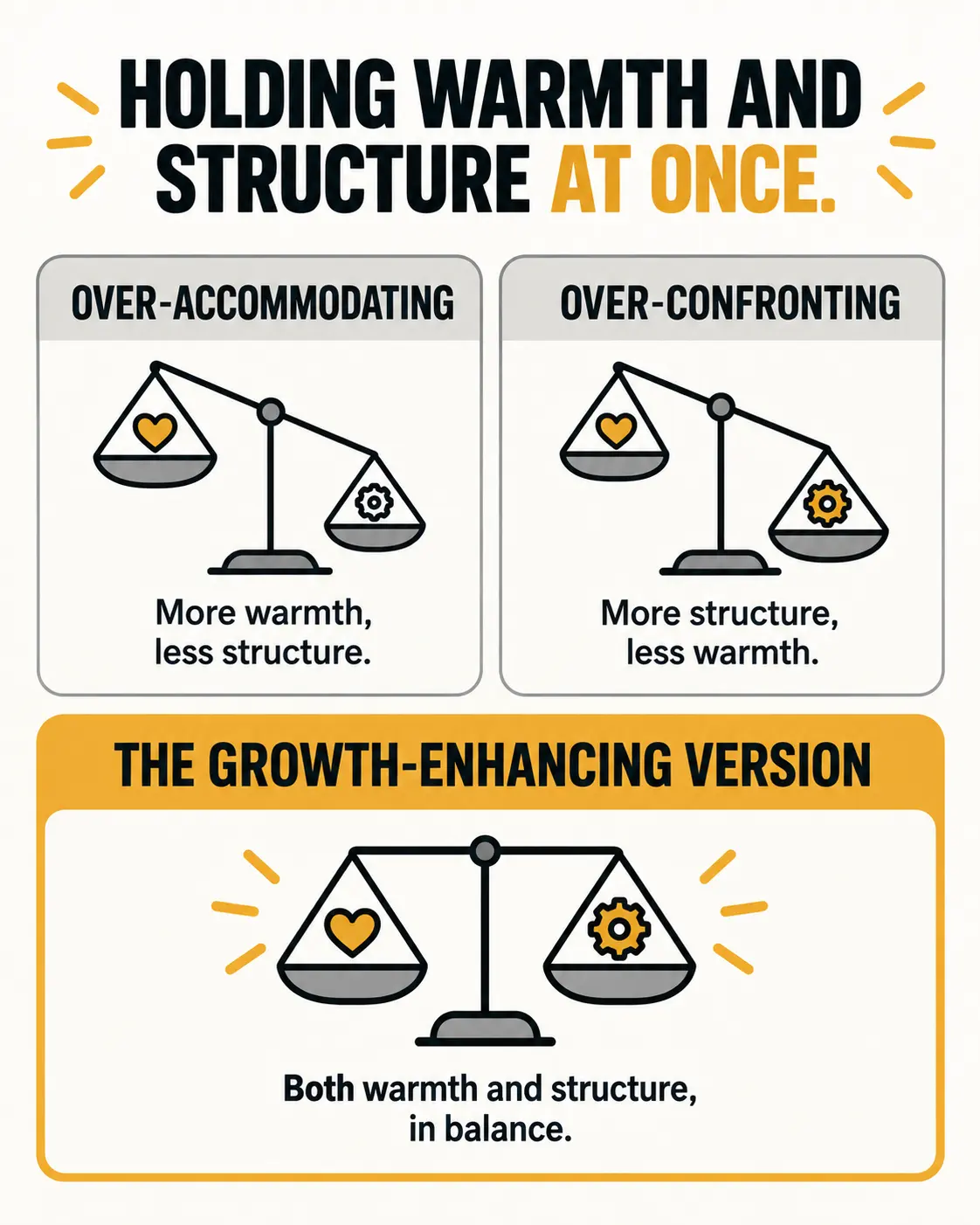
Keeping this relationship professional — not sliding into friendship, not creating a dependency the client can't outgrow — is itself part of a coach's ethical responsibility, and it gets fuller treatment later in this course's Domain 4 ethics content. For this lesson, the point to hold onto is that warmth and structure were never actually in tension; a relationship only becomes growth-enhancing when it has room for both.
8 questions on the growth-enhancing relationship, the three core conditions, and the partnership stance. NBHWC doesn't publish a fixed pass/fail line for its own exam, so this knowledge check doesn't invent one either — you'll get a raw score and a rationale for every question instead.
- A coaching relationship is the mechanism for change, not just a friendly container for giving advice — the quality of the relationship predicts outcomes at least as much as which specific technique gets used.
- Three conditions make a relationship growth-enhancing: unconditional positive regard, empathy, and congruence.
- Unconditional positive regard isn't the same as approving of every behavior — it means holding respect for the person while still being honest about what isn't working.
- Trust and rapport are the visible, session-to-session behaviors these conditions produce — noticing how a client shows up, letting their account stand, and asking rather than assuming.
- Coaching works from a partnership stance, not an expert stance — the client is the expert on their own life, and the coach's expertise is in the process of change itself.
Before moving to Lesson 3:
- Think of a recent conversation where you — or someone helping you — jumped to solving or advising before really understanding the full picture. What would a growth-enhancing response have sounded like instead?
- In one real conversation this week, reflect back what the other person told you, in your own words, before offering your own opinion — notice how it changes what they say next.
- Write down one situation, with a client or otherwise, where you tend to blur warmth with avoiding a hard truth. What would holding both at once actually look like?
- Complete the knowledge check above and review the rationale for any question you missed.