Everything covered so far — presence, self-awareness, and the growth-enhancing relationship — has to actually get set up somewhere, and that setup isn't automatic. A coach walks into every session having done some kind of preparation, whether deliberate or not, and the first handful of sessions with any new client carry work that later sessions don't repeat: agreeing on how the relationship will run, gathering enough context to coach well, and setting expectations for what's ahead. NBHWC's content outline tests this directly as part of Domain 1. This lesson covers what genuinely useful preparation looks like before a session starts, what a coaching agreement and intake actually need to cover, and why the first few sessions with a client look different from session ten.
Lesson 1 covered presence, and Lesson 2 covered the relationship conditions that make coaching actually work. Neither of those shows up automatically the moment a session starts — presence has to be brought deliberately into the room, and a growth-enhancing relationship has to be built, session by session, starting from a first conversation where the client doesn't yet know what to expect. This lesson is about that practical, unglamorous layer underneath the relationship skills: what a coach does before the client ever arrives, and what has to happen differently in the first few sessions so that everything covered in Lessons 1 and 2 has somewhere to actually land.
Before the Session Starts: What Preparation Actually Looks Like
It's tempting to think of session preparation as something that happens on paper — reviewing a client's file, maybe jotting down a few questions. That's part of it, but it's the smaller part. The preparation that actually shapes how a session goes is mostly internal: a coach checking their own headspace, noticing whatever they're carrying in from the rest of their day, and deliberately setting that aside before the client shows up. This is Lesson 1's self-awareness and self-regulation, applied at a specific moment — the few minutes before a session starts, rather than in the middle of one.
Reviewing notes from the previous session matters too, but for a narrower reason than it might seem. It isn't about walking in with a plan for what the client "should" work on today — that would undercut the partnership stance from Lesson 2. It's about being oriented enough that the coach isn't asking the client to re-explain context they've already given, while still leaving real room for the client to set today's direction. A coach who reviews notes well can open a session with "last time you mentioned X — where's that at?" without having already decided what today's session is supposed to accomplish.
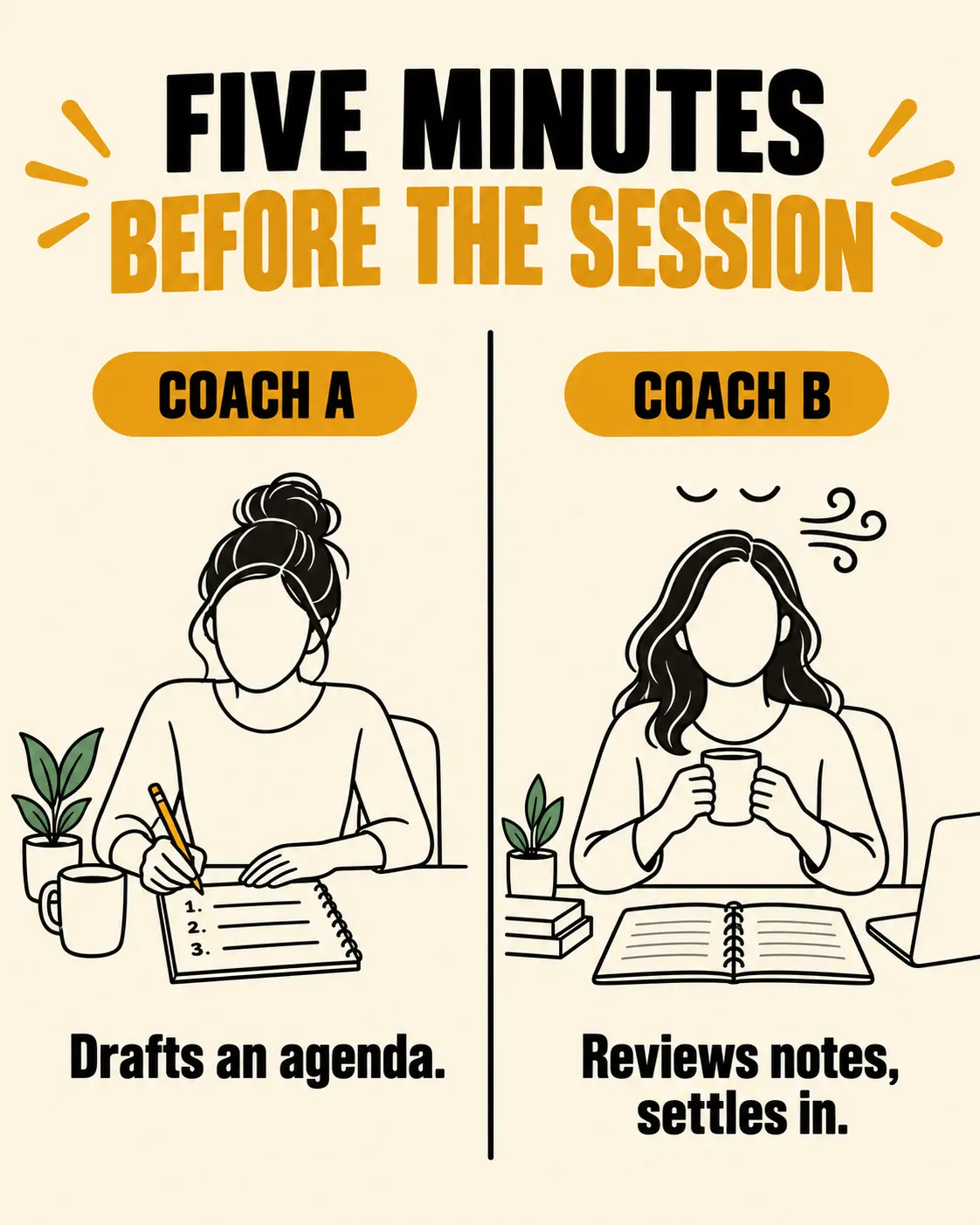
Coach A spends the five minutes before a session drafting three questions to ask, in order, based on what they think the client needs to hear. Coach B spends those same five minutes rereading their last two sessions' notes, noticing they're still a little tense from the meeting before this one, and taking a breath to let that go before the call connects. Coach A walks in with an agenda. Coach B walks in oriented, regulated, and open. Only one of them is actually prepared to run a growth-enhancing session — having questions ready isn't the same thing as being ready.
The First Session Is Different: Setting Up the Coaching Agreement
Every ongoing coaching relationship needs some shared understanding of how it's going to work, and that understanding doesn't appear on its own — it gets built explicitly, almost always starting in the first session. NBHWC's content outline refers to this as the coaching agreement: not a legal contract and not a signed waiver, but a mutual, often mostly verbal understanding of expectations, structure, and roles.
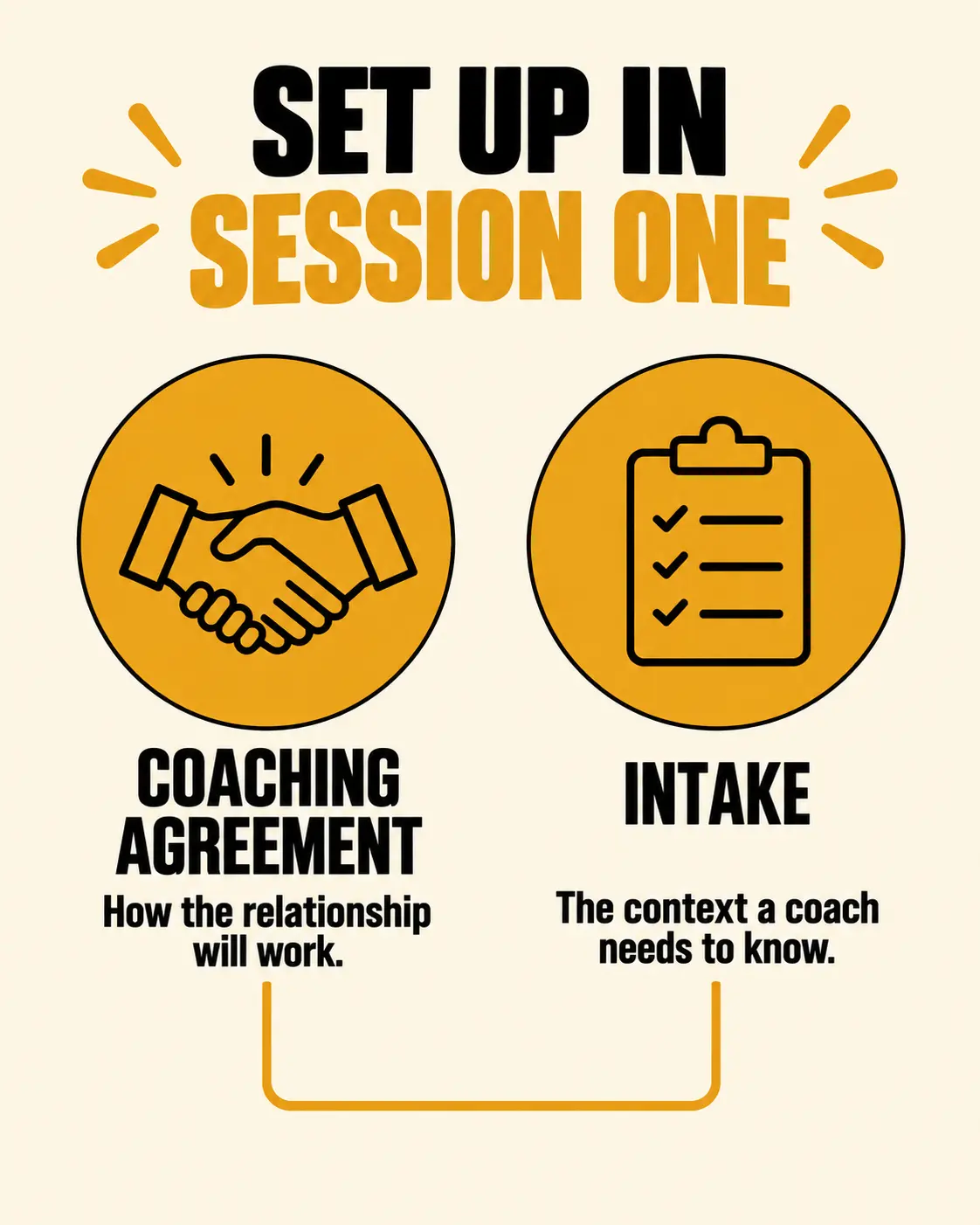
- Coaching agreementThe shared understanding of how the relationship will run — session frequency and length, what's expected between sessions, how the client can reach the coach, and what coaching is (and isn't) going to look like. Usually established in the first session and revisited if anything needs to change.
- IntakeThe process of gathering the context a coach needs to coach this specific client well — relevant history, current goals, what's already been tried, and any constraints worth knowing about early. Usually happens alongside or shortly after the coaching agreement in the first session or two.
Part of the coaching agreement is simply naming what coaching is, because most new clients arrive with an expert-model expectation left over from doctors' visits, personal training, or well-meaning friends giving advice. A coach who doesn't say anything about this will often find a client waiting to be told what to do — not because the client is being difficult, but because nobody's told them the relationship works differently. Naming the partnership stance from Lesson 2 out loud, early, saves a lot of quiet friction later.
Gathering the Full Picture Without Turning It Into an Interrogation
Intake exists because a coach genuinely coaches better with context — what a client has already tried, what's worked and hasn't, what constraints are actually in play. Skipping it isn't more client-centered; it just means the coach is working blind. The risk isn't asking too much, it's asking it in a way that flattens the conversation into a form being filled out rather than a relationship being started.
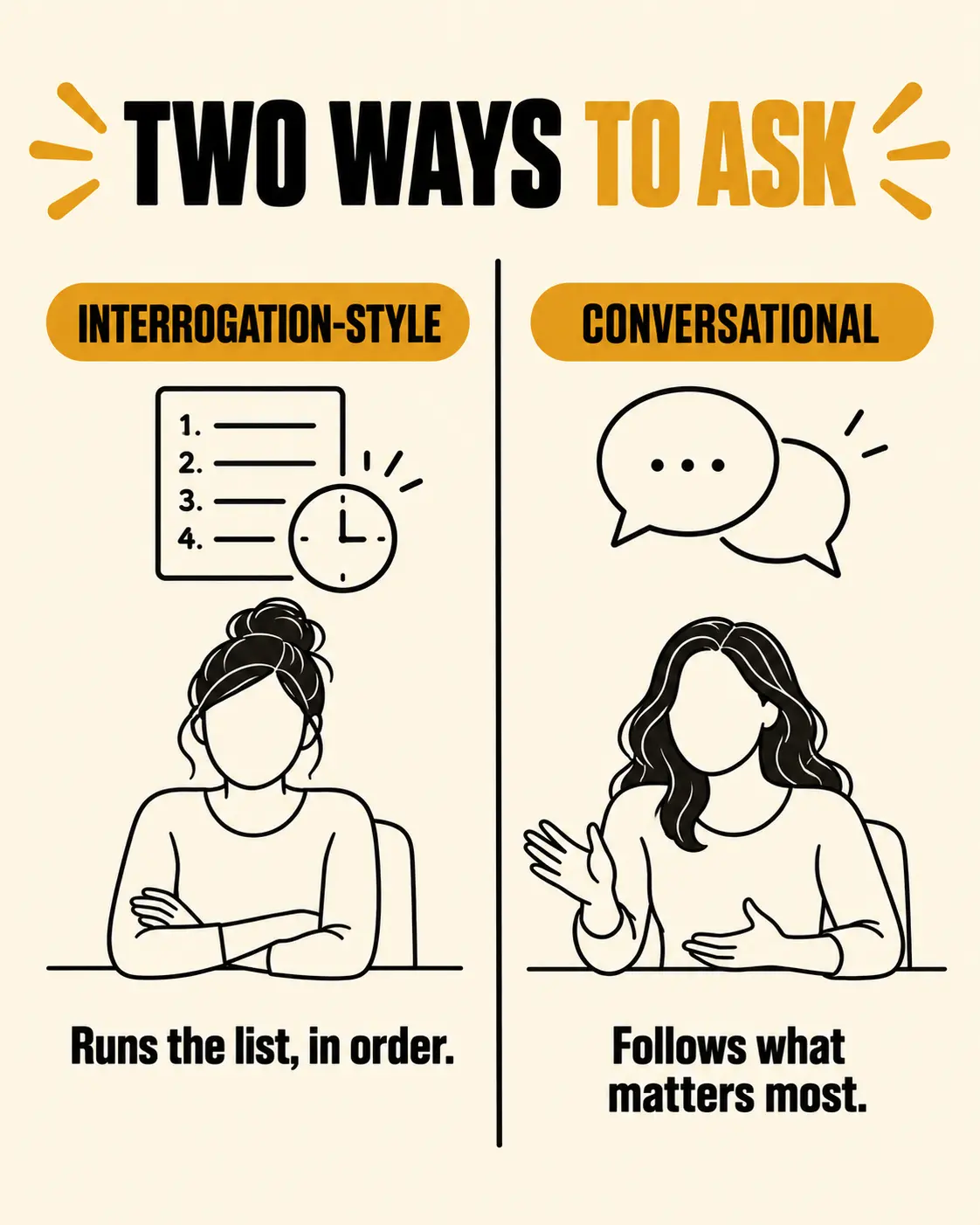
| Interrogation-style intake looks like... | Conversational intake looks like... |
|---|---|
| Running down a fixed list of questions in order, regardless of what the client just said | Letting one answer shape the next question, the way any real conversation does |
| Moving straight to the next question the instant an answer ends | Reflecting back what was heard before moving on |
| Treating every question as equally necessary to get through | Following what matters most to the client first, and filling in the rest as it comes up naturally |
| No acknowledgment of how the conversation itself feels to the client | Checking in on how the conversation is landing, especially if a topic seems sensitive |
"Have you tried to make changes like this before?" is a completely reasonable intake question. Asked as item four on a list, straight after item three, it reads as procedural. Asked after actually reflecting back what the client just said about why this matters to them now — "It sounds like this time feels different for you. Have you tried something like this before, and if so, what happened?" — it's the exact same information, gathered inside a conversation instead of a form. The content of intake and the relationship-building from Lesson 2 were never actually in competition; they only look that way when intake is rushed.
Setting Expectations for the Sessions Ahead
Alongside the coaching agreement, the first session or two is where a coach and client get concrete about what's ahead: how often they'll meet, roughly how long the coaching relationship is expected to run, what happens between sessions, and how the client can reach the coach if something comes up. None of this needs to be rigid — it needs to be said out loud, so both people are working from the same picture instead of two different unstated ones.
This is also where a coach draws a light first line around confidentiality and scope — not the full legal and ethical treatment, which this course covers in depth in Domain 4, but enough that a client understands, from session one, what stays private and when a coach would need to refer them elsewhere. Getting this backwards — leaving it vague until it matters — tends to damage trust right when a coach most needs it intact.

Setting expectations also means being honest about what coaching is for. A coach who lets a client believe coaching will feel dramatic and fast, when the real work is usually slower and more collaborative, is setting up an early session for disappointment that has nothing to do with whether the coaching itself is any good.
From First Session to Steady Rhythm: What Changes by Session Three or Four
Everything in this lesson so far is front-loaded work — it happens once, or close to it, and later sessions don't need to repeat it. That's the real difference between an early session and one further into the relationship: not that later sessions matter less, but that the foundation is already there to build on.
By the third or fourth session, a coach isn't re-explaining the coaching agreement, re-running the full intake, or spending the opening minutes establishing what coaching even is. The rapport and trust covered in Lesson 2 have had a few sessions to compound, so a coach can open more directly — referencing what happened last time, picking up a thread the client left hanging, working from real shared history instead of starting cold each time. The preparation habits from earlier in this lesson don't go away; they just get lighter, because there's less ground to re-cover before the actual coaching conversation can start.
Knowing where this arc eventually goes — what changes when a coaching relationship is nearing its natural end, and how to close it well — is covered in the next lesson.
8 questions on session preparation, the coaching agreement, intake, and what changes between early and later sessions. NBHWC doesn't publish a fixed pass/fail line for its own exam, so this knowledge check doesn't invent one either — you'll get a raw score and a rationale for every question instead.
- Real session preparation is mostly internal — reviewing context and settling into presence and self-regulation — not drafting a fixed agenda before the client arrives.
- The coaching agreement is the shared, mostly verbal understanding of how the relationship will run — session structure, expectations, and roles — usually set up in the first session.
- Intake gathers the context a coach needs to coach well, but delivered as a checklist it can undercut the very rapport Lesson 2 covers — the same questions land differently depending on how they're asked.
- Early sessions carry one-time foundational work (agreement, intake, expectations) that later sessions build on instead of repeating.
- By the third or fourth session, established rapport and shared history let a coach move directly into the ongoing conversation rather than re-laying the same groundwork.
Before moving to Lesson 4:
- Think about how you currently prepare for any important one-on-one conversation, coaching or otherwise. Is your preparation mostly logistical, mostly about the other person, or mostly about your own headspace? What would shift if it were more balanced?
- Draft, in your own words, three or four things you'd want a coaching agreement to cover in a first session with a new client.
- Think of a time you were on the receiving end of an "interrogation-style" set of questions — from a doctor, a form, an interview. What specifically made it feel that way, and what would have made it feel more like a conversation?
- Complete the knowledge check above and review the rationale for any question you missed.