This lesson closes out Domain 1 by covering the other end of the timeline from Lesson 3: what keeps a coaching relationship working once the foundational work is done, and what it actually takes to close one out well when the work is finished. Follow-up sessions aren't just early sessions repeated forever — they carry a skill of their own, staying anchored to a specific client's history without sliding into a script. And ending a coaching agreement isn't something that just happens when a client quietly stops booking; NBHWC's content outline treats it as a distinct, active part of a coach's job, with its own signs to watch for and its own things to get right. Together, both pieces round out the full arc of a coaching relationship that Domain 1 covers, start to finish.
Lesson 3 covered what makes an early session different — the coaching agreement, intake, and the front-loaded work that later sessions build on instead of repeating. This lesson picks up right where that leaves off. Once the foundation is in place and a coaching relationship settles into an ongoing rhythm, what actually keeps those follow-up sessions useful instead of just going through the motions? And on the other end of the timeline, when the relationship is doing what it's supposed to do and a client is ready to carry things forward on their own, what does ending it well actually look like? NBHWC's content outline treats both as distinct, testable skills — not things that simply take care of themselves once the early work is behind you.
Follow-Up Sessions: Building Rhythm Without Going on Autopilot
Once the coaching agreement and intake from Lesson 3 are in place, most of a coaching relationship's lifespan is spent in follow-up sessions — and that's exactly where a different failure mode shows up. Early sessions fail, when they do, by skipping foundational work. Follow-up sessions fail by having too much foundation and too little presence: the structure becomes so familiar that a coach can run one on autopilot, asking the same shape of questions in the same order regardless of what's actually going on for this client this week.
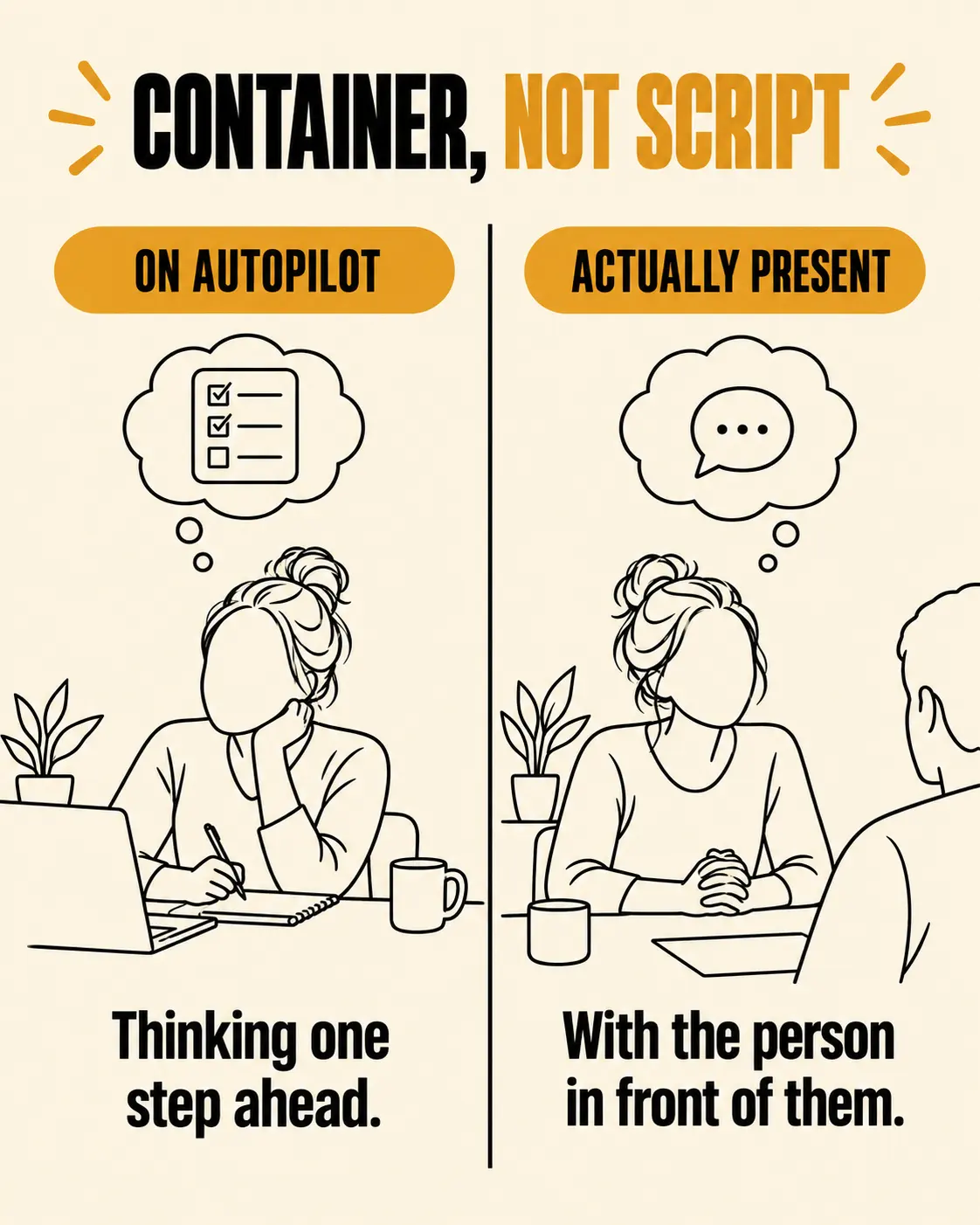
A predictable structure isn't the problem — it's genuinely useful. Knowing roughly how a session will unfold gives both people a container to work inside, and a client who knows what to expect can relax into the conversation instead of wondering what happens next. The problem is when that structure stops being a container and starts being the content: a coach who's thinking one step ahead to the next item on a mental checklist isn't actually coaching the person in front of them, even if every session technically covers the right ground.
What a Consistent Follow-Up Session Actually Looks Like
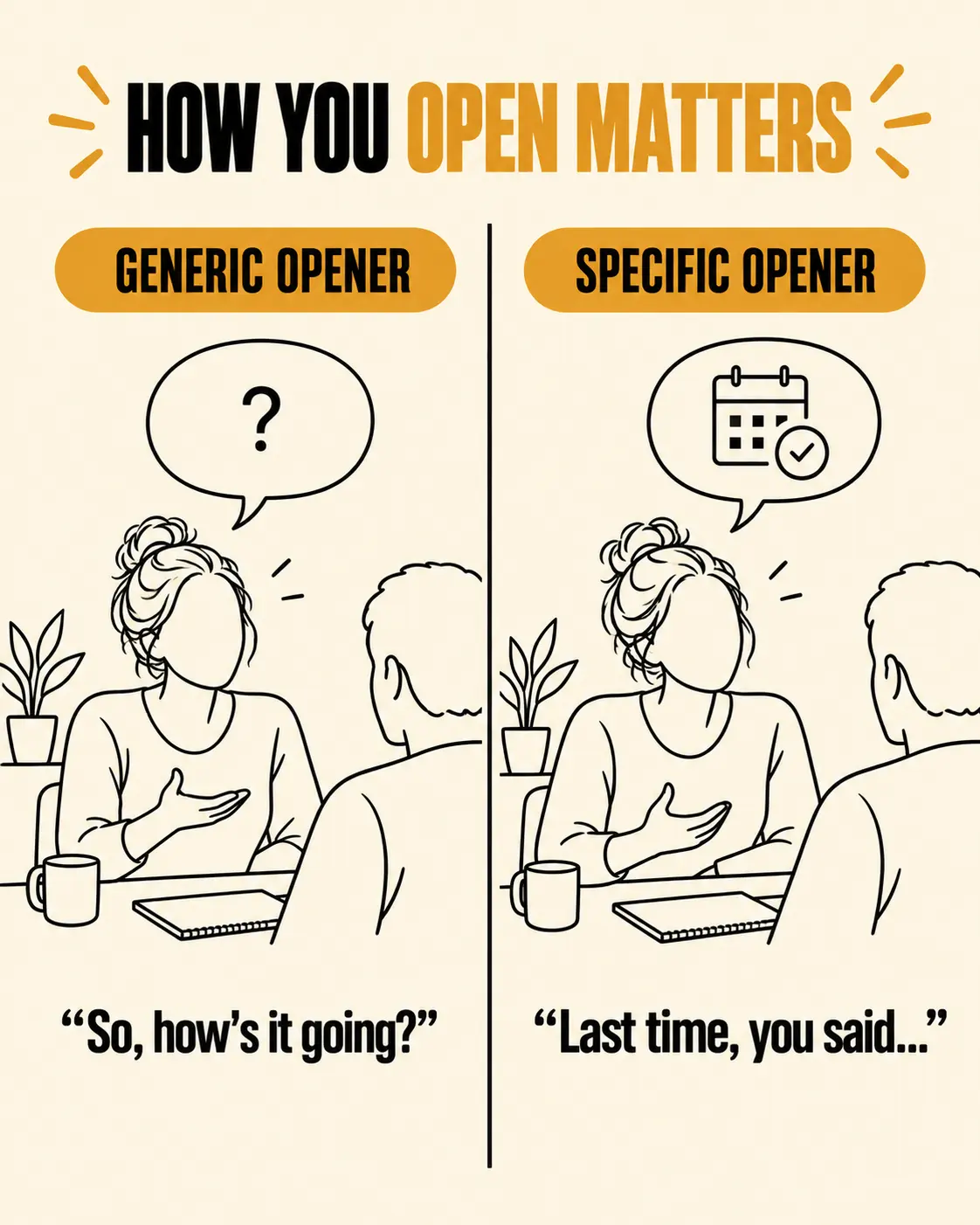
The first few minutes of a follow-up session do more work than they get credit for. A generic opener signals, even unintentionally, that the coach hasn't been tracking the client's specific situation between sessions — and clients notice, even when they can't name exactly why a session feels a little flat. An opener that references something concrete from last time, or from whatever the client said they'd try, signals the opposite: that this relationship has continuity, and today's conversation is building on something real rather than starting cold.
| A follow-up opener that flattens the relationship | A follow-up opener that builds on it |
|---|---|
| "So, how's it going?" — the same question, every session, regardless of what happened last time | "Last time you mentioned trying an earlier bedtime — how did that land?" |
| Moving straight into a prepared checklist of topics without checking what the client wants to bring today | Naming what's on the coach's radar, then asking what the client wants to prioritize |
| Treating a missed commitment as something to note and move past quickly | Getting curious about what got in the way, without judgment |
| Letting the session default to whatever topic came up last, out of habit | Checking whether today's priority has actually shifted since the last conversation |
Coach A opens session six with "So, how's it going?" — a question so generic it would fit any client, on any day, in any week of coaching. Coach B opens with "Last time, you said you were going to try moving your workout to mornings — how did that actually go?" Both questions are polite. Only one of them proves the coach was paying attention, and only one of them gives the client a specific, concrete thing to respond to instead of having to reconstruct the last few weeks from scratch before the real conversation can even start.
None of this means a coach has to remember every detail perfectly — a quick look at session notes before the call covers that, exactly as Lesson 3 described for first sessions. What it does mean is treating that review as worth doing every time, not just at the start of a relationship. The habit that made a first session land well doesn't expire after it — it's what keeps a tenth session from feeling interchangeable with the fourth.
Recognizing When a Coaching Relationship Is Ready to End
Not every coaching relationship is meant to run indefinitely, and NBHWC's content outline treats recognizing a natural ending point as a skill in its own right — not something a coach waits for the client to announce. The clearest signal isn't that a client has stopped making progress; it's that the client can increasingly do, on their own, what the coach was previously providing. Sessions start adding less new value than they used to, and the client brings fewer new topics, because there's genuinely less left that requires an outside partner to work through.
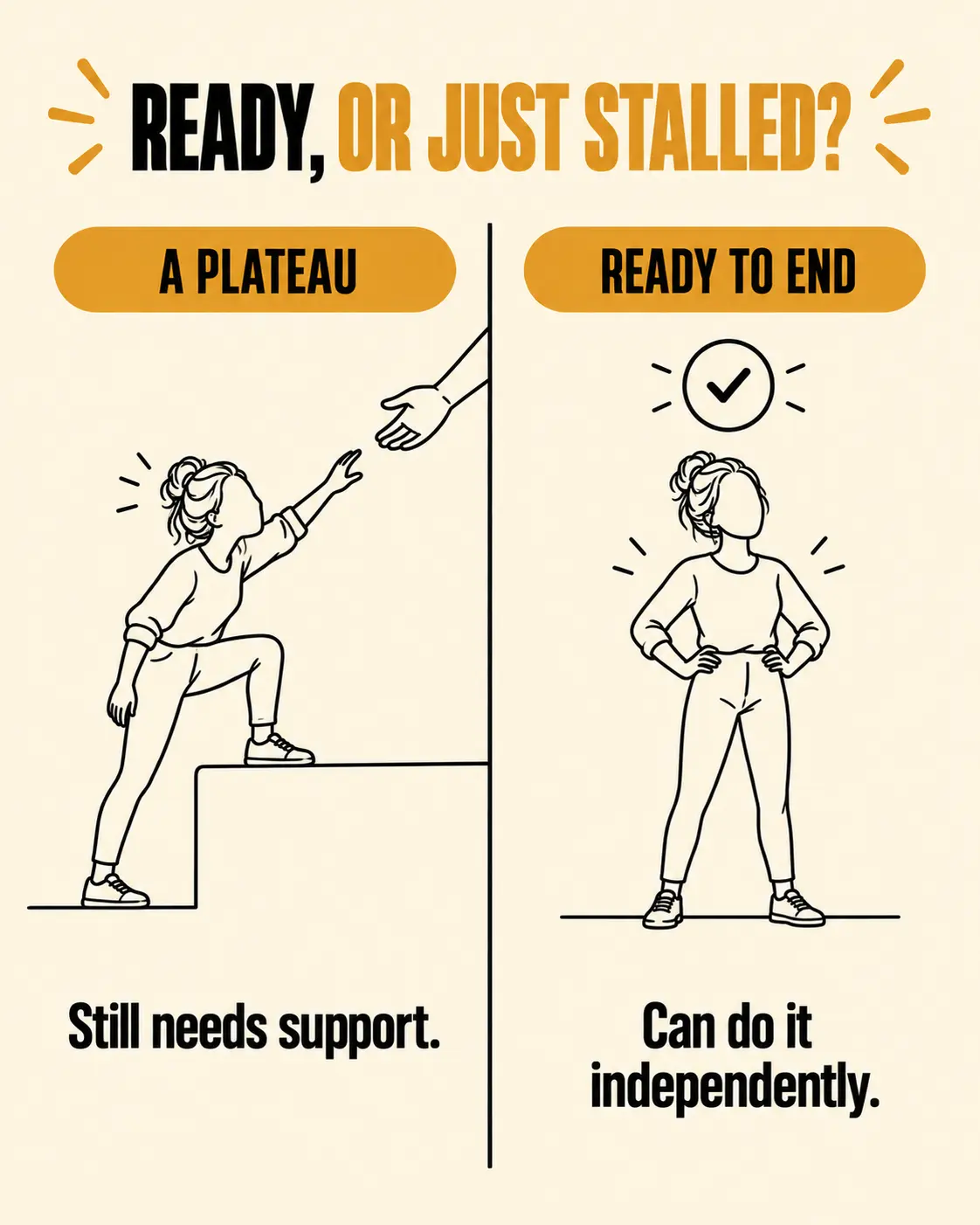
That's a meaningfully different picture from a plateau, and mixing the two up is a real risk. A client who's stalled — still struggling, still needing support, but not seeing visible movement for a stretch of sessions — isn't a client who's ready to end coaching; that client usually needs a different approach inside the relationship, not an exit from it. The distinguishing question isn't "has progress slowed," it's "can this person now do independently what I was providing." A coach who reads a plateau as a readiness signal risks ending a relationship exactly when a client needs it to continue in a different form.
Ending Well: What Closing a Coaching Agreement Actually Involves
Ending a coaching relationship well is an active thing a coach does, not a passive thing that happens because a client stops scheduling sessions. NBHWC's content outline draws a specific distinction worth knowing by name, because it separates two situations that can look similar from the outside but call for different responses.
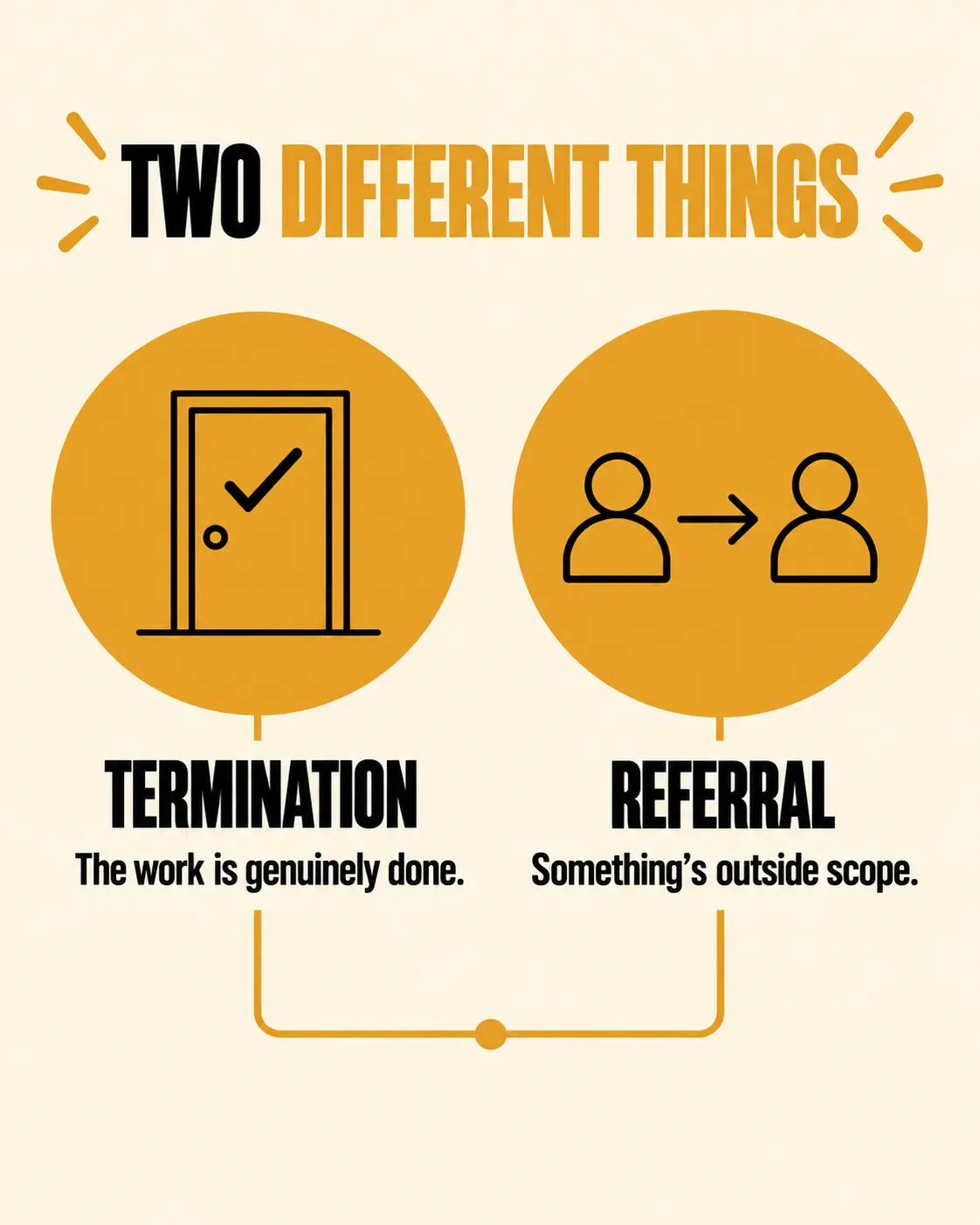
- Termination (closure)The planned, deliberate ending of a coaching relationship because the work is genuinely done — the client has met their goals or can now sustain progress without ongoing coaching support. Handled through a dedicated closing conversation, not an assumption that sessions have simply tapered off.
- ReferralDirecting a client to another professional because something has come up that falls outside a coach's scope of practice — not because the coaching relationship itself is finished. Referral ethics and scope-of-practice boundaries get their own full treatment later in this course's Domain 4.
A well-handled closure has a shape to it: a dedicated conversation, not squeezed into the last five minutes of an unrelated session, where the coach and client review how far things have come, name specifically what the client can now do without outside support, and put something concrete in place for sustaining it — not just a vague "keep it up." Leaving the door open for a future check-in or a fresh coaching agreement down the line, rather than framing the ending as permanent, tends to make the whole conversation feel like an accomplishment rather than a loss.
A client's sessions have been going well for months, and lately they've started rescheduling more, then cancelling, then going quiet. Coach A lets it fade — no follow-up, no closing conversation, just an assumption that the client moved on. Coach B reaches out to check in, and when it's clear the client has genuinely been managing well independently, holds one dedicated closing session: naming the specific progress made, confirming the client has a plan for sustaining it, and letting them know the door's open if they want to restart coaching later. Both relationships technically "ended." Only one of them ended in a way the client is likely to remember well, or return to.
The Arc of a Coaching Relationship, Start to Finish
Put together, Lessons 1 through 4 now cover a complete arc: presence and self-regulation as the coach's own foundation, the growth-enhancing relationship as the stance that makes coaching different from advice-giving, the foundational work of a first session, the sustained rhythm of ongoing sessions, and a deliberate, well-handled ending. None of these pieces work especially well in isolation — presence without a growth-enhancing relationship is just attentiveness, a strong first session without consistent follow-up loses its momentum, and even excellent ongoing sessions can undercut themselves with a closing that just fizzles out instead of consolidating what was built.
That completes Domain 1 of NBHWC's content outline, which carries the single largest share of the real exam. From here, the course moves into Domain 2: the theories and models — neuroplasticity, the stages of change, motivational interviewing, and more — that explain why the relationship skills covered so far actually work to support lasting behavior change. Domain 1 was about how a coach shows up and structures the relationship; Domain 2 is about the psychology underneath it.
8 questions on follow-up session habits, recognizing when a coaching relationship is ready to end, and what closing a coaching agreement well involves. NBHWC doesn't publish a fixed pass/fail line for its own exam, so this knowledge check doesn't invent one either — you'll get a raw score and a rationale for every question instead.
- Follow-up sessions skip the one-time foundational work of session one, but they carry their own risk: becoming routine enough that the coach stops tracking what's specifically true for this client, this week.
- Opening a follow-up session by referencing something concrete from last time — rather than a generic check-in — signals continuity and gives the client something real to respond to.
- A coaching relationship being ready to end looks different from a plateau: readiness means the client can now do independently what the coach was providing; a plateau means the client still needs support, just not visible progress right now.
- Termination (closure) happens when the coaching work is genuinely done; a referral happens when something falls outside a coach's scope of practice — they call for different responses, and referral gets full treatment in Domain 4.
- Ending well is a deliberate, dedicated conversation — reviewing progress, naming what the client can now sustain alone, and leaving the door open — not letting a relationship quietly fade out.
Before moving to Lesson 5:
- Think of an ongoing relationship in your own life — professional or personal — where check-ins have started to feel routine. What would it look like to open the next one by referencing something specific instead of a generic "how's it going?"
- Draft, in your own words, three or four signs that would tell you a coaching relationship is genuinely ready to end, as opposed to just stalled.
- Think through what a well-handled closing conversation would include if you were ending a coaching relationship with a client who'd met their goals. What would you want to make sure got said?
- Complete the knowledge check above and review the rationale for any question you missed.