Lesson 9 covered protecting a client's autonomy and helping them build awareness of their own material. This lesson turns to two more of Domain 3's skills: building a client's self-efficacy directly, using specific in-session techniques, and knowing when to expand a coaching conversation into new territory versus narrow it toward a decision. The self-efficacy techniques here are the practical counterpart to the theory Lesson 7 introduced — Bandura's four sources of self-efficacy show up almost one-for-one in NBHWC's named coaching moves.
Lesson 7 introduced self-efficacy as a theoretical framework: Bandura's four sources — mastery experiences, vicarious experiences, social persuasion, and physiological and emotional states — describe why a client's confidence rises or falls. This lesson is where that theory becomes a set of specific things a coach actually does in a session. NBHWC's outline names each source as a coaching skill, then adds two more: a structural sense for when to expand a conversation into new territory and when to narrow it toward a concrete next step.
The Techniques NBHWC Names for Building a Client's Self-Efficacy
NBHWC's outline lists seven specific things a coach does to build a client's self-efficacy. Grouped together, they map onto four moves: drawing on role models and offering genuine affirmation, inviting the client to name their own strengths, building confidence through achievable steps and reflection, and recognizing the client's identity while inviting them to problem-solve for themselves.
- Role models & affirmationIdentify positive role models for vicarious learning, and offer specific affirmations of the client's effort, qualities, and skills.
- Client-named strengthsInvite the client to articulate their own strengths and abilities, and plan how to leverage them.
- Achievable steps & reflectionBuild confidence through realistic, achievable steps, then reflection, self-assessment, and naming what was learned.
- Identity & problem-solvingRecognize the client's identity and lived experience, and invite them to problem-solve and evaluate their own options.
The first two techniques map most directly onto two of Bandura's four sources of self-efficacy from Lesson 7.
Role Models, Vicarious Learning, and Genuine Affirmation
NBHWC's outline asks a coach to help a client identify positive role models for behavior change — this is vicarious learning, one of Bandura's four sources, in direct application. Watching someone relatable succeed at something similar can raise a client's own belief that they're capable of it too, but only if the model actually feels relatable. A generic celebrity story or a person whose circumstances look nothing like the client's own does far less work than a coworker, neighbor, or family member the client already knows.

The outline pairs this with offering affirmations to support a client's positive efforts, qualities, and skills — Bandura's social-persuasion source. The word "genuine" is doing real work here. "Great job" is generic praise; it doesn't point to anything real, so it doesn't give the client any actual evidence about themselves. A genuine affirmation names something specific and true: not "great job," but "you noticed you were about to skip it and went anyway — that's the exact skill this whole plan depends on."
A client mentions, almost in passing, that a coworker lost weight by walking during lunch breaks. Rather than letting the comment pass, the coach follows it: "What was it about how they did it that seems doable for you?" The client answers that it fit into a break they already took anyway, no gym membership or early alarm required. The client now has a concrete, relatable model instead of a vague resolution to "exercise more" — and the coach did nothing but ask a follow-up question.
Achievable Steps, Reflection, and a Client's Own Identity
NBHWC's outline also asks a coach to invite a client to articulate their own strengths and abilities and plan how to leverage them — echoing the pattern from Lesson 9: the strengths have to come from the client, not a list the coach hands over, or they won't actually feel like the client's own resources to draw on.
The next technique is mastery experience, Bandura's strongest source of self-efficacy: support the client to build confidence through taking achievable and realistic steps. A step sized to what the client can actually complete becomes real evidence of capability. A step sized to what would look impressive risks the opposite outcome — a failed attempt that confirms the exact self-doubt the coach is trying to counter.
| A Step That Builds Confidence | A Step That Risks Confirming Self-Doubt |
|---|---|
| A client who hasn't exercised in years commits to a 10-minute walk, three days this week. | The same client commits to a 5 AM gym session, five days a week, starting Monday. |
| A client rebuilding a savings habit sets aside $500 this month, an amount they've hit before. | The same client tries to save $3,000 this month to "catch up all at once." |
| A client new to meal prep commits to prepping lunches for two days next week. | The same client commits to prepping every meal for the entire week, starting immediately. |
NBHWC's outline closes this list with three more moves: support the client to build confidence through reflection, self-assessment, and naming of learnings after an attempt — whether it succeeded or not; recognize and highlight the client's identity and lived experience as integral to their own decision-making, not a detail to work around; and invite the client to problem-solve and evaluate their own options, weighing both short- and long-term benefits, rather than the coach weighing them on the client's behalf.
Expanding the Conversation: Open Questions, Metaphors, and New Possibilities
Alongside self-efficacy, NBHWC's outline names a separate skill: knowing how to expand a conversation into new territory when it's useful to do so. The outline lists six specific moves — using open-ended and appreciative questions, using evocative (powerful) questions that draw out deeper reflection, using metaphors drawn from the client's own language and interests, connecting the current focus to multiple dimensions of the client's life, exploring broader perspectives to inspire interest in new possibilities, and recalling previous information and experiences the client has shared.
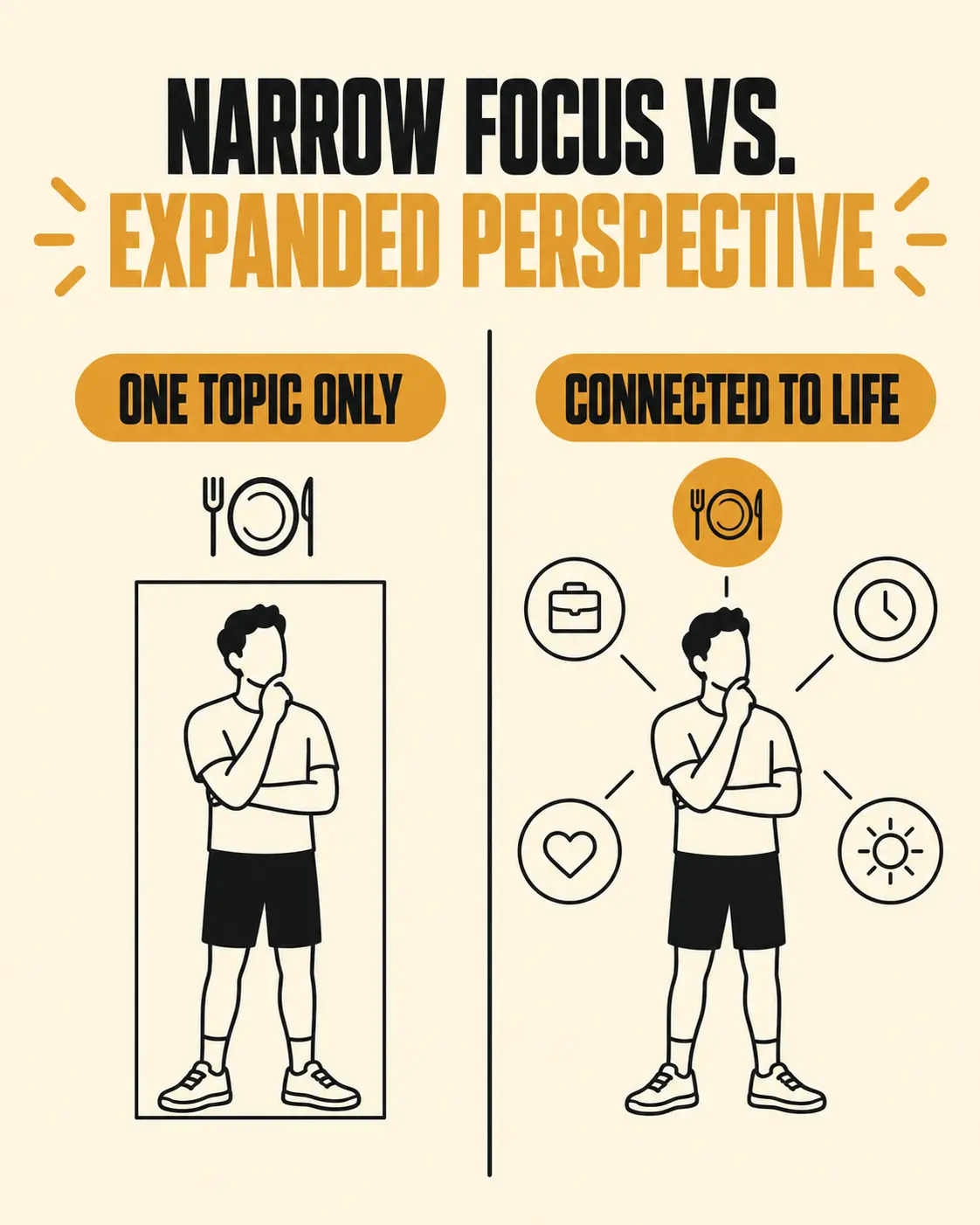
Expanding is useful when a client's stated goal is narrower than the picture actually needed to support it. A client who says "I just want to sleep better" might be missing that their evening screen use, work stress, and relationship with their partner all connect to the same problem — and a coach who only ever stays inside the original sentence never finds that out.
A client opens a session focused narrowly on "eating better." Instead of moving straight into meal planning, the coach asks an evocative question: "What does a day where eating feels easy actually look like for you?" The client's answer pulls in their work schedule, how rushed their mornings are, and how much better weekends feel. The conversation has expanded from a single behavior into the life context around it — without the coach ever steering it there directly.
Narrowing the Conversation: Interrupting, Bottom-Lining, and Summarizing
The opposite skill matters just as much. NBHWC's outline names three moves for narrowing a conversation: skillfully interrupting and redirecting, using bottom-lining, and asking the client to summarize. Each one exists because a conversation that only ever expands never turns into a decision — at some point, the session's limited time has to convert into a next step.
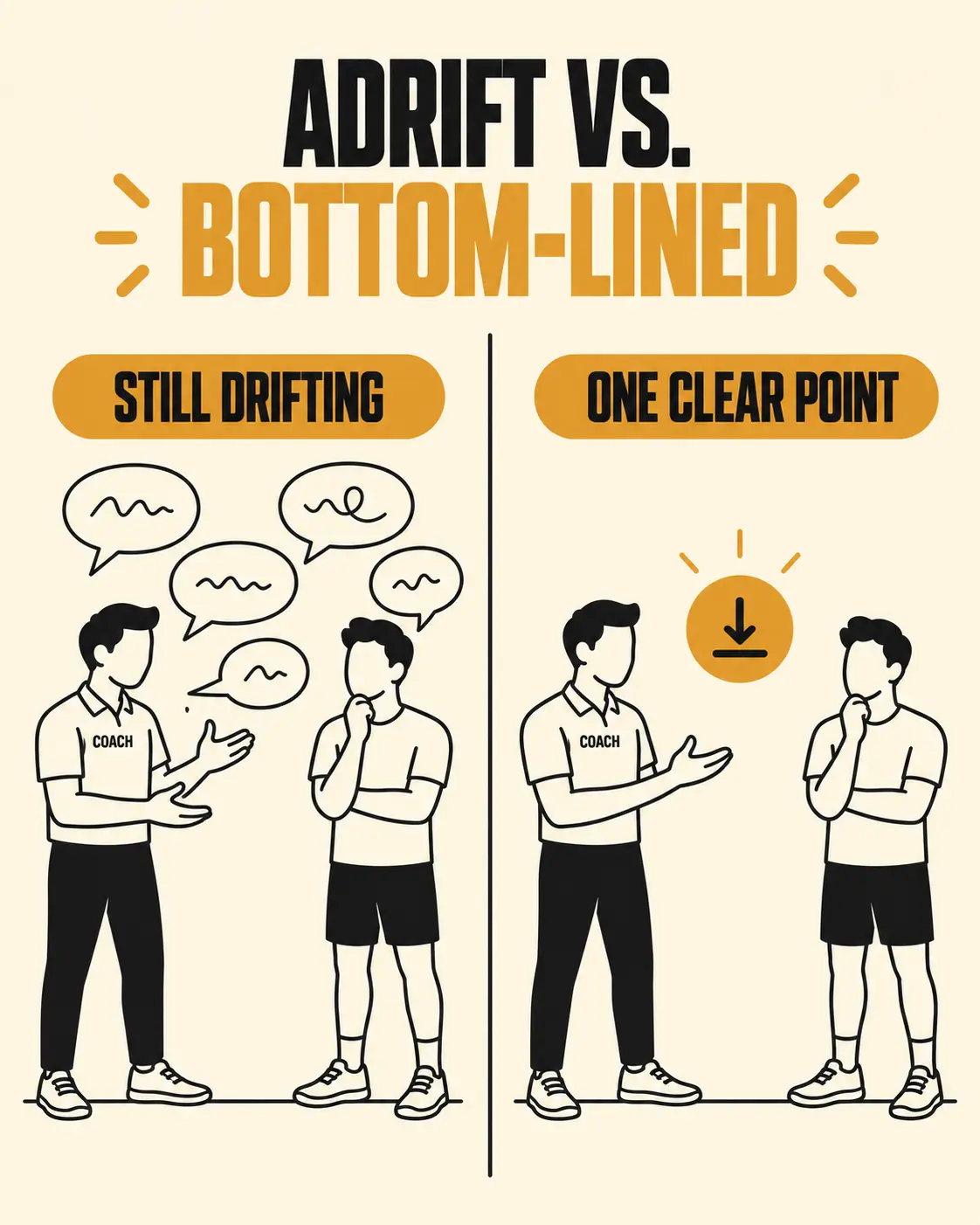
Skillfully interrupting isn't the same as cutting someone off — it's a redirect, done respectfully, when a conversation has wandered past what's useful for the time remaining. Bottom-lining means distilling everything that's been said down to its essential point, out loud, so both people are working from the same summary. Asking the client to summarize does the same work but keeps the client as the one doing the distilling — which, in keeping with the theme running through this whole domain, tends to make the resulting decision stick better than one the coach summarized for them.
Knowing When to Expand vs. When to Narrow
Expanding and narrowing aren't opposing skills so much as two settings on the same dial. A session that only expands can feel rich and insightful but end with nothing decided. A session that only narrows can feel efficient but miss the fuller picture a client's situation actually needs. NBHWC's outline doesn't tell a coach which to use when — that judgment call is part of the skill itself, shaped by how much of the session's time is left and whether the client already has enough material to act on.
A practical rule of thumb: expand early in a conversation, when there's still time to explore what matters and why; narrow later, when the session needs to land on something concrete before time runs out. The self-efficacy techniques earlier in this lesson and this expand-narrow judgment call work together — a client walks out with both a stronger belief in their own capability and a clear next step, rather than just one or the other.
Domain 3 continues in Lesson 11, which turns to a client's support systems, defining and acting on real goals, and managing the time it takes to get there.
8 questions on building self-efficacy through role models, affirmation, achievable steps, and reflection, plus expanding and narrowing a coaching conversation. NBHWC doesn't publish a fixed pass/fail line for its own exam, so this knowledge check doesn't invent one either — you'll get a raw score and a rationale for every question instead.
- NBHWC's self-efficacy techniques map almost one-for-one onto Bandura's four sources from Lesson 7 — vicarious learning, social persuasion, mastery experience, and reflection.
- A relatable role model does far more for a client's confidence than a generic success story or celebrity example.
- A genuine affirmation names a specific effort, quality, or skill the client actually demonstrated — generic praise doesn't build real evidence of capability.
- An achievable, realistic step builds confidence; an overly ambitious one risks confirming the client's self-doubt instead.
- Expanding a conversation uses open and evocative questions, metaphors, and broader life connections to explore new territory.
- Narrowing uses skillful interruption, bottom-lining, and client-led summarizing to turn a conversation into a concrete next step.
Before moving to Lesson 11:
- Next time you want to praise someone's progress, replace "great job" with a specific sentence naming exactly what they did.
- Notice one goal this week that's sized too big to realistically complete, and shrink it down to something you could actually finish.
- In your next conversation about a decision, try bottom-lining it out loud — or better, ask the other person to summarize it themselves.
- Complete the knowledge check above and review the rationale for any question you missed.