Lesson 8 covered the moment-to-moment mechanics of a session — OARS and NBHWC's named facilitation tools. This lesson turns to two of Domain 3's people-centered sub-competencies: client autonomy and intrinsic motivation, and client awareness and perspective shifts. Both rest on the same principle running through this whole course since Lesson 2: the client's own perspective, values, and insight drive change — the coach's job is to elicit and amplify them, not supply them.
So far, this course has built the coach's toolkit: how to listen, reflect, ask, and structure what gets said inside a session. This lesson turns the lens toward the client's own material — what they believe about themselves, what they value, and what they're capable of noticing about their own patterns. NBHWC names this territory explicitly across two sub-competencies: protecting a client's autonomy and intrinsic motivation, and helping them build awareness and shift perspective.
Why Client Autonomy Is Non-Negotiable
NBHWC's outline names a specific list of things a coach should elicit from a client, rather than supply: their own reasons for change, their own solutions and ideas, the experiments they want to try, their desired outcomes, the rewards or incentives that matter to them, and their cultural identity and lived experience. Every item on that list starts with the client, not the coach — a direct extension of the partnership model this course introduced back in Lesson 2, where a coach acts as a growth-enhancing partner rather than an expert handing down instructions.
This isn't a soft preference — it's the mechanism behind intrinsic motivation. A goal a client generates themselves, for their own reasons, survives a bad week in a way that a goal handed to them by a coach usually doesn't. When a coach catches themselves supplying the reason, the solution, or the plan, the fix is almost always the same: turn the statement back into a question.
- Reasons for changeWhy this matters to the client, in their own words — not the coach's.
- Solutions and ideasWhat the client thinks might actually work, including experiments they want to try.
- Desired outcomes and incentivesWhat the client is actually working toward, and what would make the effort worth it to them.
- Cultural identity and lived experienceThe context a client's own history and background bring to the goal, which a generic plan can't account for.
The same principle extends to how a client pictures success in the first place.
Eliciting Values, Meaning, and a Client's Own Vision of Wellbeing
Before a coach and client can work toward optimal health, the client has to define what that phrase means for them. NBHWC's outline asks a coach to help a client explore and articulate their own values and sense of meaning and purpose, and to help them envision their own optimal health and wellbeing — not the coach's definition of it, and not a generic wellness-industry checklist.
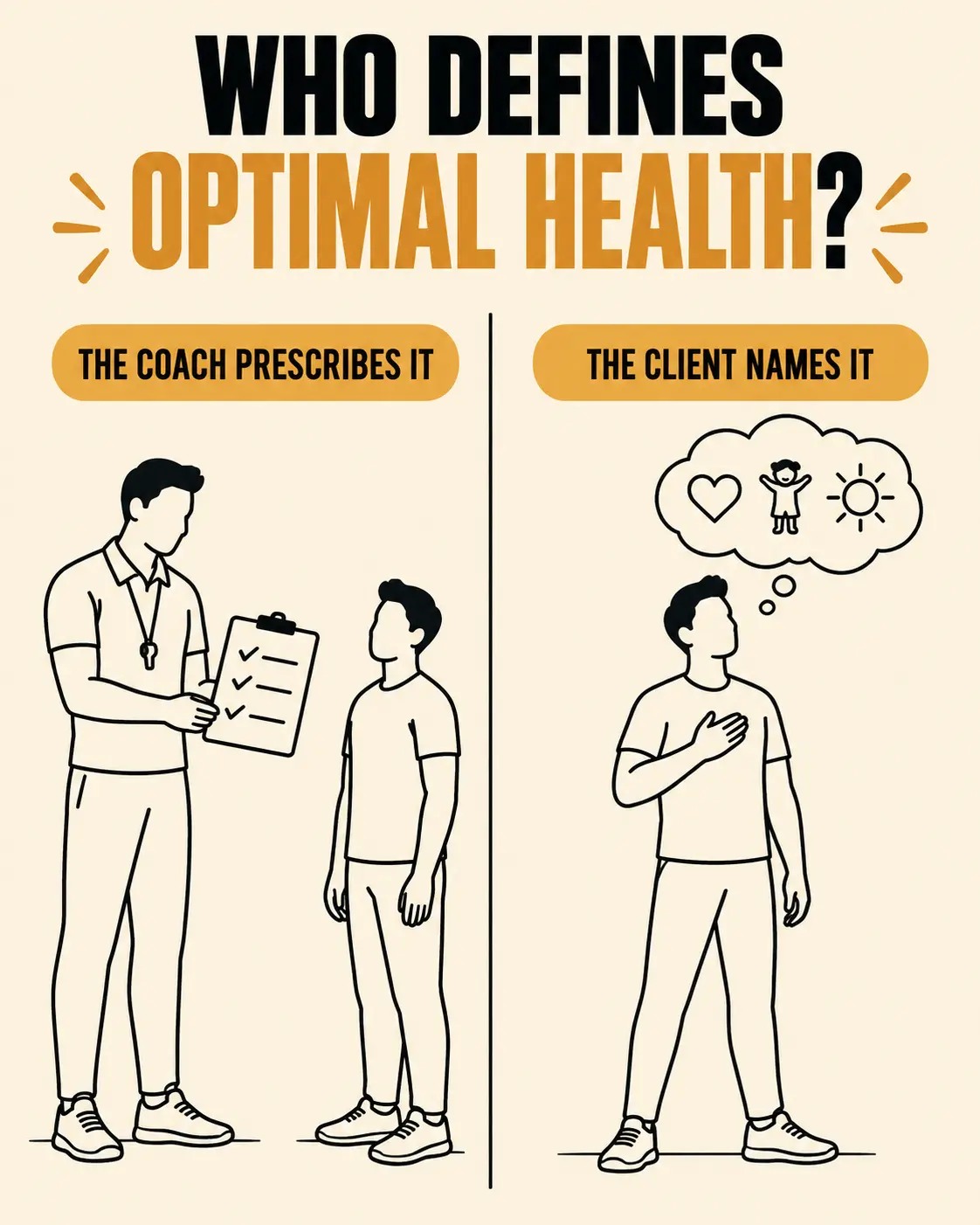
A coach's instinct, especially early on, is to describe what a good outcome looks like — more energy, better labs, a certain number on a scale. NBHWC's outline pushes the other direction: ask the client to describe it themselves, in their own words, tied to what they actually value. Two clients with an identical health metric can have completely different visions of what "well" means to them — one wants the stamina to play with their grandkids, another wants the mental clarity to finish a degree — and the plan that follows should be built around the vision the client names, not the one a coach assumes.
A coach asks a new client what "being healthy" would look like for them. The client hesitates and says, "I don't know, I guess... not being tired all the time?" Rather than filling in the rest of the picture — better sleep, more exercise, a cleaner diet — the coach reflects it back and asks, "What would you be doing, if you weren't tired all the time?" The client answers: "Actually getting on the floor and playing with my kid after work, instead of just watching him play." That answer, not "more energy," is the vision the rest of the plan gets built around.
Honoring How a Client Wants to Track and Stay Accountable
NBHWC's outline names one more piece of client autonomy directly: a coach should discuss and honor, without judgment, a client's preferences for self-monitoring, accountability, and mode of connecting between sessions — whether that's email, text, a phone call, or meeting in person. The phrase "without judgment" is doing real work here; a coach who privately thinks a client's preferred method is unsophisticated (a paper notebook instead of an app, a phone call instead of a text) still honors it, because the method that actually gets used beats the method that looks the most rigorous on paper.
This applies to more than logging food or workouts. It covers how the client wants to be reached between sessions at all — some clients want a quick check-in text; others find that intrusive and prefer everything to wait for the next scheduled call. Asking directly, early, prevents a coach from defaulting to whatever mode is easiest for them rather than what actually works for the client.
A coach's instinct is to recommend a habit-tracking app with charts and streaks. The client says they've tried apps before and stop opening them within a week — but they do keep a sticky note on the fridge for grocery lists, and it always gets used. The coach doesn't push the app; the plan uses a sticky note on the fridge instead, because that's the method this particular client will actually keep up.
Noticing Self-Talk and Limiting Beliefs
The second sub-competency, client awareness and perspective shifts, starts with something quieter: the running commentary a client has about themselves, and the patterns behind their own decisions. NBHWC's outline asks a coach to elicit a client's awareness of their own self-talk, acknowledge self-defeating thoughts and limiting beliefs when they surface, and explore the pattern behind a client's behaviors and decisions — the triggers, thoughts, emotions, physical sensations, environment, and culture involved.
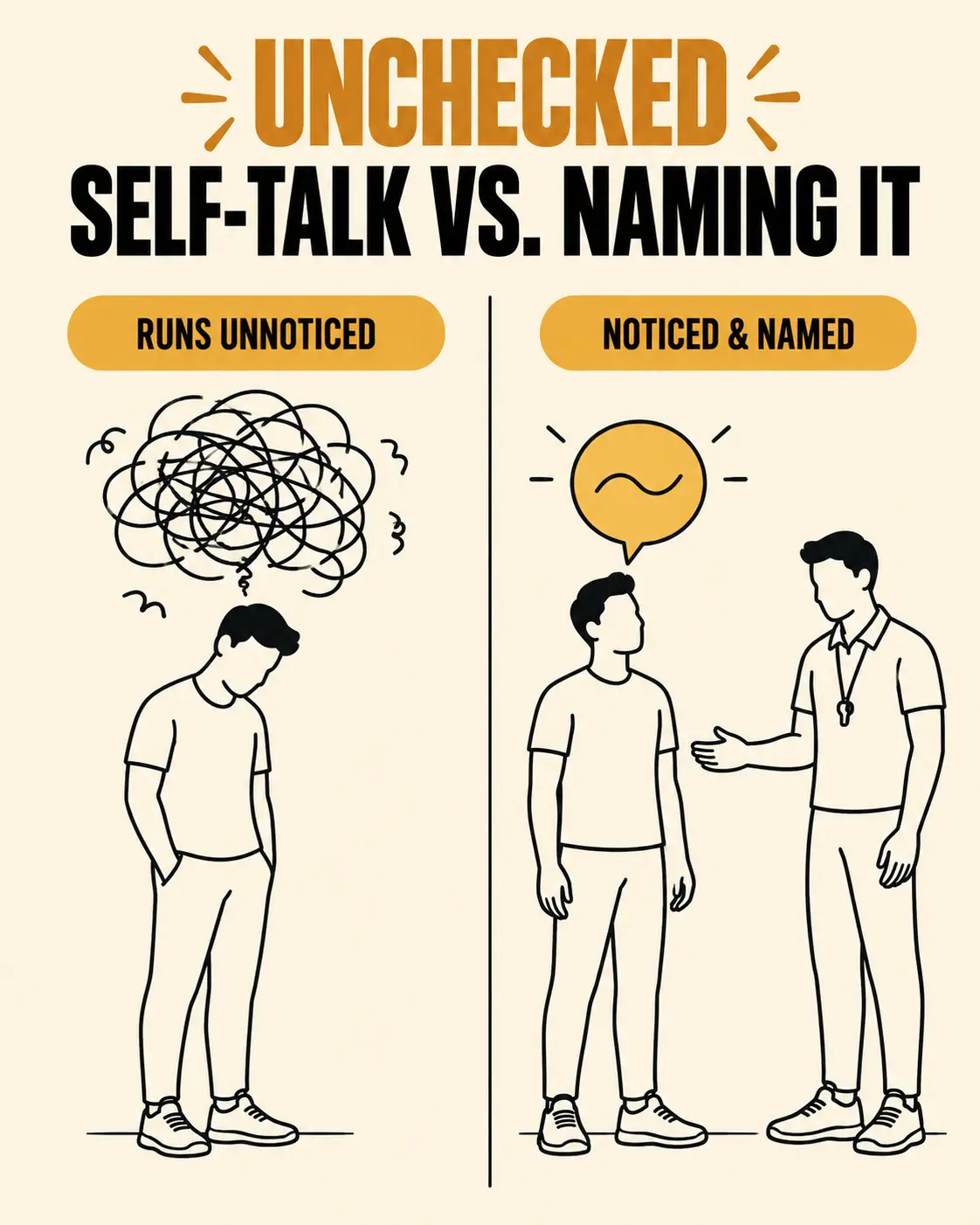
The goal isn't to argue a limiting belief out of existence — that's the same trap as arguing against resistance, covered in Lesson 8. A client who says "I've never been an athletic person" isn't persuaded by a coach listing counterexamples. The move is to help the client notice the belief is there and where it came from, using the same reflective tools from Lesson 8 rather than a new one — the content here is different, but the mechanism is the same skill already covered.
Reframing, Amplifying Insight, and Naming Emotions
Once a pattern or belief is named, NBHWC's outline asks a coach to invite and support the client in reframing it and shifting perspective, to invite and amplify insights the client generates on their own, and to support the client in recognizing, naming, and describing their own emotions. Each of these three moves keeps the client as the author — the coach invites and amplifies, but doesn't supply the reframe or the insight itself.
| A Limiting Belief | A Client-Generated Reframe |
|---|---|
| "I've never been an athletic person." | "I've never had a routine that fit my actual schedule — that's different from not being athletic." |
| "I always quit after a few weeks." | "Every time I quit, work got busier — the plan didn't account for that, not me." |
| "I don't have the willpower for this." | "I have the willpower for things that matter to me — this goal hasn't felt like mine yet." |
Notice that in each right-hand example, the reframe is something the client would need to arrive at themselves for it to actually stick — a coach handing over the right-hand column as a script defeats the purpose. The coach's job is to ask the question that makes the client's own reframe more likely, then amplify it once it shows up: "Say that again — that's a different way of putting it than a minute ago."
Building Self-Compassion, Positive Emotion, and Resilience
The last piece of client awareness looks forward rather than backward. NBHWC's outline asks a coach to encourage a client's self-compassion and self-acceptance, to deliberately draw out positive emotions — joy, contentment, serenity, peace, and gratitude are named specifically — and to nurture optimism, persistence, and resilience. None of this is incidental positivity; it's named, testable content, on the theory that a client who can be self-compassionate after a setback and can access positive emotion is more likely to keep going than one running purely on self-criticism and problem-focus.

Client autonomy and client awareness are really one idea approached from two directions: the client's own perspective — their reasons, values, insights, and even their own self-talk — is the material the whole coaching relationship works with. A coach who elicits, honors, and amplifies that material is doing the job; a coach who supplies it instead, however well-intentioned, is doing something else.
Domain 3 continues in Lesson 10, which turns to building a client's self-efficacy directly, plus two related conversational skills: knowing when to expand a conversation and when to narrow it toward action.
8 questions on eliciting a client's own perspective, honoring tracking and accountability preferences, noticing self-talk and limiting beliefs, reframing, amplifying insight, and building self-compassion and resilience. NBHWC doesn't publish a fixed pass/fail line for its own exam, so this knowledge check doesn't invent one either — you'll get a raw score and a rationale for every question instead.
- NBHWC's outline asks a coach to elicit a client's own reasons for change, solutions, and desired outcomes — not supply them.
- A client's vision of "optimal health" has to come from their own values and sense of meaning, not the coach's definition or a generic checklist.
- Tracking and accountability methods only work when they match what the client will actually use — and the coach honors that preference without judgment.
- Noticing self-talk and limiting beliefs uses the same reflective tools as working with resistance: name it, don't argue it away.
- Reframing and insight stick best when the client generates them — the coach's job is to invite and amplify, not supply the reframe.
- Self-compassion, positive emotion, and resilience are named, deliberate targets in NBHWC's outline, not incidental positivity.
Before moving to Lesson 10:
- Next time you're about to suggest a solution, try turning it into a question that lets the other person generate their own instead.
- Notice one piece of self-talk this week and just name it to yourself, without arguing it away.
- Ask someone (or yourself) what tracking method they'd actually stick with, before suggesting the one that looks the most rigorous.
- Complete the knowledge check above and review the rationale for any question you missed.