This lesson opens Domain 5: Health and Wellness with its first sub-competency — the foundational models the rest of the domain builds on. NBHWC's outline distinguishes health, wellness, and wellbeing; introduces the illness-wellness continuum; frames coaching around a whole-person model; and names eight specific dimensions of wellness, plus their interconnectedness. That's eight, not nine — a popular nine-dimension version exists, but it isn't the one NBHWC's outline tests.
Lesson 13 closed out Domain 4 with all four of its sub-competencies. This lesson opens Domain 5, worth 20% of the exam — the third-largest domain after Coaching Presence, Relationships, and Sessions, and Skills, Tools, and Strategies. Where Domain 4 was about a coach's own conduct, Domain 5 is about the subject matter of coaching itself: what "health," "wellness," and "wellbeing" actually mean, and the models NBHWC expects a coach to understand before applying them with clients in Lessons 15 and 16.
Health, Wellness, and Wellbeing
NBHWC's outline opens Domain 5 by asking a coach to describe health, wellness, and wellbeing — three words that get used interchangeably in everyday speech but mean distinct things here.
- HealthOften used narrowly, for the presence or absence of diagnosable disease — the domain of medical treatment.
- WellnessAn active, ongoing pursuit of a fuller life — not just the absence of illness, but a direction someone can move toward regardless of diagnosis.
- WellbeingThe broader lived experience of how a person is actually doing across their life — what whole-person health and the dimensions of wellness both feed into.
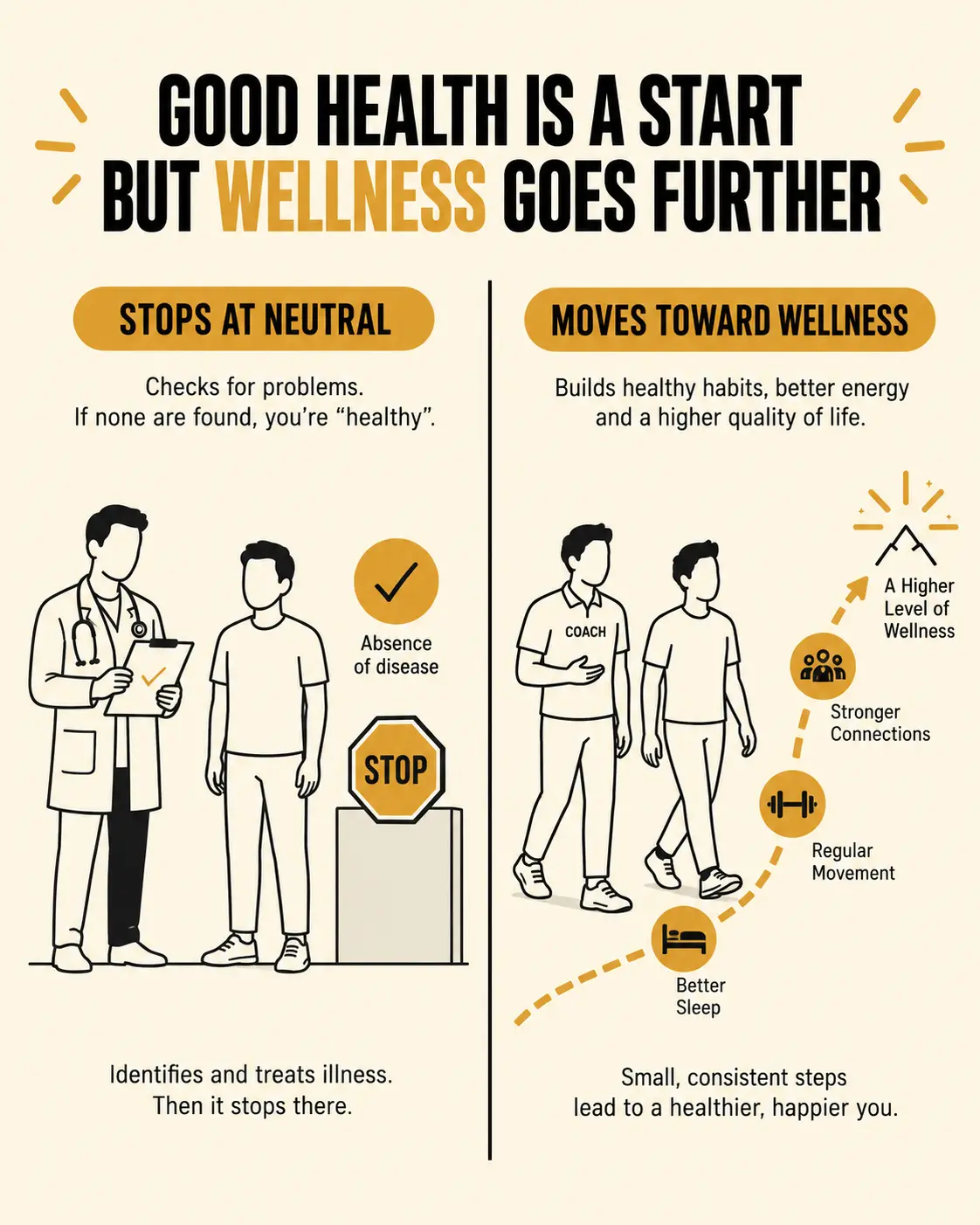
NBHWC's outline pairs this with two specific models: high-level wellness, the idea that wellness isn't a finish line but a continual process of moving toward someone's fuller potential, and the illness-wellness continuum — a way of picturing health as two independent directions of movement rather than one line from "sick" to "healthy."
Picture two axes meeting at a shared neutral point. One axis runs from premature death, through worsening symptoms, up to that neutral point — simply the absence of diagnosable disease. That's the axis medical treatment addresses. The other axis runs from the same neutral point onward toward high-level wellness, addressed through education, awareness, and daily behavior change. A person can sit anywhere on the illness axis — including living with a diagnosed chronic condition — and still move forward on the wellness axis. Coaching works on that second axis.
| Illness Axis | Wellness Axis |
|---|---|
| Runs from premature death toward the absence of diagnosable disease. | Runs from that same neutral point toward high-level wellness. |
| Addressed by treatment — diagnosis, medication, medical intervention. | Addressed by growth — education, awareness, and daily behavior change, where coaching operates. |
| A client's position here doesn't determine their position on the other axis. | A client can pursue this axis actively, even while managing a chronic diagnosis. |
NBHWC's Whole-Person Model
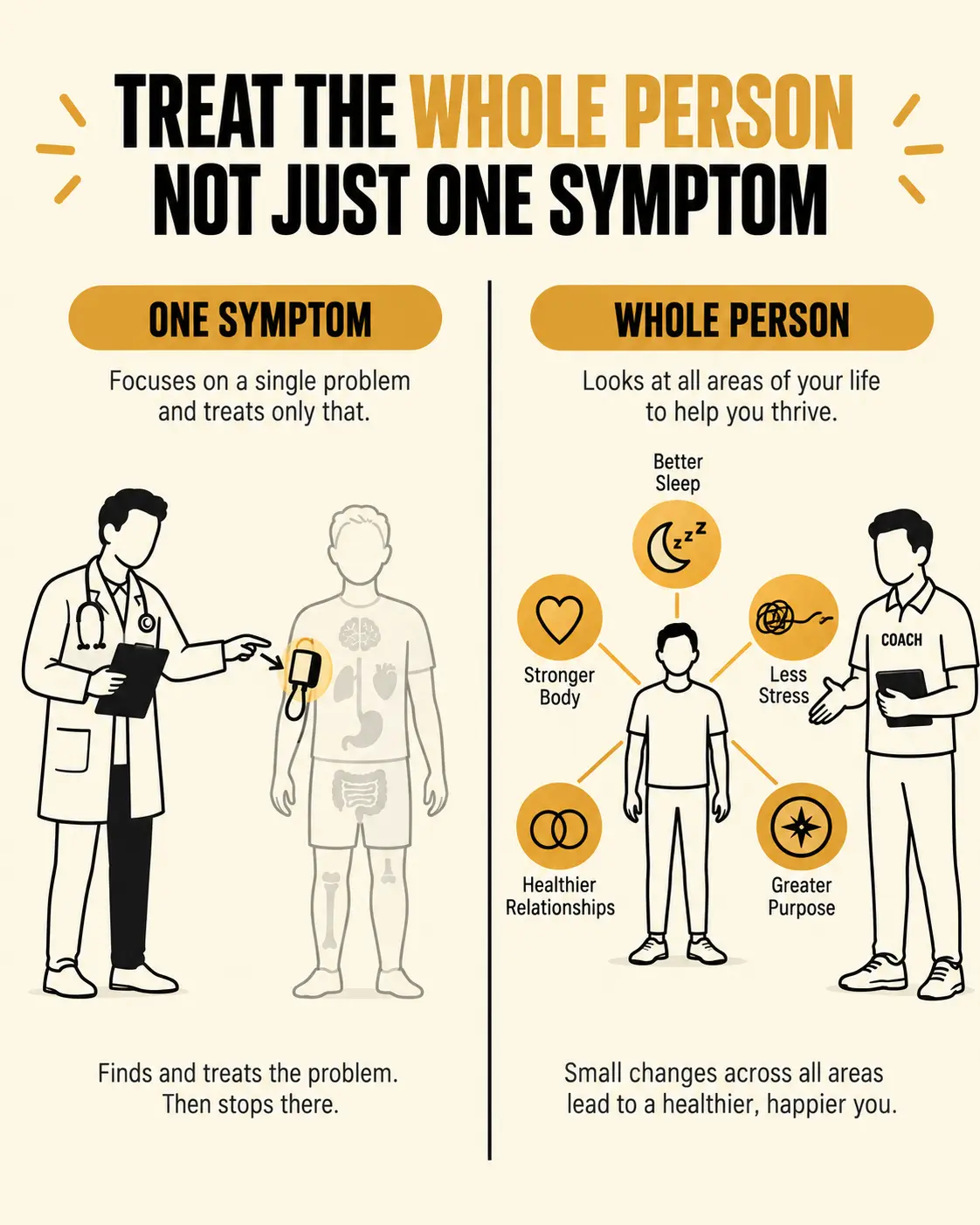
NBHWC frames health and wellness coaching as rooted in a whole-person model: a client's physical, psychological, emotional, social, and spiritual aspects, considered together, rather than a single presenting symptom treated in isolation.
That contrast is the point. A purely biomedical approach can address a client's elevated blood pressure and stop there. A whole-person approach asks what's happening across every aspect of that same client's life — sleep, stress, relationships, sense of purpose — because those aspects don't operate independently of the number on the blood-pressure cuff. This five-part framing (physical, psychological, emotional, social, spiritual) is Domain 5's opening lens; the fuller eight-item list of wellness dimensions below builds on it in more specific, practical terms.
The Eight Dimensions of Wellness
NBHWC's outline names eight specific dimensions of wellness, and asks a coach to describe not just each one, but how they're interconnected.
- PhysicalCaring for the body through exercise, nutrition, sleep, and regular medical care.
- EmotionalAwareness of feelings, healthy ways of expressing them, and coping with stress.
- IntellectualLifelong learning, curiosity, and critical thinking.
- SocialMeaningful relationships and a sense of belonging or community.
- OccupationalSatisfaction and personal enrichment from work aligned with one's values and skills.
- FinancialManaging resources in a way that supports security and reduces stress.
- SpiritualA sense of meaning, purpose, and connection to something greater than oneself.
- EnvironmentalLiving safely and sustainably within one's surroundings.
The interconnectedness matters as much as the list itself. These aren't eight separate boxes a client checks off one at a time — a change in one dimension routinely shows up in another.
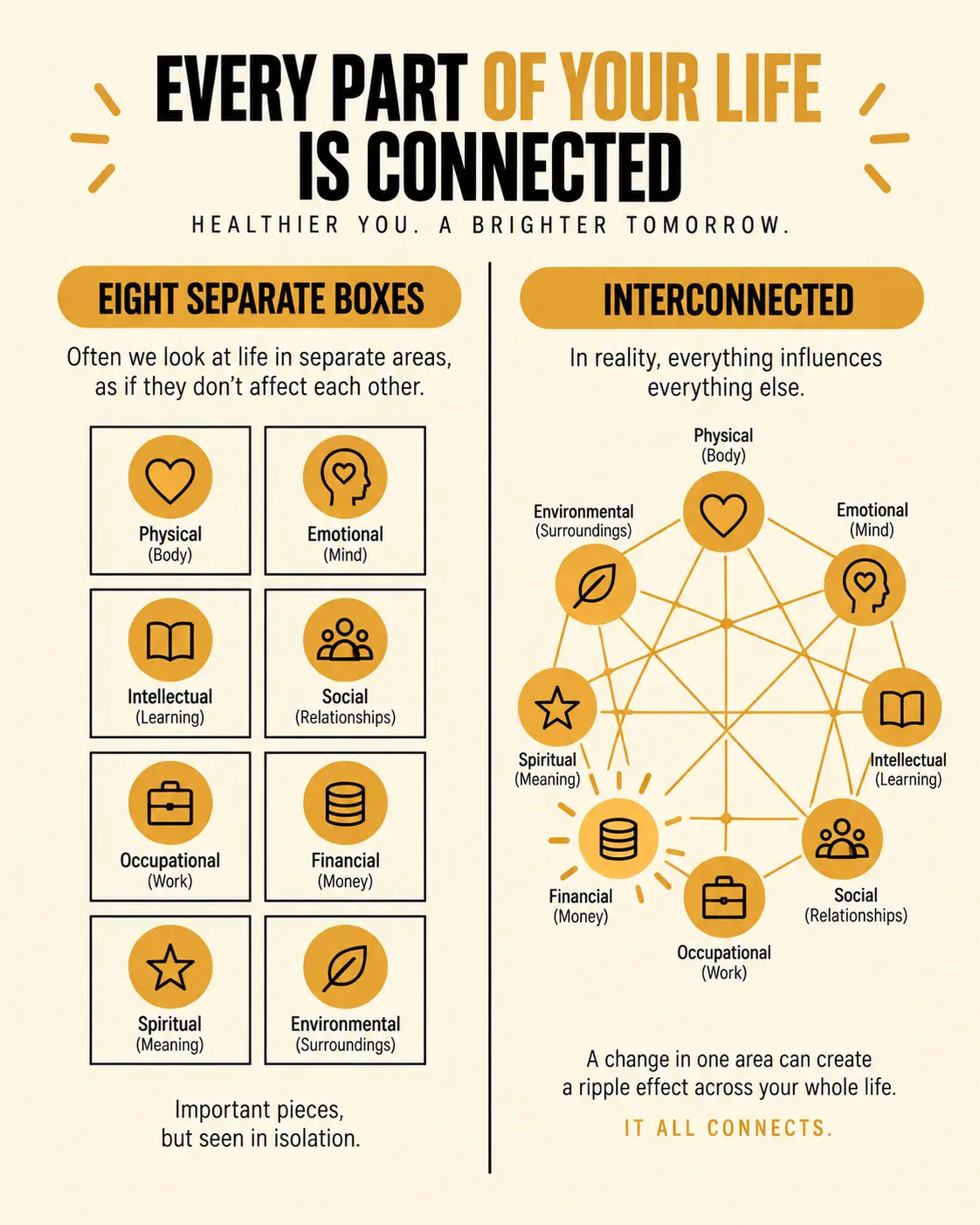
A client mentions, almost in passing, that money's been tight this month — a financial-dimension stressor. Over the next few sessions, the coach notices the client also reports worse sleep and a shorter fuse with their partner. Rather than treating the financial comment, the sleep complaint, and the relationship friction as three unrelated topics, the coach recognizes them as one dimension's strain showing up across the physical, emotional, and social dimensions too — and asks about the financial stress directly, instead of only coaching around the sleep habit in isolation.
A Common Variation: The "Nine Dimensions" Model
If you've studied wellness through a college wellness center, a corporate wellbeing program, or certain coaching resources, you may have seen a nine-dimension version of this same list — typically the eight above, plus a ninth, most often labeled Cultural (understanding and engaging respectfully with one's own and other cultural identities).
That nine-dimension model is a widely used and legitimate extension — but it isn't NBHWC's own list. NBHWC's content outline names eight dimensions specifically. If a training program or study resource presents nine, treat the extra dimension as useful context, not as something the exam itself is built around.
What Comes Next in Domain 5
This lesson covered Domain 5's foundational models: health, wellness, and wellbeing; the illness-wellness continuum; the whole-person model; and the eight dimensions of wellness and their interconnectedness. Lesson 15 builds on this foundation with a more applied focus — where coaching fits alongside medical care in supporting chronic disease prevention and self-management, and staying inside a coach's real scope while doing it.
8 questions on health, wellness, and wellbeing, the illness-wellness continuum, NBHWC's whole-person model, and the eight dimensions of wellness. NBHWC doesn't publish a fixed pass/fail line for its own exam, so this knowledge check doesn't invent one either — you'll get a raw score and a rationale for every question instead.
- Health, wellness, and wellbeing are related but distinct: health is often about the absence of disease, wellness is an active pursuit of a fuller life, and wellbeing is the broader lived experience of both.
- The illness-wellness continuum treats illness and wellness as two independent axes — a client can move toward high-level wellness regardless of where they sit on the illness axis.
- NBHWC frames coaching around a whole-person model: physical, psychological, emotional, social, and spiritual aspects considered together, not a single symptom in isolation.
- NBHWC's outline names eight dimensions of wellness — physical, emotional, intellectual, social, occupational, financial, spiritual, and environmental — plus their interconnectedness.
- A popular "nine dimensions" model (adding "cultural") exists, but NBHWC's own outline tests eight, not nine.
- This lesson opens Domain 5. Lesson 15 continues with chronic disease prevention and self-management.
Before moving to Lesson 15:
- Practice explaining the illness-wellness continuum in your own words — specifically why a chronic diagnosis doesn't block progress on the wellness axis.
- Memorize the eight dimensions of wellness in NBHWC's own list, and notice if any study resource you're using presents a ninth.
- Think of a real or hypothetical client scenario where a stressor in one dimension shows up in another, and practice naming the connection out loud.
- Complete the knowledge check above and review the rationale for any question you missed.