Nutrition doesn't happen to a person in the abstract — it happens to roughly 37 trillion individual cells, one membrane crossing at a time. Every chapter after this one is, underneath the surface, describing some part of that same story: how nutrients get to cells, what cells do with them, and how the body's systems coordinate to keep conditions inside those cells stable. Understanding this chapter's basics is what makes the rest of Unit 2 click into place instead of feeling like disconnected trivia.
Chapter 6 previewed the eight chapters ahead and made the case that this science is worth learning properly. This chapter is where that promise starts to pay off — not with abstract biology for its own sake, but with the specific cell and systems concepts that explain things clients ask about constantly: why hunger shows up on a schedule, why energy dips predictably, and why "just eat less" doesn't feel as simple in practice as it sounds on paper.
Why Cells Are Where Nutrition Actually Happens
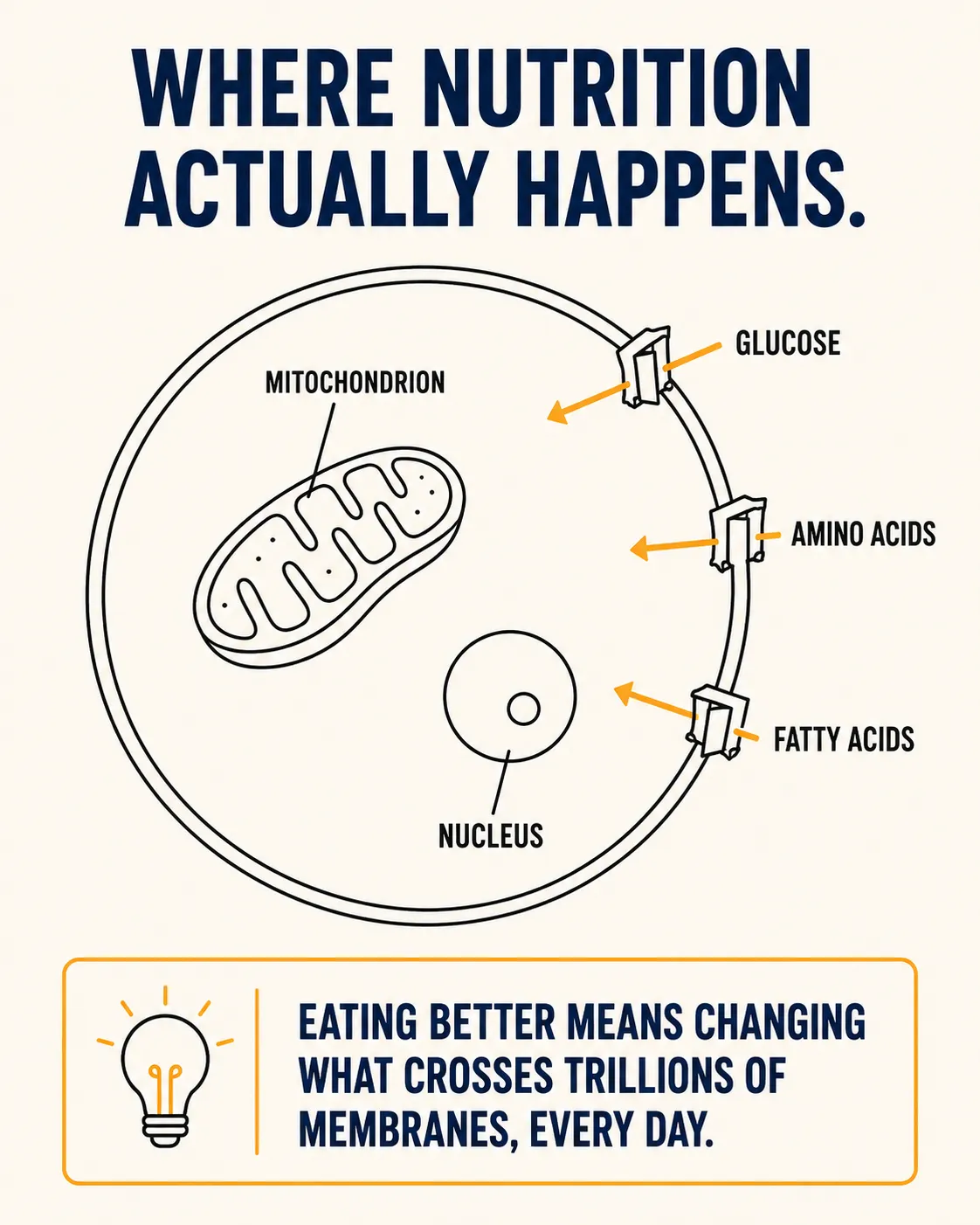
It's natural to think of nutrition at the scale of a person: "she eats too little protein," "he needs more vegetables." But zoom in far enough, and nutrition is really a cellular transaction happening trillions of times over. A cell is a self-contained unit wrapped in a membrane — a flexible, selectively permeable barrier that controls what gets in and what gets out. Glucose, amino acids, fatty acids, vitamins, and minerals all have to cross that membrane, one way or another, before they can do anything useful.
Inside that membrane, a handful of structures matter most for nutrition. The mitochondria are where cells convert nutrients into usable energy — they're the reason Chapter 9's metabolism discussion exists at all. The nucleus holds the cell's genetic instructions, which is less directly relevant to day-to-day coaching but explains why, for instance, two people can eat identically and process nutrients somewhat differently. The point isn't to memorize organelles for their own sake — it's to internalize that "eating better" is really "changing what crosses trillions of membranes, trillions of times a day."
Not everything crosses that membrane the same way, either. Some molecules, like oxygen, slip through freely. Others need a specific "door" — a transporter protein built to carry one particular nutrient and nothing else. Glucose is a good example: cells rely on dedicated glucose transporters to pull it in from the bloodstream, and insulin is part of what tells those transporters to open up. That single detail previews two ideas that come back later in the unit — Chapter 9's discussion of metabolic efficiency, and Chapter 10's discussion of why insulin sensitivity affects how easily the body manages energy balance. For now, the takeaway is simpler: different nutrients have different entry requirements, which is part of why "just eat less" oversimplifies a genuinely more complex cellular process.
The Body's Systems, at a Glance
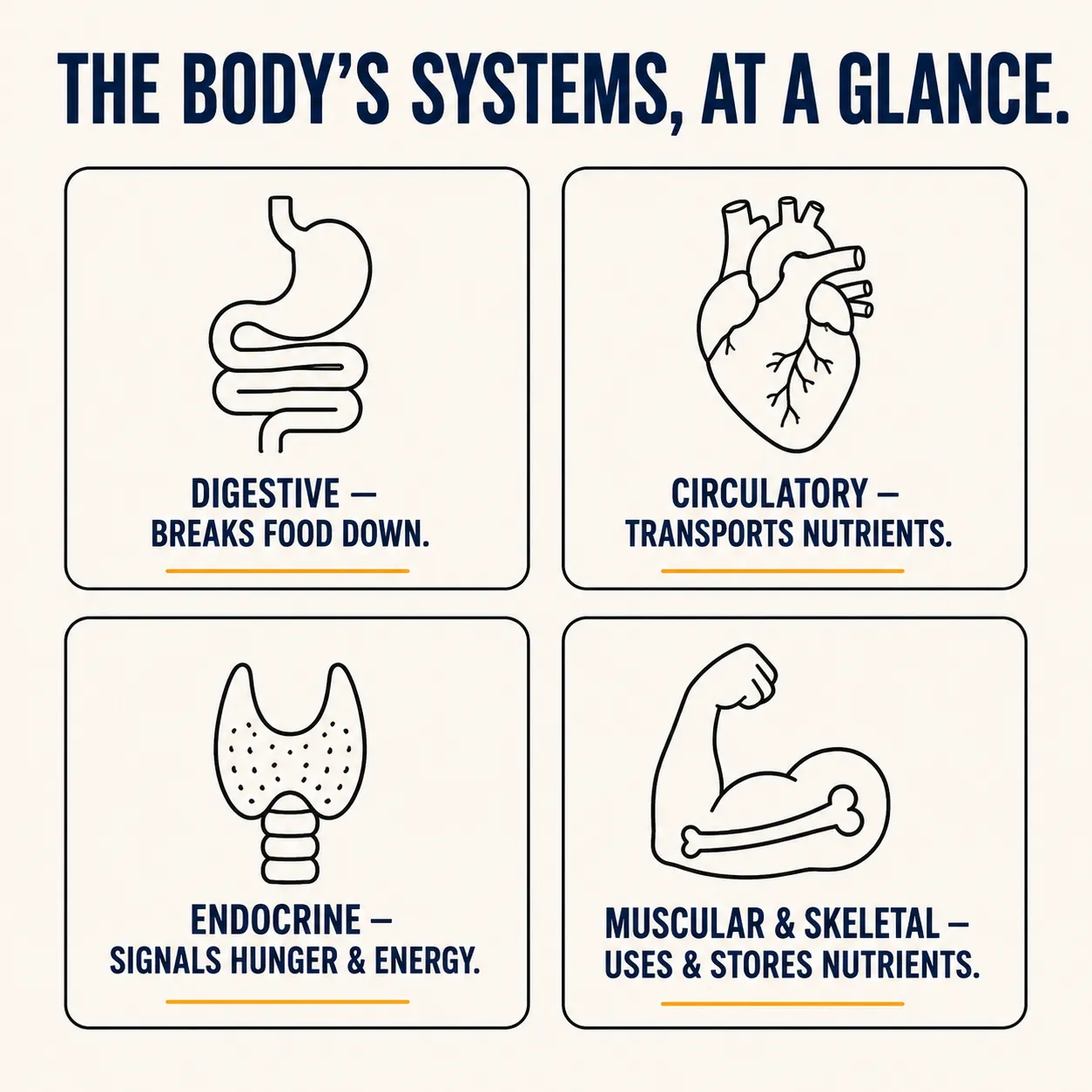
Cells don't operate in isolation — they're organized into tissues, organs, and systems that coordinate the whole process of turning food into something usable. A handful of these systems come up constantly in later chapters.
- Digestive systemBreaks food down into pieces small enough to actually cross a cell membrane. Chapter 8 (Through the GI Tract) covers this process step by step.
- Circulatory systemTransports absorbed nutrients from the gut to cells throughout the body — the delivery network connecting digestion to everywhere nutrients are actually needed.
- Endocrine systemUses hormones to signal hunger, fullness, and energy storage or release. This is the system behind Chapter 10's energy balance discussion and Chapter 14's stress and sleep chapter.
- Muscular and skeletal systemsMajor consumers and storage sites for the nutrients this whole unit is about, especially protein and carbohydrate. Chapter 11 (Macronutrients) builds directly on this.
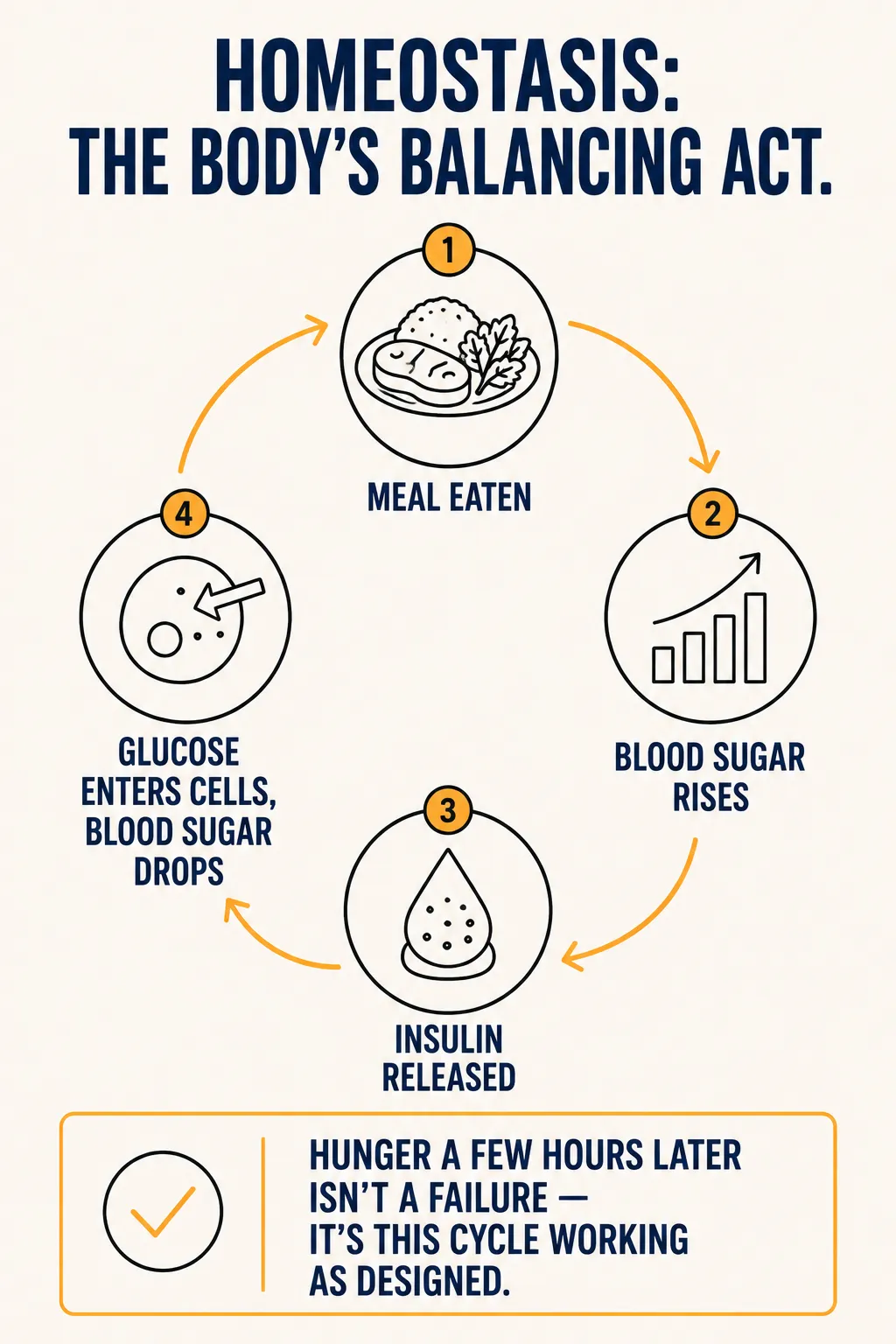
Homeostasis is the body's ongoing effort to keep internal conditions — blood sugar, hydration, body temperature, energy reserves — inside a stable, workable range, constantly adjusting as things shift. Consider blood sugar after a meal: it rises as carbohydrate is digested, which signals the pancreas (part of the endocrine system) to release insulin, which helps cells pull that glucose in from the bloodstream, which brings blood sugar back down. A few hours later, as blood sugar drifts lower, different hormonal signals trigger hunger — not as a personal failing, but as homeostasis doing exactly what it's supposed to do. A client who feels ravenous four hours after a light lunch isn't lacking willpower; their endocrine system is functioning correctly.
Why This Matters for Coaching
This isn't science for its own sake — it directly upgrades the coaching skills from Unit 1. Chapter 3 argued that great coaches lead with curiosity instead of assumption, and Chapter 4 covered helping clients through setbacks without shame. Understanding homeostasis gives both of those principles something concrete to stand on: a client who's constantly hungry on a restrictive plan isn't undisciplined, their hunger-regulating hormones are doing their job in response to a large energy deficit. A client who feels wiped out mid-afternoon isn't lazy, their blood sugar and energy systems are behaving exactly as biology predicts.
Being able to explain this in one plain sentence — the exact skill Chapter 6 asked you to practice — turns an abstract biology fact into something that immediately reduces a client's self-blame. "Your body is doing what bodies do" is a more useful sentence, delivered at the right moment, than most meal plans.
Picture a client three weeks into a fat-loss phase who says, almost apologetically, "I don't know what's wrong with me, I'm hungry all the time and it's embarrassing." A coach without this chapter's framing might quietly agree that something is wrong. A coach who understands homeostasis can say something closer to the truth: a sustained energy deficit shifts hunger-regulating hormones in a completely predictable direction, and that shift is a sign the body is defending its energy reserves the way every human body is built to — not a sign of failing discipline. That reframe doesn't remove the hunger, but it changes what the client makes it mean, which is often the difference between a client who sticks with a plan and one who quietly abandons it out of shame.
Chapter 8 picks up the story right where this one leaves off: once nutrients have crossed into the bloodstream and reached the systems described here, how did they actually get there from a plate of food in the first place? That's the digestive process, step by step.
8 questions, modeled on PN's real open-book exam style. Score 75%+ to mark this lesson complete.
- Nutrition ultimately happens at the cellular level — nutrients have to cross a cell's membrane before they can do anything useful.
- Four systems matter most for nutrition coaching: digestive (breaks food down), circulatory (transports nutrients), endocrine (hormonal signaling), and muscular/skeletal (major nutrient consumers and storage).
- Homeostasis is the body's constant effort to keep internal conditions like blood sugar in a stable range — hunger and energy dips are often homeostasis working correctly, not a personal failing.
- Understanding homeostasis gives Chapter 3's curiosity and Chapter 4's non-judgmental approach to setbacks something concrete to stand on.
- This chapter is the foundation for the rest of Unit 2 — digestion, metabolism, and hormonal signaling all build directly on the concepts here.
Before moving to Lesson 8:
- Write, in one plain sentence, an explanation of why a client might feel hungry a few hours after a meal — without using the word "willpower."
- Think of a client behavior you've previously judged as a discipline problem. Could a homeostasis-driven explanation fit just as well?
- List the four systems from this chapter from memory, along with one line on what each does.
- Complete the knowledge check above and review any question you missed.