Chapter 7 established that nutrition happens at the cellular level, one membrane crossing at a time. This chapter fills in the step before that: how a plate of food actually becomes something small enough to cross a membrane in the first place. Digestion is a roughly 24-to-72-hour mechanical and chemical breakdown process spanning four major stops — mouth, stomach, small intestine, and large intestine — and knowing where each stop's job ends is what lets you troubleshoot a client's "something feels off after I eat" instead of guessing.
Chapter 7 closed by promising this exact story: how nutrients get from a plate of food into the bloodstream and reach the systems and cells already covered. This chapter delivers that story in order, one organ at a time, and ends where Chapter 9's metabolism discussion picks up.
From Mouth to Stomach: Digestion Starts Before You Swallow
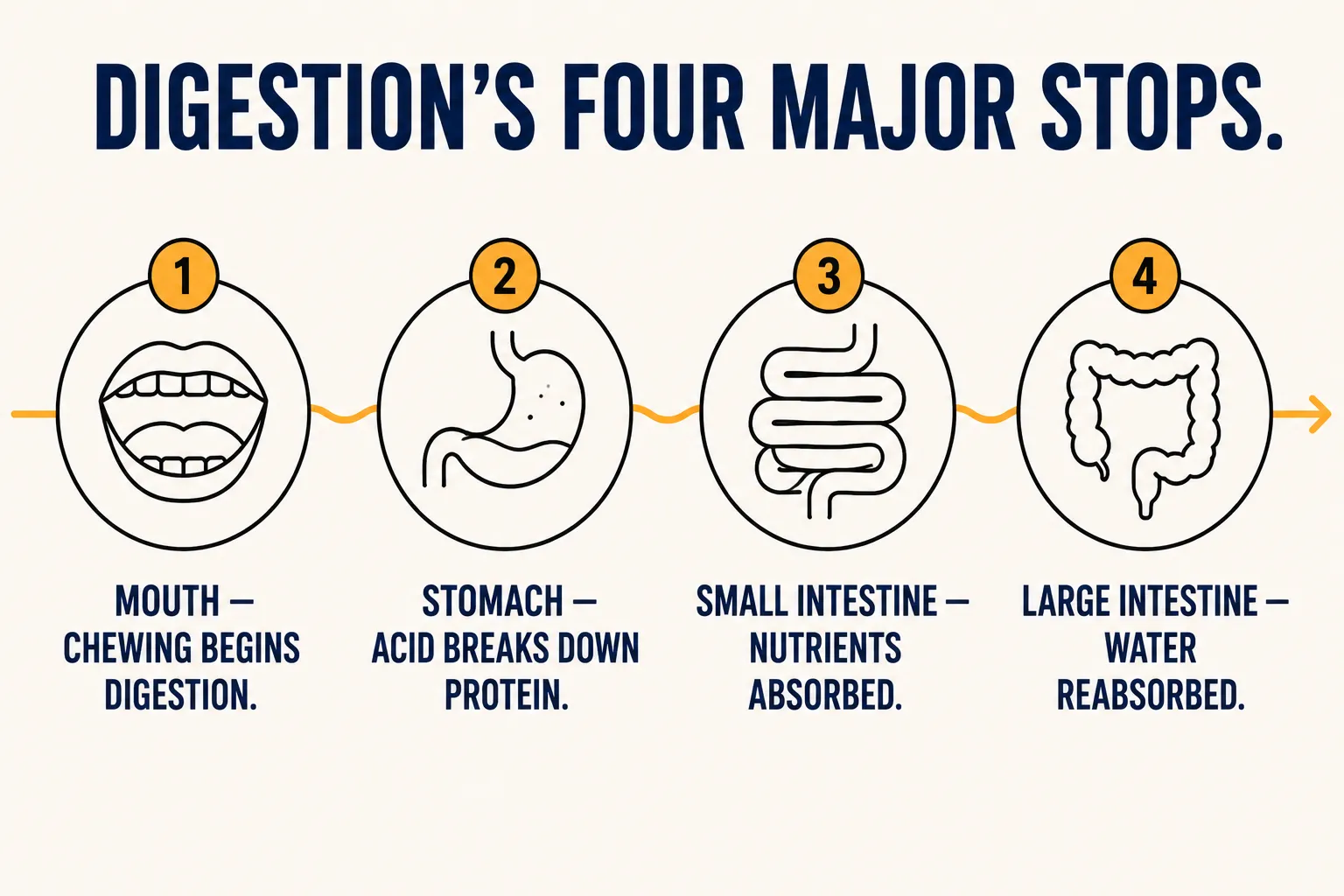
Digestion begins the moment food enters the mouth, not later in the stomach as many people assume. Chewing is mechanical digestion — physically breaking food into smaller pieces and mixing it with saliva, which contains an enzyme called amylase that starts breaking down carbohydrate immediately. This is why a cracker held in the mouth for a minute starts tasting faintly sweet: the starch is already being split into simpler sugars before it's even swallowed.
Once swallowed, food travels down the esophagus into the stomach, where digestion shifts into a much harsher environment. Stomach acid — hydrochloric acid, strong enough to dissolve metal in a lab setting — combines with an enzyme called pepsin to begin breaking down protein specifically, while the stomach's muscular walls churn everything into a semi-liquid mixture. This isn't a gentle process, and it isn't supposed to be: protein's tightly folded structure needs a genuinely aggressive environment to start coming apart.
A ring of muscle called the lower esophageal sphincter sits at the junction between the esophagus and stomach, acting as a one-way valve that normally keeps that harsh acidic mixture from traveling back up. When it doesn't close properly, acid escapes upward — the mechanism behind the burning sensation most people know as acid reflux or heartburn. It's a useful example of how a single small structure working slightly differently can produce a very physical, very common client complaint that has nothing to do with willpower or food choices.
None of this — chewing, saliva, acid, churning — absorbs a single nutrient into the bloodstream yet. This entire first stage is preparation. Nothing is usable by a cell until it reaches the next stop.
The Small Intestine: Where Nutrients Actually Get In
The small intestine is where the bulk of digestion finishes and almost all nutrient absorption happens. Two organs contribute enzymes and fluids here without doing any absorbing themselves: the pancreas releases enzymes that finish breaking down carbohydrate, protein, and fat into pieces small enough to cross the cell membranes covered in Chapter 7, and the liver (via the gallbladder) releases bile, which doesn't digest fat chemically but instead emulsifies it — breaking large fat globules into smaller droplets so digestive enzymes can actually reach their surface.
- VilliFinger-like projections lining the small intestine's inner wall, dramatically increasing its surface area for absorption.
- MicrovilliEven smaller hair-like projections on each villus, increasing surface area further still — together, the two give the small intestine roughly the surface area of a tennis court.
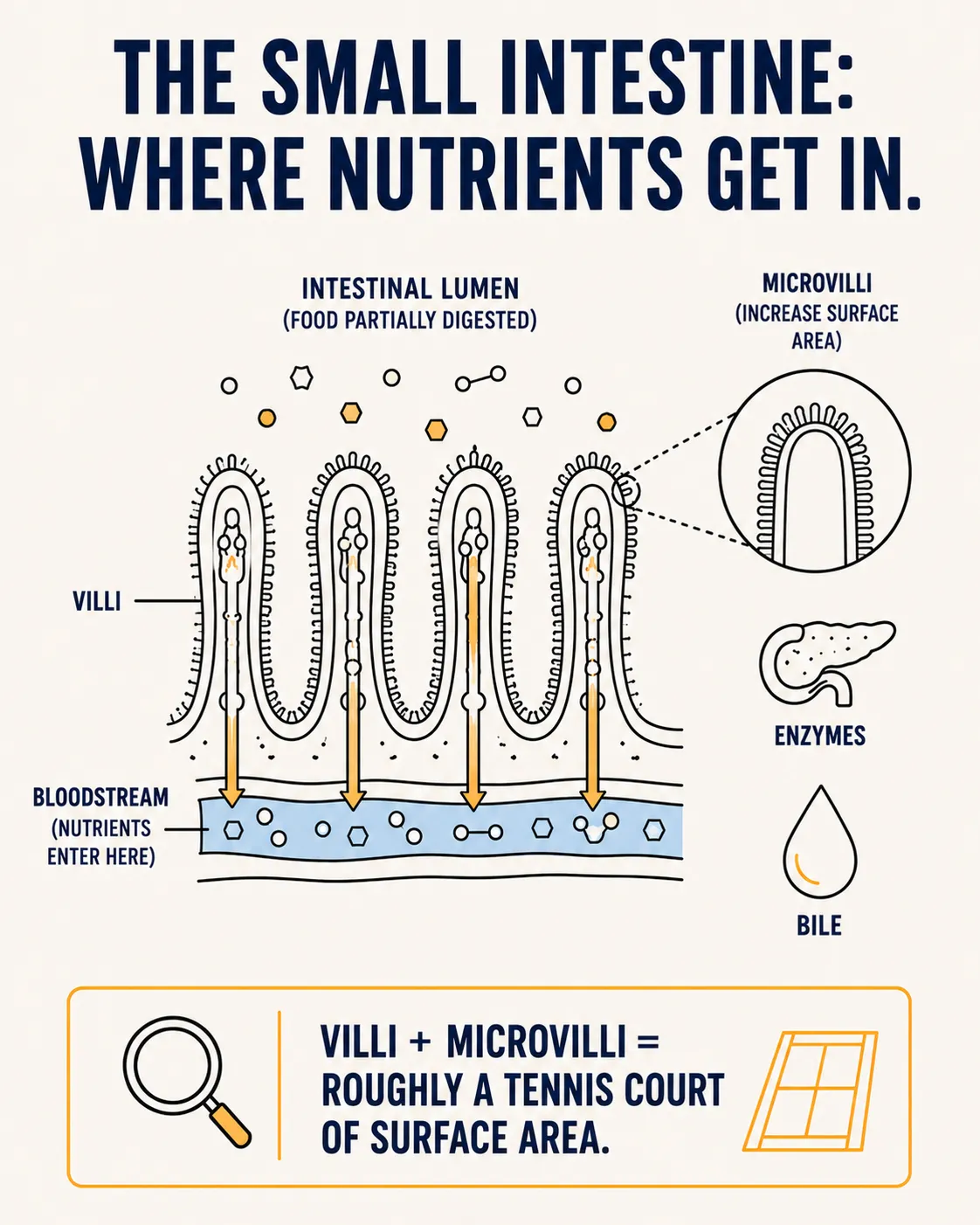
Once broken down, nutrients cross those villi and microvilli into the bloodstream using exactly the membrane-transport mechanics from Chapter 7 — glucose through its dedicated transporters, amino acids through theirs, and so on. This is the direct link between the two chapters: Chapter 7 explained the "door," and this chapter explains how the nutrient gets delivered to the door in the first place.
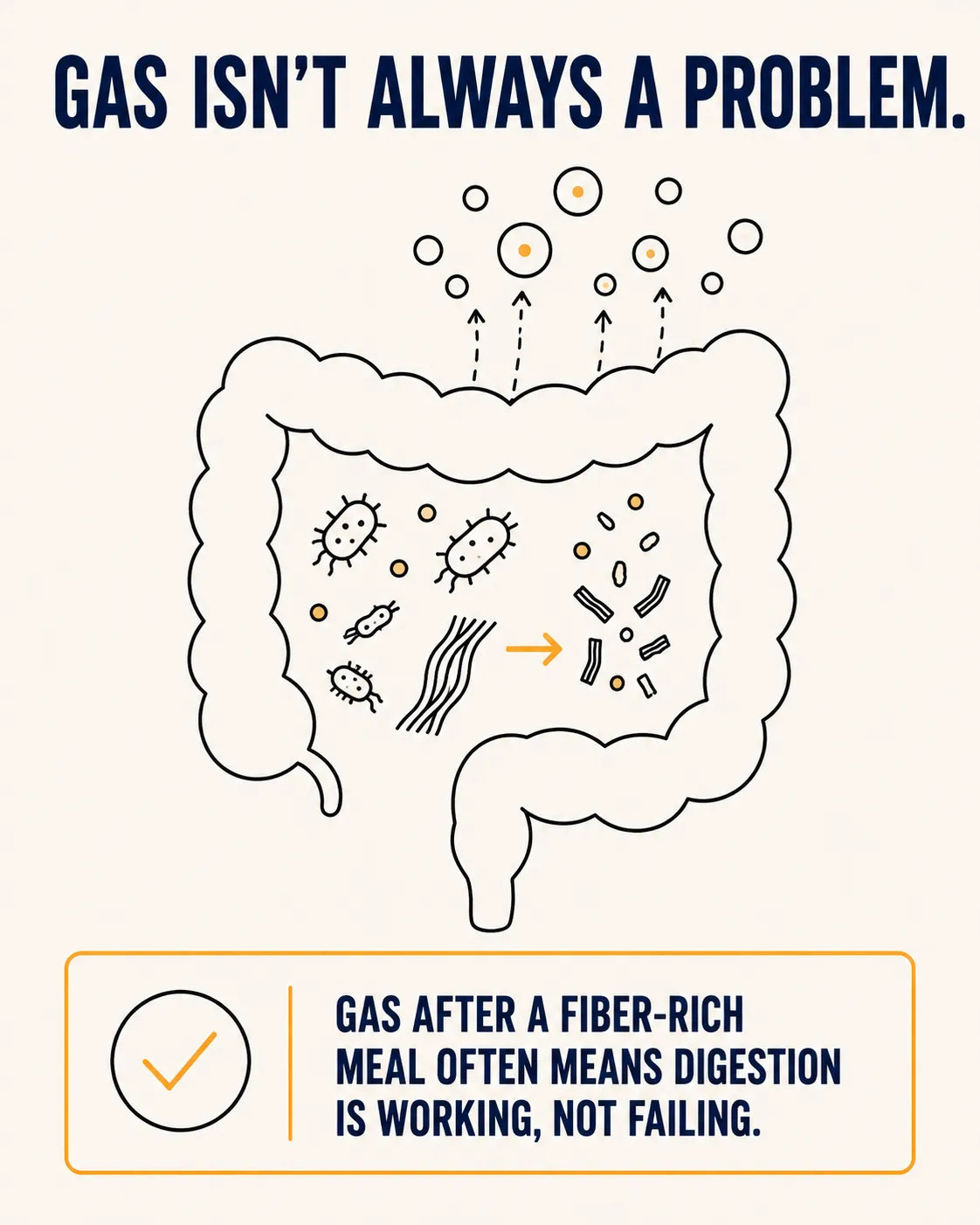
Picture a client who messages you, worried, after feeling gassy and bloated following a bean-heavy dinner. Beans contain fiber and certain carbohydrates the small intestine can't fully break down, so they pass largely intact into the large intestine, where resident gut bacteria ferment them — producing gas as a normal byproduct. That gas is a sign digestion and the gut microbiome are doing exactly what they're built to do with a fiber-rich meal, not evidence of an intolerance or a mistake. A coach who understands this stage of digestion can reassure a client instead of jumping straight to cutting out a nutritious food.
The Large Intestine and the Gut Microbiome
Whatever the small intestine doesn't absorb moves into the large intestine, whose main jobs are reabsorbing water and hosting a dense population of gut bacteria that ferment remaining fiber. This fermentation produces gas, as described above, but also short-chain fatty acids that offer their own health benefits — one reason fiber intake matters well beyond "regularity," a theme Chapter 12's discussion of whole foods will return to.
By the time material reaches the end of the large intestine, essentially all usable nutrients have already been extracted upstream. What's left is water, fiber, and waste — the tail end of a journey that, depending on the person and the meal, has taken anywhere from about a day to three.
Why This Matters for Coaching
A client who says "certain foods just don't agree with me" is describing something real, and this chapter gives you the vocabulary to figure out where in the process things might be going differently for them — slower stomach emptying, insufficient pancreatic enzyme output, or simply a food that's naturally gas-producing for anyone. That's a more useful starting point than either dismissing the complaint or overreacting to it with a restrictive elimination diet.
This also extends Chapter 4's non-judgmental approach to setbacks into physical territory: digestive discomfort isn't automatically a discipline failure any more than hunger was in Chapter 7. Sometimes it's just fiber doing its job a little louder than expected.
That said, this isn't a license to wave away every complaint. A client with persistent, severe, or worsening digestive symptoms should be encouraged to see a doctor rather than have it explained away as "normal fermentation" — a good coach knows the difference between reassuring someone about ordinary digestion and staying quiet about something that's genuinely outside a coach's scope of practice. Chapter 12's discussion of fiber and whole foods will build on the gut-health thread from this chapter, so it's worth getting comfortable with the basic mouth-to-large-intestine sequence now.
Chapter 9 picks up from here: once nutrients have been absorbed into the bloodstream through the process in this chapter, what does the body actually do with them to produce usable energy? That's metabolism, and it's where Unit 2 turns next.
8 questions, modeled on PN's real open-book exam style. Score 75%+ to mark this lesson complete.
- Digestion starts in the mouth, not the stomach — chewing and salivary amylase begin breaking down carbohydrate immediately.
- The stomach uses acid and pepsin to begin protein breakdown and churns food into a semi-liquid mixture, but doesn't absorb nutrients itself.
- The small intestine is where the bulk of absorption happens, using villi and microvilli to massively increase surface area, and the membrane-transport mechanics from Chapter 7 to move nutrients into the bloodstream.
- The large intestine reabsorbs water and hosts gut bacteria that ferment remaining fiber, producing gas as a normal byproduct — not automatically a sign of intolerance.
- Digestive discomfort deserves the same non-judgmental framing as hunger — often it's normal physiology, not a discipline failure.
Before moving to Lesson 9:
- Write, in one sentence, what bile does and doesn't do to fat during digestion.
- List the four major stops in digestion in order, and one job each stop is responsible for.
- Think of a time you or a client blamed "willpower" for something that might actually be normal digestive physiology.
- Complete the knowledge check above and review any question you missed.