"Metabolism" gets used as a single mysterious dial in everyday conversation — fast, slow, broken, boosted. In reality it's the sum of every chemical reaction that turns absorbed nutrients into usable energy and the raw materials cells need, and most of that energy spend has nothing to do with the gym. Understanding where daily energy expenditure actually goes is what separates a coach who can have an honest, useful conversation about a stalled result from one who either blames the client or blames a mysterious "slow metabolism" that usually isn't the real story.
Chapter 8 ended with nutrients freshly absorbed into the bloodstream, on their way to the cells and systems Chapter 7 introduced. This chapter picks up exactly there: what does the body actually do with those nutrients once they arrive, and where does all that energy go over the course of a day?
What Metabolism Actually Means
Metabolism isn't one process — it's an umbrella term for every chemical reaction happening inside the body's cells, all at once, all the time. Some of those reactions break things down to release energy; others build things up, using energy to construct new tissue, hormones, and enzymes. Both directions are "metabolism," which is already a wider definition than the popular "how fast you burn calories" version.
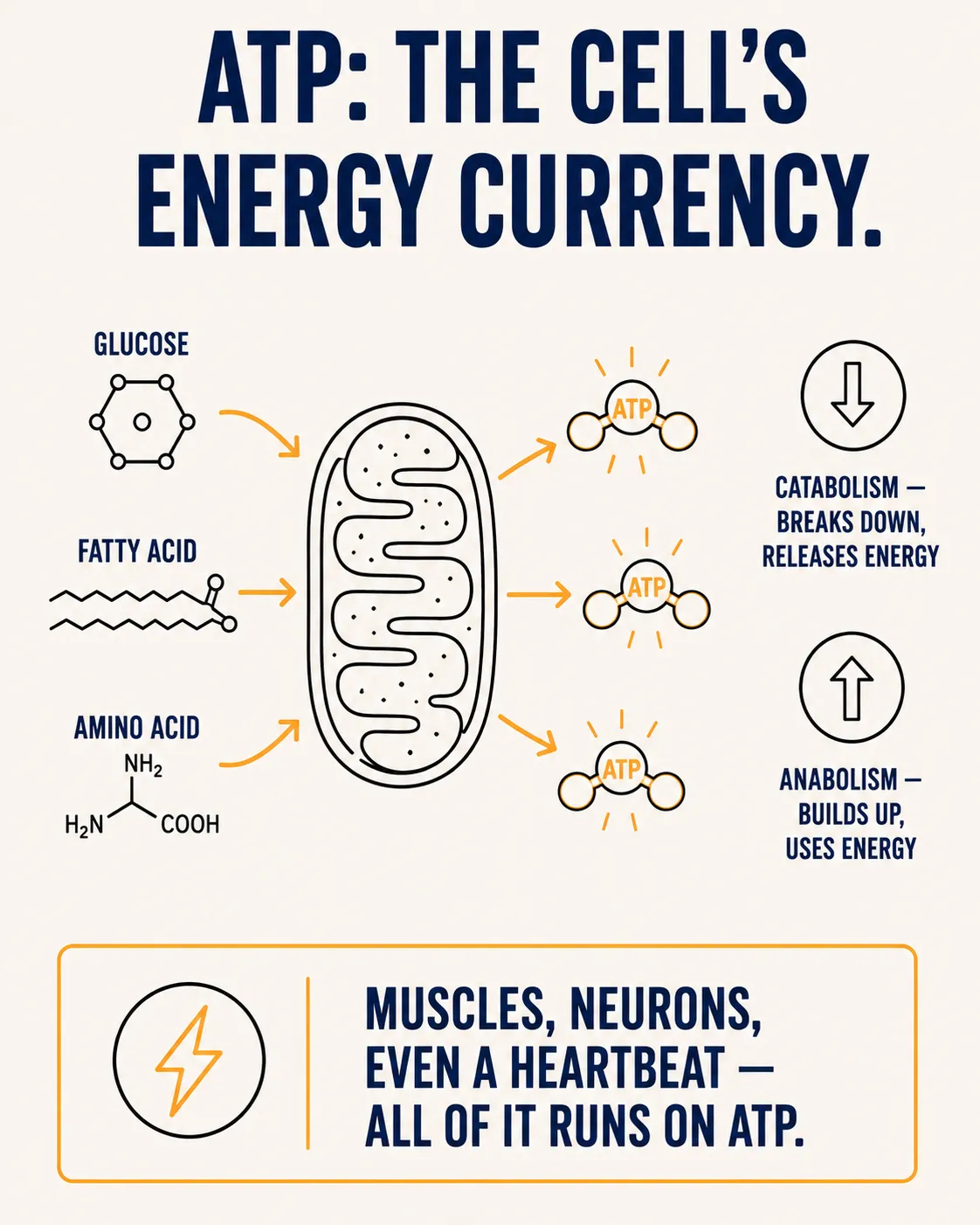
The energy side of that equation comes back to the mitochondria from Chapter 7. Inside them, nutrients absorbed in Chapter 8 — glucose, fatty acids, amino acids — go through a series of reactions that convert their stored chemical energy into a molecule called ATP (adenosine triphosphate), which functions as the cell's universal energy currency. Muscles contracting, neurons firing, the heart beating, even a single cell dividing — all of it runs on ATP produced through this process. When people say "boost your metabolism," what they usually mean, whether they realize it or not, is "increase the rate of ATP production and use" — which is a much narrower and more specific claim than it sounds.
Two broad categories cover all of this activity: catabolism, which breaks larger molecules down and releases energy, and anabolism, which uses energy to build new molecules and tissue. Digesting a meal and using its glucose for energy is catabolic; repairing muscle after a workout or synthesizing a new enzyme is anabolic. Both are happening simultaneously, in every cell, all the time — dieting doesn't switch the body into pure catabolism any more than muscle building switches it into pure anabolism. It's always a balance of both, with the net direction shifting depending on energy intake, activity, sleep, and recovery.
Not every nutrient costs the same to metabolize, either. Protein requires noticeably more energy to digest, absorb, and process than carbohydrate or fat — part of why Chapter 11's macronutrient discussion will return to protein's relatively high thermic cost as one of several practical reasons it gets particular attention in a coaching context.
Where Your Energy Expenditure Actually Goes
Total daily energy expenditure — the number Chapter 10 will build its entire energy-balance discussion around — breaks down into four components, and their relative sizes surprise most people.
- Basal / resting metabolic rate (BMR/RMR)The energy spent just keeping the body alive at rest — breathing, circulating blood, maintaining organ function. Typically the largest single share of total expenditure, often 60–70%.
- Thermic effect of food (TEF)The energy the body spends digesting, absorbing, and processing food itself — the direct continuation of Chapter 8's GI-tract process. Roughly 8–10% of intake, though it varies by macronutrient.
- Non-exercise activity thermogenesis (NEAT)Everyday movement that isn't deliberate exercise — fidgeting, walking to a meeting, standing instead of sitting. Highly variable between individuals and often underestimated.
- Exercise activity thermogenesis (EAT)Energy spent on deliberate exercise. For most people, despite the attention it gets, this is usually the smallest of the four components.
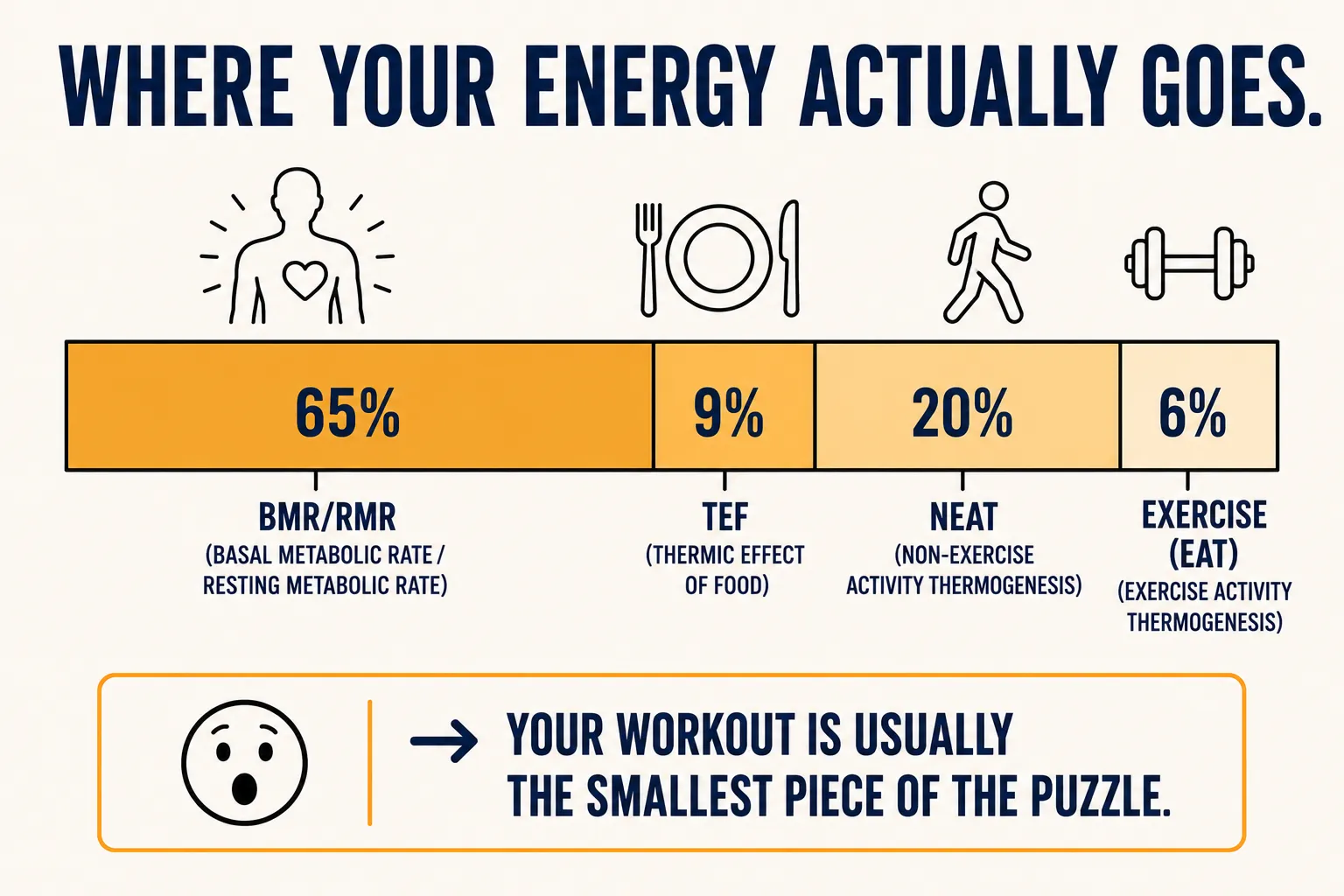
That last point is worth sitting with: for most clients, the workout they trained hard for is a smaller piece of their daily energy expenditure than simply existing, digesting food, and moving around during the rest of the day. This doesn't make exercise unimportant — it has benefits far beyond calories — but it reframes where coaching attention on "expenditure" often belongs.
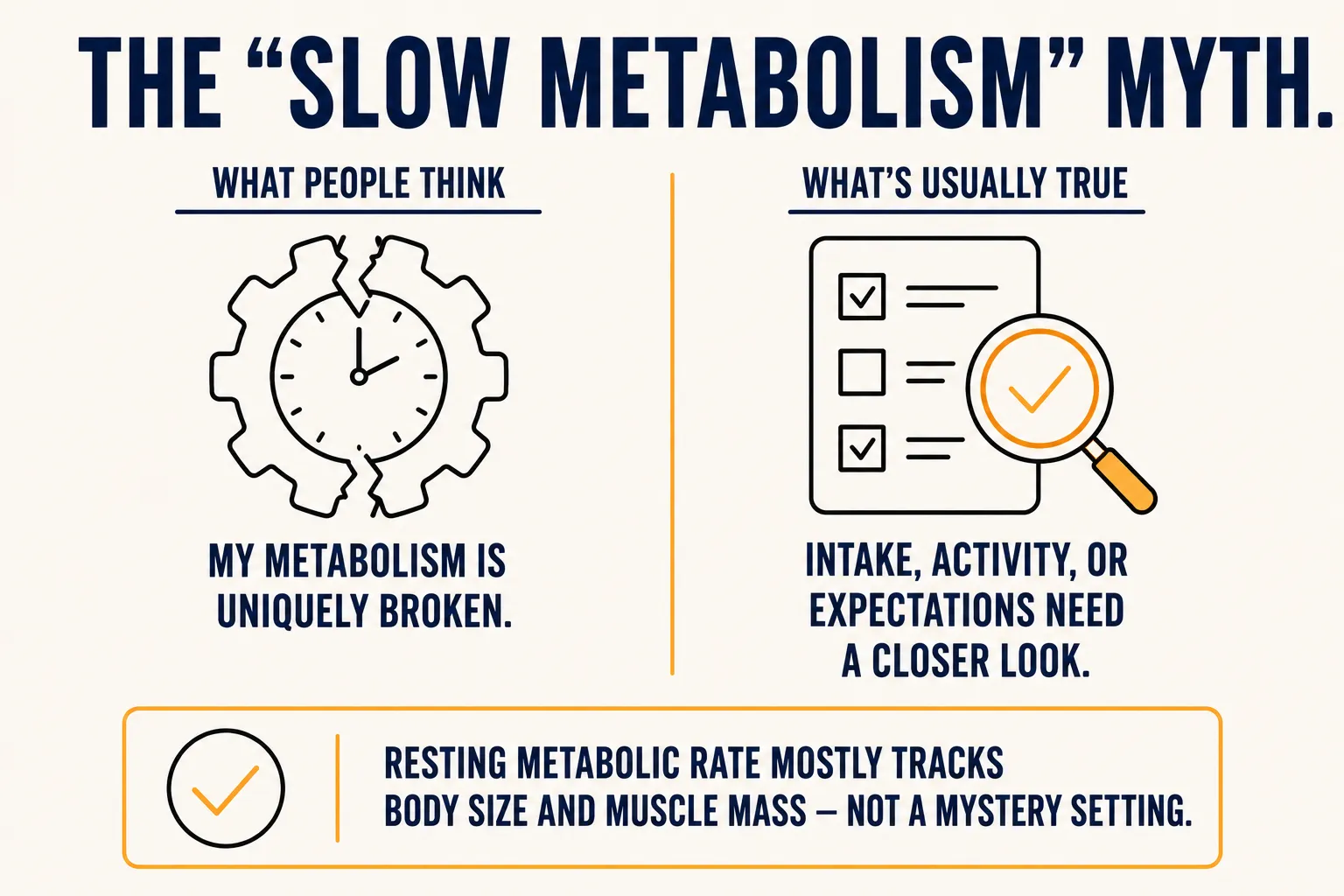
A client says, with real frustration, "I barely eat anything and I still can't lose weight — I think my metabolism is just slow." Resting metabolic rate does genuinely vary between people, but research consistently shows that variation mostly tracks body size and muscle mass, not some mysterious internal setting. Two people of similar size and composition typically have resting metabolic rates within a fairly narrow range of each other. The more common explanations for a stalled result are underestimated food intake, overestimated NEAT, or a genuine but modest metabolic adaptation to sustained dieting — not a broken internal furnace. The honest, useful response isn't "your metabolism is fine, you're just not trying hard enough" (dismissive) or "yes, your metabolism is uniquely slow" (usually inaccurate) — it's working through tracking, movement, and expectations together.
Why This Matters for Coaching
Metabolism talk is emotionally loaded in a way most biology isn't — clients often use it to explain frustration, and sometimes shame, about their bodies. Understanding the real components of energy expenditure gives you a way to have that conversation honestly: not flattering a myth, but also not dismissing a real and common frustration. "Your metabolism isn't broken, but let's actually look at where your energy is going" is both more accurate and more useful than either extreme.
This continues the thread from Chapters 3 and 4: coaching with curiosity instead of assumption means asking what's actually happening with a client's movement, food tracking, and expectations before reaching for "slow metabolism" as an explanation — in either direction.
In practice, that curiosity usually pays off around NEAT more than anywhere else. A client who took a desk job after years of an on-your-feet role can lose a meaningful chunk of daily movement without changing a single workout or meal — and without noticing, because none of it felt like a decision. Asking about daily steps, standing time, or commute changes often surfaces more useful information than another conversation about willpower or "trying a new diet."
Chapter 10 picks up directly from the four components introduced here, turning "where does energy go" into "how does energy in versus energy out actually determine weight change" — and why that phrase is more nuanced than it sounds.
8 questions, modeled on PN's real open-book exam style. Score 75%+ to mark this lesson complete.
- Metabolism is the sum of every chemical reaction converting nutrients into usable energy (ATP) and building blocks — not a single "fast or slow" dial.
- Total daily energy expenditure has four components: basal/resting metabolic rate (usually the largest), thermic effect of food, non-exercise activity thermogenesis, and exercise activity — often the smallest.
- Resting metabolic rate does vary between people, but mostly tracks body size and muscle mass — the variation is smaller than popular belief suggests.
- A stalled result is more often explained by underestimated intake, overestimated activity, or modest metabolic adaptation than a uniquely "slow metabolism."
- The most useful coaching response neither dismisses metabolism frustration nor validates the myth — it looks at the real components together.
Before moving to Lesson 10:
- Write, in one sentence, what ATP is and why cells need it.
- Rank the four components of daily energy expenditure from largest to smallest for a typical person.
- Think of a time you or a client blamed "slow metabolism" for a result — what other explanations might fit just as well?
- Complete the knowledge check above and review any question you missed.