"Calories in, calories out" is correct — it's basic thermodynamics, not a diet theory, and nothing in this chapter disputes it. What's incomplete is treating that phrase as a simple instruction. Both sides of the equation move in response to each other, and both are harder to measure accurately than they look on paper. A coach who understands why energy balance is real but genuinely difficult to manage will help clients far more than one who either recites the phrase as if it settles everything or dismisses it as irrelevant.
Chapter 9 broke total daily energy expenditure into four components and showed that most of it has nothing to do with exercise. This chapter puts that expenditure number on one side of a scale, food intake on the other, and looks honestly at why balancing them is harder than "eat less, move more" makes it sound.
The Equation Is Real — But It Isn't Static
Energy balance is genuine physics: consume more energy than the body uses and the surplus gets stored, mostly as fat; consume less than it uses and the body draws on stored energy to cover the difference. Over a long enough timeframe, weight change reliably tracks the gap between energy in and energy out. This part isn't controversial among researchers, and nothing later in this chapter walks it back.
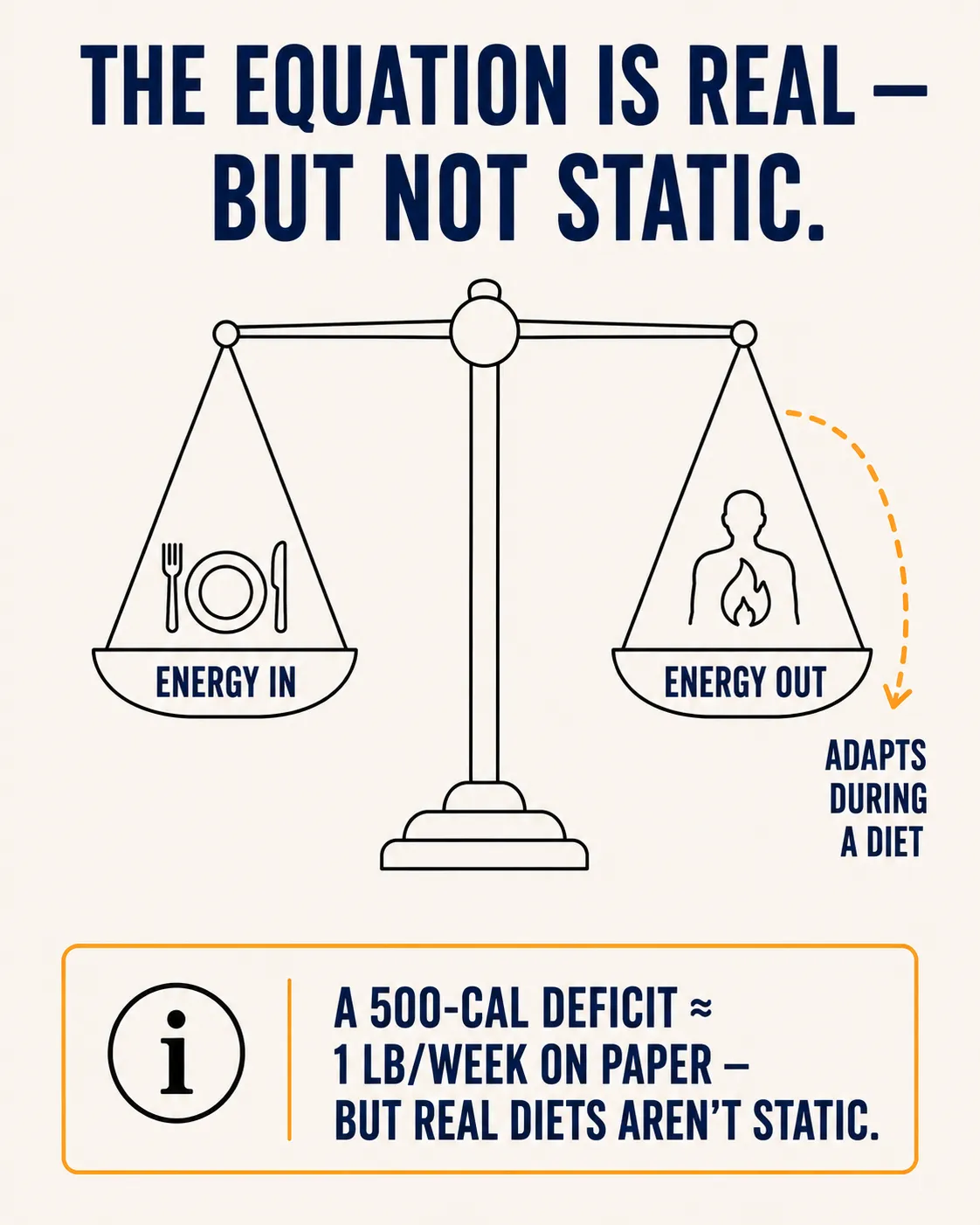
What the simple version leaves out is that "energy out" isn't a fixed number sitting quietly on one side of the equation. Chapter 9 already introduced adaptive thermogenesis — the tendency for resting metabolic rate and NEAT to shift somewhat during sustained dieting, partly as the body responds to reduced energy availability. Someone eating in a large, prolonged deficit often moves less without deciding to (fidgeting less, taking the elevator instead of the stairs) and burns slightly less at rest than their starting numbers would predict. The effect is real but modest — nowhere near large enough to make weight loss impossible — but it does mean a fixed calorie target calculated once at the start of a diet quietly becomes less accurate over time.
A rough example makes this concrete. A 500-calorie daily deficit is often quoted as producing about a pound of fat loss per week, since a pound of fat represents roughly 3,500 stored calories. That math is a reasonable starting estimate, but it assumes a completely static "energy out" side — no adaptive drop in NEAT, no change in resting rate as body weight itself decreases (a smaller body simply costs less energy to maintain), and perfectly accurate tracking of intake. In practice, most or all of those assumptions bend a little over the course of a multi-week diet, which is exactly why the same calorie target that worked in week one often needs revisiting by week six — not because the physics changed, but because the inputs quietly did.
Why "Just Eat Less" Undersells the Problem
The other side of the equation has its own complications. Self-reported food intake is well documented to run lower than actual intake, often substantially — not usually because people are lying, but because portion sizes get misjudged, cooking oil and condiments get forgotten, and inconsistent logging quietly lets days slip by unrecorded. A client insisting "I'm eating so little" may be reporting an honest but incomplete picture rather than a fabricated one.
- Hunger hormone signalingChapter 7's homeostasis discussion applies directly here — a sustained deficit shifts hunger-regulating hormones to defend the body's energy reserves, which is exactly why deficits feel harder over time, not evidence of failing willpower.
- Adaptive thermogenesisThe modest drop in resting metabolic rate and NEAT that Chapter 9 introduced, which slowly narrows a deficit that looked larger on paper at the start of a diet.
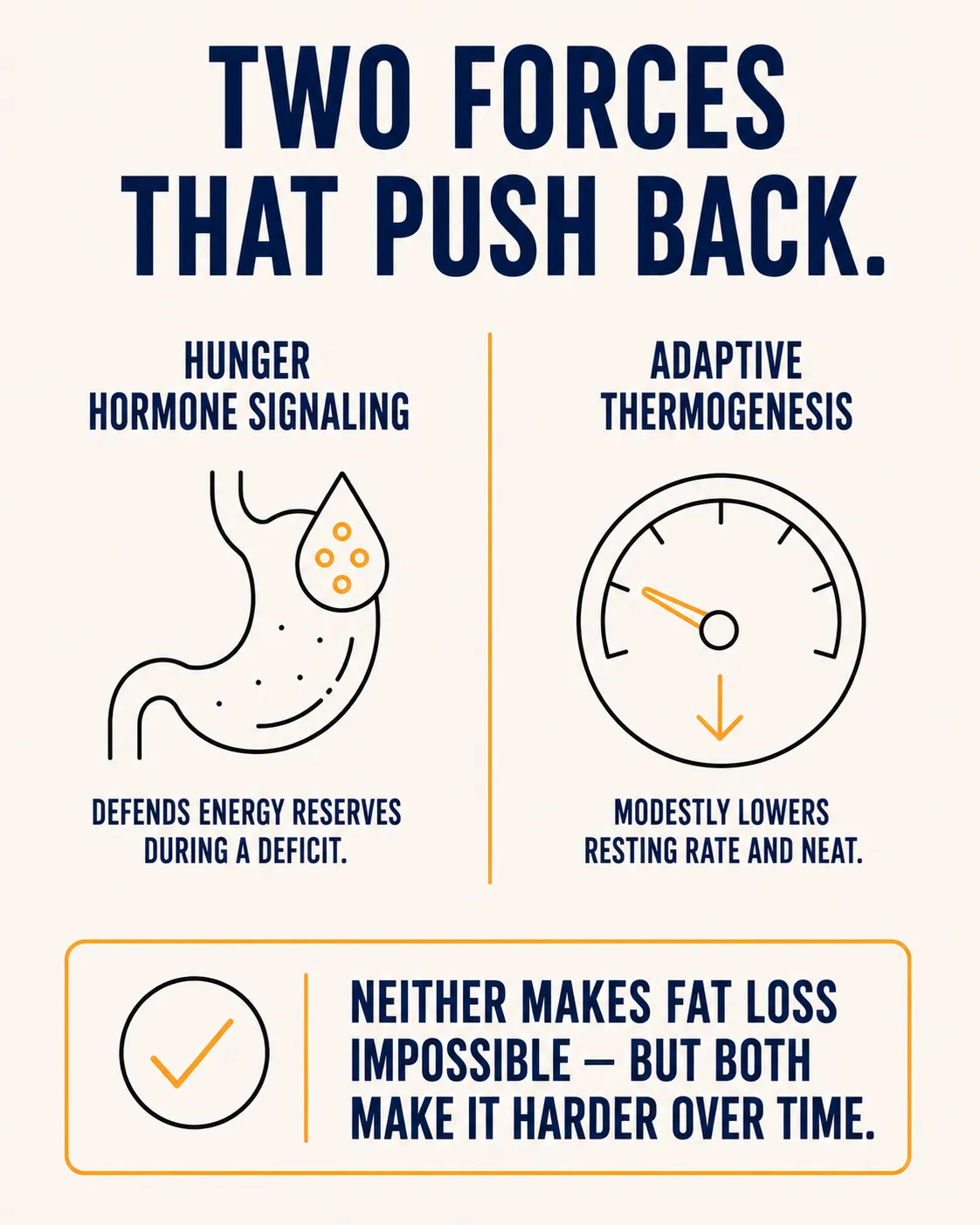
Neither of these forces makes sustained fat loss impossible — millions of people do it — but together they explain why "just eat less" is technically true and practically incomplete advice. A coach who only repeats the equation, without addressing hunger management, environment design, and realistic tracking, is handing a client an accurate fact without a usable plan.
It's worth being precise about what "pushing back" actually looks like day to day: it rarely feels like a dramatic wall. More often it's a slightly shorter walk that used to feel automatic, a slightly bigger portion that used to feel like "enough," or a slightly stronger pull toward a snack in the evening. None of that is a client failing — it's the exact mechanism this section describes, showing up in ordinary moments rather than announcing itself.
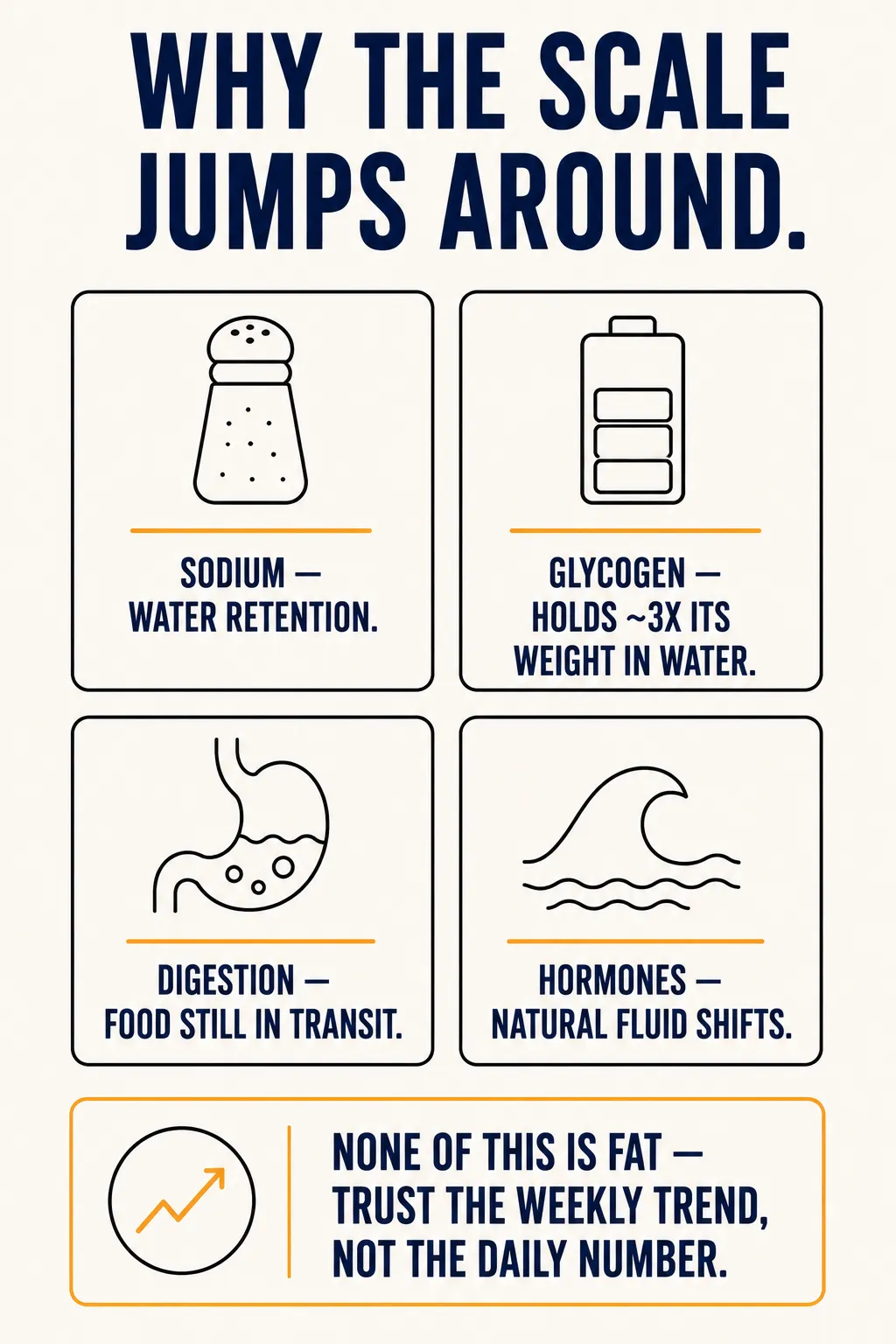
A client messages you in a mild panic: the scale is up three pounds the morning after a salty restaurant dinner, despite a week of consistent tracking. Body weight fluctuates day to day for reasons that have nothing to do with fat gain — water retention from sodium intake, glycogen stores that each hold roughly three grams of water per gram of glycogen, the simple weight of food and fluid still in the digestive tract, and hormonal cycles that shift fluid balance for some clients. None of that is fat gained overnight, which is physiologically close to impossible from one meal. A coach who understands this can point a worried client toward the weekly trend instead of a single alarming data point.
Why This Matters for Coaching
Energy balance is true, but reciting it at a struggling client is rarely what actually helps them. The more useful coaching move is treating the equation as background physics while focusing on what Chapter 4 already introduced: sustainable behavior change, realistic tracking, and expectations that account for hunger pushing back and the scale bouncing around for reasons unrelated to progress.
This is also where Chapter 9's NEAT discussion earns its keep again — since exercise is usually the smallest expenditure lever, and intake is harder to measure accurately than most clients assume, the most reliable levers a coach actually has are often environment design and non-exercise movement, not simply telling someone to "eat less and work out more."
Picture two clients with identical calorie targets on paper. One tracks meticulously, hits their number most days, and still hears "the math should be working" when a stall happens — missing the adaptive thermogenesis and measurement-error factors covered above. The other undercounts oil, sauces, and weekend drinks without realizing it, and assumes their "slow metabolism" from Chapter 9 is to blame. Both scenarios call for the same coaching move: revisit the actual numbers and the actual physiology together, rather than assuming either total effort or a broken body is the explanation.
Chapter 11 picks up from here, looking at whether all calories are created equal from a coaching standpoint — how protein, carbohydrate, and fat behave differently within the same energy-balance framework this chapter just laid out.
8 questions, modeled on PN's real open-book exam style. Score 75%+ to mark this lesson complete.
- Energy balance is real physics — weight change reliably tracks the gap between energy in and energy out over time.
- "Energy out" isn't fixed — adaptive thermogenesis modestly lowers resting metabolic rate and NEAT during sustained dieting.
- Self-reported food intake commonly runs lower than actual intake, usually from misjudged portions and inconsistent logging, not dishonesty.
- Hunger hormone signaling (Chapter 7) and adaptive thermogenesis (Chapter 9) both push back against a sustained deficit — expected, not a sign of failure.
- Day-to-day scale fluctuations often reflect water, glycogen, digestive contents, or hormonal cycles — not actual fat gained or lost overnight.
Before moving to Lesson 11:
- Write, in one sentence, why "calories in, calories out" is true but incomplete as coaching advice.
- List two reasons a client's logged food intake might undercount what they actually ate.
- Think of a time you or a client panicked over a scale jump — which of this chapter's explanations might have fit?
- Complete the knowledge check above and review any question you missed.