Chapter 10 established that total energy in versus energy out drives weight change. This chapter zooms into what makes up "energy in" — protein, carbohydrate, and fat each play a distinct physiological role well beyond their calorie count, and none of them deserves the moral reputation, good or bad, that popular diet culture tends to assign it. Protein gets particular coaching attention for practical reasons; carbohydrate and fat both remain essential, and the right ratio between them depends far more on the individual client than on any universal formula.
Chapter 10 put energy in on one side of the scale without asking what that energy is actually made of. This chapter opens that question up: three macronutrients, each behaving differently in the body, each relevant to a different piece of the science already covered in this unit.
Protein: The Priority Macro
Protein is built from amino acids, several of which the body cannot manufacture itself and must get from food — the reason nutrition science calls them "essential." Beyond building muscle tissue, protein forms enzymes, hormones, and the structural material for skin, hair, and connective tissue, making it functionally different from a pure energy source.
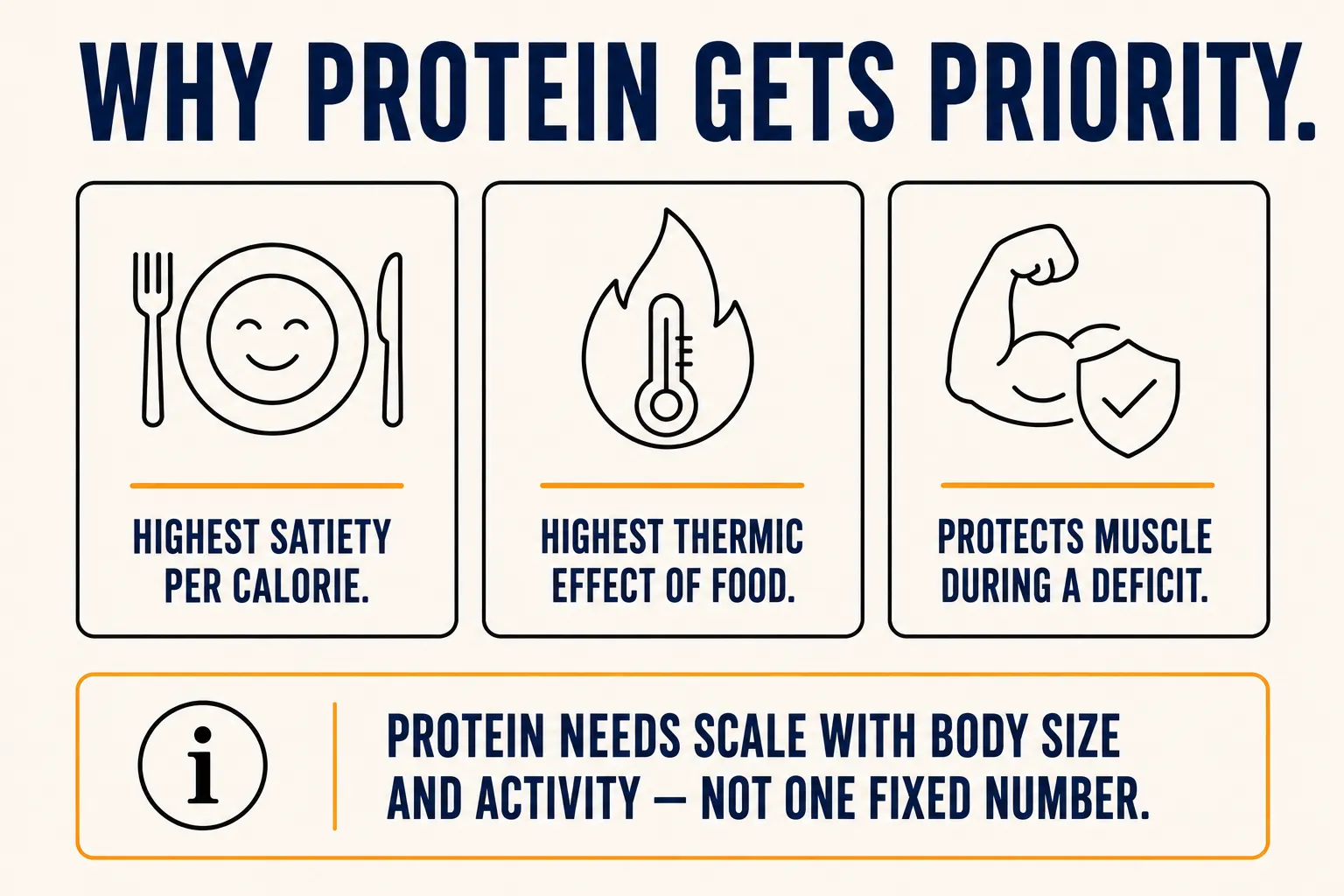
Three practical properties explain why protein tends to get particular coaching attention. It has the highest satiety per calorie of the three macronutrients, meaning it keeps people feeling full longer relative to its energy content. It carries the highest thermic effect of food of any macronutrient — Chapter 9 already flagged this, noting the body spends noticeably more energy digesting protein than carbohydrate or fat. And during a calorie deficit, adequate protein intake is one of the most effective tools for preserving muscle tissue while losing fat, directly relevant to Chapter 10's energy-balance discussion. None of this makes carbohydrate or fat optional — it simply explains why protein is usually the first macronutrient a coach helps a client get right.
Protein needs also scale with body size and activity level rather than sitting at one fixed number for every person. Someone doing regular resistance training generally benefits from more protein per kilogram of body weight than someone who's sedentary, since building and repairing muscle tissue increases the raw-material demand. This is a general pattern to be aware of, not a specific number to hand every client — individual protein targets are a personalized calculation, not a one-size-fits-all rule.
Carbohydrate and Fat: Fuel and Function
Carbohydrate and fat both provide energy, but they aren't interchangeable, and neither deserves the blanket reputation — good or bad — that diet trends regularly assign them.
- CarbohydrateThe body's preferred fuel for the brain and high-intensity exercise, providing about 4 calories per gram. Stored as glycogen (the same glycogen from Chapter 10's discussion of scale fluctuations), and its fiber component feeds the gut bacteria covered in Chapter 8.
- FatThe most energy-dense macronutrient at about 9 calories per gram — more than double carbohydrate or protein. Essential for building the cell membranes described in Chapter 7, producing hormones, and absorbing fat-soluble vitamins A, D, E, and K.
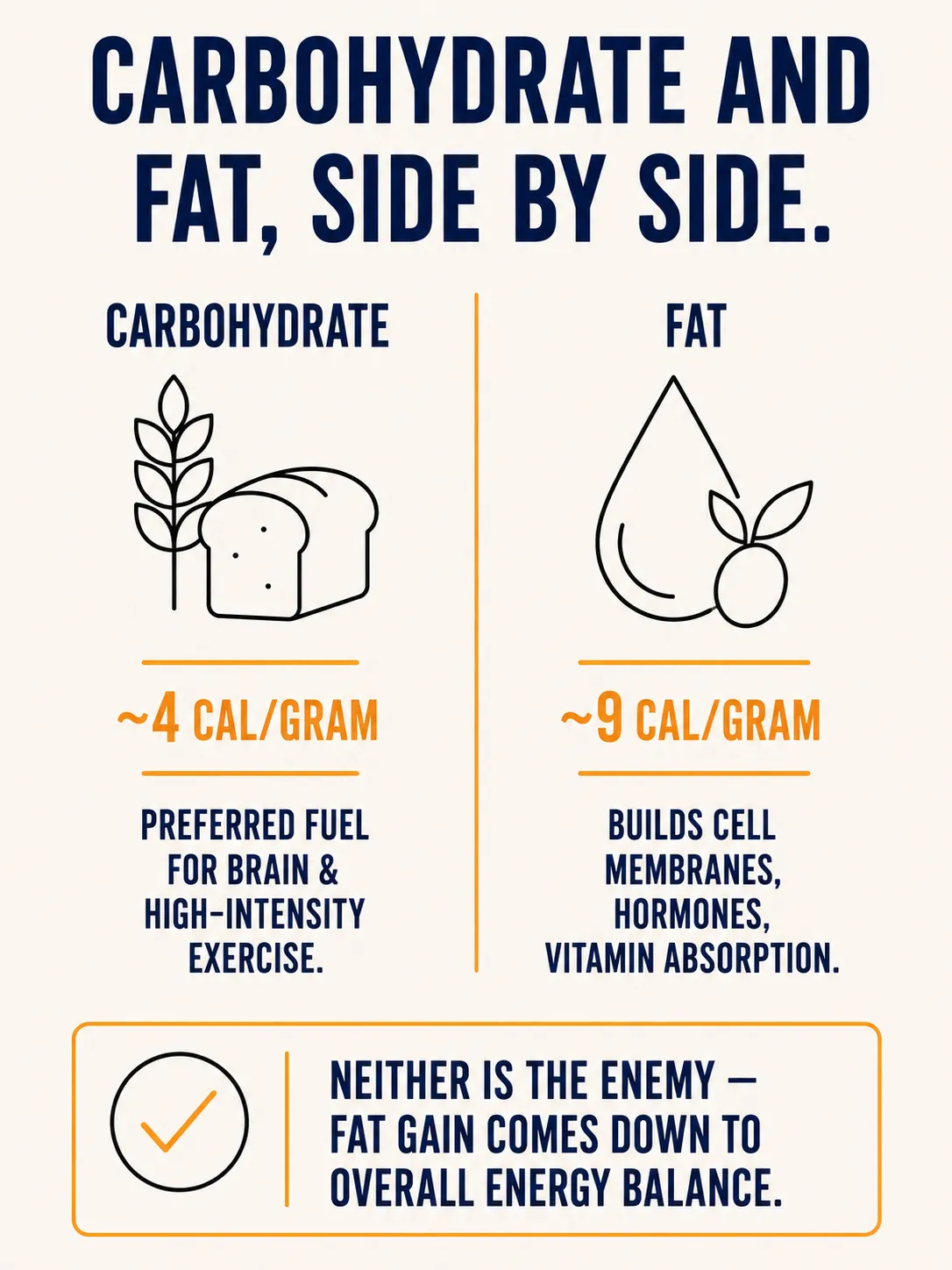
Neither macronutrient is the villain popular diet culture periodically makes it out to be. Carbohydrate doesn't inherently cause fat gain — that comes down to overall energy balance from Chapter 10, not any single macronutrient in isolation. Fat doesn't automatically raise disease risk — some fats deserve more attention than others, but fat as a category is required for basic physiological function, not something to eliminate.
Both macronutrients also have internal variety that matters. Carbohydrate ranges from simple sugars that digest quickly to complex, fiber-rich sources that digest more slowly and support the gut health covered in Chapter 8 — the source matters as much as the total amount for most clients. Fat similarly spans a spectrum from unsaturated sources generally associated with better health outcomes to saturated and trans fats that deserve more moderation — but this is a matter of proportion and source, not a reason to fear fat as a category.
A client, influenced by something they read online, asks whether cutting carbs entirely is the fastest way to lose fat. The honest answer draws on everything this unit has covered so far: fat loss depends on sustained energy balance (Chapter 10), carbohydrate is the preferred fuel for the brain and intense training, and severely restricting it often makes workouts feel harder and adherence less sustainable — without offering any special metabolic advantage once total calories and protein are held constant. The more useful question isn't "which macro is the enemy," but "what combination of protein, carbohydrate, and fat will this specific person actually stick to."
Why This Matters for Coaching
Chapter 5 argued there's no single best diet, only criteria — adequate, balanced, sustainable — that any good approach has to satisfy. Macronutrient ratios are where that principle gets tested directly. Protein intake is worth prioritizing fairly consistently across clients, for the practical reasons covered above. The remaining balance between carbohydrate and fat, though, has much more room to flex based on a client's training demands, personal preference, and what they can realistically sustain — exactly the kind of individualized judgment Chapter 4's behavior-change approach depends on.
A coach who prescribes one rigid macro split for every client is repeating Chapter 6's original warning: confident advice that happens to be wrong for the person in front of you. A coach who understands what each macronutrient actually does can instead adjust the ratio to the client, not the other way around.
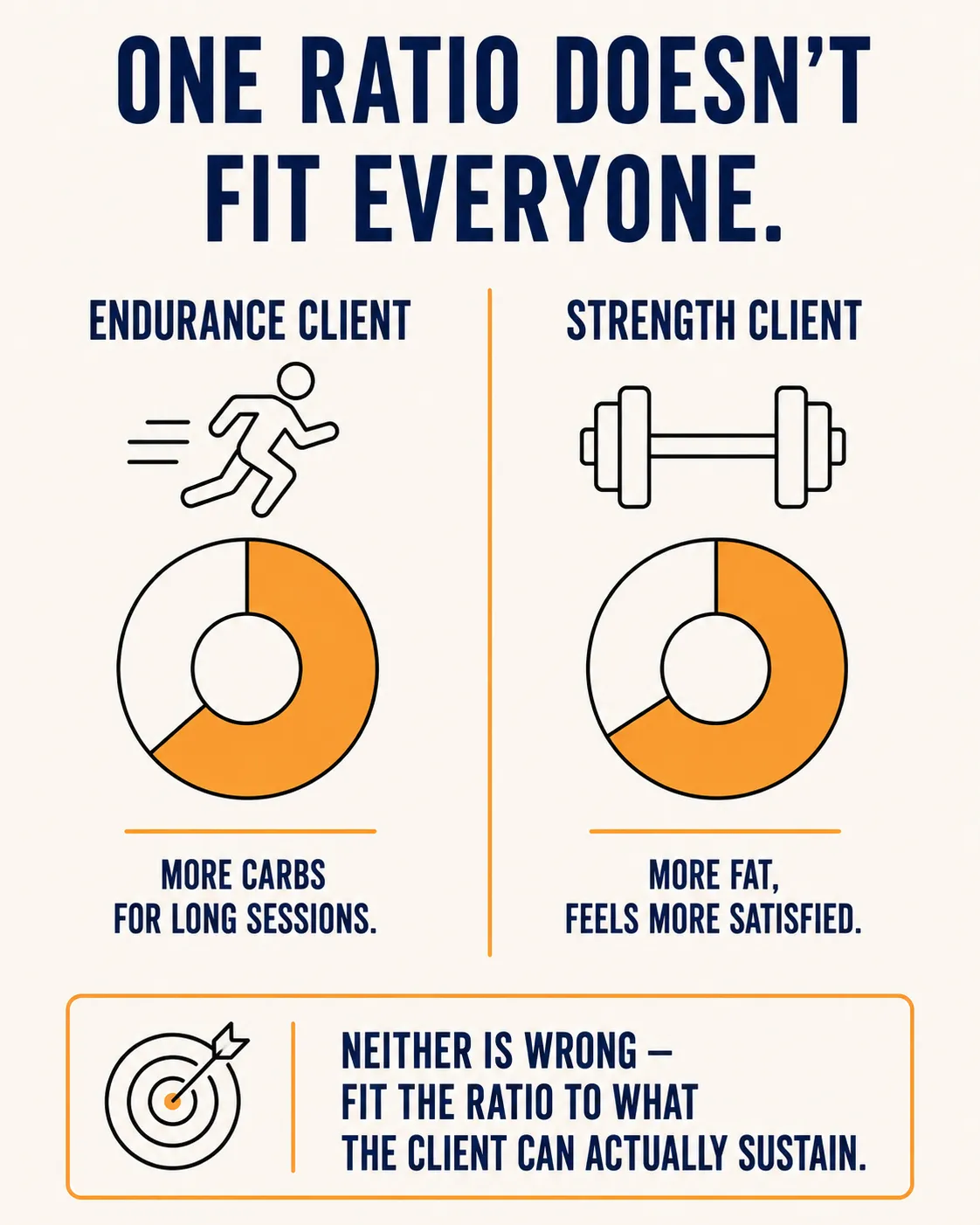
Consider two clients with identical calorie and protein targets: one is training for endurance running and performs noticeably better with more carbohydrate to fuel long sessions, while the other lifts weights a few times a week and reports feeling more satisfied on a higher-fat, lower-carbohydrate split. Neither is wrong, and neither ratio is "more correct" in the abstract — the right answer is whichever combination lets each of them train well, feel satisfied, and stick with the plan long enough for energy balance to do its work.
Chapter 12 continues this thread by moving from macronutrients to micronutrients and whole foods — narrowing in on food quality considerations that matter well beyond the calorie and macro totals covered here. Getting protein, carbohydrate, and fat roughly right is what makes a diet workable; the next chapter is about what makes it genuinely nourishing beyond the numbers.
8 questions, modeled on PN's real open-book exam style. Score 75%+ to mark this lesson complete.
- Protein builds muscle, enzymes, and hormones, and is made of amino acids — some of which are essential and must come from food.
- Protein gets coaching priority for three practical reasons: highest satiety per calorie, highest thermic effect of food, and its role in preserving muscle during a deficit.
- Carbohydrate is the preferred fuel for the brain and high-intensity exercise and feeds gut bacteria through fiber; fat builds cell membranes, hormones, and enables fat-soluble vitamin absorption.
- Neither carbohydrate nor fat is inherently good or bad — fat gain and loss come down to overall energy balance, not any single macronutrient.
- The right carbohydrate-to-fat ratio depends on the individual client's training, preferences, and adherence — not a single universal formula.
Before moving to Lesson 12:
- Write, in one sentence, why protein tends to get more consistent coaching priority than carbohydrate or fat.
- List one physiological role of fat that has nothing to do with body fat storage.
- Think of a time you or a client blamed a single macronutrient for a result — what other explanations from this unit might fit better?
- Complete the knowledge check above and review any question you missed.