Chapters 16 and 17 covered clients building consistency and clients adding moderate precision. This chapter completes the three-part framework with clients who've already done both and are working toward something specific and demanding — a competition, a performance goal, a body-composition target with a real deadline. The coaching skill shifts here too: less about building new habits, more about interpreting data, making tight adjustments, and knowing exactly where a coach's own expertise ends.
Chapter 17 closed by pointing toward Level 3 clients as the far end of this same population-specific lens — clients who need the kind of high precision and advanced strategies that would have overwhelmed them at either earlier stage.
What Defines a Level 3 Client
A Level 3 client has already integrated everything the previous two stages cover: the consistent foundational habits from Chapter 16, and the moderate precision tools from Chapter 17. Meals happen reliably, portion awareness is second nature, and simple tracking methods no longer feel like a burden. What's different now is the goal itself — something specific and demanding enough that the previous level of precision genuinely isn't enough to reach it.
This might be a client prepping for a physique competition with a fixed date, an athlete trying to hit a precise performance target, or someone pursuing a body-composition goal aggressive enough that small execution errors meaningfully change the outcome. The common thread isn't the specific goal — it's that the stakes and specificity involved genuinely justify a level of precision that would have been pointless, even counterproductive, at Level 1 or Level 2.
Just as importantly, a Level 3 client can typically self-manage day-to-day execution without heavy coaching support. They know how to log food accurately, they understand why a habit matters without needing it re-explained, and they can generally troubleshoot small deviations from a plan on their own. What they need from a coach at this stage looks different from what a Level 1 or Level 2 client needs.
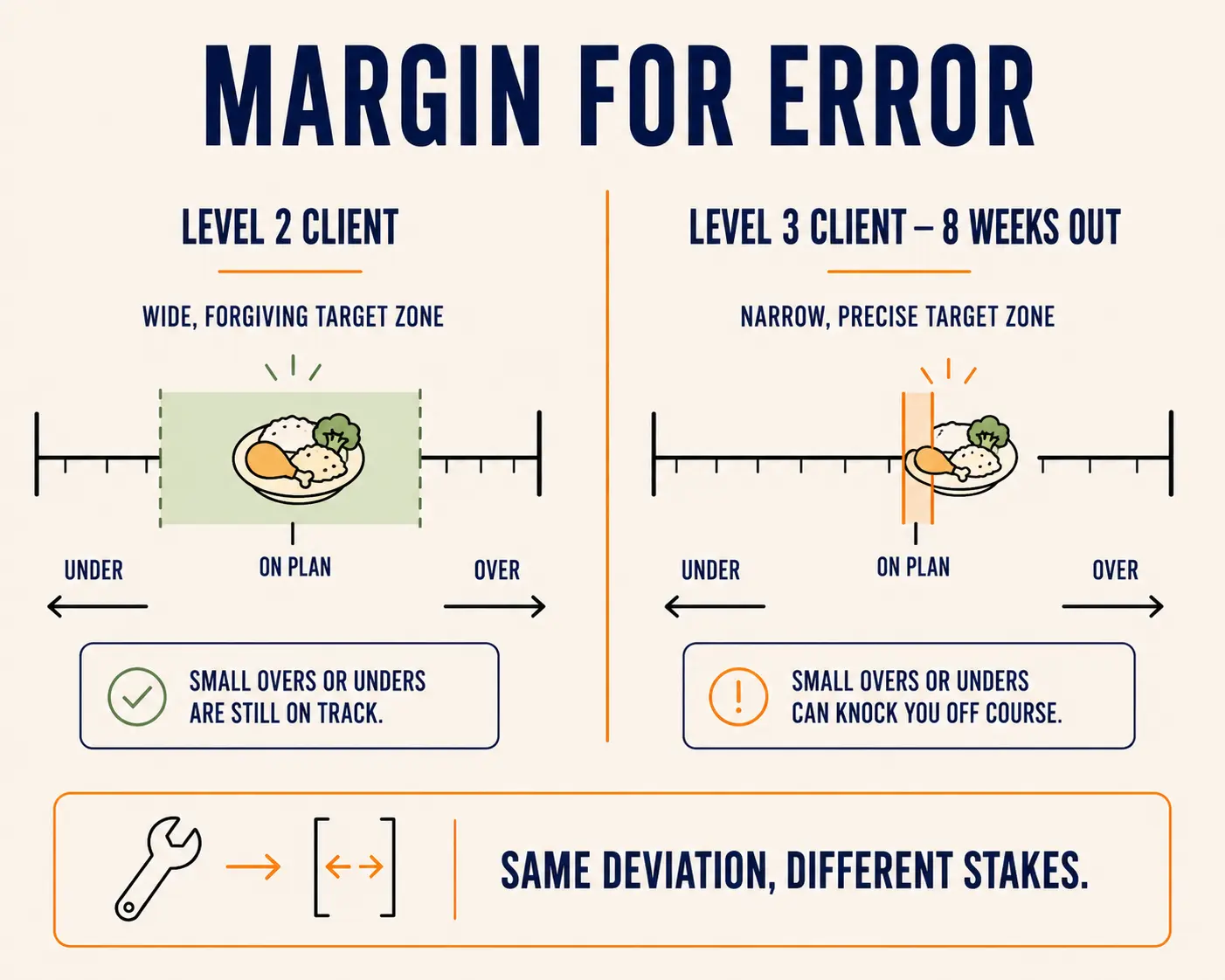
The stakes involved are worth making concrete. A Level 2 client who eats slightly more than planned on a given day barely moves the needle on a loosely defined goal — there's enough margin built in that small deviations wash out over time. A Level 3 client eight weeks from a competition weigh-in, working within a genuinely tight calorie range, doesn't have that same margin; a pattern of small deviations can be the difference between hitting the target and missing it. That difference in margin, not any judgment about which client is working "harder," is what justifies the difference in precision.
From Building Habits to Refining Strategy
The coaching relationship itself shifts at Level 3. Where Level 1 coaching is mostly about establishing behaviors and Level 2 coaching is about layering in precision incrementally, Level 3 coaching looks more like an ongoing, collaborative feedback loop — closer to a consultant relationship than a habit-formation one.
- Precise targetsSpecific calorie and macro targets calculated from Chapter 10's energy-balance principles, adjusted regularly based on real progress data rather than set once and left alone.
- Nutrient timing around trainingStructuring meals and fueling around specific training sessions or competition demands, where the timing itself becomes a meaningful lever.
- Tight, data-driven feedback loopsFrequent check-ins built around actual data — weight trends, performance markers, training output — rather than the broader "how's it going" conversations appropriate earlier on.
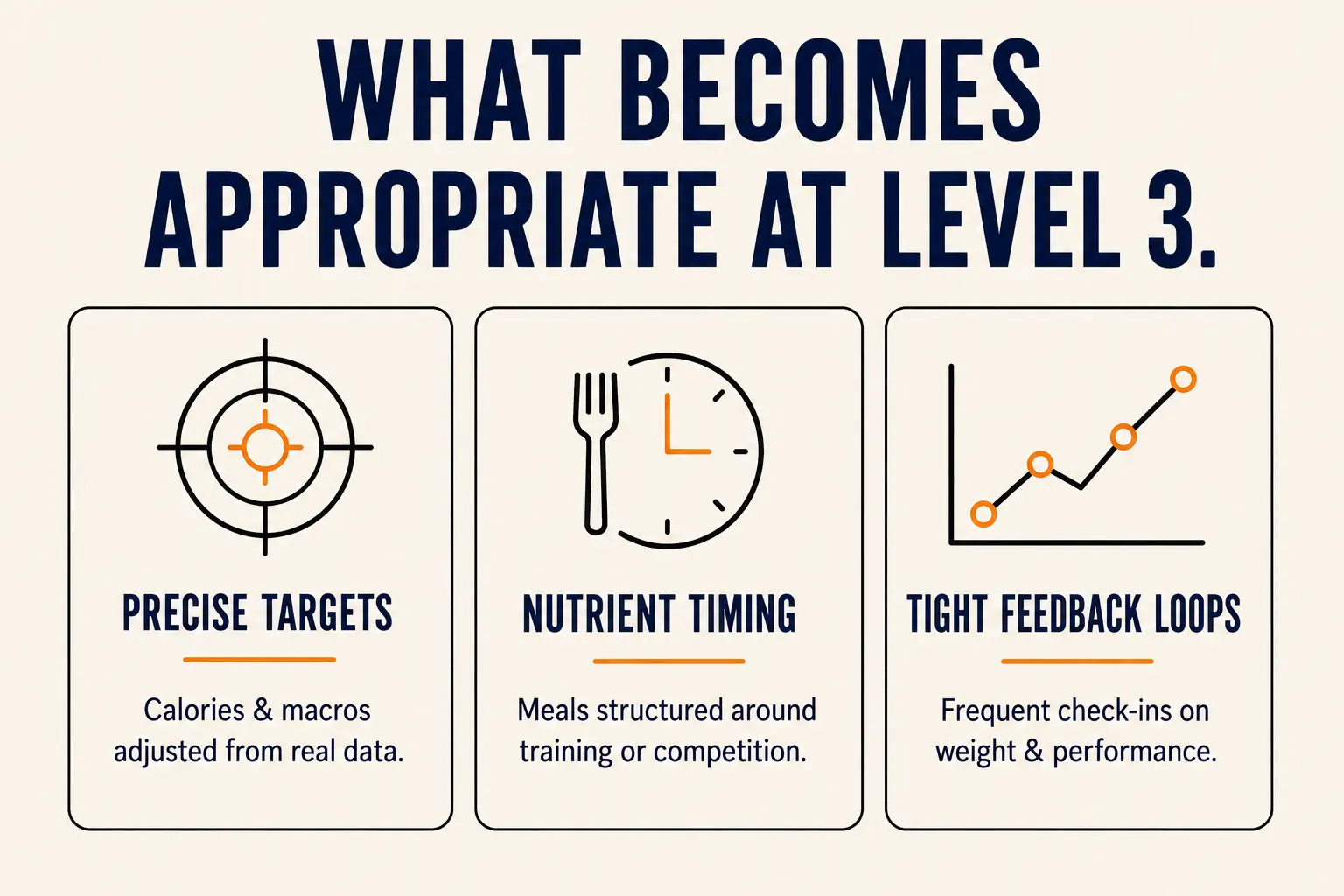
None of this precision would have been appropriate at Level 1 or Level 2 — it's not that these tools are inherently better, it's that they only become useful once a client has both the consistency to execute them and a goal specific enough to need them. Applying Level 3 tools to a Level 1 client is the same over-teaching mistake from Chapter 16, just wearing a more sophisticated outfit.
Interpreting the data itself is a skill in its own right, distinct from simply collecting it. A single day's weigh-in fluctuates for reasons that have nothing to do with actual progress — water retention, sodium intake, the timing of the last meal — so a coach working with data-driven feedback learns to read the trend across a week or more rather than reacting to any single number. A Level 3 client who has learned to do the same, rather than panicking over one high reading, is often further along in the coaching relationship than one still hitting every macro target perfectly.
An experienced client preparing for a competition asks a coach to skip the usual check-in questions and just adjust their macro targets based on this week's weigh-in and training log. A coach applying this chapter recognizes that this isn't a client being difficult — it's a client who has genuinely earned a more autonomous relationship. Micromanaging someone who's demonstrated real self-sufficiency can feel patronizing and actually erode trust, where a Level 1 client in the same situation would still need the fuller conversation.
Why This Matters for Coaching
The scope-of-practice conversation from earlier chapters returns here with particular force. Level 3 clients disproportionately intersect with contexts that sit right at the edge of, or beyond, what a PN Level 1 coach is trained to handle: competitive contest prep, a history of disordered eating resurfacing under the pressure of aggressive dieting, or a medical condition that interacts with an intense nutrition protocol. A coach who recognizes these signals and refers to a registered dietitian, physician, or more specialized coach is doing exactly the right thing, not admitting failure.
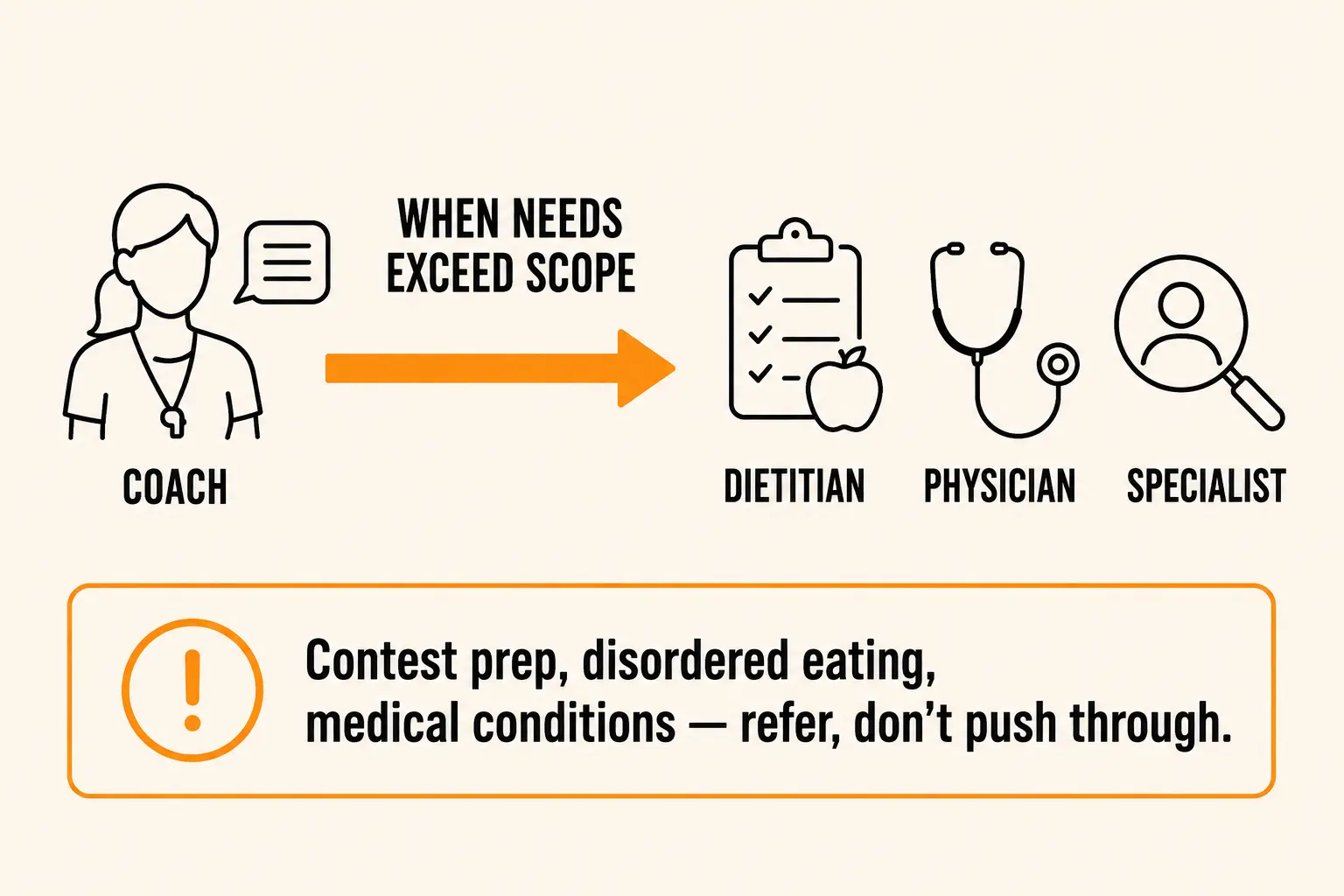
The psychological pressure that often accompanies Level 3 goals deserves specific attention too. A client pursuing an aggressive, deadline-driven target is more likely to experience heightened body-image stress, anxiety around food, or a compulsion to over-execute beyond what the plan actually calls for. A coach who stays alert to these signs — a client apologizing for normal eating, expressing distress disproportionate to a minor deviation, or fixating on the scale between sessions — is watching for exactly the kind of warning sign that belongs back in Chapter 14's stress discussion, now showing up in a higher-stakes context.
This chapter also completes something worth naming directly: the same coach might work with a Level 1, a Level 2, and a Level 3 client in the same week, and the skill isn't mastering one style of coaching — it's correctly reading which client needs which approach, and adjusting accordingly rather than defaulting to whatever style feels most natural. Chapter 19 continues into special scenarios that don't fit neatly into any of these three levels, closing out this population-specific stretch of Unit 3.
8 questions, modeled on PN's real open-book exam style. Score 75%+ to mark this lesson complete.
- A Level 3 client has already integrated consistency and moderate precision, and is now pursuing a specific, demanding goal that justifies genuine precision.
- Level 3 clients can typically self-manage day-to-day execution, shifting coaching toward a collaborative, data-driven feedback loop.
- Precise targets, nutrient timing around training, and tight feedback loops are appropriate here — but would overwhelm a Level 1 or 2 client.
- Level 3 clients disproportionately intersect with contexts (contest prep, disordered eating, medical conditions) that call for referral to a specialist.
- A coach's core skill is correctly reading which level a client needs, not mastering one single coaching style.
Before moving to Lesson 19:
- Write, in one sentence, what actually justifies Level 3-style precision for a client.
- List two scope-of-practice red flags that would prompt a referral for a Level 3 client.
- Think of a situation where more autonomy, not more oversight, would have been the better coaching call.
- Complete the knowledge check above and review any question you missed.