Chapters 16 through 18 organized clients along a single axis: how much consistency and precision a client is ready for. This chapter is different — it covers four situations that cut across all three levels rather than fitting neatly into any of them: injuries and physical limitations, food sensitivities and allergies, older adult clients, and clients with a history of disordered eating. None of these are about how "advanced" a client is. They're about factors external to the Level 1/2/3 framework that change what's actually safe or appropriate to coach, regardless of where a client otherwise sits.
Chapter 18 closed the three-part Level 1/2/3 framework by pointing toward situations that don't fit neatly into any of its stages. This chapter picks that thread up directly, working through four of the most common ones a coach is likely to encounter.
When the Level 1/2/3 Framework Doesn't Fit
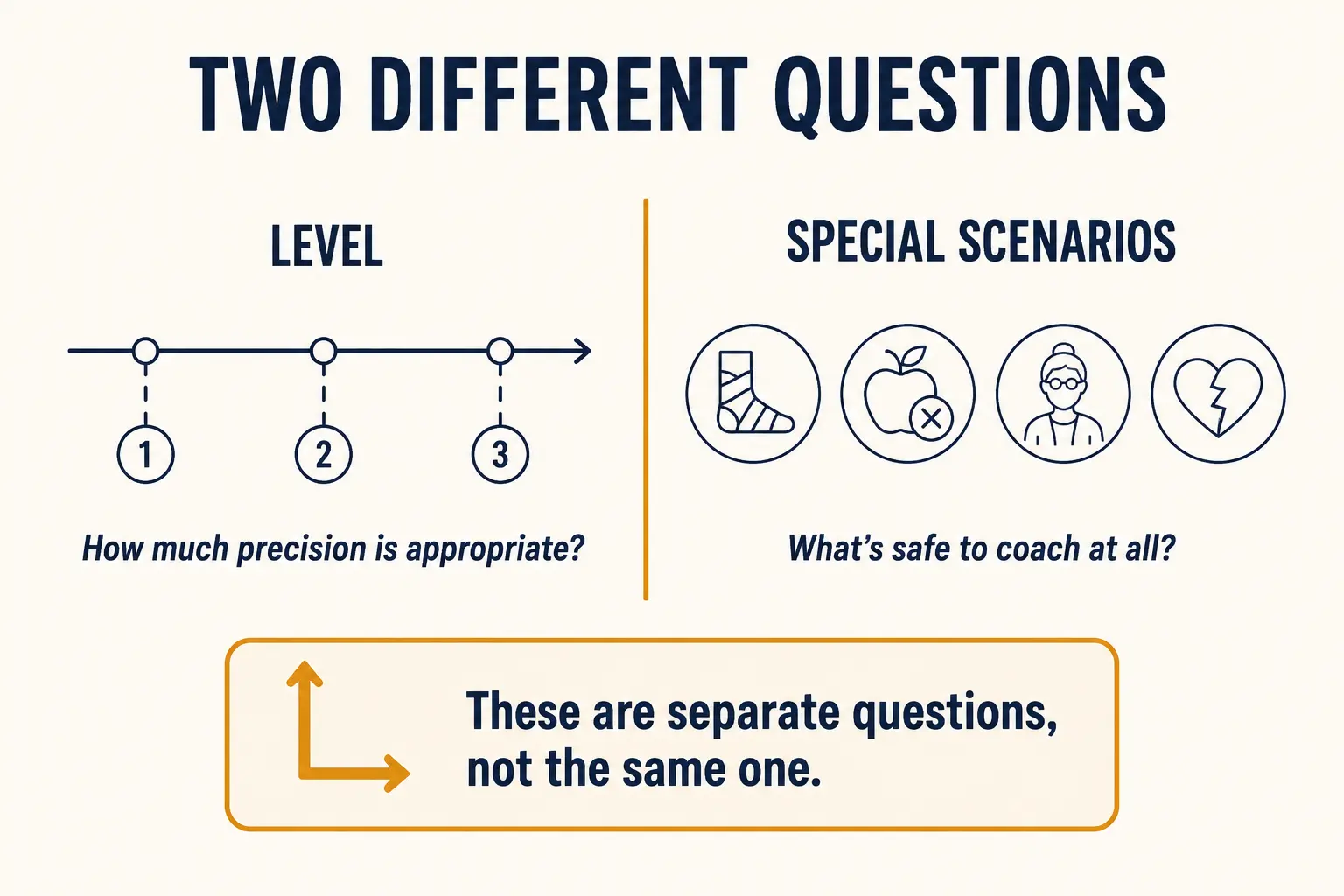
The Level 1/2/3 framework from Chapters 16 through 18 is genuinely useful for most clients most of the time — it organizes coaching around a single, sensible question: how much consistency and precision is this person ready for right now? But that question assumes the only thing varying between clients is readiness. In practice, some clients bring factors that don't move along that axis at all, and forcing them into a purely level-based lens can mean missing what's actually going on.
Consider a client who is highly consistent and clearly ready for Level 3 precision by every marker this course has covered so far, but who is also six weeks post-surgery with a physician-directed activity restriction. Their readiness for precision hasn't changed — but what's appropriate to coach around has, and none of that shows up if a coach is only asking "what level is this client at?" The same is true for a client whose food allergy changes what "consistency" even looks like in practice, an older client whose physiological needs differ from a younger client at the exact same level, or a client whose history with disordered eating means that precision-focused language could do real harm even if their stated goal calls for it.
The distinction worth holding onto is this: level answers "how much precision is appropriate," while these special scenarios answer "what does safe, appropriate coaching even look like here, before precision is on the table at all." A coach who treats every client purely as a Level 1, 2, or 3 problem will eventually run into a client where that question isn't the right one to be asking.
Four Common Special Scenarios
These four situations recur often enough in real coaching practice that they're worth knowing well, even though none of them is exhaustive on its own. Each one changes the coaching conversation in a different way.
- Injuries & physical limitationsRecovery often increases protein needs to support tissue repair, while reduced activity can lower overall energy needs — and any nutrition adjustment should work alongside, not around, whatever a physical therapist or physician has directed.
- Food sensitivities & allergiesReal, medically diagnosed conditions like celiac disease or a life-threatening allergy differ meaningfully from a perceived intolerance — a coach's role is to help find substitutions within existing medical guidance, not to diagnose a sensitivity themselves.
- Older adult clientsProtein needs often run higher in older adults to help counter age-related muscle loss, appetite can decline naturally with age, and medication interactions with specific nutrients become more common.
- Disordered eating historyPrecision-focused tools like calorie counting or strict macro tracking can retrigger disordered patterns in a client with this history, even years after the fact — sometimes the right call is less precision, not more, regardless of the client's stated goal.
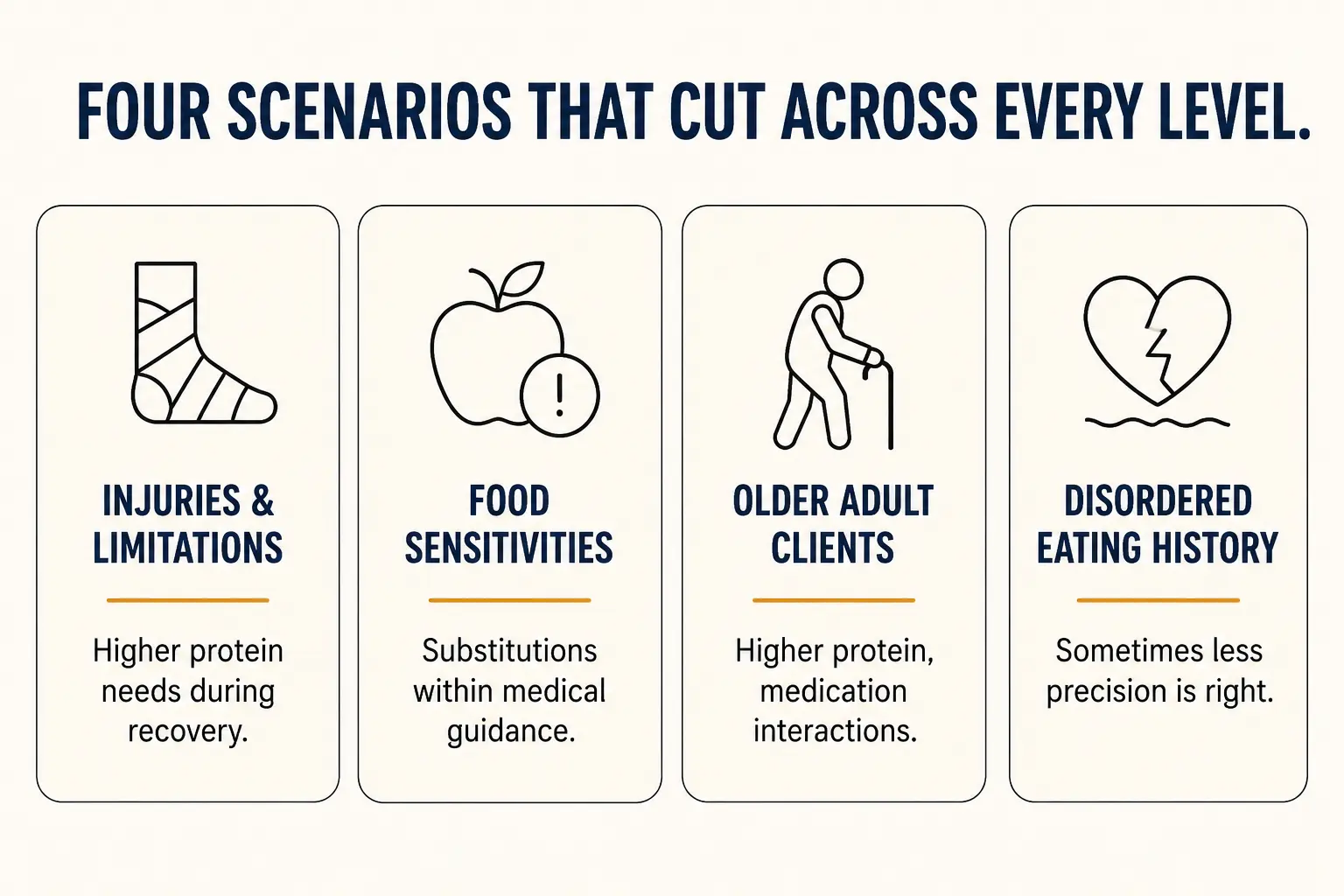
What ties these four together isn't the specific accommodation each one requires — those are genuinely different from each other. It's that in every case, the accommodation has to be decided before the Level 1/2/3 conversation resumes, not folded into it as an afterthought. A coach who adjusts a program for an injury but never circles back to reintroduce appropriate precision once the client has healed is making the opposite mistake: treating a temporary scenario as if it were permanent.
These scenarios can also stack on top of each other rather than showing up in isolation. An older client recovering from a hip replacement who also has a diagnosed gluten intolerance isn't three separate problems to solve one at a time — the physician's activity restriction, the age-related protein consideration, and the medically necessary substitutions all have to be weighed together when deciding what a realistic nutrition plan even looks like this month. A coach who works through each scenario as a standalone checklist item risks landing on a plan that technically satisfies all four considerations individually but is still impractical or unsafe once combined.
A client six weeks from a competition — clearly a Level 3 client by every measure covered in Chapter 18 — discloses a history of an eating disorder in college and says tracking macros this closely is starting to feel dangerous for their mental health. A coach applying this chapter recognizes that the client's competition goal doesn't override this disclosure. The right move is to loosen precision immediately, have an honest conversation about what's actually safe to ask of this client, and refer to a qualified mental health professional — even though nothing about the client's physical readiness has changed.
Why This Matters for Coaching
The scope-of-practice principle from earlier chapters applies here with a slightly different emphasis than it did with Level 3 clients in Chapter 18. There, the concern was mostly about clients whose goals exceeded what a coach was trained to help with. Here, the concern is that safety and appropriateness can override precision entirely, regardless of what a client's level would otherwise call for — a coach who keeps chasing a precision target after a client discloses a disordered eating history, or who ignores a physician's activity restriction because a client "feels ready," isn't respecting the client's stated goal so much as failing to recognize when a different priority has taken over.
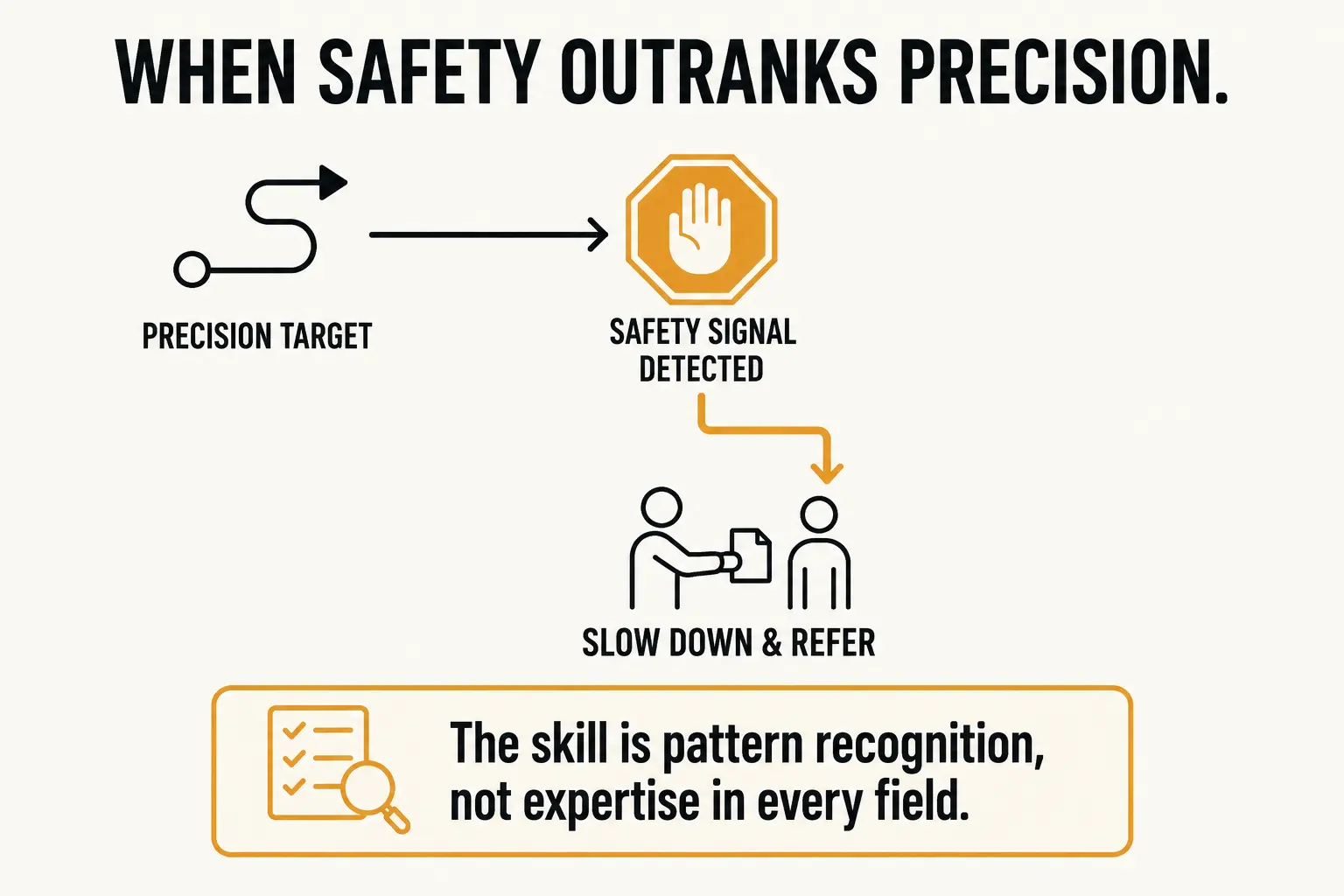
Recognizing these scenarios also means recognizing their limits. A coach isn't expected to have deep expertise in sports medicine, clinical nutrition, or eating-disorder treatment — the skill this chapter asks for is pattern recognition: knowing that a physical injury, a medical food restriction, an older client's changing physiology, or a disclosure of disordered eating history is a signal to slow down, ask more questions, and often bring in someone with more specific training, rather than defaulting to whatever the Level 1/2/3 framework would otherwise suggest.
This chapter closes out the population-specific stretch of Unit 3 that began back in Chapter 15. Chapter 20 continues into one specific version of exactly this kind of special scenario — coaching clients on GLP-1 medications — before Chapter 21 closes the course with the business fundamentals behind building an actual coaching practice.
8 questions, modeled on PN's real open-book exam style. Score 75%+ to mark this lesson complete.
- Injuries, food sensitivities, older age, and disordered eating history don't fit the Level 1/2/3 framework — they're about what's safe and appropriate, not how much precision a client can handle.
- Injury recovery often raises protein needs while activity restrictions lower energy needs, and any adjustment should follow physician or physical-therapist direction.
- Real food allergies and medically diagnosed sensitivities require substitutions within existing medical guidance, not a coach's own diagnosis.
- Older adult clients often need more protein and closer attention to medication-nutrient interactions than a younger client at the same level.
- A disordered eating history can mean less precision, not more, is the right call — even for a client whose stated goal would otherwise justify Level 3 tracking.
Before moving to Lesson 20:
- Write, in one sentence, the difference between a client's "level" and one of these special scenarios.
- List one adjustment you'd make for a client recovering from an injury, and one for a client with a disclosed disordered eating history.
- Think of a situation where a client's physical or psychological safety would need to override their own stated precision goal.
- Complete the knowledge check above and review any question you missed.